Your Guide to Rectangle Eyeglass frames

Rectangle eyeglass frames are a true classic, and for good reason. They’re known for their uncanny ability to add a bit of structure and definition to your face, especially if you have softer, rounder features. With their clean, angular lines, they just work, creating a sense of balance that feels both stylish and effortless.
Why Rectangle Frames Are a Timeless Choice
When you’re on the hunt for new glasses, you’re really looking for two things: something that enhances your look and something that fits into your daily life. Rectangle frames nail both. Think of them as the perfect architectural touch for your face; their straight lines and sharp angles offer a subtle contrast that brings focus right to your eyes.
But this classic shape is about more than just good looks—it’s incredibly versatile. For professionals, a sleek metal or dark acetate rectangle frame projects confidence and polish in the workplace. For students and gamers staring at screens for hours, a durable, lightweight rectangular frame is comfortable without looking clunky. It's a perfect example of form meeting function.
A Foundation for Style and Health
The real magic of rectangle frames is how adaptable they are. They’re a fantastic canvas for building your perfect pair of glasses, whether you’re after a bold, retro vibe or something more minimalist and modern. Their simple geometry plays well with all sorts of materials and colours, giving you a solid base to create a look that’s all your own. You can see more on how classic shapes get a modern twist in our guide to rocking retro eyewear.
Beyond just style, getting the frame right is your first step toward better vision and Eye Health and Safety. A frame that fits you properly ensures your prescription lenses are perfectly positioned for the clearest sight. It also makes you want to wear your glasses, which is key for protecting your eyes from strain and other environmental factors. A practical example of this is ensuring your frame is wide enough so your peripheral vision isn't obstructed, which is crucial for activities like driving.
We believe that your glasses should be as unique as you are. That’s why we can customise an eyewear package to suit your requirements, starting with a universally flattering frame shape and pairing it with lenses that protect and support your vision every single day.
Ultimately, the strength of the rectangle frame lies in its perfect balance of classic style and everyday practicality. It’s a shape that complements a huge range of faces and adapts to any lifestyle, making it a reliable and sharp-looking choice for anyone in need of new glasses.
Matching Rectangle Frames to Your Face Shape
Finding the perfect pair of rectangle frames is all about creating a sense of balance. The real goal is to pick a frame that complements your natural features, not one that overpowers them. Think of it this way: your face shape is the canvas, and the right frames are the accents that pull everything into a harmonious look.
The core principle here is simple contrast. If your face has softer, curved lines, the sharp, angular structure of a rectangle frame adds some welcome definition. On the other hand, if your face already has strong angles, you'll want to look for rectangular styles with softer edges to avoid a harsh or overly severe appearance. Getting this interplay right is the key to choosing frames that feel like they were made just for you.
This handy decision tree helps you visualise which styles of rectangle frames will work best for your face shape.
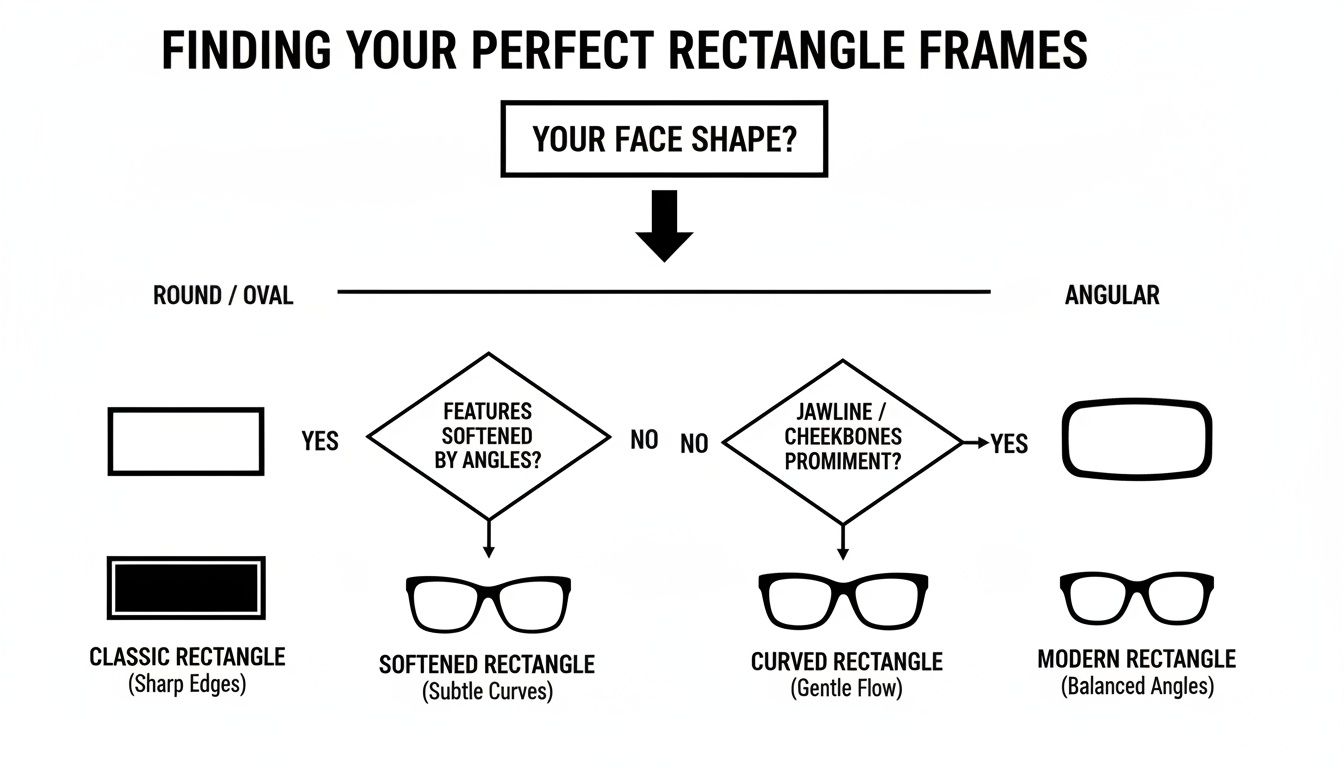
As you can see, anyone with a softer, more curved face shape—like round or oval—is an ideal candidate for classic, sharp-angled rectangle frames. If your face is more angular, you'll want to lean towards softened styles instead.
Frames for Round and Oval Faces
If you have a round face, known for its full cheeks and rounded chin, your features are naturally soft and don't have many strong angles. This is exactly why rectangle frames are such a fantastic choice. Their defined, horizontal lines create a beautiful contrast, helping to visually lengthen your face and add structure right where it's needed most.
Oval faces are often considered the most versatile because their proportions are already quite balanced. If this is your face shape, you're in luck—you can pull off almost any style. Classic rectangle frames are particularly flattering, as they maintain your natural symmetry while adding a touch of sophisticated structure.
Frames for Square and Heart-Shaped Faces
A square face typically has a strong jawline, a broad forehead, and distinctly angular features. Now, you might think adding more angles with rectangle frames would be too much, but the trick is to choose the right kind. Opt for thinner, more delicate rectangular styles or frames that have slightly curved or rounded edges. This approach softens your natural angles instead of competing with them.
For those with a heart-shaped face—which is wider at the forehead and tapers down to a narrower chin—the goal is to create balance for the lower half of your face. Here's a practical example:
- Choose frames wider at the bottom: A style that flares out slightly can help create the illusion of a broader jawline.
- Opt for lighter colours or rimless styles: These keep the top half of your face from appearing too heavy.
- Avoid oversized frames: Frames that are too large can easily overwhelm the more delicate lower portion of your face.
To help you find your perfect match at a glance, we've put together this quick reference table.
Rectangle Frame Styles for Different Face Shapes
| Face Shape | Best Rectangle Frame Style | Why It Works |
|---|---|---|
| Round | Classic, sharp-angled rectangle | Adds definition and structure, making the face appear longer and slimmer. |
| Oval | Classic or slightly wide rectangle | Maintains natural balance while adding a touch of sophisticated structure. |
| Square | Thin, softened, or slightly curved rectangle | Softens the face's strong natural angles without competing with them. |
| Heart | Rectangles that are wider at the bottom | Adds visual weight to the lower part of the face, creating a more balanced look. |
This table makes it easy to see how a few small tweaks to a rectangular frame can make all the difference in highlighting your best features.
Selecting the right frame isn't just about looking good; it's also a matter of Eye Health and Safety. A well-fitting frame ensures your prescription lenses are perfectly centred over your pupils. This alignment is absolutely critical for clear vision and helps prevent the eye strain, headaches, and dizziness that can come from poorly positioned lenses. Getting the fit right is fundamental to your visual comfort and overall health.
You can learn more by exploring our detailed guide on what glasses suit your face.
The popularity of this frame shape is no surprise. In the Australian eyewear market, rectangular frames have become a go-to choice, echoing global trends where the square/rectangular segment grabbed the largest revenue share of 30.50% in 2023. This is largely thanks to their incredible versatility for different face shapes, offering a contemporary and professional vibe that’s a perfect fit for professionals, gamers, and students alike.
Choosing the Right Frame Material and Size
Okay, so you’ve figured out the perfect style for your face shape. What’s next? Now we get into the nitty-gritty: the frame material and the fit. This is just as important as the look, because it all comes down to comfort, durability, and even your eye health. A frame that fits like a glove will stay put all day, while the right material can prevent skin irritation and handle whatever your day throws at it.
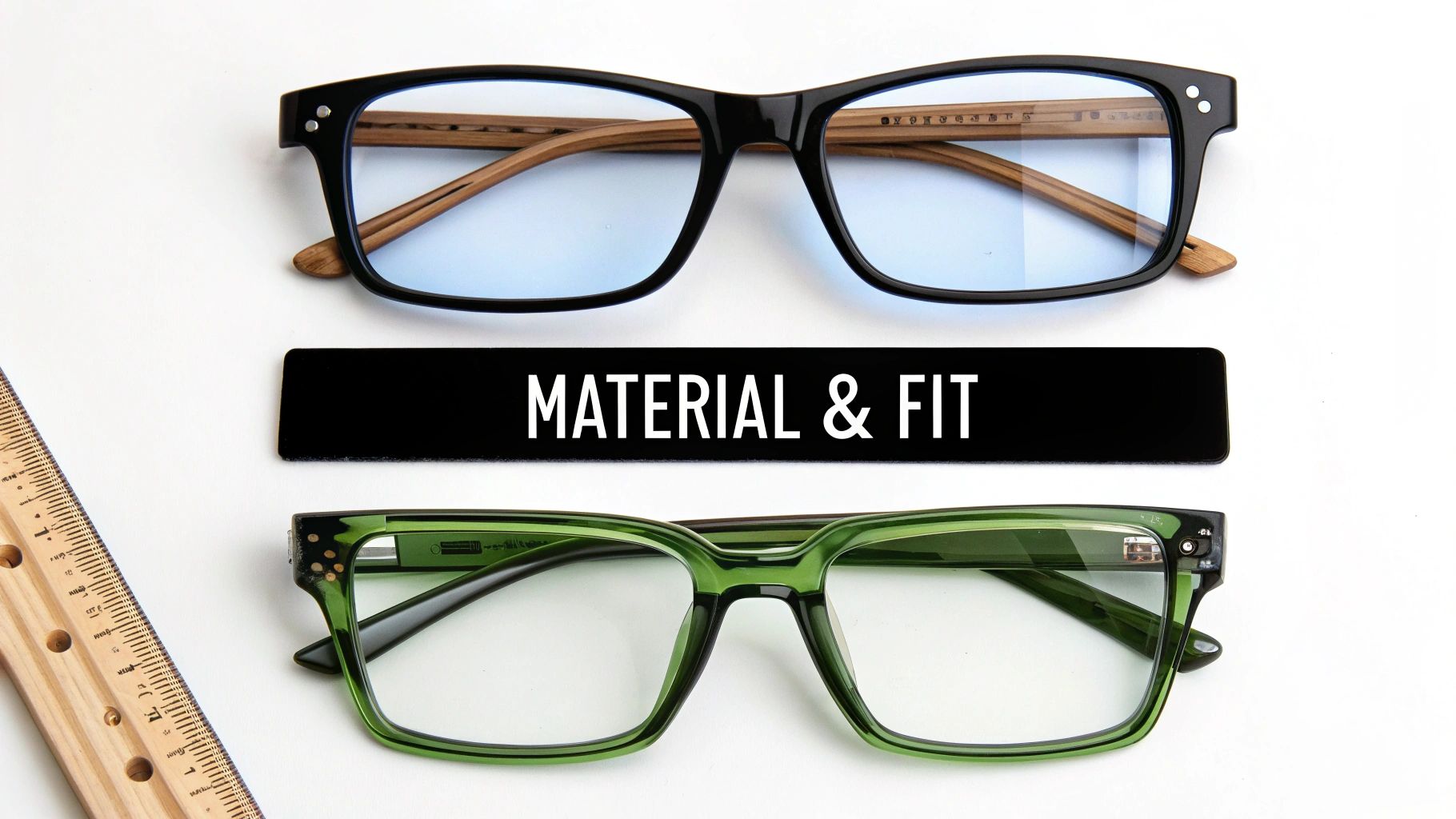
Think of frame materials like athletic gear. Some are built for being lightweight and going the distance, while others are all about rugged flexibility. The best one for you really depends on your lifestyle. If you’ve got sensitive skin or lead a pretty active life, some materials are going to be a much better match than others.
A Guide to Common Frame Materials
Getting to know the different materials is the key to picking glasses that truly work for you. Each one brings its own unique mix of comfort, strength, and style to the table.
-
Acetate: This is a plant-based plastic that's famous for its rich, deep colours and lightweight feel. If you’re after bold, vibrant frames that really make a statement, acetate is a brilliant choice. It’s also hypoallergenic, which is great news for anyone with sensitive skin.
-
Metal: This broad category includes materials like stainless steel and titanium. Titanium frames are the marathon runners of the eyewear world—they're unbelievably strong, yet feel as light as a feather. They're also corrosion-resistant and hypoallergenic, making them a fantastic investment for comfortable, long-term wear. For a different vibe, metal frames come in a huge range of looks, including cool minimalist options like semi-rimless glasses frames.
-
TR90: This is a seriously impressive thermoplastic material. It’s incredibly durable, flexible, and light. You can literally bend TR90 frames and they’ll bounce right back to their original shape. This makes them a perfect choice for students, gamers, or anyone who’s just a little bit rough on their glasses.
A frame that feels too heavy or irritates your skin is one you’ll stop wearing. When that happens, you risk eye strain and headaches. That’s why putting comfort first is a massive part of Eye Health and Safety.
How to Measure Your Fit at Home
Getting the fit right is absolutely crucial for both comfort and your vision. If your prescription lenses aren’t sitting correctly in front of your eyes, your vision can feel off. The good news is that measuring for new frames at home is much easier than it sounds. All you need is a ruler with millimetre markings.
You'll usually find these key measurements printed on the inside of one of the temple arms of a pair of glasses.
1. Lens Width: This is simply the horizontal width of one lens at its widest point.
- Practical Example: If you have a narrower face, look for a smaller lens width—something like 48-50 mm—to keep the frames in proportion with your features.
2. Bridge Width: This is the distance between the two lenses, right where the frame rests on your nose.
- Practical Example: A 16 mm bridge is designed for a narrow nose, while a 21 mm bridge will fit a wider one much better. The wrong bridge fit is usually why glasses constantly slide down your face!
3. Temple Arm Length: This is the length of the glasses' "arm," from the hinge all the way to the tip that sits behind your ear. The most common lengths are 135 mm, 140 mm, or 145 mm.
- Practical Example: If your current specs are always slipping forward, you might need shorter temple arms. If they dig in behind your ears, a longer pair will feel much more comfortable.
Nailing these measurements means your new rectangle eyeglass frames will sit perfectly centred, letting your prescription lenses do their job exactly as your optometrist intended. Once you have these numbers, you’ve got everything you need to customise an eyewear package that feels like it was made just for you.
Selecting Lenses for Your Lifestyle and Eye Health
Choosing the right rectangle eyeglass frames is only half the story. The lenses are where your eyewear truly comes to life. Think of your frames as the chassis of a car and the lenses as the engine—they do all the heavy lifting to make sure your vision is clear, comfortable, and protected. Picking the right lens type is absolutely critical for your daily comfort and long-term Eye Health and Safety.
Your lifestyle really dictates the kind of visual demands you face every day. A student spending hours under fluorescent library lights has completely different needs than a professional who bounces between indoor meetings and bright outdoor lunches. This is exactly why a one-size-fits-all approach to lenses just doesn't work.
Lenses Tailored to Your Daily Routine
To find your perfect match, it helps to just picture your daily activities. Are you constantly staring at a screen? Do you duck in and out of buildings all day? Each of these scenarios calls for a specific lens technology designed to cut down on strain and keep your eyes safe.
Let’s run through some practical examples of how specialised lenses can make a huge difference:
-
For the Office Professional: Imagine stepping out of your brightly lit office for a quick coffee. Your Photocromic lenses instantly adapt, darkening to a comfortable sunglass tint the moment you hit the sunlight. This seamless transition shields your eyes from harsh UV rays without you ever needing to fumble for a second pair of glasses.
-
For the Dedicated Gamer: During a late-night gaming session, your eyes are getting blasted with high-energy blue light from the screen. BlueRay lenses act like a personal bodyguard for your eyes, filtering out this specific wavelength to reduce digital eye strain and help you wind down for a good night's sleep.
-
For the University Student: You’re studying at a café, then walking to your next class across a sunny campus. Bluecromic lenses give you the best of both worlds. They block the blue light from your laptop and darken under UV light, providing complete protection no matter where your day takes you.
This kind of specialised tech is more important than ever. The Australian eyewear market, which is forecasted to hit AUD 443.82 million by 2035, shows just how much people are prioritising their vision health. With 53.7% of Australians dealing with long-term eye conditions, proper support from frames and lenses is essential. Full-rim rectangle eyeglass frames are a top pick, holding a 65% market share, because their sturdy design is perfect for supporting advanced lenses. You can dive deeper into the data on the Australian eyewear market and its growth.
A Closer Look at Your Lens Options
Getting to know the specific benefits of each lens type helps you make a confident decision. And since we can customise an eyewear package to suit your requirements, you have the power to build glasses that perfectly align with your needs.
Choosing the right lenses isn't just about clearer vision; it's an active step in preserving your Eye Health and Safety for the future. The right protection today can help minimise the long-term effects of UV and blue light exposure.
So, let's break down the five specialised lens types we offer to help you match the right technology to your lifestyle.
Prescript Glasses Lens Options Explained
We've put together a simple table to help you compare our five lens types. Think about your daily routine—where you are, what you're doing—and see which option sounds like the perfect fit for you.
| Lens Type | Primary Benefit | Ideal For |
|---|---|---|
| Photocromic | Adapts to light, darkening in the sun and clearing indoors. | People who frequently move between indoor and outdoor environments. |
| BlueRay | Filters harmful blue light from digital screens. | Gamers, students, and office workers with high screen time. |
| Bluecromic | Combines blue light filtering with photochromic technology. | The ultimate all-in-one solution for both screen use and sun protection. |
| Clear | Standard vision correction with anti-scratch and anti-reflective coatings. | Anyone needing straightforward prescription lenses for general use. |
| Sunglass | Permanent tinting for consistent UV protection and glare reduction. | Drivers, outdoor enthusiasts, and anyone needing dedicated sunwear. |
By carefully thinking about your daily habits, you can choose lenses that don’t just correct your vision but actively protect it. This ensures your rectangle eyeglass frames become a powerful tool for keeping your sight clear and comfortable, every single day.
Ordering Your Custom Prescription Glasses Online
Jumping into ordering glasses online for the first time can feel like a bit of a leap of faith. But honestly, the whole process is much simpler than you might think and is built around making your life easier. We've mapped it all out into a straightforward path so you can get your hands on the perfect pair of rectangle eyeglass frames with total confidence.
The journey is pretty simple: it starts with you spotting a pair of frames you love and ends with those frames, fitted with your custom prescription lenses, arriving right at your doorstep. Let’s walk through the three main steps to make it happen.
Your Step-by-Step Guide to Ordering
Getting your glasses sorted is a simple, three-part process. The only thing you need to get started is an up-to-date prescription from your optometrist.
-
Select Your Frames and Lenses: First things first, have a look through our collection and pick out the rectangle eyeglass frames that catch your eye. Once you've found 'the one', you'll choose the lens package that suits your day-to-day, whether that’s BlueRay for all that screen time or Photocromic for seamless indoor-to-outdoor wear.
-
Upload Your Prescription: This next part is the most critical. You'll be asked to upload a clear photo or a scan of your prescription. Our system makes this incredibly easy—it's just like attaching a picture to an email. This is a non-negotiable step for Eye Health and Safety and ensures we get everything spot-on.
-
Enter Your Pupillary Distance (PD): Finally, we'll need your Pupillary Distance. This measurement is the key to making sure your lenses are perfectly centred for your eyes, giving you the clearest vision possible.
Once you’ve ticked off these steps, you can finalise your order. From there, our job begins. We can customise an eyewear package to suit your requirements, crafting your lenses to your exact specifications and fitting them snugly into your chosen frames.
Understanding Your Pupillary Distance
Your Pupillary Distance, or PD, is simply the measurement in millimetres between the centres of your pupils. It's an essential piece of the puzzle for aligning your prescription lenses correctly. While it should be on your prescription, sometimes it gets left off.
Don't stress if your PD isn't on your prescription slip. Measuring it at home is surprisingly easy and takes just a minute with a ruler and a mirror. Getting the PD right is crucial for sharp vision and avoiding eye strain.
Here’s how you can measure it yourself:
- Stand about 20 cm away from a mirror.
- Hold a millimetre ruler flat against your brow.
- Close your right eye and line up the '0' on the ruler with the centre of your left pupil.
- Now, keeping the ruler steady, close your left eye and open your right. The measurement that lines up with the centre of your right pupil is your PD.
- Practical Example: If the ruler reads 63 mm, that's your PD. It's a good idea to repeat this a couple of times just to be sure you have a consistent number.
When you’re ordering prescription glasses online, tools like a virtual try-on can be a huge help, letting you see how different rectangle frames look on your face before you buy. Combining a great virtual try-on with accurate measurements is the surefire way to get a final product that not only looks fantastic but gives you perfect vision, no matter if you're in Australia, the UK, Canada, or the USA.
Caring for Your New Eyeglasses
Looking after your new rectangle frames is about more than just aesthetics; it's a core part of your long-term Eye Health and Safety. A bit of proper care keeps your lenses crystal-clear and free from scratches, ensuring you get the sharp vision you paid for. Think of it as a simple tune-up for one of your most important tools.
A quick, consistent cleaning routine stops oils and dust from building up, which can slowly degrade the special coatings on your lenses. These coatings are there to cut down glare and fight off scratches, so keeping them in good nick is key to the life and performance of your glasses. It’s a small effort that makes a huge difference in how well you see.
Your Daily and Weekly Care Routine
The easiest way to keep your glasses pristine is to build a simple habit. It only takes a minute or two each day, but it pays off big time by extending the life of your eyewear.
Daily Care (Less than 1 minute):
- Rinse First: Always start by running your glasses under a gentle stream of lukewarm tap water. This gets rid of any dust or grit that could scratch the lenses when you wipe them.
- Gentle Lather: Put a tiny drop of lotion-free dish soap on each lens and use your fingertips to gently rub both sides.
- Rinse Thoroughly: Make sure you wash all the soap off. Any residue left behind will just cause streaks and smudges.
- Dry with Microfibre: Carefully dry the lenses and frame with a clean, soft microfibre cloth. Steer clear of paper towels, tissues, or the corner of your shirt—their fibres can create tiny, permanent scratches.
Weekly Care (Just a few minutes): Once a week, it’s worth giving your frames a more detailed clean. Pay extra attention to the nose pads and the ends of the arms where they rest behind your ears. This is where skin oils and grime tend to build up.
Proper cleaning is an essential practice for both hygiene and visual clarity. A smudged or dirty lens can cause subtle distortions, forcing your eyes to work harder and potentially leading to strain or headaches.
Basic Troubleshooting and Adjustments
Over time, you might notice your glasses feel a bit loose or sit crooked. While you should leave any major repairs to the professionals, there are some minor tweaks you can do at home to get the fit just right again.
Practical Example: The Frame is Crooked If one lens seems to be sitting higher than the other, pop your glasses on a flat surface to see which arm isn't touching down. If the left arm is raised, gently bend the right arm down just a fraction at the hinge or where it curves over the ear. If the right arm is up, do the opposite. Always make tiny, careful adjustments until they sit level.
Remember, every pair of glasses is an investment in your sight. Taking these small steps ensures your rectangle eyeglass frames serve you well for years. Because we can customise an eyewear package to suit your requirements, we want you to get the absolute best value and performance from it.
Your Questions Answered: A Quick Guide to Rectangle Frames
Even with all the options laid out, a few final questions usually pop up when you're close to making a decision. To make sure you feel totally confident picking out your new glasses, we’ve put together some straightforward answers to the things people ask us most about rectangle frames.
Frame Choices for Different Face Shapes
One of the biggest worries we hear is whether rectangle frames will suit a particular face shape. The short answer is almost always a resounding yes. It just comes down to picking the right kind of rectangle for you.
For example, what if you have a square face? You can absolutely rock rectangle eyeglass frames. The trick is to find a pair that softens your naturally strong angles instead of doubling down on them.
A great practical example is to look for a thin metal or semi-rimless rectangle frame. These styles, especially ones with slightly rounded corners, give you that classic rectangular look without adding any harshness. The result? A perfectly balanced and sophisticated vibe. Choosing a frame that’s just a touch wider than your cheekbones is another pro tip for creating flattering proportions.
Timeless Style and Modern Lenses
Another question we get all the time is whether this shape is still in style or if it's a bit dated.
Here’s the thing: rectangle eyeglass frames are a true classic. They never really go out of fashion. Designers are constantly updating this clean, versatile shape with new materials, fresh colours, and subtle tweaks. This means they always feel current, making them a super reliable choice whether you’re in a boardroom or just kicking back on the weekend.
People also ask about the difference between our BlueRay and Bluecromic lenses. Think of it like this: BlueRay lenses are your dedicated digital shield. They have a special filter that blocks the harsh blue light from screens, which is a must for protecting your Eye Health and Safety if you spend a lot of time indoors on a computer or gaming.
Bluecromic lenses, on the other hand, are the ultimate two-in-one. They give you that same essential blue light protection but are also packed with photochromic technology. That’s just a fancy way of saying they automatically darken into sunglasses when you step outside into UV light. It’s complete, convenient protection, all in one pair of glasses.
Getting the right lens is a huge part of creating glasses you'll love. We can customise an eyewear package to suit your requirements, making sure your lenses deliver the exact protection you need for everything you do—from staring at a screen all day to enjoying a bright, sunny afternoon.
Ready to find your perfect pair? At Prescript Glasses, we make it simple to match stylish frames with lenses built for your lifestyle. Dive into our collection of rectangle eyeglass frames and build your custom eyewear package today at https://www.prescriptglasses.com.