What Are Transition Lenses An Essential Guide

Let's get straight to it. Transition lenses, which you might also hear called photochromic lenses, are a smart bit of tech for your eyes. They have the clever ability to darken automatically when you step into the sunlight and then fade back to completely clear once you're indoors.
Think of them as your everyday prescription glasses and your favourite sunnies, all rolled into one convenient, stylish pair. It’s a practical solution for maintaining your eye health and safety without a second thought.
What Are Transition Lenses? A Clear Introduction
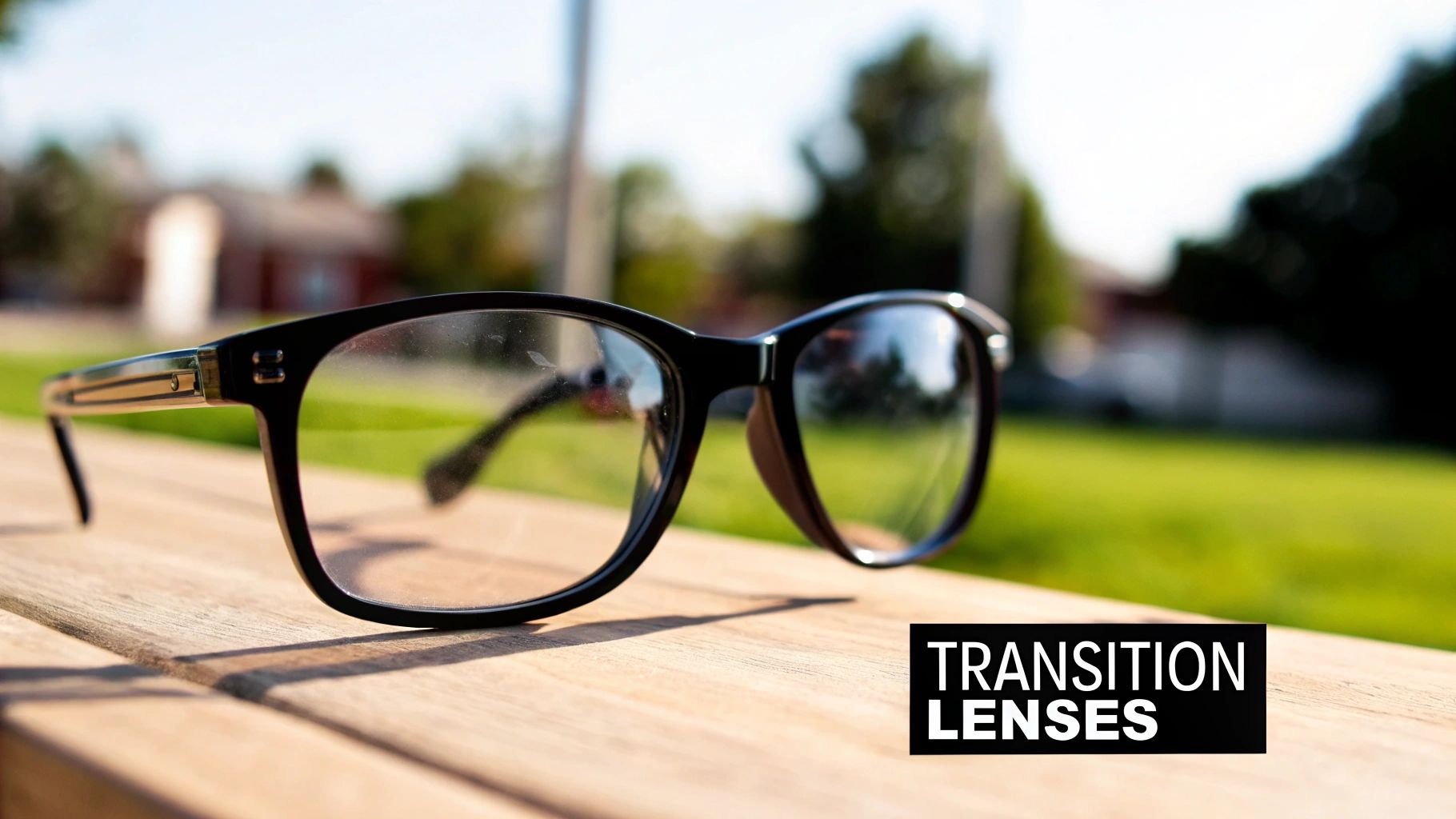
Transition lenses are built for a life in motion. Their whole purpose is to adapt to your surroundings, giving you comfortable vision whether you’re sitting at your desk or out for a walk on a sunny day. This isn't just about convenience; it's about crucial eye health and safety.
By adjusting their tint on the fly, these lenses shield your eyes from the sun's harsh UV rays and cut down on annoying glare. That means less squinting and less eye strain as you move between indoors and out, protecting the delicate structures of your eyes from cumulative sun damage.
The Everyday Convenience
Here’s a practical, real-world scenario: you're working at the office and decide to pop out for lunch. If you wear standard glasses, you’d have to fumble around for your prescription sunglasses and make the switch. With transition lenses, that change happens for you automatically, so your eyes are protected the second you step outside. It’s a seamless way to ensure consistent eye health and safety.
This all-in-one approach is becoming more popular every day. Here in Australia, the eyewear market is growing fast as people put a greater focus on eye health and embrace new lens technologies. Valued at roughly AUD 229 million in 2024, the market is expected to keep growing over the next decade. You can discover more insights about the Australian eyewear market here.
At their heart, transition lenses make a simple promise: continuous visual comfort and protection, no matter where your day takes you. They do away with the need to juggle multiple pairs of glasses, making your daily routine that much simpler.
This technology is a game-changer for anyone looking for both vision correction and sun protection in a single package. At Prescript Glasses, we can customise an eyewear package to suit your requirements, making sure your lenses are a perfect match for your specific lifestyle and vision needs.
Transition Lenses At a Glance
To make it even simpler, here’s a quick rundown of what makes transition lenses so practical.
| Feature | What It Means for You |
|---|---|
| Adaptive Tinting | Your lenses darken in sunlight and go clear indoors—all on their own. |
| 100% UV Protection | Shields your eyes from harmful UVA and UVB rays, promoting long-term eye health and safety. |
| Glare Reduction | Cuts down on harsh reflections for more comfortable vision outside. |
| All-in-One Solution | Combines your prescription glasses and sunglasses into a single pair. |
Essentially, you get effortless protection and clarity without ever having to think about it.
The Science Behind How Transition Lenses Adapt to Light

The way transition lenses seamlessly shift from clear to dark can feel a bit like magic, but it’s actually some very clever chemistry at work. The secret is hidden within trillions of special photochromic molecules that are either embedded directly into the lens material or applied as a super-thin coating.
Think of these molecules as microscopic, light-sensitive flowers. When you’re indoors and away from UV light, these "flowers" stay tightly closed and folded up. In this state, they’re completely transparent, allowing light to pass through without interruption. That's why your lenses look perfectly clear inside.
The Chemical Reaction to Sunlight
The moment you step outside, the UV radiation from the sun—even on a cloudy day—acts as a trigger. This energy hits the photochromic molecules and causes them to instantly change their chemical structure, essentially making them "unfold" or blossom open.
As they change shape, they start absorbing visible light, which is what we see as the lens darkening. It’s a completely reversible chemical reaction that provides on-demand shade for your eyes, improving comfort and boosting your eye health and safety by cutting down glare. The more intense the UV rays, the darker your lenses will get.
This automatic adjustment isn't just a gimmick; it’s a functional shield. The molecules react in seconds to protect your eyes from harsh light and damaging UV rays, providing a constant, reliable defence throughout your day.
The technology that makes transition lenses work has come a long way. Early versions could be a bit slow to react and were sometimes affected by the temperature. Today’s modern lenses, however, offer much faster activation and fade-back times, giving you more consistent colour and performance no matter the conditions.
The Return to a Clear State
Once you head back inside, away from the UV exposure, the process simply reverses. Without the sun’s energy to hold them open, the molecules naturally fold back into their original, closed state. This allows the lenses to become completely clear again, usually within just a few minutes.
This blend of convenience and protection has seen a huge uptake across the globe. The market for transition lenses is growing strong, with an expected compound annual growth rate of around 4.3% between 2025 and 2035. While North America and Europe are the biggest markets right now, the Asia-Pacific region, including Australia, is catching up fast as more people become aware of the benefits. You can read the full research about these market trends if you're interested in the data.
This growth points to a global shift towards smarter, more practical eyewear. At Prescript Glasses, we can customise an eyewear package to suit your requirements, ensuring you get the latest in photochromic technology perfectly tailored to your prescription and lifestyle.
Key Benefits For Your Eye Health And Safety
Beyond everyday convenience, transition lenses quietly work behind the scenes to safeguard your vision. Over months and years, that extra layer of protection can make a real difference to your long-term eye health and safety.
Here’s what happens when you choose transition lenses:
- 100% Of Harmful UVA And UVB Rays Blocked: UV isn’t just an issue on sunny days—it’s present even when it’s overcast. This constant defence is vital for preventing long-term damage like cataracts and macular degeneration.
- Adaptive Tint Adjustment: Lenses darken outdoors and clear up indoors, so your eyes aren’t constantly overworking.
- One-Pair Convenience: No more juggling between clear glasses and sunglasses—just a single pair that does it all.
Reducing Daily Eye Strain And Fatigue
Squinting into bright light might seem harmless, but it builds tension in your eyes and can trigger headaches. Transition lenses smooth out those brightness spikes, letting your eyes relax whether you’re under glaring sun or facing headlight glare on wet roads.
A practical example is a gardener moving from sun-drenched flowerbeds to a shady porch. With transition lenses, there’s no need to swap frames—their vision stays comfortable and protected at every step, reducing strain on the eyes.
The Power Of Consistent All-Day Protection
One of the simplest ways to look after your eyes is to wear the right pair—every time you head outdoors. When your lenses adjust on their own, you’re far less likely to leave protection behind.
By making UV protection effortless and automatic, transition lenses ensure your eyes are never left vulnerable. It’s a simple change that delivers a powerful, lasting defence against the sun’s invisible dangers, which is fundamental for your long-term eye health and safety.
Here in Australia, nearly 49.5% of Australians rely on some form of vision correction. Many also face long-term risks such as cataracts and macular degeneration, where UV defence plays a crucial role.
Transition lenses cover both vision and sun safety in one user-friendly solution. You can learn more about Australian eye health trends here.
At Prescript Glasses, we know each person’s lifestyle is unique. That’s why we can customise an eyewear package to suit your requirements, ensuring comfort and protection exactly where you need it.
Transition Lenses vs Other Eyewear Options
Picking the right glasses isn't just about getting your prescription right—it's about finding lenses that genuinely fit your day-to-day life. To help you figure out if transition lenses are the right call for you, let’s see how they stack up against the other common options out there.
Think about a practical example: when you walk out of a shopping centre into a bright car park, transition lenses go dark on their own, giving you instant UV protection and reducing uncomfortable glare. But is that better for your eye health and safety than a dedicated pair of sunnies?
This infographic breaks down some of the key health benefits that come with photochromic lenses.
As you can see, a single pair of glasses can pull double or even triple duty. They block harmful rays and stop you from squinting, all in one. It’s this simple convenience that makes them such a practical choice for everyday wear.
Transition Lenses vs Standard Sunglasses
Your trusty pair of sunnies are unbeatable in really specific, high-glare situations. For a day out fishing or hitting the ski slopes, a good pair of polarised sunglasses is almost always the better choice for your eye health and safety. That’s because the polarisation is purpose-built to cut through the intense, reflective glare bouncing off water or snow far more effectively than a standard transition tint can.
The downside? It's the juggle. You have to remember to bring them with you and constantly switch between frames as you move from outside to inside. For someone just running errands around town, that can be a real pain. Transition lenses give you that continuous protection without you even having to think about it.
Transition Lenses vs Dedicated Blue Light Glasses
With so much of our lives spent in front of screens, many of us have a pair of blue light filtering glasses to combat digital eye strain. They’re brilliant for long days at the office or a weekend gaming session, but they offer zero protection from the sun’s UV rays the moment you step away from your desk.
This is where today’s transition lenses really shine. Many of the newer photochromic lenses we offer come with blue light filtering technology already built in. That means they’re protecting your eyes from your laptop indoors and from the sun outdoors, merging two essential functions into one clever lens. For a deeper dive, check out our guide on photochromic lenses vs Transitions.
A Clear Comparison
Sometimes, seeing it all laid out makes the choice much clearer. Here's how the different types of eyewear stack up side-by-side.
Transition Lenses vs Other Eyewear: A Feature Comparison
| Lens Type | UV Protection | Blue Light Filtering | Adapts to Light | Best For |
|---|---|---|---|---|
| Transition Lenses | Excellent (100%) | Often included | Yes | All-day wear, moving between indoors and outdoors |
| Sunglasses | Excellent (100%) | Some options | No | Intense, prolonged sun and high-glare activities |
| Blue Light Glasses | None | Excellent | No | Extended screen time and indoor office work |
| Standard Clear Lenses | Varies (often a coating) | Optional | No | Primarily indoor use with minimal sun exposure |
At the end of the day, the best choice really boils down to your lifestyle. Transition lenses offer the ultimate convenience for people with dynamic, on-the-go days, while more specialised lenses are the champions of their specific environments.
Here at Prescript Glasses, we can customise an eyewear package to suit your requirements. Whether you need the all-in-one simplicity of photochromic lenses or a multi-pair solution for different activities, we can build the perfect set for your vision and your life.
Are Transition Lenses Right for Your Lifestyle?
So, are photochromic lenses actually a good investment for you? The answer really boils down to your daily routine and what you need from your glasses. Their biggest strength is providing seamless, automatic protection for people who are always on the move. It's a simple, set-and-forget solution that looks after your eye health and safety without you even having to think about it.
Let’s paint a practical picture. Imagine an office worker who steps outside for lunch on a bright, sunny day. The second they walk out the door, their lenses darken, instantly shielding their eyes from harsh glare and UV rays. When they head back inside, the lenses quickly fade back to clear, ready for an afternoon in front of the computer. That’s the magic in action.
Who Benefits Most from Transition Lenses?
This clever adaptive technology is a game-changer for certain lifestyles where convenience and consistent protection are top priorities. You’ll really feel the benefits if you:
- Move frequently between indoors and outdoors. Think of a busy parent running errands, a teacher supervising kids during recess, or a real estate agent showing properties all day. The automatic adjustment is invaluable.
- Are an avid gardener or hobbyist. For anyone who spends time in their backyard, moving between a sunny garden and a shaded patio, you get continuous comfort without ever needing to swap your glasses.
- Are sensitive to light. If you find bright light uncomfortable or even a bit painful, these lenses can dramatically cut down on eye strain and improve your eye health and safety. If you struggle with light sensitivity, you might also find our guide on glasses specifically for light sensitivity really helpful.
Transition lenses excel by removing a small but constant friction point from your day—the need to switch eyewear. This convenience encourages consistent UV protection, which is a vital habit for maintaining long-term eye health.
When Transition Lenses Might Be Less Ideal
But let's be honest—they aren’t the perfect fix for every single situation. It's important to understand where they fall short before you make a decision.
One of the biggest drawbacks is their performance inside a car. Most standard photochromic lenses are triggered by UV light, and modern car windscreens block almost all of it. This means your lenses won't darken much, if at all, while driving. This poses a challenge for eye health and safety for professional drivers or anyone who spends a lot of time on the road.
Temperature can also affect how they work. In colder weather, the photochromic molecules can react a bit more intensely, causing the lenses to get darker and take longer to fade back to clear. While this gives you extra protection on a chilly, bright day, that slower fade time can be a minor inconvenience when you step back inside.
Ultimately, the best choice really depends on your specific needs. Here at Prescript Glasses, we can customise an eyewear package to suit your requirements, helping you weigh up these factors to find the perfect lens for your life.
Finding Your Perfect Pair of Transition Lenses

Choosing the right transition lenses isn't just about grabbing a pair off the shelf; it's about matching them to your life and style. Getting the personalisation right is what makes a good pair of glasses feel like they were made just for you. A big piece of that puzzle is the tint colour, as it literally changes how you see the world.
Don't think of the tint as just a fashion choice. It’s a practical decision that can make a real difference to your vision and eye health and safety. For example, a classic grey tint is fantastic for keeping colour perception true and natural, making it a great all-rounder for everyday activities like driving or walking the dog. A brown tint, on the other hand, boosts contrast and depth perception, which is why it’s often a favourite for outdoor activities like golf or hiking where seeing details clearly is key.
Customising Your Lens Package
Once you’ve settled on a tint, there are other features that round out your perfect eyewear package. An anti-reflective coating is a must-have for cutting down annoying glare from headlights and screens, while a scratch-resistant finish is just common sense for protecting your investment. These little extras go a long way in keeping your vision clear and your glasses looking great for years.
The whole point is to build a pair of glasses that feel custom-made for your daily grind. When you combine the right tint with the right protective coatings, you get the best of both worlds: top-notch eye health and safety and a visual experience that’s second to none.
Here at Prescript Glasses, we can customise an eyewear package to suit your requirements. That means we’ll walk you through selecting the ideal mix of lens material, tint, and coatings based on your prescription and how you live your life. Take a look at our full range and see how we can build your perfect pair of photochromic sunglasses today.
Your Top Questions About Transition Lenses Answered
Alright, let's wrap things up by tackling some of the most common questions we hear about transition lenses. Getting straight answers to these will help you feel confident that you’re choosing the right eyewear for your life.
How Quickly Do Transition Lenses Actually Change?
Today's photochromic lenses are impressively fast. You can expect them to darken noticeably within the first 30 to 60 seconds of stepping into the sun, and they'll continue to adjust over the next few minutes to reach their full tint. Think about stepping out of the office for a coffee run—they’ll give you comfortable shade almost right away.
When you head back inside, they fade back to clear much faster than older versions used to. Temperature can play a small role in the speed, but you’ll generally find them mostly clear within a few minutes.
Will My Transition Lenses Work in the Car?
This is a big one for a lot of people, and the answer is usually no. Most standard transition lenses need UV light to activate, and your car's windscreen is designed to block nearly all of it. This means they won’t darken much, if at all, when you're behind the wheel, impacting your eye health and safety from sun glare while driving.
However, there are newer, specialised lenses out there that react to both UV and visible light. These are designed to get moderately dark inside a car. If you spend a good chunk of your day driving, this is definitely something to bring up when you’re choosing your lenses.
For most day-to-day activities, transition lenses are fantastic for sun protection. But for long drives or situations with intense glare, like being out on the water, a pair of dedicated polarised sunglasses will still give you the best visual comfort and safety.
How Long Does the Colour-Changing Effect Last?
The clever technology that makes transition lenses work is built to last for the life of a typical prescription, which is about two to three years. Over time and with constant use, the molecules can eventually get a bit tired and won't switch back and forth as effectively. This is just another reason why regular eye check-ups are so important for keeping your eye health and safety in check.
At Prescript Glasses, we know that everyone's vision and lifestyle are different. That’s why we can customise an eyewear package to suit your requirements, ensuring your new lenses are a perfect match for you.
Ready to find your perfect pair? Explore our customisable eyewear options at Prescript Glasses.