Best Glasses Frames for Round Face: Flattering Styles and Expert Fit Tips

When you have a round face, the secret to finding the perfect pair of glasses is all about creating contrast. Your best bet is to go for angular frames—think square, rectangular, and cat-eye styles. Their sharp lines and defined corners cut through the softness of your features, adding structure and making your face appear longer and more streamlined.
Finding Your Perfect Frames Instantly
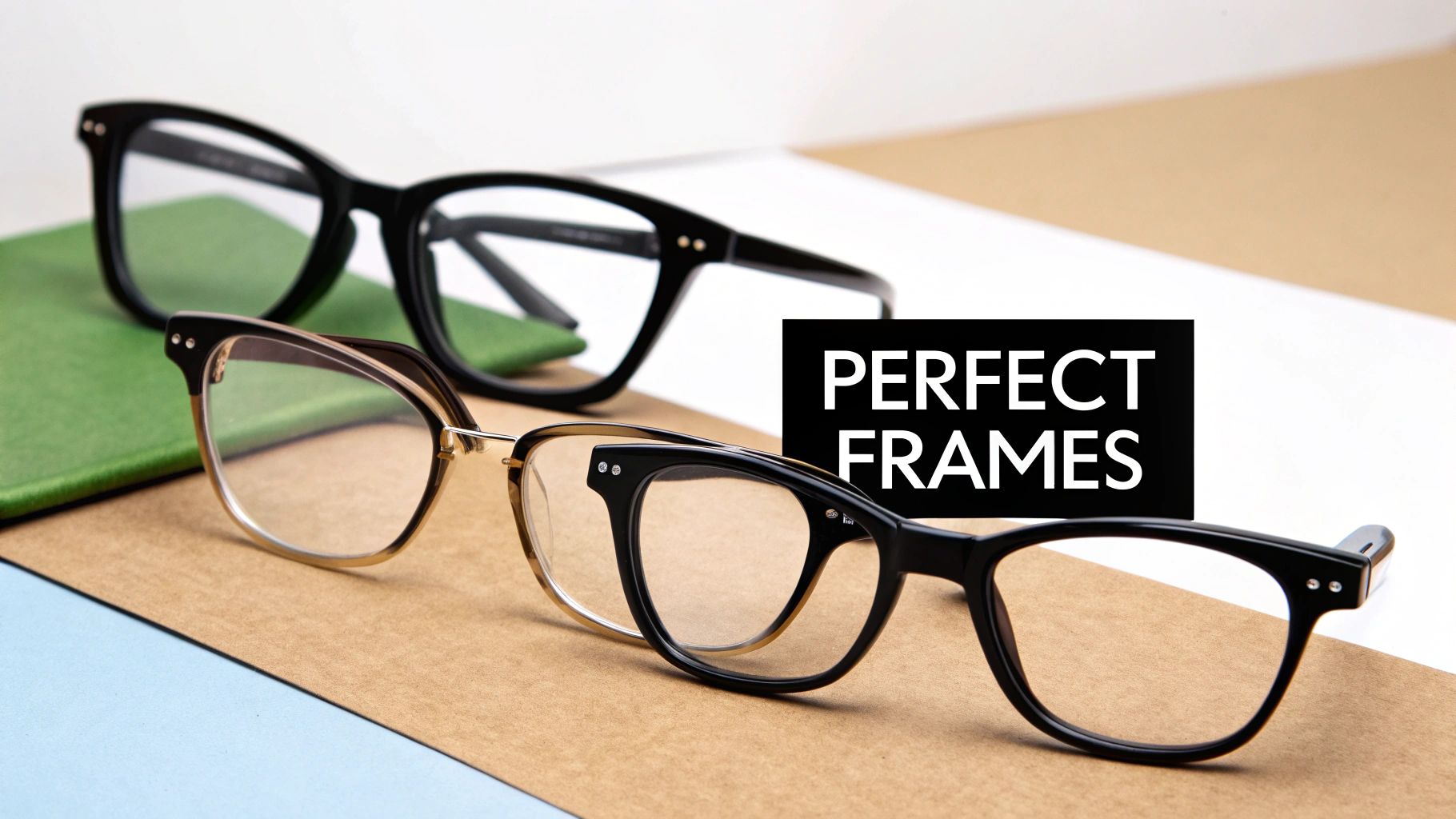
Choosing the right eyewear is a game of balance. A round face is defined by its soft curves and roughly equal width and height. The trick is to introduce angles that add definition where nature didn't. It's a simple rule of opposites: complement soft curves with hard lines.
This isn't just a style tip; it's a principle backed by eyewear experts everywhere. Here in Australia, top optical retailers consistently point people with round faces towards angular frames like rectangle, square, and browline styles. Why? Because these shapes visually break up the circular outline of the face, drawing the eye upwards and outwards for a more flattering effect.
Top Frame Styles for Round Faces at a Glance
To give you a head start, we've put together a quick summary of the best frame shapes for a round face and the visual magic each one creates.
| Frame Style | Why It Works | Practical Example |
|---|---|---|
| Rectangle | Its horizontal shape adds width, making the face appear longer and slimmer. | An office worker might choose slim rectangular frames for a professional, defined look that's comfortable for long hours. |
| Square | The strong, equal-sided lines provide a bold contrast to soft facial curves. | A creative professional could opt for bold, black square frames to make a confident and stylish statement. |
| Cat-Eye | The upswept corners lift the face and draw attention to the eyes and cheekbones. | Perfect for adding a touch of retro glamour to a weekend outfit, instantly elevating your look for a social event. |
This table is a great starting point for finding your new favourite frames.
The principles of balance and contrast don't just stop at glasses. Funnily enough, the same rules apply to other accessories. For instance, this a guide to choosing earrings for your face shape explores similar concepts for refining your overall look.
Of course, the best way to know for sure is to see them on your own face. You can virtually try on glasses right from home to see exactly which shape you love best.
So, Are You Sure You Have a Round Face?
Before we jump into picking out the perfect frames, let's make absolutely sure you have a round face. It’s a common mistake to misjudge your face shape, which can lead to choosing glasses that just don't feel right. The good news? You don't need any fancy tools to figure this out.
A round face is all about soft, gentle curves. Unlike square or heart-shaped faces, you won't find any sharp, prominent angles. Think of it like a circle—the width and height are nearly the same, giving it a lovely, balanced look.
The Mirror Test: A Simple Self-Check
Ready to find out for sure? Here’s a quick test you can do right now with a mirror or even your phone's front-facing camera.
-
Pull Your Hair Back: Get your hair completely off your face. You need a clear view of your entire facial outline, from your hairline down to your chin.
-
Look at Your Outline: Stare straight into the mirror and really observe the widest part of your face. If you have a round face, this will almost always be your cheeks.
-
Check Your Jaw and Chin: Now, trace the line from your ear down to your chin. A round face has a soft, curved jawline, not a sharp, angular one. The chin itself is typically rounded instead of pointed.
If that sounds like you—cheeks are the widest point, a soft jawline, and a face that's almost as wide as it is long—then congratulations! You can be confident you have a round face. Knowing this is the first crucial step to finding glasses you'll love.
Key Takeaway: A round face is characterised by soft curves, full cheeks, a rounded chin, and a width and height that are almost identical. The absence of sharp angles is the most telling feature.
Round vs. Oval: What’s the Difference?
One of the biggest mix-ups is telling a round face apart from an oval one. They both share that soft jawline, but it all comes down to proportion. An oval face is noticeably longer than it is wide, while a round face is much closer to a perfect circle in its dimensions.
If you're curious to learn more about different facial structures and what frames suit them, our guide on what glasses suit my face is a great place to start. Nailing these small details makes all the difference.
Ultimately, getting your face shape right is the foundation for finding glasses that do more than just help you see—they boost your confidence. Now that you're sure, you're ready to explore the styles that will bring a fantastic definition and structure to your look.
Why Angles and Width Are Your Secret Weapons
Ever wondered why some glasses frames look amazing on a round face, while others just seem to miss the mark? It all comes down to a few simple but powerful design tricks. Think of your face as a soft, curved canvas; the right glasses are like an artist’s brushstroke, adding definition and structure exactly where you need it.
The whole strategy boils down to one word: contrast. When you place sharp, angular lines against the gentle curves of your face, you create a visual counterpoint that’s instantly flattering. It’s not about changing your features, but complementing them in a way that makes your best ones pop.
This chart helps break down the key identifiers for a round face by looking at cheek and jawline characteristics.
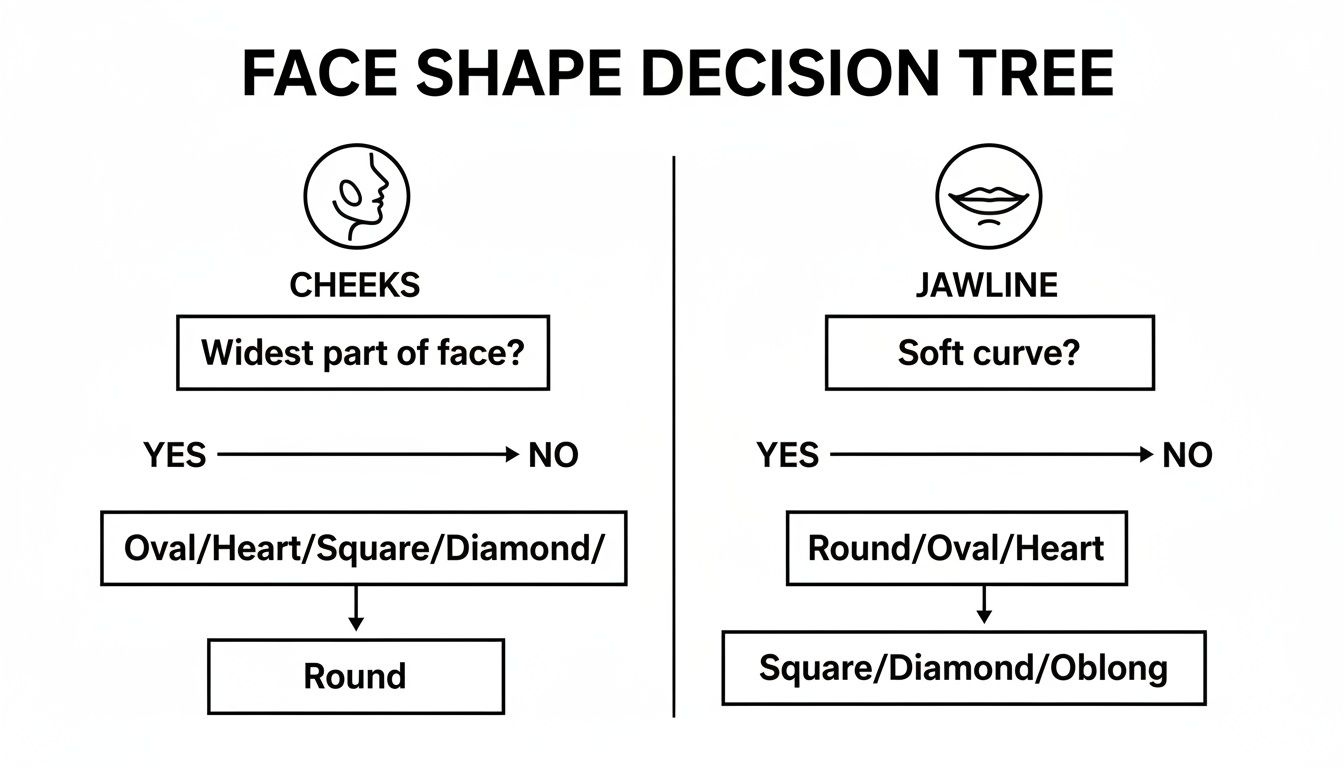
As the decision tree shows, if your cheeks are the widest part of your face and your jawline has a soft curve, you’re likely in the round face shape family. That makes angular frames your ideal choice.
Harnessing the Power of Angular Shapes
When you have soft facial features, the best glasses are the ones that introduce clean, straight lines. This is exactly why eyewear specialists consistently point people with round faces towards square and rectangular frames.
- Square Frames: The strong, symmetrical lines of square glasses are the total opposite of a round face’s circular nature. This contrast adds an immediate sense of structure, helping to define your cheekbones and jawline.
- Rectangular Frames: Because these frames are wider than they are tall, they create an illusion of length. This horizontal line draws the eye outwards, which has the neat effect of making your face appear a little slimmer and more elongated.
For a simple analogy, imagine drawing a square inside a circle. The sharp corners of the square instantly break up the smooth curve, giving it more definition. That’s exactly what these frames do for your face.
Getting the angles right is also crucial for your eye health and safety. A well-chosen angular frame that sits properly ensures your pupils are perfectly centred in the lens, which is essential for accurate vision correction and keeping distortion to a minimum.
By picking frames with distinct angles, you're doing more than just making a style choice; you're using a fundamental design trick to create balance. The sharper the corners, the more definition you'll add to your softer features.
Why Frame Width Is a Game Changer
Shape is only half the story. The width of your glasses plays a massive role in creating a balanced look. The golden rule here is to choose frames that are slightly wider than the widest part of your face—for most people, that’s across the cheekbones.
This subtle extension on either side helps to break up the roundness, making your face appear more proportionate. On the flip side, frames that are too narrow can end up making your cheeks look fuller and your face seem wider than it really is.
Another clever detail to look out for is where the temples (the "arms" of the glasses) connect to the frame. Frames with higher temple attachments, near the top of the frame, can create a subtle lifting effect. This draws the eye upward, helping to elongate the face even more.
Think about it this way: a wide-set rectangular frame not only adds those slimming horizontal lines but also makes sure there's no uncomfortable pinching at your temples. This blend of style and comfort is the secret to finding a pair you'll actually love wearing all day.
Understanding these concepts—contrast through angles, balance through width, and lift through temple placement—turns vague advice into a practical toolkit. It gives you the power to select glasses that don't just fit, but truly flatter. Of course, every face is unique, and that’s where personalised advice comes in. We can customise an eyewear package to suit your requirements, ensuring your chosen frames are paired with the perfect lenses for your vision and lifestyle.
Mastering Frame Size for the Perfect Fit
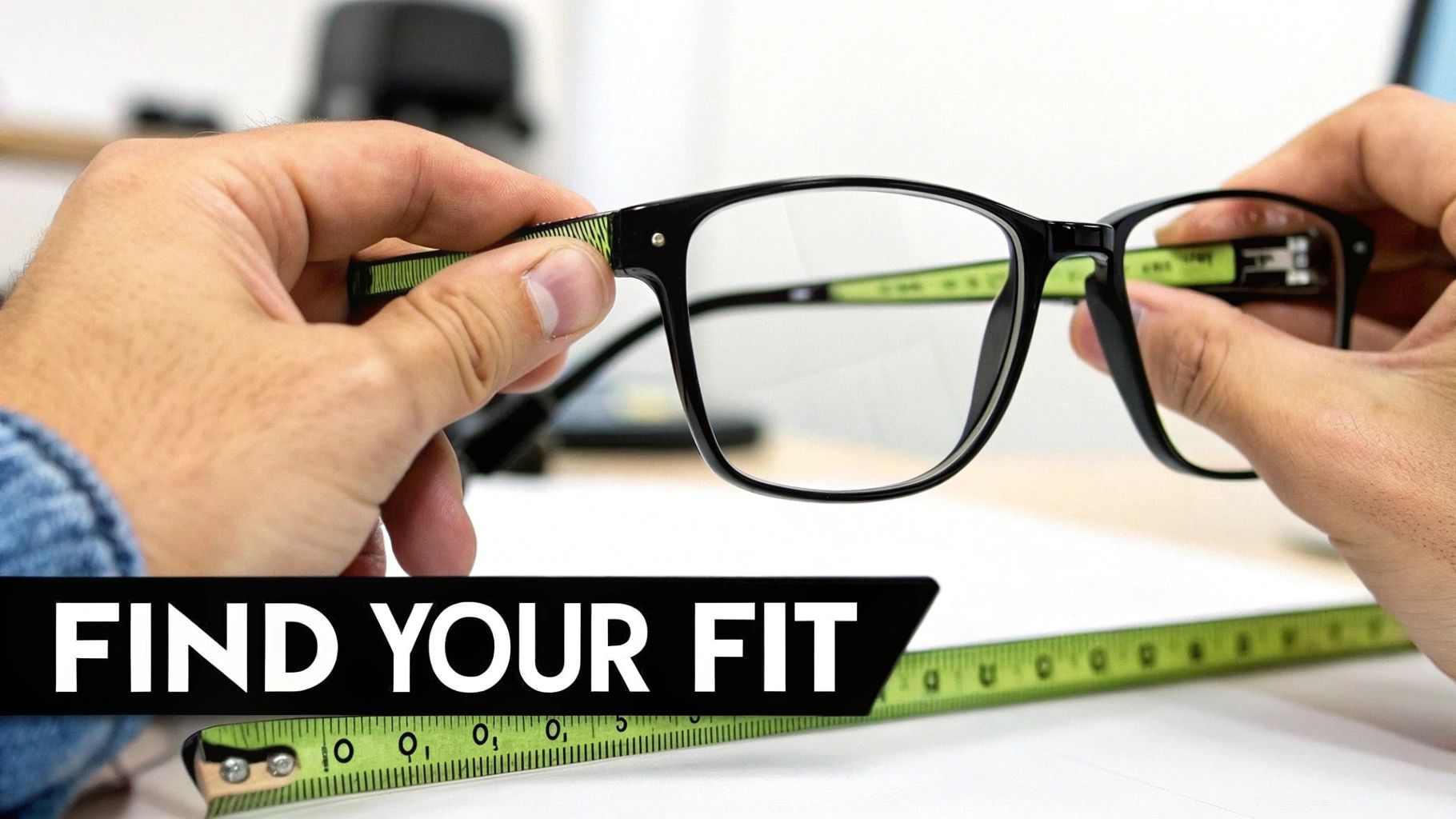
Choosing a stylish, angular frame is a great start, but the real secret to glasses you’ll love wearing all day is getting the fit just right. We’ve all seen it—frames that slip down the nose, pinch behind the ears, or just look out of proportion. It’s not just uncomfortable; a poor fit can compromise your eye health and safety by misaligning your prescription, potentially leading to headaches and eye strain.
Understanding frame sizing is your superpower when shopping for glasses. It gives you the confidence to know a pair will be as comfortable as it is flattering.
Luckily, every pair of glasses comes with its own cheat sheet. If you look closely at the inside of one of the temple arms, you’ll see three small numbers. They’ll look something like this: 52 □ 18 145. These aren't just random codes; they are the exact dimensions of your frames, and they’re your blueprint for finding the perfect new pair.
Decoding the Three Magic Numbers
So, what do those numbers actually mean? Each one corresponds to a critical part of the frame, measured in millimetres. Getting these right isn’t just about comfort—it’s vital for your eye health and safety, ensuring your lenses are perfectly positioned for clear vision.
- Lens Width (e.g., 52): This is the horizontal width of one lens at its widest point. For a round face, you’re looking for a lens width that contributes to a total frame width just a touch wider than your face.
- Bridge Width (e.g., 18): This is the distance between the lenses—the part that rests on your nose. A good bridge fit is everything. It stops the glasses from slipping and makes sure they sit at the correct height.
- Temple Length (e.g., 145): This is simply the length of the arm, from the hinge to the tip that curves behind your ear. It needs to be long enough to sit securely without pinching.
This sizing standard is incredibly helpful. For a practical example, if you find an old pair of glasses that fit perfectly and see the numbers 48 □ 18 135 on the arm, you now have the exact measurements to search for online or show an optician. This makes shopping for your next pair so much easier.
Your Practical Fit Checklist
Numbers are a fantastic starting point, but the real test is how the frames actually feel on your face. When you try on a new pair, run through this simple checklist to nail the fit.
Pro Tip: Your pupils should sit at or very close to the horizontal and vertical centre of the lens. This is non-negotiable for accurate vision, especially with prescription lenses. For a deeper dive, check out our guide on how to measure pupillary distance.
Here are a few more quick checks to perform:
- The Slip Test: Tilt your head down. Do the glasses immediately slide down your nose? If they do, the bridge is probably too wide or the temple arms need adjusting.
- The Pinch Test: Do the frames feel too tight on the sides of your head? You should be able to slide one finger comfortably between the temple arm and your head. Anything tighter will become a nuisance.
- The Cheek Check: Give a big smile! Do the bottoms of the frames lift off your nose and rest on your cheeks? That’s a sign they’re either too big or the bridge fit isn’t quite right.
By combining the technical know-how of frame measurements with these practical, real-world checks, you're all set to find frames for your round face that offer both incredible style and unbeatable comfort. Remember, we can customise an eyewear package to suit your requirements, making sure your perfectly sized frames are paired with lenses that meet all your vision needs.
Choosing Lenses That Protect Your Eyes
Finding angular frames that flatter your round face is a fantastic style win, but let's be honest—the real workhorse of your eyewear is the lenses. The right frames show off your personality, but the right lenses are absolutely critical for your eye health and safety. This is where your glasses stop being just a fashion accessory and become an essential tool for protecting your vision in every situation.
Making smart lens choices is all about matching the technology to your daily life. It’s not just about seeing clearly; it’s about cutting down on strain, protecting against damage, and just making your day-to-day feel a whole lot more comfortable.
Shielding Your Eyes from Digital Screens
In our screen-focused world, our eyes are constantly bombarded with high-energy visible (HEV) light, which most of us know as blue light. It’s blasted out by our computers, smartphones, and tablets, and too much exposure can lead to digital eye strain—think dry eyes, blurry vision, and nagging headaches.
This is where blue light filtering lenses come into play. They’re specifically designed to block a portion of this intense light from ever reaching your eyes, acting like a protective shield during screen time.
-
Practical Example for Students: Imagine pulling an all-nighter to get that assignment done. Blue light lenses can help reduce the eye fatigue that kicks in after hours of staring at your laptop, which might just help you stay focused and comfortable.
-
Practical Example for Professionals: If your day is a marathon of virtual meetings and firing off emails, these lenses can make the workday far more pleasant. Many people find they feel less eye tension by the end of the day.
The All-in-One Solution for Indoors and Out
Tired of constantly swapping between your regular glasses and your sunnies? If your days involve a lot of running between indoor and outdoor spots, photochromic lenses (you might know them as "Transitions") are an incredibly practical solution.
These clever lenses automatically darken when they’re hit with UV light and lighten up again the moment you step back inside. That means you get crystal-clear vision indoors and full sunglass-level protection outdoors, all in a single pair of specs.
Key Insight: Photochromic lenses offer seamless UV protection. The second you step outside, they start shielding your eyes from 100% of harmful UVA and UVB rays—something that’s non-negotiable for long-term eye health.
For example, a real estate agent who’s constantly moving from showing a house (indoors) to walking the property (outdoors) would find these lenses invaluable. There’s no need to juggle two pairs of glasses; the lenses just adapt on the fly, providing instant comfort and protection.
Uncompromising Protection with Dedicated Sunglasses
While photochromic lenses are brilliant for everyday convenience, nothing beats a pair of dedicated sunglass lenses for long stretches in bright sunlight. They provide a consistent, dark tint that slashes through glare and boosts visual comfort, which is especially important for things like driving or a day at the beach.
Choosing quality sunglass lenses is a crucial part of looking after your eyes. Always, always make sure your sunglasses offer 100% UV protection. This is vital for preventing long-term damage to your eyes, including nasty conditions like cataracts and macular degeneration.
Think about a keen angler spending a day out on the water. For them, polarised sunglass lenses are a complete game-changer. They don't just make things darker; they’re engineered to cut the intense, reflected glare bouncing off the water's surface, giving them clearer vision with way less eye strain.
At Prescript Glasses, we know the perfect eyewear is more than just a frame. That’s why we can customise an eyewear package to suit your requirements, pairing your ideal frame with the exact lens technology that fits your life.
Bringing Your Perfect Look to Life
You’ve got the right frame shape and lens tech sorted. Now for the fun part: pulling it all together to create a look that feels completely, authentically you.
This is where the magic of frame colour and material comes in. It’s what transforms your glasses from a simple vision tool into a true fashion statement. Taking a moment to consider your skin tone, hair colour, and personal style helps you land on a frame that doesn’t just fit, but genuinely complements your features.
A classic tortoiseshell frame, for example, often sings against warm skin tones and brown hair. On the other hand, a bold black or sleek silver frame can create a striking, modern contrast for cooler skin tones. The goal is to find that sweet spot, a balance that enhances your natural colouring without overpowering it.
Finalising Your Choice with Confidence
Of course, the ultimate test is trying them on. Whether you’re browsing in-store or using a virtual try-on tool online, this is the step that confirms your chosen style delivers on both comfort and looks. The Australian market is packed with fantastic options, which makes finding the best glasses frames for a round face easier than ever.
From national retailers to online specialists, there are thousands of frames to explore. Many sites now have face-shape filters and virtual mirrors to take the guesswork out of finding that perfect angular style.
Your Personalised Eyewear Solution
At the end of the day, picking the perfect glasses is a personal journey. Your lifestyle, your specific prescription, and what you find stylish are all unique—your eyewear should be, too. This is where getting some expert guidance can really make a difference.
We know that one size never fits all. That's why we can customise an eyewear package to suit your requirements, making sure every single element—from the frame material to the lens coatings—is perfectly matched to your needs and your budget.
Our job is to pair your ideal frames with the right lenses, creating a complete package that protects your vision and elevates your style. Whether you need lightweight titanium for all-day comfort or want a pop of colour with vibrant acetate, we’ll help you navigate the choices.
And remember, your glasses are just one part of your overall look. Taking a holistic approach by mastering eyebrow shaping for your face shape can ensure your new frames work in perfect harmony with your features.
Putting It All Together
Let's make this real. Imagine a student with a round face who spends hours staring at a laptop. Here’s what a practical, customised package could look like:
- Frame: A lightweight, rectangular acetate frame in a dark blue. The angular shape adds definition, while the colour is smart enough for uni but still has personality.
- Lenses: Blue light filtering lenses are a non-negotiable here. They’ll help reduce digital eye strain and improve comfort during those long study sessions.
- Fit: We'd make sure the bridge sits comfortably on the nose without slipping and that the temple arms are exactly the right length for a secure, forget-they're-there fit.
This tailored approach means your glasses aren't just flattering and stylish; they're genuinely optimised for your daily life, providing crucial support for your eye health and safety.
Frequently Asked Questions
Even with all the best advice, a few questions always seem to pop up right when you’re about to make your choice. We’ve put together the most common ones we hear to give you clear, straight-to-the-point answers, so you can feel completely confident in your decision.
What Frame Shapes Should I Absolutely Avoid?
When you have a round face, the name of the game is contrast, not matching. Because of this, you’ll want to steer clear of frames that are overly small, round, or circular.
These shapes just end up accentuating the very features you're trying to balance. Think of it like putting a circle inside another circle—it just reinforces the shape. A perfectly round frame on a round face, for instance, can make your features appear fuller and wider. What you really need are angles to cut through the softness and add some definition.
Can I Wear Oversized Glasses With a Round Face?
Absolutely! Oversized glasses can be an incredibly stylish choice for a round face, but the secret is all in the proportion and shape. The trick is to pick oversized frames that are angular and wider than the broadest part of your face.
Take a large, square frame, for example. Its strong, straight lines create a fantastic contrast to your softer features. That extra width helps to break up the circular outline of your face, which has a natural slimming effect and brings everything into balance. It’s a bold, fashion-forward look that works perfectly because it sticks to that core principle: add structure.
The Rule for Oversized Frames: Always lean into angular styles like squares, rectangles, or even a dramatic cat-eye. Just make sure they extend a little bit beyond your cheekbones. This maintains a flattering balance and stops the frames from making your face look smaller in comparison.
How Do I Know if My Glasses Are the Right Width?
Getting the width right is non-negotiable. It’s crucial for comfort, but it also directly impacts your eye health and safety. If a frame is too narrow or too wide, it can throw your prescription off-centre, making your vision feel weird. Luckily, there are a couple of quick visual checks you can do in a few seconds.
First off, the frames should roughly align with the widest part of your face—for most people with round faces, that’s the cheekbones. The total width of the glasses, from one side to the other, should be just a fraction wider than your temples.
Here’s a simple way to check:
-
The Finger Test: You should be able to slide just one finger between the temple arm and the side of your head. If you can fit more, they’re too wide. If there's no space at all and they're digging in, they’re definitely too tight.
-
The Pupil Alignment: Look straight ahead in a mirror. Your pupils should be right in the centre (or very close to it) of each lens. This is the best way to know you’re looking through the optical centre of your prescription, which gives you the sharpest vision.
Finding the perfect pair is a mix of art and science, and at Prescript Glasses, we get that every little detail counts. We can customise an eyewear package to suit your requirements, from finding that perfect angular frame to fitting it with high-performance lenses. Explore our collection and build your perfect pair today!