Eyeglass Lens Replacement: A Clear Guide to Better Vision

Eyeglass lens replacement is a straightforward, budget-friendly way to refresh your vision without the hassle of buying a whole new pair of glasses. It’s the perfect move when you still love your frames, but your prescription has changed or the lenses are looking a bit worse for wear.
The whole idea is to fit new, custom-made lenses into your existing frames, effectively giving your favourite pair a second life.
Why Replace Your Lenses Instead of Your Frames?
Before you start browsing for a completely new set of specs, it’s worth thinking about the real benefits of just replacing the lenses. This isn't just about saving a bit of cash; it's a smart choice for sustainability, your personal style, and most importantly, your eye health and safety.
Let's be honest, finding that perfect pair of frames is a journey. Maybe you’ve got a vintage set that fits your face just right, or a designer pair you splurged on and still adore. Replacing only the lenses means you get to keep that comfort and style you love while upgrading to crystal-clear vision.
Common Reasons for an Upgrade
There are plenty of situations where a lens replacement just makes sense. The most obvious one is an updated prescription from your optometrist. Wearing glasses with an outdated script is a recipe for eye strain, headaches, and fuzzy vision—none of which are good for your long-term eye health.
Other great reasons to make the switch include:
- Damaged Lenses: Scratches, chips, or coatings that are starting to peel don’t just look bad; they can seriously obstruct your vision and create distracting glare. This can be especially risky when you’re driving at night, as a deep scratch can cause light to scatter, making it harder to see oncoming traffic clearly.
- Lifestyle Changes: Life changes, and sometimes your glasses need to change with it. For example, starting a new job that involves staring at a screen all day might mean you suddenly need blue light protection to fend off digital eye strain and improve sleep quality.
- Technological Advancements: Lens technology is always improving. Modern lenses offer massive gains in clarity, durability, and protection that your old pair might be missing out on.
Lens Replacement Decision Matrix: When to Replace vs Buy New
Sometimes it's hard to decide whether to stick with your current frames or start fresh. This quick table should help you weigh up the options based on your situation.
| Scenario | Recommended Action | Key Considerations |
|---|---|---|
| You love your current frames | Replace Lenses | If the frames are comfortable, stylish, and in good condition, there's no need to change them. |
| Prescription has changed slightly | Replace Lenses | This is the most common reason and is far cheaper than buying a whole new pair of glasses. |
| Lenses are scratched or damaged | Replace Lenses | Give your frames a new lease on life with fresh, clear lenses. It’s a simple fix for better vision and safety. |
| Frames are broken or worn out | Buy New | If the frame itself is beyond repair, it’s time to invest in a new pair for reliability and safety. |
| You want a completely new look | Buy New | Lens replacement won't change your style. If you're after a fashion update, new frames are the way to go. |
| Your frames are a vintage/rare find | Replace Lenses | Preserve a unique or sentimental pair by fitting them with modern, high-quality lenses. |
Ultimately, if your frames are still structurally sound and you're happy with how they look and feel, replacing the lenses is almost always the more practical and economical choice.
The Growing Demand for Specialised Lenses
The need for better, more tailored vision solutions is on the rise. In fact, the Australia eyewear market was valued at USD 163.55 million in 2024 and is expected to jump to USD 350.84 million by 2034.
A big driver behind this growth is our increasing use of digital devices. All that screen time has made people more aware of their eye health, leading to a spike in issues like digital eye strain. This has made specialised options, like blue light-blocking lenses, a must-have for many of us. You can dig deeper into these trends over at MarketResearch.com.
By opting for eyeglass lens replacement, you get a fully modernised visual experience without discarding frames you love. It’s a tailored approach that prioritises both your vision and your personal style.
Whether you're a gamer who needs peak visual performance, a student cramming for exams, or a professional navigating a screen-filled workday, a lens upgrade can make a world of difference. At the end of the day, we can customize an eye wear package to suit your requirements, ensuring your glasses work perfectly for your life.
Want to know more? Check out our guide on how to replace lenses in existing frames in Australia.
Choosing Lenses That Fit Your Real Life
Picking the right lenses goes way beyond simply correcting your vision. It's about genuinely improving your day-to-day life and looking after your long-term eye health and safety. Modern lens tech has some incredible solutions, so it's time to match your glasses to the life you actually live.
Think about what your average day looks like. Are you a graphic designer glued to a high-res monitor for eight hours straight? Or maybe you're a keen hiker, constantly moving between the deep shade of a forest and the bright glare of an open trail. Each of these situations calls for different lens technology to give you the best comfort, clarity, and protection.
When you're looking at an eyeglass lens replacement, choosing wisely is a big step in safeguarding your eye health for the future.
For the Screen-Centric Professional
If your day is dominated by digital screens—whether you're a programmer, writer, or student—you know all about digital eye strain. That nagging headache, dry eyes, and blurry vision after hours of screen time? A lot of that is down to the high-energy visible (HEV) blue light from our devices.
This is exactly where BlueRay lenses come in. They are specifically built to filter out a huge chunk of this disruptive blue light, acting like a protective shield for your eyes.
Let's take a real-world example: a marketing manager juggling video calls on her laptop, poring over spreadsheets, and checking her phone all day. Without any protection, that constant blue light exposure can leave her feeling drained by mid-afternoon. By switching to BlueRay lenses, she cuts down that strain, making her workday more comfortable and productive, with far fewer headaches.
For the Outdoor Adventurer
For anyone who lives for the outdoors, dealing with changing light is a constant battle. Squinting in sudden sunlight or finding it hard to see in shady spots isn't just annoying; it can be unsafe. This is where Photochromic lenses really shine.
These smart lenses darken automatically when they're hit with UV light and lighten up again once you're back inside. The transition is seamless, giving you non-stop comfort and protection.
Picture a cyclist out for a long weekend ride. They might start in the early morning mist, ride through the bright midday sun, and finish as the afternoon light starts to fade. Photochromic lenses adapt to every single change, so there's no need to fumble with swapping between regular glasses and sunnies. It means their eyes are always protected from 100% of UVA and UVB rays, and their vision stays sharp and comfortable, boosting both performance and safety on the road.
By matching your lens technology to your primary activities, you're not just buying a product; you're investing in your visual comfort and health. The right eyeglass lens replacement can dramatically improve how you see and experience the world.
For the Versatile All-Rounder
But what if your life is a mix of inside and out? Most of us split our time between the office and being on the go for meetings, errands, or just enjoying life. Juggling multiple pairs of glasses is a pain, which is why a hybrid solution is often the perfect fit.
Meet Bluecromic lenses – a brilliant mash-up of blue light filtering and photochromic tech. These lenses give you the best of both worlds. They offer solid protection from digital screens while you're indoors and seamlessly adapt to sunlight the moment you step outside.
Here’s a practical scenario: think of a real estate agent. Their day involves office work on a computer, then driving to show properties, and walking clients through bright, sun-filled homes. Bluecromic lenses handle it all effortlessly:
- In the Office: They filter blue light from the computer screen, keeping eye strain at bay.
- While Driving: They darken to slash glare, making for a safer, more relaxed drive.
- At a Property: They adjust to the light levels, ensuring clear vision whether they're inside or out in the garden.
This all-in-one capability makes Bluecromic lenses a fantastic choice for anyone with a dynamic lifestyle.
Customising Your Vision Package
At the end of the day, an eyeglass lens replacement is all about creating a solution that works for you. There’s no one-size-fits-all answer here. Your vision needs are as unique as your daily routine, and your lenses should match that.
We can customize an eye wear package to suit your requirements. That means we look beyond your prescription to understand how you use your eyes every single day. By getting a clear picture of your specific needs, we can recommend the perfect combination of lens material, type, and coatings to give you the best visual experience and protection possible.
Understanding Your Prescription and Measurements
Trying to make sense of your glasses prescription can feel like cracking a code. All those numbers and abbreviations look intimidating at first, but they’re actually just a straightforward map to getting your vision spot on. Getting a handle on these details is the first step toward confidently ordering your eyeglass lens replacement online.
First things first: your prescription needs to be current. Using a script that’s more than two years old is a recipe for trouble. An outdated prescription can lead to eye strain, persistent headaches, and even dizziness because your eyes are working overtime to see clearly. Think of it as the essential foundation for good vision and eye health.
Decoding Your Prescription
Let's break down that script. When you look at your prescription, you'll find a few key terms, each telling us exactly what your eyes need.
- SPH (Sphere): This is the main strength of the lens, measured in dioptres. If you see a minus sign (-), you're short-sighted (myopia). A plus sign (+) means you're long-sighted (hyperopia).
- CYL (Cylinder) & AXIS: These two go hand-in-hand to correct astigmatism, which happens when your cornea is shaped more like a footy than a perfect sphere. CYL is the power needed for the correction, and AXIS (a number from 0 to 180) shows its orientation.
- ADD (Addition): This number only appears on scripts for multifocal or progressive lenses. It’s the extra magnifying power you need for reading and other close-up work.
This information is absolutely vital. While we can customize an eye wear package to suit your requirements, it all hinges on having accurate data from your optometrist. A valid, up-to-date script is non-negotiable for crafting lenses that are perfect for you.
As this chart shows, your lifestyle also plays a huge role. A graphic designer staring at a screen all day has very different needs from a hiker who's constantly out in the sun.
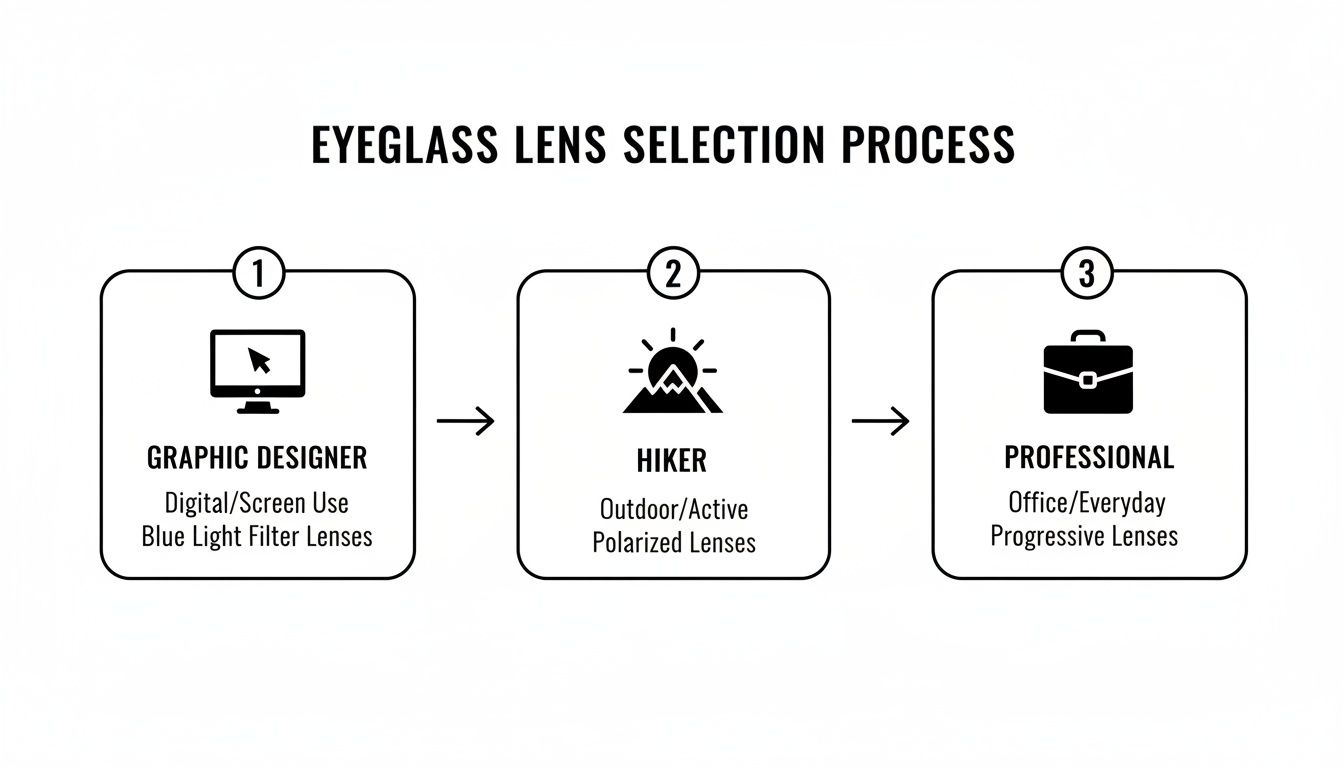
Knowing your daily routine helps you choose the right lens features and coatings for maximum comfort and performance.
The Importance of Pupillary Distance
Beyond the main prescription numbers, there’s one measurement that is absolutely critical for ordering lenses online: your Pupillary Distance (PD).
Put simply, your PD is the distance between the centres of your pupils, measured in millimetres.
Why is this little number so important? The optical centre of each lens has to line up perfectly with your pupil for you to see clearly. If it’s off by even a few millimetres, you can end up with distorted vision, headaches, and serious eye strain. It completely defeats the purpose of getting new lenses.
Getting your PD right is the most important step you can take to ensure your new lenses perform correctly. It is the key to unlocking crisp, comfortable vision and maximising the benefit of your investment in eye health and safety.
For example, a PD of 63mm means the centres of your pupils are 63 millimetres apart. Sometimes, a script will provide a dual PD, like 31/32. This is even better, as it measures the distance from the centre of your nose to each pupil individually, offering superior precision.
How to Measure Your PD at Home
While your optometrist provides the most accurate PD, they don't always include it on the prescription. The good news is that you can easily and accurately measure it at home. All you need is a millimetre ruler and a mirror.
- Stand about 20cm away from a mirror. Hold the ruler flat against your brow.
- Close your right eye. Line up the '0' mark on the ruler with the exact centre of your left pupil.
- Now, hold the ruler steady, close your left eye, and open your right.
- Read the measurement that lines up with the centre of your right pupil. That number is your PD.
It's a good idea to repeat this a few times to make sure your measurement is consistent. For a more detailed walkthrough and a couple of other methods, you can learn more about measuring your pupillary distance in our article. Taking a few minutes to get this right will make a world of difference to the comfort and clarity of your new lenses.
The Lens Replacement Process From Start to Finish
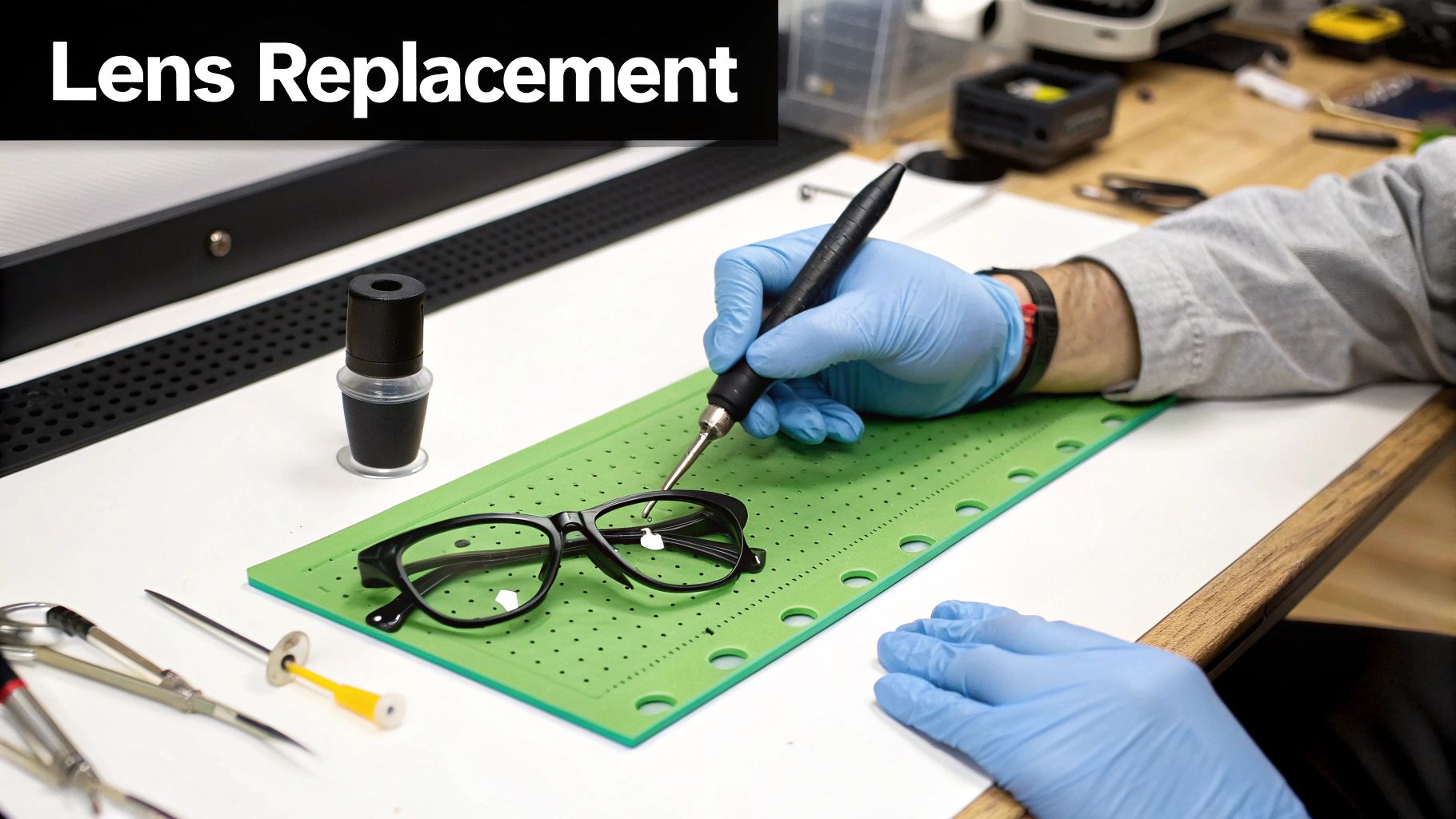
So, you've decided to go for an eyeglass lens replacement. Great choice. But what actually happens next? Knowing the journey your frames will take—from your mailbox to our lab and back again—can make the whole thing feel a lot more comfortable. It's a precise, organised process designed to keep your frames safe while delivering perfectly fitted lenses for your vision.
This isn't just a niche service; it's becoming more and more common, especially here in Australia. The local eyewear market is valued at a huge AUD 229.00 million in 2024 and it's growing fast. With 56.7% of Aussies—that’s a staggering 14.4 million people—living with long-term eye conditions, it's no surprise the demand for updated, high-quality prescription lenses is always on the rise. You can learn more about the trends shaping the Australian eyewear market to see why so many people are choosing to reglaze their favourite frames.
Let's walk through what happens from the moment you send your glasses our way.
Preparing Your Frames for Their Journey
First things first: you need to package your glasses safely. This is a crucial step to make sure they arrive at our lab in the same condition you sent them. Think of it like shipping a delicate instrument—a little extra care makes all the difference.
We always suggest using a small, sturdy box. Your original glasses case is ideal because it's literally made to hold your frames snugly.
- Wrap the Case: Pop your glasses inside their hard case, then give the case a good wrap in bubble wrap or a soft cloth for another layer of cushioning.
- Secure in a Box: Place the wrapped case inside a small shipping box. Fill any empty space with crumpled paper or more bubble wrap so it can’t rattle around during transit.
- Include Your Details: Don't forget to put a note inside with your name and order number. This simple step helps us match your frames to your order the second they land in our lab.
Getting this part right protects your frames and helps us get started on your order without a hitch.
A secure package is the first and most crucial step in the lens replacement journey. Taking a few extra minutes to pack your frames properly ensures they arrive safely, ready for their high-tech upgrade, and safeguards your investment in better eye health.
A Glimpse Inside the Lab
Once your frames arrive, they're handled in a clean, high-tech environment. Our technicians treat every pair with incredible care, blending advanced machinery with hands-on skill to craft your new lenses. It’s a real mix of science and craftsmanship.
The first thing we do is give your frames a thorough inspection. We look for any weak spots or damage that could cause issues when we fit the new lenses. This is an important health and safety check to make sure the frame is strong enough for the job.
Next, we use a digital tracer to create a precise 3D map of your frame's lens openings. This is essential for a perfect fit. For example, the unique curve of a classic aviator frame requires a completely different cutting profile than a sharp, modern rectangular one. This digital blueprint guarantees your new lenses will sit perfectly, with no gaps or stress on the frame.
Crafting and Fitting Your New Lenses
With the 3D trace complete, we pull the exact lens material and coatings you ordered. Whether it’s a lightweight high-index lens for a strong prescription or a super-durable polycarbonate option, we start with a lens 'blank'. Your prescription details are then fed into a computer-guided generator, which grinds the lens to the exact curvature needed to correct your vision.
After the initial cut, the lenses are edged to match the shape of your frames down to the micrometre. Any coatings you chose—like anti-scratch, anti-reflective, or blue light filters—are applied in a sterile, dust-free environment.
Finally, a skilled technician carefully fits the new lenses into your frames by hand. They do one last quality check, making sure the alignment is perfect and the fit is secure. We can customize an eye wear package to suit your requirements, and this hands-on final step is where that promise really comes to life, ensuring your glasses are sent back to you looking and feeling better than ever.
Caring For Your New Lenses and Common Fixes
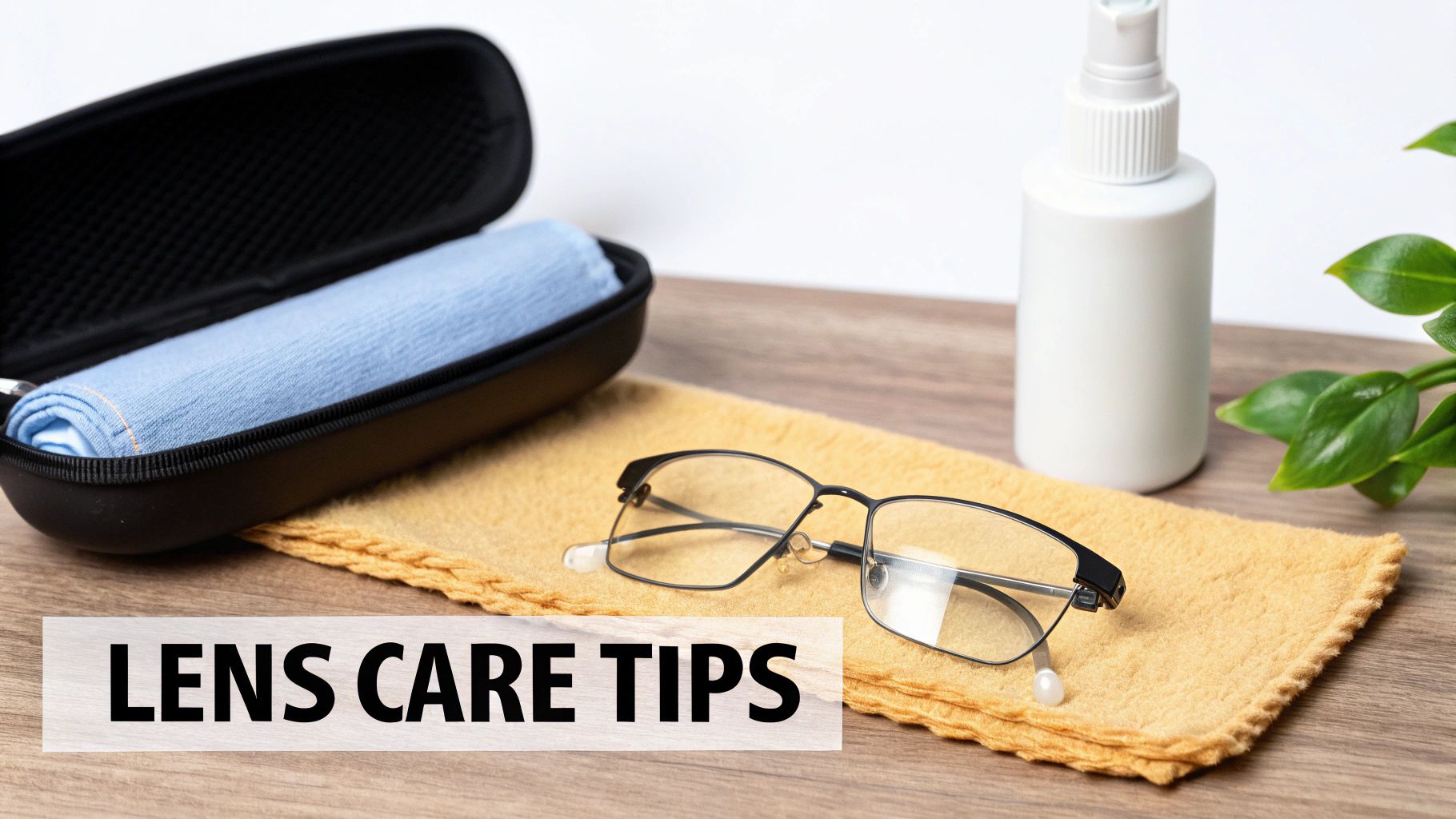
Your frames are back, now fitted with a set of fresh, high-performance lenses. To make sure you get the most out of this investment in your vision, a little bit of care goes a long way. Building a few simple habits will keep your lenses crystal clear and your coatings effective for years to come.
Good lens care starts with breaking bad habits. It's so easy to grab the corner of your shirt or a paper towel for a quick wipe, but these materials are surprisingly abrasive. Over time, they create a network of tiny micro-scratches that dull the lens surface and can damage the protective coatings you've paid for.
The Dos and Don'ts of Daily Lens Care
Think of lens care as simple, daily maintenance, not a major chore. The real goal is to protect your new lenses from the usual culprits: dust, fingerprints, smudges, and accidental drops.
Here are a few practical tips to keep your lenses looking pristine:
- DO use a proper microfibre cloth. These are specifically designed to trap grease and lift away dust without scratching or leaving lint behind. It's a good idea to keep one in your glasses case, one at your desk, and maybe one in your car.
- DON'T reach for household cleaners. Things like window cleaner, ammonia, or bleach are far too harsh for modern lens coatings and will strip them right off, ruining your investment. All you need is lukewarm water and a tiny drop of gentle, lotion-free dish soap.
- DO store them in a hard case. Whenever you’re not wearing your glasses, their case is the safest place for them. This protects them from getting crushed, dropped, or scratched while rattling around in a bag or on a nightstand.
- DON'T leave them on your car's dashboard. Extreme heat can wreak havoc on both the lens coatings and the frame material, leading to warping and distortion.
If you’re dealing with existing damage and want to know your options, you can check out our guide on what to do about scratches on your glasses. Of course, we can customize an eye wear package to suit your requirements if you're ready for a fresh start.
Troubleshooting Common Issues
Even with a perfect eyeglass lens replacement, you might run into a couple of common situations as you get used to your new view of the world. Don't worry—most are a normal part of the process and easy to resolve.
The most common experience is a short adjustment period. If your prescription has changed, even just slightly, your brain needs a little time to catch up. Things might seem a bit "off," swimmy, or mildly distorted for the first day or two. This is completely normal.
It's really important to wear your new glasses as much as possible for the first few days. This helps your brain and eyes synchronise with the new prescription, leading to long-term comfort and clarity. If things still don't feel right after a week, it’s best to check in with your optometrist.
Another thing that can happen is a slight change in the frame's fit. The process of inserting new lenses can sometimes shift the alignment just a fraction. If your glasses feel a bit loose or sit crookedly on your face, a simple adjustment is usually all it takes. For instance, if one side is sitting higher than the other, you can often level them out by gently bending the opposite arm down at the hinge. Small, careful tweaks can bring back that perfect, comfortable fit.
Got Questions? We’ve Got Answers
Deciding to replace the lenses in your favourite frames can feel like a big step, and it's totally normal to have a few questions before you jump in. We get it. This final section is all about tackling the most common queries we hear day in and day out, giving you clear, straightforward answers so you can feel confident in your choice. We’ll cover the practical stuff—cost, timing, health funds, and whether your frames are up to the task.
The need for good vision is a massive part of daily life here in Australia. In fact, our local optometry and optical dispensing industry is a big deal, and a huge part of that comes down to the simple fact that 14.4 million Australians (56.7% of us) are living with at least one long-term eye condition. This creates a constant need for services like lens replacement. If you're curious, you can get a deeper look into the trends shaping the Australian optical industry.
How Much Can I Expect to Pay?
This is usually the first question on everyone's mind, and the honest answer is: it depends entirely on what you choose. The final price tag for your lens replacement is shaped by two main things: the complexity of your prescription and the specific lens and coatings you go for.
For instance, a standard single-vision lens for a mild prescription will naturally be more budget-friendly than a custom-made progressive lens for a complex one. Likewise, adding on great features like blue light filtering, photochromic (light-adjusting) technology, or a high-index material for a stronger prescription will add to the cost.
The best way to think about it is like building a custom package just for you. You only pay for the features that will genuinely improve your vision and suit your lifestyle. This way, you get the best possible value without spending on tech you don't actually need.
The easiest way to get a precise number is to simply walk through our online ordering process. You can click through the options, see the total cost update in real-time, and get a clear picture before you commit to anything.
What Is the Turnaround Time?
We know that being without your glasses is a pain. From the moment we get our hands on your frames to when we ship them back to you, the whole process typically takes between 7 to 14 business days.
Here’s a quick breakdown of what happens during that time:
- Safe Transit: Allowing time for your frames to arrive safely at our lab.
- Thorough Inspection: We give your frames a detailed check-up for any hidden issues, a key safety step.
- Precision Crafting: This is where we custom-make, cut, and coat your new lenses.
- Expert Fitting: We carefully install the new lenses and do a final quality check to make sure everything is perfect.
Sometimes, a particularly complex prescription or special custom coatings might add a day or two, but our goal is always to get your glasses back to you as fast as possible without ever cutting corners on quality and safety.
Can I Use My Health Fund?
Yes, absolutely. In most cases, you can claim your lens replacement through your private health fund. The majority of Australian health funds that offer extras or optical cover will provide benefits for new prescription lenses.
The process is pretty simple. Once you've paid for your new lenses, we'll send you a detailed tax invoice. You just need to submit that invoice to your health fund, and they'll handle the rebate based on your policy. It's always a good idea to give your provider a quick call beforehand just to confirm your level of cover and any annual limits.
Are My Frames Suitable for New Lenses?
The great news is that the vast majority of frames are perfectly fine for a lens reglaze. As long as your frames are in good condition—meaning they aren’t brittle, cracked, or broken—we can almost certainly fit them with shiny new lenses. This goes for full-rim metal or plastic frames, semi-rimless styles, and even many rimless designs.
Here’s a real-world example: Say you have a pair of designer frames you bought five years ago. The acetate is still solid and the hinges are strong, but the lenses are scratched to bits. That’s the perfect candidate for a replacement. We can bring that beloved pair back to life with modern, high-performance lenses.
However, if a frame has visible damage or is extremely old and fragile, it might not be a safe bet. Our initial inspection is a crucial safety step to ensure the frame can hold your new lenses securely for everyday wear.
Ultimately, our goal is to customise an eye wear package that suits your exact requirements, and that always starts with making sure your frames are ready for the job.
Ready to see the world more clearly without giving up the frames you love? At Prescript Glasses, we make it simple to upgrade your vision. Explore our lens options, upload your prescription, and let us handle the rest. Visit us today to get started.