How to Get Scratches Out of Glasses Safely

Dealing with scratched glasses is more than just an annoying cosmetic flaw; it’s a real problem for your eye health. Those tiny scratches create visual distortions that force your eyes to constantly refocus, leading to eye strain, headaches, and even blurry vision. Your brain has to work harder to see clearly, which can be exhausting and, in some situations, dangerous.
This guide will walk you through safe, practical solutions and explain why professional care is often the best investment for your vision and safety in the long run.
The Hidden Dangers of Scratched Lenses
That tiny scratch on your glasses might seem like nothing, but it can create serious issues for your vision and overall safety. When a lens is scratched, light can't pass through cleanly anymore. Instead, it scatters, creating glare and visual noise that your brain has to work harder to interpret.
Think about driving at night. The glare from an oncoming car's headlights hits your scratched lenses and suddenly explodes into a starburst effect, momentarily blinding you. This isn't just irritating—it’s a major safety hazard that can seriously compromise your reaction time on the road. Similarly, if you work with machinery, a scratch could obscure a critical detail, leading to a workplace accident.
More Than Just an Annoyance
The constant effort your eyes make to see past these imperfections leads to what's often called digital eye strain, even if you’re not staring at a screen.
Symptoms can build up over the day and often include:
- Persistent, dull headaches, especially around the temples.
- Watery, itchy, or dry eyes.
- Noticeably blurry or double vision.
- Increased sensitivity to light, both indoors and out.
If any of these sound familiar, understanding the importance of a regular eye check-up is a crucial first step toward protecting your vision.
Scratched lenses effectively alter your prescription by creating an uneven surface. This means your eyes aren't receiving the precise correction they need, forcing them to work overtime just to achieve focus.
The Impact on Australians
This isn't just a minor issue; it's incredibly widespread. Recent data from Australia’s optical health sector shows just how common this problem is.
In 2023, reports showed that nearly 53.7% of Australians needed corrective eyewear for long-term conditions. Among those wearing glasses, about 37% reported dealing with reduced visual clarity because of scratches.
What's more, surveys in major cities found that scratched lenses led to a 15-20% decrease in wearer satisfaction, which has a real impact on how people care for and replace their eyewear. You can discover more insights about the Australian eyewear market and consumer behaviour.
Ultimately, prioritising clear, undamaged lenses is one of the most important things you can do for your eye health. At Prescript Glasses, we can customise an eye wear package to suit your requirements, ensuring your vision is always protected.
Inspect Your Glasses Before Trying Any Fix
Hold on. Before you reach for the baking soda or toothpaste, you need to take a good, hard look at your glasses. I can't stress this enough: jumping into a DIY fix without knowing exactly what you're dealing with is a recipe for disaster. You could strip off essential lens coatings or, even worse, permanently damage the lens itself.
First things first, what kind of lenses are we talking about? Are they old-school glass, or something more modern like polycarbonate or a high-index plastic? It matters. Polycarbonate, for instance, is super tough against impacts but scratches if you so much as look at it the wrong way. Glass is the opposite.
Next, check for any special coatings. Most glasses these days have an anti-reflective coating. The easiest way to spot this is to hold your lenses up to a light. See a faint green, purple, or blueish sheen on the surface? That's your coating. These layers are incredibly thin and delicate, and abrasive home remedies will destroy them in seconds.
Gauging the Scratch Depth
This is the most critical part of your inspection: figuring out how deep that scratch really is. There's a tried-and-true method for this that we call the "fingernail test."
Just gently run your fingernail across the scratch.
- Does your nail glide over it without catching? Good news. It's probably just a superficial scuff on the surface or the coating. You might have a shot with a very gentle polishing method.
- Does your nail catch in the groove? Stop right there. The scratch is too deep for any DIY solution. Trying to buff it out will only grind away more of the lens and its coating, creating a permanent blurry spot right in your line of sight.
This simple test is your best defence against turning a small problem into an expensive one. A deep scratch means the actual lens material is compromised, and any attempt to polish it at home will mess with the optical precision of your prescription.
This isn't just about looks; a scratch can quickly become a real problem for your vision and safety.
As you can see, even small scratches can cause significant eye strain or become a genuine hazard when you're driving. Taking a moment to inspect your glasses properly helps you figure out what you’re up against so you can make a smart decision. It’s about protecting your eyewear and your eyesight.
Safer At-Home Methods For Minor Surface Scuffs
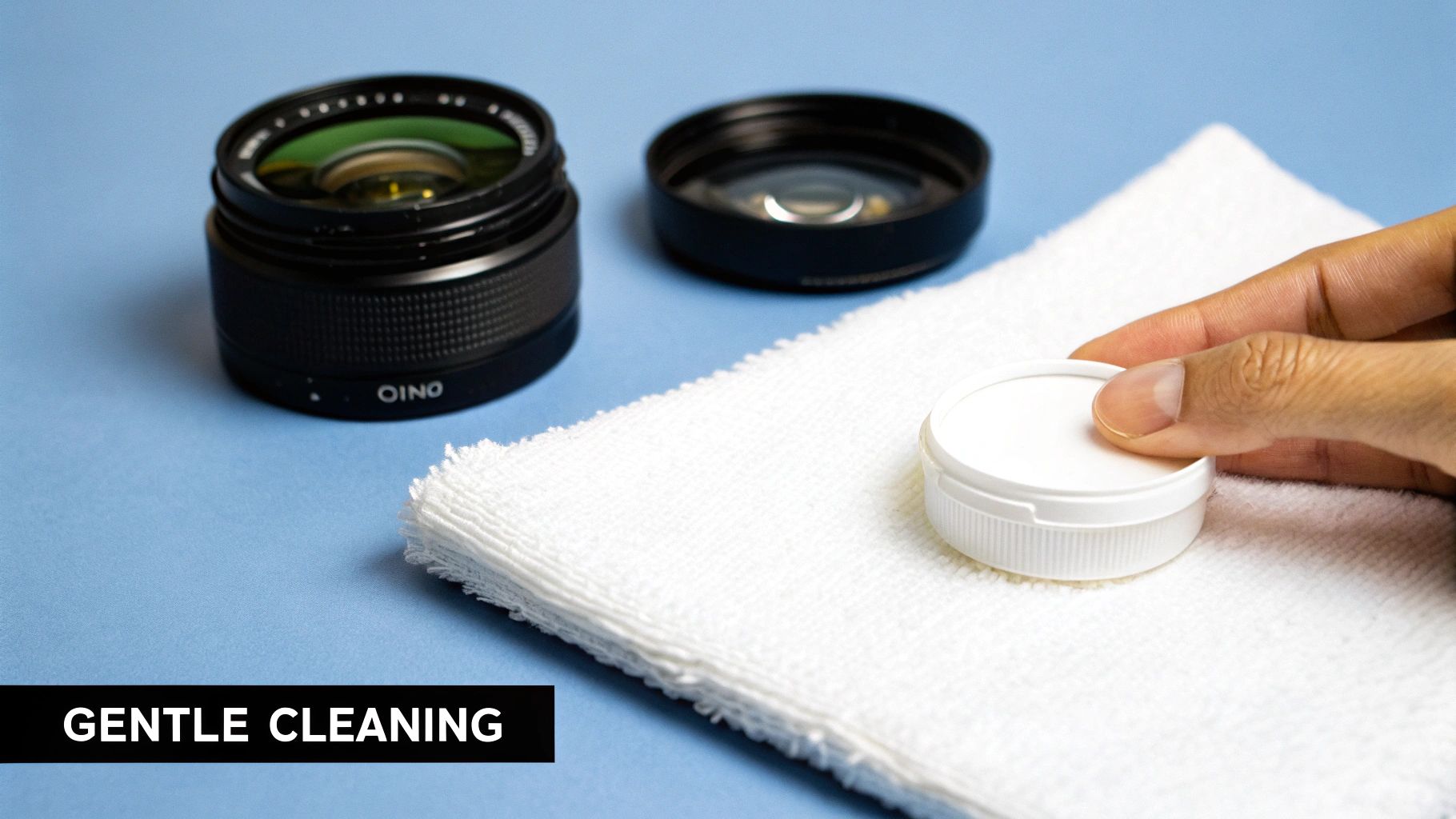
We’ve all been there. You spot a small scuff on your glasses and immediately the temptation to google a quick fix kicks in. Before you reach for the toothpaste or car wax, stop. Most of these internet 'hacks' are a one-way ticket to ruined lenses. They're far too abrasive and will strip away the crucial coatings that protect your eyes and keep your vision sharp.
However, for a very light, superficial scuff—the kind your fingernail just glides over without catching—there is one cautious method you could try as a last resort. This should only ever be attempted on older glasses you know don't have specialised coatings, because the risk of making things worse is always there.
The Cautious Baking Soda Paste Method
If you're set on trying a home remedy, a non-abrasive baking soda paste is the only one worth considering. Think of it as a very mild polish that can sometimes smooth the edges of a tiny blemish without destroying the lens itself.
Here’s how to do it with the utmost care:
- Make the paste: Mix two parts baking soda with one part water. For example, use one teaspoon of water and two teaspoons of baking soda. You're after a thick, consistent paste, not a watery liquid.
- Apply gently: Using a clean, high-quality microfibre cloth, dab a tiny amount of the paste onto the scuff. Never use your t-shirt or paper towels.
- Polish carefully: Rub the paste over the scratch in a soft, circular motion for just a few seconds. Do not apply pressure. Let the paste do the work.
- Rinse and dry: Immediately rinse the lens under cool, running water until every trace of the paste is gone. Gently dry it with a fresh, clean microfibre cloth.
Remember, this is a polishing action, not a magic scratch eraser. The idea is to gently smooth the edges of a microscopic scuff to make it less noticeable. If you can still see it, don't repeat the process. You'll only risk wearing down the lens coating further.
The urge to try a fix at home is strong. A 2022 survey found that around 62% of Australian consumers tried a DIY repair on their glasses before seeking professional help. While it’s common, optometry associations are clear that these methods are only for the most minor of issues.
A Guide to DIY Scratch Removal
It can be confusing to know which internet hacks are genuinely harmful and which might be worth a cautious try. This table breaks down the most common suggestions.
DIY Scratch Removal Methods: What to Try vs. What to Avoid
| Method | Risk Level | Best For | Why It's Risky/Recommended |
|---|---|---|---|
| Baking Soda Paste | Low (if done correctly) | Very minor surface scuffs on uncoated plastic lenses. | Recommended (with caution): It's a mild abrasive that can gently buff out superficial marks without harsh chemicals. |
| Toothpaste | High | Nothing. | Avoid: Contains harsh abrasives (like silica) that create thousands of new micro-scratches and strip lens coatings. |
| Car Wax/Furniture Polish | High | Nothing. | Avoid: These products contain chemicals that can permanently damage lens coatings and may only fill in the scratch temporarily. |
| Glass Etching Cream | Extremely High | Nothing. | Avoid: This is acid. It will completely strip all coatings and can permanently fog and destroy the lens material itself. |
As you can see, the list of things to avoid is much longer. When it comes to something as precise as your glasses, caution is always the best approach.
Understanding The DIY Mindset
The desire to find a hands-on solution isn't unique to glasses. You see a similar mindset when people want to learn about DIY screen replacement for their electronics. But there's a critical difference: eyeglass lenses are precision medical devices. A mistake doesn't just mean a cracked screen; it can directly impact your vision and eye health.
Proper glasses maintenance goes beyond the lenses, too. If you find your frames are sitting a bit crooked after handling them, the alignment might be off. Our guide on how to tighten your glasses can help you make safe adjustments at home, ensuring the lenses are positioned correctly in front of your eyes.
Ultimately, while fixing things yourself is satisfying, your eyesight is simply too important to risk with unproven methods. If a gentle polish doesn't do the trick, it’s time to stop and look at professional options.
When You Need to See a Professional
While it's tempting to try a quick fix for scratched glasses, there are definitely times when DIY methods will do more harm than good. A simple and reliable way to know if a scratch is too deep for a home remedy is the fingernail test.
Gently run your fingernail across the lens. If it catches in the groove, it’s time to stop what you're doing and get a professional opinion.
Trying to polish out a deep scratch can strip away your lens coatings, creating a permanent blurry spot that's far worse than the original scratch. This is a critical point—your eye health and safety should always come first.
Why a Professional Assessment Matters
An optician or an optical lab has the specialised tools and expertise to properly assess the damage without making it worse. They can determine the exact depth of the scratch and, importantly, where it sits in relation to your direct line of sight.
Imagine you've dropped your glasses on concrete, leaving a noticeable gash. An optician can immediately tell if that scratch has compromised the lens's structural integrity or distorted the optical centre of your prescription. This isn't just about looks; it's about making sure your eyes aren't straining to see through a damaged surface, which can lead to headaches and fatigue.
Investing in a professional opinion isn't admitting defeat; it's a smart decision for your long-term eye health. A compromised lens can alter how light enters your eye, effectively changing your prescription and undermining the very reason you wear glasses.
Repair vs. Replacement
In some cases, a professional might be able to minimise a minor scratch. They can't magically make a deep gouge disappear, but they sometimes have access to optically safe fillers or can carefully buff the area to make it less obvious—but only if it's well outside your central field of vision. This is where their expertise is invaluable.
However, more often than not, a deep scratch means the lens is beyond safe repair. At this point, the best and safest solution is to replace the lens. This doesn’t mean you need a whole new pair of glasses. You can find more helpful information about replacing lenses in existing frames.
For significant damage, you could also look into professional glass polishing services to see what might be possible, although this is less common for prescription eyewear.
Ultimately, turning to a professional is an investment in clear, comfortable vision. At Prescript Glasses, we can help you find the right solution. If new lenses are what you need, we can customize an eye wear package to suit your requirements, ensuring you get a durable, high-quality replacement that perfectly matches your prescription and lifestyle.
How to Prevent Scratches on Your Glasses
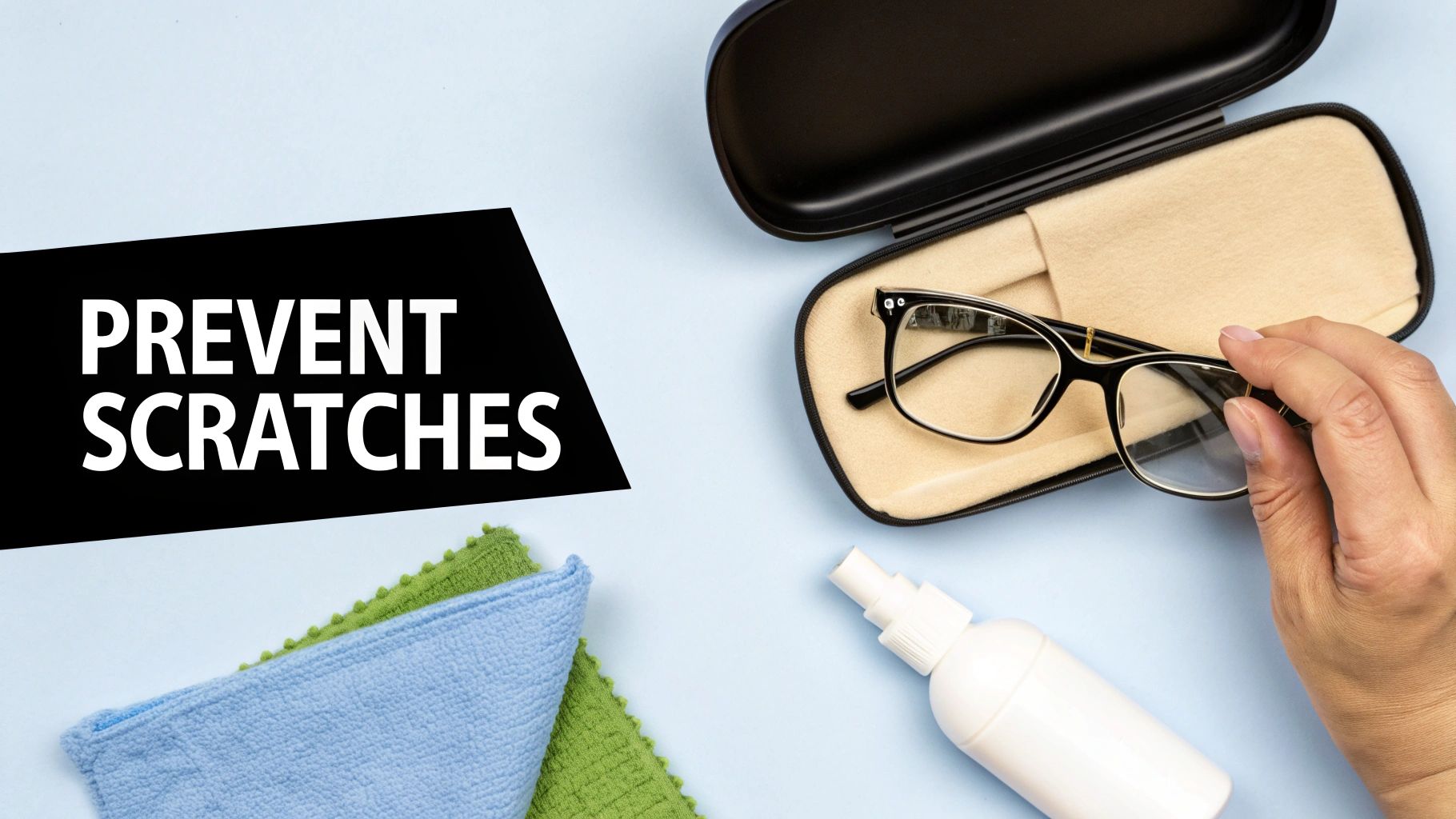
While it’s good to know how to fix minor scuffs, the real win is stopping them from ever happening. Honestly, prevention is miles more effective than any cure, and it all boils down to building better habits day-to-day. After all, your safety and eye health rely on having perfectly clear vision.
The biggest mistake we all make? Wiping our lenses on our shirts. It feels harmless, but clothing fibres are loaded with microscopic dust and grit that basically act like sandpaper. Over time, this creates a web of tiny scratches you can’t un-do.
Instead, the only truly safe way to clean your glasses is with a proper lens spray and a clean microfibre cloth. This simple routine is designed to lift oils and dirt away, not grind them into the surface, which is key to preserving those delicate lens coatings.
Build Smarter Habits Today
A few small changes to your routine can dramatically extend the life of your lenses and keep your vision sharp. It’s not about grand gestures, just consistent, mindful care.
Here are a few practical habits to get into:
- Always use two hands to take off your glasses. Grabbing them with one hand can slowly bend the frame, misaligning the lenses and making you more likely to drop them.
- Never place glasses lens-down. This is the golden rule. When you set them on a table, always fold them up and make sure the lenses face the ceiling.
- Rinse before you wipe. If your specs are especially dusty or dirty—say, after a day at the beach or working in the garden—give them a quick rinse under lukewarm tap water first. This washes away any larger particles before you start wiping.
Another non-negotiable habit is proper storage. If your glasses aren't on your face, they need to be in their case.
A hard-shell case is your eyewear's best friend. Tossing your glasses into a pocket, bag, or glove box unprotected is just asking for scratches from keys, coins, and whatever else is rattling around in there.
Invest in Protective Coatings
Next time you’re buying glasses, seriously consider adding a high-quality anti-scratch coating. This isn't just an upsell; it’s a crucial layer of defence that hardens the lens surface, making it far more resistant to the knocks of daily life.
This is a huge deal for glasses wearers. In Australia, the eyewear market was valued at around USD 102.40 million in 2024, partly because consumers are demanding more durable products. Because of this, many Australian optometrists now offer advanced scratch-resistant coatings that can reduce surface scratches by up to 70% compared to standard, uncoated lenses. You can read the full research about these Australian eyewear market trends for more detail.
Thanks to advancements in nanotechnology, these protective coatings have become much more common and effective. It's a small upfront investment that can save you a lot of money and frustration down the track. At Prescript Glasses, we can customize an eye wear package to suit your requirements, making sure you get the best protective features for your lifestyle.
Your Questions About Scratched Lenses, Answered
When you're dealing with scratched glasses, it's easy to fall down a rabbit hole of DIY fixes and conflicting advice. Let's cut through the noise. Here are some clear, practical answers to the questions we hear most often, keeping your vision and safety front and centre.
Can An Optician Really Fix a Deep Scratch?
This is a common hope, but the honest answer is usually no—at least not perfectly. If a scratch is deep enough for your fingernail to catch on it, a complete repair is off the table.
An optician can sometimes polish the lens to make a minor scratch less obvious, but this is only a viable option if the damage is well away from your direct line of sight. Any polishing alters the lens curvature.
A deep scratch right in the middle of your vision permanently damages the lens and its crucial coatings. In this situation, the only safe and effective solution is to replace the lenses. An eye care professional can fit new, more durable lenses into your existing frames, bringing your vision back to its best.
Are Store-Bought Scratch Kits a Good Idea for Coated Lenses?
Using one of these kits is a huge gamble, and one we’d strongly advise against. Most of them contain a fine abrasive compound designed to sand down the top layer of your lens. While this might temporarily buff out a tiny surface scuff, it will also strip away your anti-reflective, UV, and blue-light filtering coatings in that spot.
The result is an uneven patch on your lens that creates distracting visual distortions and glare. This isn't just annoying; it can be downright dangerous, especially when you're driving at night.
A lot of people don't realise that 'removing' a scratch with these kits actually means removing the protective coatings with it. This compromises the very function of the lens, defeating the whole purpose of having high-quality eyewear.
Does the Toothpaste Trick Actually Work?
This is probably the most widespread myth out there, and it will absolutely do more harm than good. Toothpaste contains abrasive particles like hydrated silica—great for scrubbing tough tooth enamel, but disastrous for delicate lenses.
Think of it this way: rubbing toothpaste on your lens is like scrubbing it with a pinch of fine beach sand. You won't fix the original scratch; you'll just create thousands of new micro-scratches, dulling the surface and destroying any protective coatings in the process. Never, ever use toothpaste or other household abrasives on your eyewear.
Is an Anti-Scratch Coating Really Worth the Extra Cost?
Absolutely. No lens is 100% scratch-proof, but a quality anti-scratch coating provides a much harder, more resilient surface that can stand up to the rigours of daily life. It’s a small investment upfront that can dramatically extend the lifespan of your glasses.
Consider it essential protection. Not only does this coating keep your vision clearer for longer, but it also saves you money by preventing the need for premature lens replacements. When it comes to the longevity and performance of your eyewear, it's one of the smartest upgrades you can make.
At Prescript Glasses, your eye health is our top priority. If you're dealing with scratched lenses that are past the point of a safe repair, it might be time for an upgrade. We can help you customise an eye wear package to suit your needs, ensuring you get the clear, protected vision you deserve. Explore your options at https://www.prescriptglasses.com.