Glasses for Driving at Night: Do They Help or Hinder?

We’ve all been there. That sudden, blinding glare from an oncoming car's headlights is more than just an annoyance—it's a genuine safety hazard. For many, grabbing a pair of glasses for driving at night seems like the obvious fix, but it's vital to know what actually works and what's just marketing hype to keep yourself safe on the road.
The Dangers of Night Driving and Your Vision
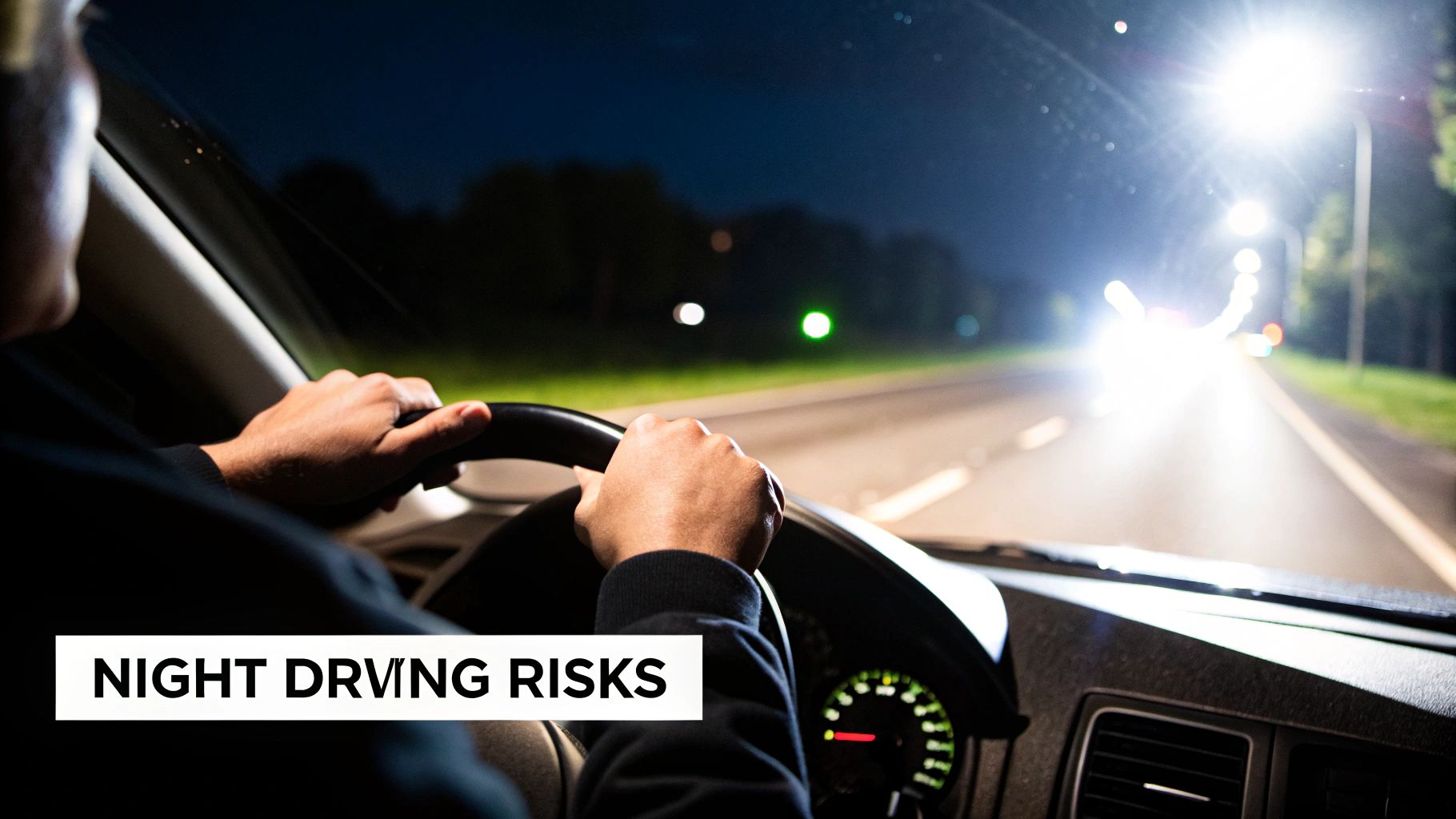
Driving after dark throws a unique set of challenges at us, turning a simple trip into a high-stakes task. The shift from broad daylight to the limited, artificial light of the road completely changes how we see the world around us.
Our eyes simply aren't built for peak performance in low light. To compensate, our pupils dilate to let in as much light as possible. While this helps us see in the dark, it also reduces the sharpness of our vision and makes us far more sensitive to the glare from streetlights and, of course, those piercingly bright modern LED headlights.
Why Your Vision Struggles After Sunset
This difficulty with night vision isn't just in your head; it has very real consequences for your safety. When your eyes are fighting against glare and poor contrast, your reaction time to unexpected hazards drops significantly.
Some of the most common issues drivers run into at night include:
- Difficulty Reading Road Signs: Important information on signs can become a blurry mess, often staying unreadable until you're right on top of them.
- Reduced Contrast Sensitivity: It becomes much harder to spot pedestrians, cyclists, or debris on the road. Things just don't "pop" the way they do during the day.
- Increased Eye Strain and Fatigue: Constantly squinting and straining to make sense of the scene ahead leads to tired eyes and a dangerous lapse in focus.
These problems get even worse if you have an uncorrected or out-of-date prescription. A minor issue like astigmatism, which you might not even notice in daylight, can create massive starbursts and halos around lights at night, making it incredibly difficult to see clearly.
Your eye health and safety should always be the top priorities. A precise, up-to-date prescription is the absolute foundation for clear and safe night driving.
The Real Impact on Australian Drivers
This isn't just a collection of anecdotes; it's a measurable safety problem. Nighttime driving is a major challenge in Australia. While 19% of drivers between 35 and 54 report struggling to see road signs during the day, that number jumps to 25% for the same group at night. This shows just how much reduced lighting impacts driver safety and vision. You can find out more about these driving and vision statistics.
Understanding these risks is the first step toward finding a real solution. While countless products promise to fix your night driving problems, true safety comes from proven lens technology, not gimmicks. We can customize an eyewear package to suit your requirements, giving you the best possible vision for the road ahead.
Why Yellow Tinted Glasses Fail the Night Driving Test
You’ve definitely seen them. Hanging in a servo display or popping up in online ads, those bright yellow-tinted glasses are sold as the secret weapon for night driving. The marketing promises they sharpen contrast and slice through glare, making the road ahead safer.
But when it comes to something as serious as your vision on the road, it’s crucial to separate slick marketing from scientific reality.
The idea behind yellow lenses is that they filter out a chunk of the blue light spectrum. Because blue light can scatter inside the eye, blocking it is supposed to reduce visual ‘noise’ and make things look sharper. While this can sometimes feel true on a gloomy, overcast day, applying that same logic after dark is a recipe for disaster.
Here’s where the marketing story completely falls apart. Think of any tinted lens—yellow, grey, brown, it doesn’t matter—as a screen. Its job is to block a percentage of light from ever reaching your eyes. During the day, that’s great. It’s exactly what sunglasses are for: to dial down the sun’s intensity and make your vision comfortable.
The Problem with Filtering Light at Night
At night, your eyes are already in a state of desperation, working hard to gather as much light as possible. Your pupils are wide open, trying to catch every last photon.
Putting any kind of tint in front of them, including yellow, is completely counterproductive. It simply reduces the total amount of visual information hitting your retina.
This seemingly small reduction in light can have huge consequences:
- It could make it harder to spot a pedestrian stepping off the kerb.
- It might delay your reaction to an animal darting across the road.
- It can mean you don't see a pothole or debris until it's too late.
Put simply, while the yellow tint might create a subjective feeling of brightness, it's objectively making it harder for you to see in the dark.
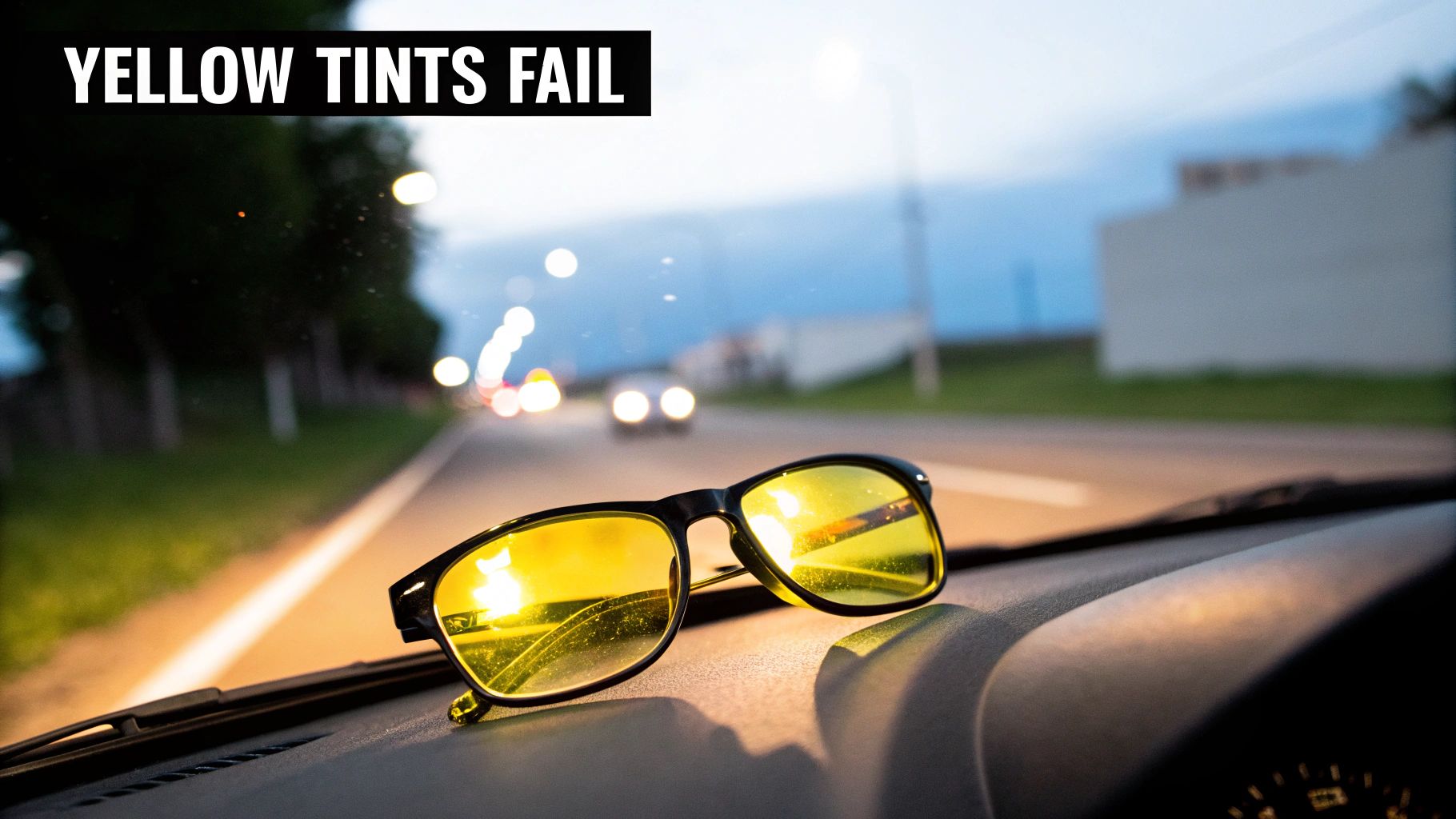
This image shows the exact scenario where these glasses are meant to shine, but in reality, they steal the light your eyes desperately need to navigate safely. For anyone serious about improving their night driving safety, skipping any kind of tint is the first step. If you want to dive deeper into the science, you can learn more about why yellow lenses are not the answer in our detailed article.
What the Science Says
Don't just take our word for it—this has been tested time and time again. Researchers at Harvard's Schepens Eye Research Institute ran a study using simulated night-driving scenarios. Participants wore either yellow-tinted glasses or clear lenses, and the results left no room for doubt.
The study found that the yellow glasses did not improve pedestrian detection at all. Worse, they did nothing to reduce the negative effects of headlight glare.
The researchers' own conclusion was that their findings "do not appear to support having eye care professionals advise patients to use yellow-lens night-driving glasses."
The takeaway is clear and simple: yellow-tinted glasses are a gimmick, not a safety tool. A real solution doesn't involve subtracting light with a tint but rather optimising the light that’s already there. That’s why we focus on proven lens technologies that genuinely improve clarity and reduce glare without compromising your vision when you need it most.
The Real Solution Is in the Lens Technology
Now that we’ve put the myth of yellow-tinted glasses to rest, let’s focus on what actually works to give you a safer, clearer view of the road at night. The real fix isn't about adding colour or blocking light—it's about maximising the quality of the light that reaches your eyes. The proven hero for night drivers is a sophisticated piece of optical science called an anti-reflective (AR) coating.
Think of it like the special coating on a high-quality camera lens. A photographer’s biggest headache is lens flare, that distracting burst of light that can completely ruin a shot. AR coatings on camera lenses are engineered to wipe out that flare, making sure the final photo is sharp, vibrant, and crystal-clear.
An AR coating on your driving glasses does the exact same thing. It’s an ultra-thin, multi-layered treatment precisely engineered to manage light as it passes through your lenses.
How Anti-Reflective Coatings Enhance Your Vision
Without an AR coating, a standard spectacle lens reflects a surprising amount of light—sometimes up to 10% or more. At night, this scattered light shows up as dangerous glare from oncoming headlights, streetlights, and even the lights on your own dashboard. This visual "noise" forces you to squint and strain, cutting down your focus and slowing your reaction time.
AR coatings work by simply cancelling out these reflections.
By minimising reflections, a high-quality AR coating allows up to 99.5% of available light to pass directly through the lens and reach your eye. This translates into a sharper, brighter, and much more comfortable visual experience.
The safety benefits are immediate and obvious. With more light reaching your retina and less glare getting in the way, you can react faster to hazards on the road. Road signs become easier to read from further away, and you'll notice significantly less eye strain, even on long drives after dark.
Here’s a practical example: Imagine you're on a two-lane road and a big truck with blazing LED headlights is coming towards you. Without an AR coating, the light scatters across your lenses, creating a blinding "starburst" that obscures your view. With an AR coating, that glare is dramatically cut down, letting you keep a clear line of sight on your lane and the edge of the road.
What About Modern LED Headlights?
The challenge of night driving has definitely evolved with car technology. Modern LED and HID headlights are incredibly bright and pump out a high concentration of high-energy visible (HEV), or blue, light. This type of light is notorious for scattering, which is why it often looks like a harsh, piercing glare.
This is where another layer of lens tech comes in handy. While tinted blue light blockers are a definite no-go for night driving, modern clear blue light filters are a completely different story. These advanced filters are designed to be virtually transparent, so they don’t reduce the total amount of light reaching your eye.
Instead, they selectively filter the specific, harsh wavelengths of blue-violet light common in LED headlights. When you combine a clear blue light filter with a premium AR coating, you get a powerful one-two punch against nighttime glare. To learn more about lens treatments that adapt to different light conditions, check out our guide comparing photochromic lenses vs Transitions.
Ultimately, it all comes down to your eye health and safety. The right lens technology doesn't just make driving more comfortable; it makes it fundamentally safer by improving clarity and reducing visual fatigue. At Prescript Glasses, we can customize an eyewear package to suit your requirements, combining your precise prescription with these essential coatings to create the ultimate glasses for driving at night.
Finding Your Perfect Night Driving Glasses
So, how do you turn all this lens science into a pair of glasses that actually works for you? It's all about understanding what you need. Picking the right glasses for driving at night is a straightforward process when you focus on the three core things that genuinely impact your safety and vision on the road.
First things first, and this is the absolute non-negotiable: you need an up-to-date prescription. Even tiny, uncorrected vision problems like slight astigmatism or mild nearsightedness get amplified in the dark. These issues are often the real culprits behind the starbursts and halos you’re trying to get rid of, so getting your prescription checked is the single most important step you can take.
Next up, let's talk frames. Your peripheral vision is your early warning system for hazards sneaking up from the side. A frame with thin arms and a wide field of view keeps your awareness maxed out. On the flip side, thick, chunky frames can create dangerous blind spots. When it comes to night driving, visibility and safety should always be the deciding factors in your frame choice.
Choosing the Right Lens Package
With your prescription sorted and a good frame picked out, the final piece of the puzzle is the lens technology. This is where we can put together a package that directly tackles the challenges you face on the road after dark.
To keep it simple, here’s a quick guide to help you decide, based on the biggest complaint most night drivers have: glare.
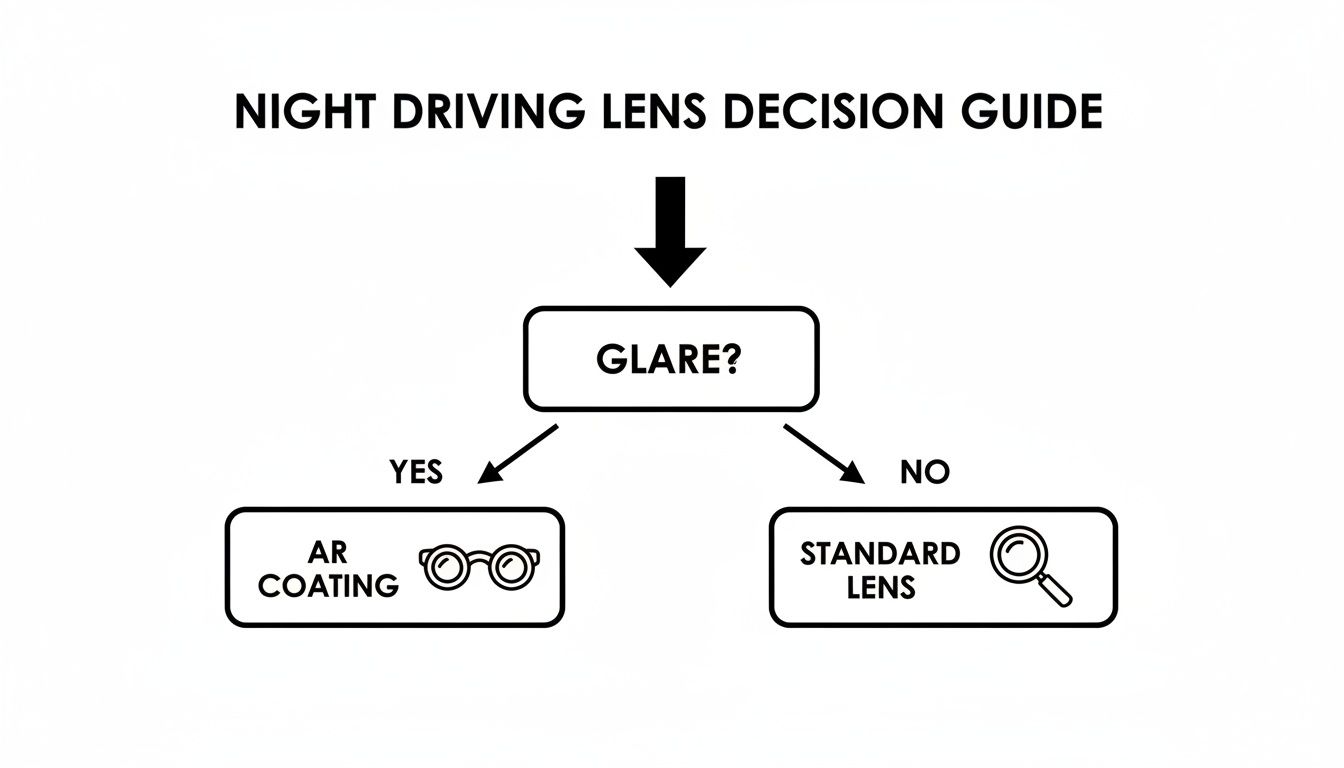
As you can see, it boils down to a simple but crucial point: if glare from oncoming headlights is your main frustration, an anti-reflective coating isn't just a nice-to-have—it's the essential tool for safer, clearer vision at night.
Comparing Lens Options for Night Driving
To give you a clearer picture, this table breaks down how different lens choices stack up against the common struggles of night driving. It's designed to compare different lens types and coatings based on how well they address these challenges, helping you make the safest choice.
| Lens or Coating | Reduces Headlight Glare | Improves Visual Clarity | Best Suited For |
|---|---|---|---|
| Standard Clear Lens | Low | Moderate | Drivers who need prescription correction but don't have significant issues with glare. |
| Clear Blue Light Filter | Moderate | Good | Drivers who are especially sensitive to the sharp, piercing light from modern LED headlights. |
| Anti-Reflective (AR) Coating | High | Excellent | All night drivers. This is the single most effective treatment for cutting glare and letting the maximum amount of good light through. |
This comparison really highlights why a combination of the right prescription with an AR coating is the gold standard for most drivers.
Practical Examples of Customised Packages
Seeing how these elements work together in the real world makes it all click. Here are a couple of common scenarios and the ideal glasses we'd build for them.
-
Example 1: The Glare-Sensitive Commuter
Sarah drives home on a busy motorway every evening and finds the relentless glare from LED headlights draining. Her perfect package would start with a lightweight, wide-view frame fitted with her exact prescription. For her lenses, we'd absolutely recommend a premium AR coating combined with a clear blue light filter. This duo is specifically designed to target and neutralise that harsh, fatiguing glare she deals with daily. -
Example 2: The Rural Driver
Mark lives out in the country, where the roads are long and unlit. His main challenge isn't a constant stream of traffic, but making sure he can spot wildlife or other hazards from a distance. For Mark, the priority is getting as much light to his eyes as possible. His ideal glasses would feature his up-to-date prescription in lenses with a top-quality AR coating. This ensures that nearly 100% of the available light reaches his eyes, giving him the crispest, sharpest vision possible in the dark.
Your safety is what matters most. Getting the right combination—an accurate prescription, a suitable frame, and proven lens tech like an AR coating—isn't just about being more comfortable. It’s about giving yourself the clear vision you need to react confidently to whatever the road throws at you after sunset.
At the end of the day, the best glasses for night driving are the ones built just for your eyes and your driving environment. By focusing on these core components, you can skip the gimmicks and invest in a genuine tool for safety. You can learn more about how these coatings work in our detailed guide on anti-glare glasses for night driving.
Right, you're ready to dial in your night driving vision. Ordering a custom pair of glasses to make those dark roads clearer and safer isn't complicated. Let's walk through how to get it done, making sure every choice puts your eye health and safety first.
It all starts with picking the right frame. You'll want a design that gives you a wide, unobstructed field of view. Think thin temple arms and a larger lens area—these are almost always the best bet for driving, as they keep your peripheral vision wide open.
Building Your Perfect Lens Package
Once you've found a frame you love, it's time to build your lens package. This is where you put all the pieces together to create a pair of glasses that actually works for night driving. The absolute must-have here is an anti-reflective (AR) coating. It's the key to slashing that blinding glare from headlights and streetlights.
Here’s a simple way to think through your options:
- Start with Your Prescription: This is your foundation. A current, accurate prescription from your optometrist is the first step in reducing eye strain and seeing clearly.
- Add the Essential AR Coating: Make sure you select the anti-reflective coating. Seriously, if headlight glare is your enemy, this is non-negotiable.
- Consider a Clear Blue Light Filter: If you're particularly sensitive to those sharp, piercing LED headlights, adding a clear blue light filter can give you another layer of comfort without darkening your vision.
The goal isn't to tint or darken your view; it's to make it sharper and cleaner. By starting with a clear lens and adding an AR coating, you're letting the maximum amount of good, useful light reach your eyes.
Submitting Your Prescription with Confidence
Frame picked, lenses sorted. Now it's time to plug in your prescription details. We've made this part easy, whether you're here in Australia or ordering from overseas.
You’ll need a valid prescription from a qualified eye health professional. If your script has expired, it's really important to book an eye check-up. Your vision changes, and driving with an outdated prescription can be risky. An eye exam doesn't just update your numbers; it’s a check-up for your overall eye health.
During the checkout process, you'll enter your prescription details, including a crucial measurement called Pupillary Distance (PD). It's just the distance in millimetres between the centre of your pupils, and it's what allows us to align the lenses perfectly for your eyes. If the PD isn't on your script, just ask your optometrist—they can measure it for you in a snap.
We know every driver is different. That's why we can customise an eyewear package to suit your requirements. From the frame style right down to the lens treatments, our mission is to build the perfect pair of glasses to help you feel safer and more confident on the road after dark.
More Than Glasses: Essential Tips for Safer Night Driving
Your specialised night driving glasses are a powerful tool, but they're not a silver bullet. True safety after dark comes from combining the right gear with smart driving habits.
Think of your new eyewear as the final, crucial piece of a larger safety puzzle. These practical tips are designed to work with your glasses, reducing the overall visual stress you feel and building your confidence behind the wheel.
Prepare Your Vehicle for Clear Vision
Your eye health and safety don't stop with your lenses. In fact, how well you can see at night has a lot to do with the condition of your car.
Before you even turn the key, a few simple checks can make a huge difference in cutting down glare. Start with your glass surfaces—inside and out. A clean windscreen, spotless windows, and clear mirrors are non-negotiable. They prevent light from scattering across dirt and smudges, which is what creates that distracting haze and those annoying starbursts around lights.
Beyond the basics, here are a few easy but effective adjustments:
- Aim Your Headlights Correctly: If your headlights are misaligned, they might point too low, shortening your view of the road, or too high, blinding oncoming drivers. A quick check at your local garage ensures your lights are doing their job properly without creating a hazard for others.
- Clean Your Headlight Lenses: Headlight covers can get cloudy and yellowed over time, which can reduce their brightness by a surprising amount. A simple cleaning kit can make them look—and perform—like new again.
- Dim Your Dashboard Lights: A brightly lit dashboard creates internal glare that reflects off both your windscreen and your glasses. Turning the display down to the lowest comfortable level helps your eyes stay adjusted to the darkness outside the car.
Master Defensive Driving Techniques for Nighttime
Adjusting how you drive is just as important as prepping your car. When a vehicle with intensely bright headlights is coming your way, the natural instinct is to squint or look right at them. Don't.
A proven technique is to shift your gaze slightly down and to the right, focusing on the white line that marks the edge of your lane. This lets you safely maintain your road position while using your peripheral vision to track the other car until it passes.
Modern cars also have features that can help. Technologies like auto dimming mirrors to instantly reduce headlight glare are fantastic for taking the sting out of the lights from vehicles behind you.
The demand for better night vision solutions is clearly growing. The global night driving glasses market was valued at USD 4.2 billion in 2023 and is projected to hit USD 8.1 billion by 2032. This tells us just how many drivers are looking for help. While many turn to ineffective gimmicks, we can customise an eyewear package with proven anti-reflective coatings that truly address these real-world vision challenges.
Common Questions About Glasses for Driving at Night
When it comes to something as important as your safety on the road, it's natural to have questions. Let's tackle some of the most common queries about night driving glasses and give you the straightforward, expert answers you need to make a confident choice.
We want to make sure you have all the facts, cutting through the marketing hype to get to what really works.
Are Yellow Tinted Glasses Good for Night Driving?
Absolutely not. While they're often sold with the promise of boosting contrast, the science is clear: yellow tints are not safe or effective for driving at night.
The core problem is simple. The tint, by its very nature, cuts down on the total amount of light that reaches your eye. When you're driving in the dark, your eyes need every last bit of available light to see clearly. Reducing that light is not just unhelpful—it can be dangerous. For genuine safety, clear lenses with a quality anti-reflective coating are the only proven choice.
Can I Use My Blue Light Blocking Glasses at Night?
This is a classic "it depends" situation, and it all comes down to the type of blue light filter you have. If your glasses have a very noticeable yellow or amber tint, they fall into the same trap as the yellow-tinted glasses mentioned above—they block too much light to be safe for night driving.
However, if you've got glasses with a modern, high-quality blue light filter that appears virtually clear to the naked eye, you're in luck. When you pair that subtle filter with an essential anti-reflective (AR) coating, you get a powerful combination that's excellent at cutting the harsh, distracting glare from modern LED headlights without dimming your overall vision.
Do I Need a Different Prescription for Night Driving?
You don't need a special type of prescription just for night driving, but what you absolutely must have is one that's accurate and up-to-date.
Vision issues that you might barely notice during the day—like a touch of astigmatism or slight nearsightedness—get amplified in the dark. These minor refractive errors are often the real culprits behind the starbursts, halos, and fuzzy glows around lights that can make night driving so stressful.
The safest and most effective solution is always your correct, current prescription. When that's put into lenses treated with a premium AR coating, you're directly solving both your vision needs and the challenge of nighttime glare.
What Is the Most Important Feature to Look For?
If you take only one thing away from this guide, let it be this: the single most crucial feature for any pair of night driving glasses is a high-quality anti-reflective (AR) coating. This isn't just a nice-to-have; it's the core technology that makes the biggest difference.
An AR coating works by eliminating the distracting reflections and glare that bounce off your lenses from headlights, streetlights, and traffic signals. By letting more of the "good" light pass cleanly through to your eyes, it delivers a crisper, clearer view of the road and drastically improves your visual comfort. It's the foundation of any effective pair of glasses for driving after dark.
At Prescript Glasses, your clarity and safety on the road are what matter most. We know that every driver's vision is unique, which is why we can customise an eyewear package to suit your requirements. Take a look at our range of frames and lens options today to build the perfect glasses for confident, clear night driving.
Find your perfect night driving glasses at PrescriptGlasses.com