A Driver's Guide to Anti Glare Glasses for Night Driving

Anti-glare glasses for night driving do their magic with a special coating that cuts down on the distracting reflections and halos you see from oncoming headlights and streetlights. The result is sharper, clearer vision and a whole lot less eye strain, which can make your after-dark journeys significantly safer. It's all about maximising the good light that helps you see, while shutting down the disruptive glare that gets in the way.
Seeing Clearly and Safely After Dark
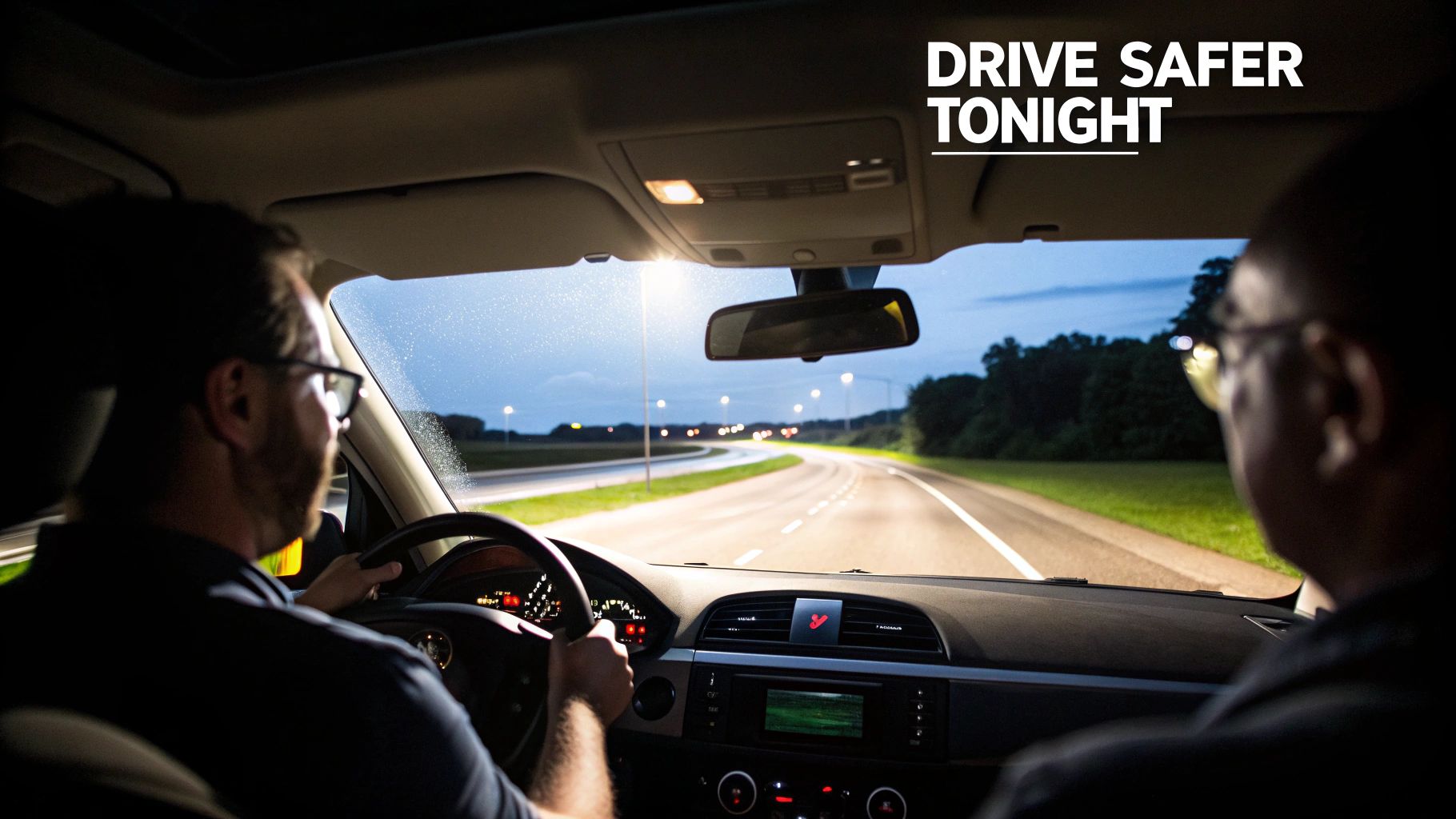
Driving after sunset throws a unique set of challenges at you. The world just looks different in low light—colours fade, judging distances becomes tricky, and the sudden blast from a pair of high beams can be temporarily blinding. This isn't just about feeling comfortable behind the wheel; it’s a serious issue of eye health and safety.
The statistics for Australian drivers paint a pretty stark picture. Fatal accidents are a staggering three times more likely to happen at night. For younger drivers, the risk is even more pronounced; P-platers aged 16-17 are involved in seven times more crashes after dark. It's clear that the hidden dangers of night driving are very real.
The Problem with Glare
Picture this: you're on a dark, winding road. A car approaches, and its modern LED headlights explode into a brilliant, starburst-like glare. Your view is obscured, you're forced to squint, and for a split second, you lose focus on the road ahead. We’ve all been there. This moment of temporary blindness is a major safety risk.
This happens because light scatters as it hits standard eyeglass lenses, creating a kind of visual noise that your brain has to work overtime to filter out.
This constant visual disruption leads to a few key problems for your eye health and safety:
- Reduced Contrast Sensitivity: It becomes much harder to distinguish objects from their background. For example, you might struggle to spot a pedestrian in dark clothing stepping off a shadowy kerb until it's too late.
- Slower Reaction Times: When glare compromises your vision, your ability to react to sudden hazards—like a kangaroo jumping onto the road—is dangerously delayed.
- Increased Eye Strain and Fatigue: Continuously battling glare can lead to headaches, tired eyes, and general fatigue—the last thing you want on a long drive, as it directly impacts your concentration and safety.
The Anti-Glare Solution
This is where anti-glare glasses for night driving make a world of difference. These lenses are treated with a special anti-reflective (AR) coating designed to manage incoming light much more effectively. Instead of letting light bounce off the lens surface, the coating allows more of it to pass straight through to your eye.
The real-world result is a dramatic cutback on those distracting halos around streetlights and the blinding starbursts from oncoming headlights. You see the light source itself, not the fuzzy, overwhelming glare that surrounds it.
By sharpening your vision and easing the strain on your eyes, anti-glare glasses add a crucial layer of safety to your night-time drives. While they are an incredibly powerful tool, it’s always smart to combine them with other essential night driving tips for total peace of mind after dark.
Ultimately, our goal is to help you find the solution that fits you perfectly. We can customise an eyewear package to suit your requirements and keep you seeing clearly and safely on the road, no matter the time of day.
How Do Anti-Reflective Coatings Actually Work?
To get a handle on how anti-glare glasses for night driving work, let's start with a simple, practical example. Picture a standard window on a bright, sunny day. You can see through it just fine, but you also get that distracting reflection of yourself and everything behind you. Now, think about the special glass used for a high-end museum display—it's so incredibly clear it almost seems like it’s not even there.
That "invisible" effect is precisely what an anti-reflective (AR) coating brings to your glasses. It essentially transforms a lens from a surface that bounces light away and lets it pass through, into one that is almost entirely focused on transmission. This is a critical factor for eye health and safety when driving in low light.
A standard, uncoated lens can lose up to 8-10% of the available light because of reflections bouncing off both the front and back surfaces. This reflected light is the culprit behind the starbursts and halos you see from oncoming headlights. It's just visual noise that gets in the way, forcing your eyes to work overtime to see what's really on the road ahead.
The Science of Cancelling Out Light Waves
The real magic behind an AR coating comes down to a process called thin-film interference. It sounds complicated, but the goal is surprisingly simple. During the manufacturing process, a series of microscopic layers of metallic oxides are bonded to the lens inside a vacuum-sealed chamber. Each of these layers is measured with incredible precision to be a specific thickness.
When a light wave from a headlight smacks into the coated lens, some of it reflects off the very top layer of the coating. The rest of it passes through, reflecting off the layers underneath and the lens surface itself.
And this is where things get really clever:
- The layers are engineered so that the reflected light waves are knocked completely out of phase with each other.
- This mismatch causes them to cancel each other out, almost like how noise-cancelling headphones use an opposing sound wave to create silence.
- By neutralising all these distracting reflections, the coating lets over 99% of the available light pass cleanly through the lens to reach your eye.
For you, the driver, this is the difference between seeing a fuzzy, overwhelming blob of light and seeing the two distinct, clear headlights of an approaching car. It brings back clarity and cuts down on the visual stress that makes night driving so draining.
What This Means for You on the Road
This technology translates directly into a better, safer drive. When more light is getting to your eyes and there's far less visual static to deal with, you'll notice an immediate difference. For instance, you'll find you can read road signs more clearly from further away or spot a cyclist on the edge of the road that much sooner. This enhanced clarity is fundamental to your eye health and safety on the road.
At the end of the day, the right eyewear is a critical piece of safety equipment. That's why we're so focused on providing high-quality solutions—because when you're behind the wheel, clear vision isn't just a luxury, it's non-negotiable. If you're ready to experience a safer drive, we can customise an eyewear package to suit your requirements, making sure your lenses are a perfect match for your vision needs.
Debunking the Myth of Yellow Night Driving Glasses
It's one of the most stubborn—and dangerous—myths in eyewear: the idea that yellow-tinted glasses are the secret to safer night driving. They're often sold as a fix for headlight glare, but the real story is far more concerning. This is a classic case of a product feeling like it's helping while actually making a critical situation worse, posing a direct threat to your eye health and safety.
The whole problem boils down to a simple principle of light. To see clearly in the dark, your eyes need every last bit of light they can get. Yellow lenses work by filtering out specific wavelengths, particularly blue light, which is why they can make things look a bit sharper on a foggy day. But at night, that filtering effect is a major liability because it reduces the total amount of light reaching your retinas.
Why Less Light Is a Major Problem
Here's a practical example: you're driving down a quiet suburban street at night. A cyclist in dark clothing is just ahead. Your ability to spot them in time depends entirely on maximising the faint light from streetlamps and your own headlights. By slapping a yellow filter in front of your eyes, you're essentially dimming the entire scene, which could be the difference between seeing that cyclist and not seeing them at all. This reduction in visibility is a serious safety compromise.
This isn't just a theory; it's backed by solid research. A key study from Harvard's Schepens Eye Research Institute investigated this exact scenario. Researchers discovered that yellow-lens glasses did absolutely nothing to improve the most crucial task for night driving—detecting pedestrians. In fact, their findings suggested that wearing them could even slightly worsen performance. That’s a terrifying outcome for any driver.
The right way to fight glare is by letting more light in, not less.
This diagram shows how a proper anti-reflective coating cuts through distracting glare, allowing clean, crisp light to pass through for clear vision. Tinted lenses just block the light you desperately need.
The Superior Alternative: Clear Anti-Glare Lenses
This is where understanding the difference between a tinted lens and a coated lens becomes essential for your safety. Genuine anti-glare glasses for night driving don't use a tint at all. Instead, they feature clear lenses treated with a high-tech anti-reflective (AR) coating.
Unlike yellow tints that subtract light, an AR coating is engineered to maximise it. It allows over 99% of available light to pass straight through the lens to your eye, while simultaneously cancelling out the distracting reflections that create glare.
This technology delivers the best of both worlds, giving you exactly what you need on the road at night:
- Maximum Light Transmission: This ensures you see as clearly and brightly as possible in low-light conditions.
- Glare Reduction: It neutralises the blinding starbursts and halos from oncoming headlights and streetlights.
If you want to go deeper into the science, you can learn more about the effectiveness of yellow lenses in our detailed article. At the end of the day, choosing the right eyewear is a serious safety decision. We can customise an eyewear package to suit your requirements, ensuring you get the proven benefits of a top-quality AR coating without compromising on vision when it matters most.
Choosing the Right Lenses for Your Driving Needs
Picking the perfect lenses isn't about finding a single 'best' option for everyone. It's about matching the right lens technology to your unique lifestyle and driving habits. Getting this right is crucial for your comfort, your eye health, and ultimately, your safety on the road.
When it comes to driving after dark, there’s one combination that stands out as the undisputed gold standard: a pair of clear lenses with a premium anti-reflective (AR) coating. This is the most effective and scientifically-backed choice. These lenses are designed to do one thing brilliantly—let the maximum amount of good light reach your eyes while stamping out the dangerous, distracting glare from oncoming headlights and streetlights.
For many drivers, this is all they need. A practical example is the daily commuter who drives to work in the morning and heads home after sunset. They need vision that's crisp and clear, with no colour distortion. An AR coating tackles the biggest challenge of night driving head-on, making it the perfect, straightforward solution.
Beyond the Standard Clear Lens
But what if your day involves more than just driving? Your job, your hobbies, and the amount of time you spend looking at screens all place different demands on your eyes. Your glasses should be able to keep up.
Let's imagine a practical example: a professional who spends eight hours staring at a computer screen before getting in the car to drive home. The eye strain from a full day of screen glare combined with road glare can be exhausting and detrimental to their long-term eye health.
-
For the Office Worker: A pair of BlueRay lenses with an AR coating is a fantastic solution. These lenses are designed to filter a portion of the high-energy blue light from digital screens, helping reduce digital eye strain and fatigue throughout the workday. When it’s time to drive home, the AR coating kicks in to handle headlight glare.
-
For the All-Day Wearer: If you wear your glasses from the moment you wake up until you go to bed, Photochromic lenses (often called transitions) with an AR coating offer incredible convenience. They darken automatically in the sun and turn completely clear indoors or at night. The AR coating ensures that once they're clear, they perform perfectly for night driving.
Customising Your Eyewear Package
Your glasses should work for your entire day, not just the drive home. The trick is to understand that different lens technologies can be combined to create a single, powerful solution that supports your vision in every situation.
We believe in creating personalised eyewear because no two people have the same visual needs. We can customise an eyewear package to suit your requirements, whether you need single-vision lenses, progressives, or specific coatings. Our goal is to build the perfect pair of anti glare glasses for night driving that fits seamlessly into your life.
To help you find the best lens type for your driving habits and lifestyle, we've put together a simple comparison table.
Comparing Lens Options for Drivers
Use this table to find the best lens type for your specific driving habits, screen time, and lifestyle needs.
| Lens Type | Primary Benefit | Best for Night Driving? | Ideal User Example |
|---|---|---|---|
| Clear with AR Coating | Maximum glare reduction and light transmission | Yes, the top choice | Any driver wanting the clearest possible vision after dark. |
| BlueRay with AR Coating | Reduces digital eye strain and road glare | Yes, excellent choice | Professionals who spend long hours on computers before driving. |
| Photochromic with AR | All-in-one convenience for indoor/outdoor use | Yes, when fully clear | People who wear one pair of glasses for all activities. |
Exploring the different types of lenses for eyeglasses can give you even more insight into creating your ideal pair.
Ultimately, the right choice is the one that keeps your eyes comfortable and your vision sharp, ensuring you feel safe and confident every time you get behind the wheel.
Why Your Prescription Is the Foundation of Night Driving Safety
Your eyesight isn't static; it shifts and changes, especially as daylight fades. This is why having an accurate, up-to-date prescription isn't just a good idea—it's a non-negotiable part of staying safe behind the wheel after dark. Think of it as the foundation: you can't build effective anti-glare glasses on a weak or incorrect base. Prioritising this is fundamental to your eye health and safety.
Even tiny, uncorrected vision problems can become major hazards at night. For example, a slight astigmatism you barely notice during the day can transform oncoming headlights into dramatic, distracting starbursts and halos. This visual noise forces you to squint and strain, pulling your focus away from what really matters: the road ahead.
A precisely crafted prescription, paired with a high-quality anti-reflective coating, is designed to tackle these distortions right at the source. It works by making sure the light reaching your eyes is focused, sharp, and clean, letting you see the road clearly, not just the bright lights on it.
How Your Pupils Affect Night Vision
A huge piece of the night vision puzzle is your eye's natural reaction to darkness. In low light, your pupils get bigger (dilate) to let in as much light as possible. While this is a clever survival mechanism, it can also magnify any existing vision errors, making it even harder to see clearly. This physiological change underscores the need for lenses optimised for your specific eye health needs in the dark.
This is where modern lens technology really shines. Australian eye care professionals are increasingly recommending specialised coatings for drivers, understanding that our eyes need a different kind of correction when our pupils are wide open in dim light. The custom lenses made with this tech are engineered for sharper vision and better colour and contrast, specifically for these low-light conditions. You can learn more about how ZEISS lenses are optimised for driving.
The bottom line is simple: an off-the-shelf pair of glasses just can't account for how your individual eyes work in the dark. A custom prescription ensures your vision correction is actually effective when you’re driving at night.
Getting the perfect pair is a straightforward process. When you provide a valid prescription from your optometrist, you're guaranteeing your new lenses are made to your exact visual needs. Understanding your script can also help you make smarter choices for your eyewear, which is why we've put together a guide to understanding your eye prescription.
Our goal is your complete visual wellness. Because every driver’s eyes are unique, we can customise an eyewear package to suit your requirements, making sure your glasses deliver true high-performance vision when it counts the most.
Protecting Your Investment in Clear Vision
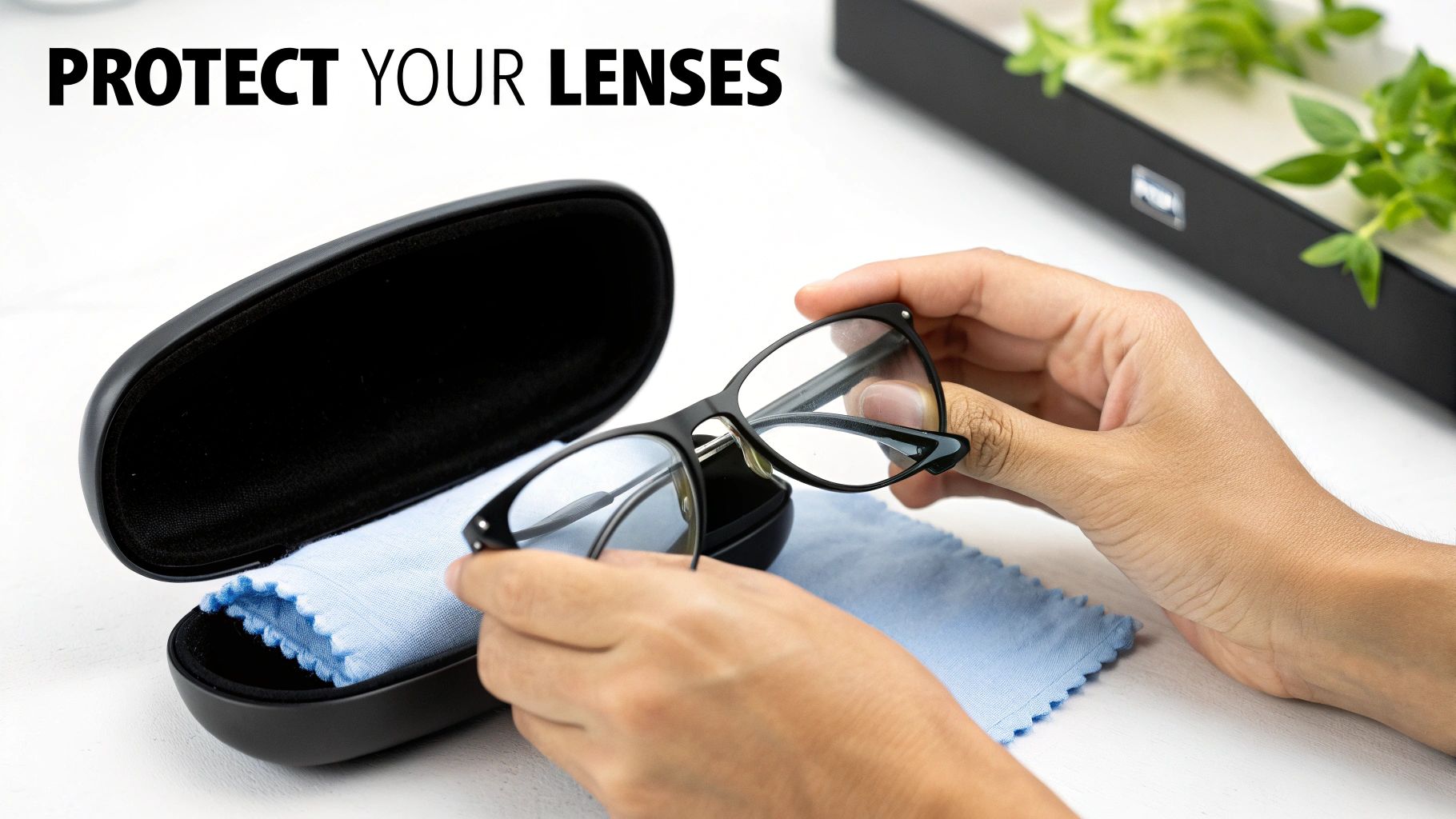
Your anti glare glasses for night driving aren’t just another pair of specs; they're a crucial piece of safety equipment. To keep them performing at their best for years to come, proper care is non-negotiable. It’s all about protecting the delicate anti-reflective (AR) coating that does the heavy lifting, which is a key part of maintaining your long-term eye health and safety.
A lot of us are guilty of cleaning our lenses with whatever’s handy—the corner of a t-shirt, a paper towel, or a tissue. It might seem harmless, but these materials are surprisingly rough. As a practical example, using a paper towel, which contains coarse wood fibres, can create tiny micro-scratches on the AR coating, slowly chipping away at its ability to cut through glare. Over time, that damage adds up and can seriously compromise your vision on the road.
The Right Way to Clean Your Lenses
Keeping your glasses crystal clear is actually pretty simple once you know the right technique. Following these steps will protect that all-important AR coating and give you a perfect view every single time.
- Rinse First: Always start by running your lenses under a bit of lukewarm tap water. This washes away any loose dust or grit that could scratch the surface when you start wiping.
- Use a Gentle Soap: Add just one tiny drop of lotion-free dish soap to each lens.
- Lather and Rinse Again: Using your fingertips, gently rub the soap across both sides of the lenses and then rinse them off thoroughly.
- Dry with Microfibre: Carefully dry the lenses and the frame with a clean, soft microfibre cloth made specifically for glasses.
Here's a practical tip that makes all the difference: proper storage. When you're not wearing your glasses, always put them away in a hard-shell case. Tossing them onto the car dashboard or into a bag is a recipe for scratches and damage.
Taking these simple steps is a huge part of your long-term eye health and safety, making sure your glasses are always ready to go when you are. At Prescript Glasses, we can customise an eyewear package to suit your requirements, getting you set up with the best vision tools for the road ahead.
Still Have Questions About Night Driving Glasses?
It's completely normal to have a few questions when you're looking into new eyewear. To make sure you feel totally confident and in the loop, we’ve tackled some of the most common queries we get about anti glare glasses for night driving.
Can I Get Them Without a Prescription?
Absolutely. You don’t need a prescription to benefit from these glasses. Many drivers with perfect 20/20 vision still find themselves squinting against oncoming headlights.
You can easily get non-prescription lenses, often called "plano" lenses, fitted with a high-quality anti-reflective (AR) coating. Think of it as tackling a specific problem—even if your vision is sharp, the AR coating is there purely to cut down those distracting reflections, making your drive more comfortable and boosting your eye health and safety.
Are All Anti-Reflective Coatings Created Equal?
Not at all. There’s a world of difference between a standard coating and a premium one. While any AR coating is certainly better than nothing, the premium versions really step up the performance.
Premium coatings are far more effective at killing glare, they’re built tougher with better scratch-resistant layers, and they often come with hydrophobic and oleophobic properties. That’s just a fancy way of saying they repel water and oil, which makes them a breeze to keep clean. For example, driving in the rain, water droplets will bead up and roll off a premium coated lens much more easily, maintaining clear vision. For something as critical as your driving glasses, that extra investment in quality is always a smart move for your safety.
The key thing to remember is this: no coating can eliminate 100% of reflected light, but a premium AR treatment makes a huge, immediately noticeable difference. It dramatically dials down the intensity of halos and starbursts, giving you much clearer and more comfortable vision.
So, How Do I Choose the Right Pair for Me?
The best way is to tailor them specifically to you. Start with an up-to-date prescription from your optometrist to make sure your vision correction is spot-on. From there, have a think about your daily routine. This will help you decide on the right lens type, whether that's clear, BlueRay, or photochromic lenses.
We know every driver is different. That's why we can customise an eyewear package to suit your requirements, making sure your glasses give you the best possible safety and clarity for your specific lifestyle.
Ready to see the road in a whole new light after dark? At Prescript Glasses, we bring together your exact prescription and the latest in lens technology to create the perfect eyewear for you. Have a look at our options and build your custom pair today at https://www.prescriptglasses.com.