Glasses for oval face: Find the Perfect Pair in Australia

If you have an oval face, you’ve hit the eyewear jackpot. Seriously. This versatile face shape works with a huge variety of styles, so finding the perfect glasses is less about strict rules and more about personal taste. The key is to choose frames that complement your natural balance rather than disrupt it.
Think of frames with strong angles, like rectangular, square, and browline styles. They're fantastic choices because they add a bit of definition to your softer features, creating a look that’s instantly flattering. For example, a sharp, rectangular frame can add a professional, structured look to your features, making it ideal for the office.
Your Guide to the Best Frames for an Oval Face
So, you're ready to find the perfect pair of glasses for your oval face? Great! We know the sheer number of options can feel a bit much, so we’ve put together this guide to make it simple. We’ll start with what makes an oval face so adaptable in the first place—it's all about those beautifully balanced proportions, from your high cheekbones to that gently curved jawline.
Our mission is to help you find glasses that don't just correct your vision but also feel like a true expression of you. Consider this your personal cheatsheet for a confident shopping trip, ensuring your new specs highlight all your best features. The right pair should feel like they were made just for you.
Why Proportion Matters Most
While everyone talks about frame shape, the real secret to nailing the look is proportion. It’s all about scale. Your frames should be about as wide as the broadest part of your face, which is usually right across your cheekbones. This simple guideline keeps everything in harmony and prevents your glasses from looking either too small or too big.
For example, if you have a more petite oval face, a huge, chunky square frame might overwhelm your features. A sleeker rectangular style or a classic Wayfarer would probably feel more balanced. On the flip side, if you have a larger oval face, you can totally pull off those bolder, more statement-making frames without a second thought.
Choosing eyewear is all about creating harmony. The right frames should complement your facial structure, not compete with it. It’s that perfect mix of art and science that delivers both comfort and confidence.
Style Is Great, but Don't Forget Eye Health and Safety
Let's be real: looking good in your new glasses is a priority, but their main job is to help you see clearly and protect your eyes. A pair that doesn't fit right can be a real pain—literally. This is a critical aspect of eye health and safety, as a poor fit can cause headaches, discomfort, and even throw off the effectiveness of your prescription. A proper fit ensures the optical centre of each lens lines up perfectly with your pupils, which is non-negotiable for crisp vision.
And remember, what’s in the frames is just as important as the frames themselves. To keep your eyes safe from everyday strains and hazards, we always recommend adding a few key features to your lenses:
- Blue Light Filtering Lenses: A must-have if you spend hours on a computer or phone. They help cut down on digital eye strain. A practical example is an office worker who no longer experiences afternoon headaches after switching to blue light lenses.
- Photochromic Lenses: These are the ultimate convenience, automatically adjusting from clear indoors to dark outdoors, giving you UV protection on the fly.
- Full UV Protection: Every pair of glasses, clear or tinted, should offer full protection from the sun's damaging rays. It’s like sunscreen for your eyes.
We believe that great eyewear is where perfect fit, personal style, and essential protection meet. We can customize an eye wear package to suit your requirements, so you get the best of all worlds.
To get you started, here’s a quick summary of the best (and not-so-great) frame styles for an oval face.
Frame Styles for an Oval Face At a Glance
This table breaks down the most flattering frame shapes for an oval face to help you narrow down your choices quickly.
| Frame Style | Why It Works (Or Doesn't) | Best For |
|---|---|---|
| Square | Adds sharp angles to contrast soft curves, creating definition. | Making a bold, confident statement. |
| Rectangular | Wider than they are tall, they maintain the natural balance of an oval face. | A classic, professional, or everyday look. |
| Browline | The heavy top bar draws attention upward, highlighting your eyes and brows. | Adding a touch of retro or intellectual flair. |
| Aviator | The classic teardrop shape complements the balanced proportions perfectly. | A cool, timeless, and effortlessly stylish vibe. |
| Oversized | A larger oval face can handle bold, oversized frames without being overwhelmed. | Fashion-forward individuals who love to stand out. |
| Round (Use Caution) | Can sometimes make an oval face appear longer or softer than it is. | Those wanting to soften their look, but proportion is key. |
| Narrow (Avoid) | Frames that are too narrow can make an oval face look unnecessarily long. | Generally not recommended for this face shape. |
Hopefully, this gives you a great starting point. Remember, these are guidelines, not unbreakable rules. The most important thing is that you find a pair of glasses that you love and feel amazing in
How to Confirm You Have an Oval Face Shape
Before you jump into choosing the perfect frames, let's make sure you’re actually shopping for an oval face. It’s a common mistake to guess, and that can lead to picking glasses that just don't feel right. The good news is, figuring this out is simple – all you need is a mirror or your phone's camera.
An oval face is all about gentle balance. The forehead tends to be a touch wider than the softly rounded jawline, and the face itself is longer than it is wide. If you picture an egg held upside down, you're on the right track. Your cheekbones are typically the widest part of your face and sit quite high, giving your features a natural, harmonious flow.
A Simple Step-by-Step Guide
Ready to know for sure? Just follow these quick steps. This little check will give you the confidence that you're looking at frames that are genuinely going to flatter you.
- Pull Your Hair Back: First things first, get your hair out of the way. You need a clear view of your entire facial outline, from hairline to jaw, to get an accurate read.
- Observe Your Proportions: Look straight into the mirror. How do your forehead, cheekbones, and jaw relate to each other? On an oval face, they all blend together smoothly without any harsh angles.
- Check the Length vs. Width: Is your face clearly longer than it is wide? This is one of the biggest clues you have an oval shape. It’s what sets it apart from round or square faces, which are much more symmetrical in length and width.
- Examine Your Jawline: Lastly, take a look at your jaw and chin. An oval face has a soft, curved jawline, not the strong, angular line of a square face or the pointed chin you’d see on a heart-shaped face.
If you’ve ticked all these boxes – a slightly wider forehead, high cheekbones, a longer-than-wide structure, and a rounded jaw – then congratulations, you officially have an oval face shape!
This handy decision tree can help you visualise that first crucial choice: opting for angular frames to add a beautiful contrast to your balanced features.
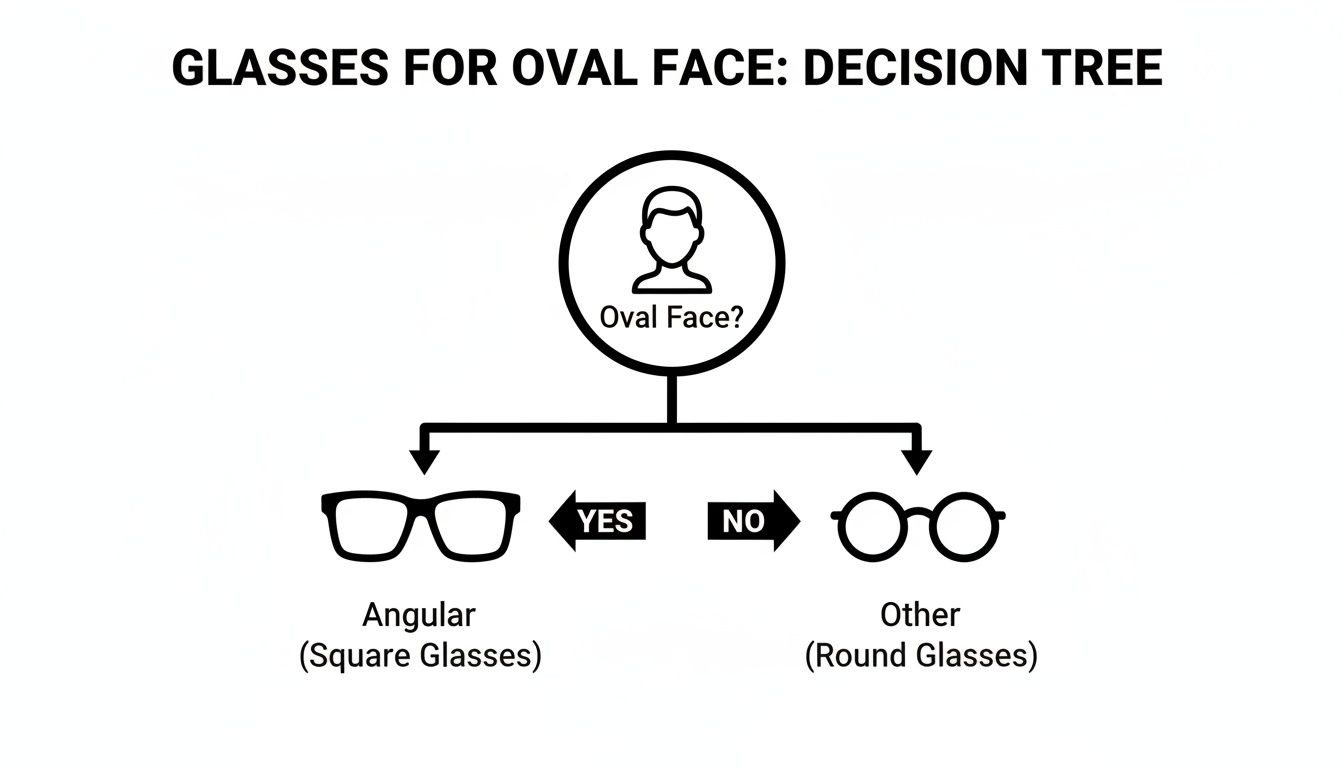
The main takeaway here is that adding structure with angular glasses creates a really pleasing contrast to the soft curves of an oval face, making your natural features pop.
Practical Measurement Tips at Home
If you want to be extra precise, you can grab a flexible tape measure (or even a piece of string and a ruler) and take a few quick measurements.
- Forehead: Measure across the widest part of your forehead, from one side of your hairline to the other.
- Cheekbones: Find the highest point of your cheekbones and measure the distance between them.
- Jawline: Measure from the tip of your chin up to the point just below your ear, then double that number.
- Face Length: Measure from the centre of your hairline straight down to the tip of your chin.
An oval face is typically defined by its length being about 1.5 times greater than its width. Your forehead will also be wider than your jawline, with your cheekbones being the widest point of all.
Knowing these proportions doesn't just confirm your face shape; it's also really important for your eye health and safety. Accurate measurements help us ensure a perfect fit, which is critical for making sure the optical centre of your lenses aligns perfectly with your eyes. This alignment is what gives you crisp, clear vision and prevents eye strain. At Prescript Glasses, we can customize an eye wear package to suit your requirements, using your measurements to craft glasses that are not only stylish but perfectly functional for you.
Exploring Flattering Frame Shapes for Your Face
Now for the fun part: finding the perfect frame shape that really shows off your personal style. Having an oval face is a bit like having a cheat code for eyewear—you can pull off almost any look. Still, some shapes do a much better job of creating balance and definition.
The secret is to choose frames that add complementary angles, creating a subtle contrast with the gentle curves of your face. Think of it like framing a beautiful painting; the right frame enhances the art without stealing the show. For an oval face, angular frames do exactly that, adding structure that makes your features pop.
Why Angular Frames Create Harmony
When it comes to glasses for an oval face, the magic is in the contrast. Your facial structure is naturally defined by soft, rounded lines, so frames with strong, clear angles provide a beautiful counterpoint. This dance between curves and lines results in a look that’s both striking and perfectly harmonious.
Rectangular and square frames are the go-to choices here. Their straight lines and sharp corners slice through the softness of your features, adding definition right where it counts—around your eyes and cheekbones. This contrast stops your face from looking too long or soft, creating a wonderfully balanced aesthetic. A great angular frame doesn't just sit there; it actively works with your face.
This isn’t just a style tip; it’s a major trend backed by the market. Australia's spectacles market hit a value of USD 3,780.3 million in 2024 and is tipped to grow to USD 4,848.6 million by 2030. Glasses for oval faces are the fastest-growing part of this market, with a huge 52% of wearers preferring rectangular and browline styles.
Timeless Classics That Always Work
Beyond basic squares and rectangles, a few iconic styles feel like they were practically designed for oval faces. These classics have stood the test of time for one simple reason: they deliver a perfect blend of style, structure, and balance.
- Wayfarers: This legendary trapezoidal shape has a bold upper rim that adds width to the top half of your face, creating a seriously appealing contrast.
- Browline Glasses: With a strong top frame that follows the natural curve of your eyebrows, this style pulls attention upward, beautifully highlighting your eyes and balancing your facial length.
- Aviators: The subtle teardrop shape of an aviator frame traces your cheekbones perfectly, while the double bar adds a horizontal line that complements the vertical symmetry of an oval face.
Practical Example: Picture a professional aiming for a sophisticated vibe. A pair of sleek, black browline glasses instantly adds an intellectual flair that highlights their eyes in meetings. For a casual weekend, classic tortoiseshell Wayfarers offer a relaxed yet polished look that works perfectly with the balanced proportions of an oval face.
Exploring More Daring Styles
Feeling a bit more adventurous? Your balanced features are the perfect canvas for more expressive, fashion-forward frames. Don't be afraid to experiment with bolder shapes that can bring a unique twist to your look.
Cat-eye frames are a fantastic choice. The upswept corners give your face a little lift and draw attention to your eyes, creating a chic, slightly retro feel. The trick is to find a cat-eye that isn’t overly wide or narrow, keeping everything in proportion. Similarly, geometric shapes like hexagons or octagons can add an artistic, modern edge, giving you those sharp angles that contrast so well with your softer features.
No matter which style you're leaning towards, a proper fit is non-negotiable for both comfort and your eye health and safety. A frame that’s constantly slipping or pinching isn’t just annoying; it can mess with your vision by misaligning the lenses. As you explore these different shapes, you can find more tips in our guide on what glasses suit my face. At Prescript Glasses, we can customize an eye wear package to suit your requirements, making sure your chosen frame not only looks great but also fits perfectly.
Choosing Frame Colours and Materials to Match Your Style
While the right frame shape lays the groundwork, it’s the colour and material that really make your glasses pop. These details are every bit as important as the shape, turning your eyewear from a simple tool into a true reflection of your personal style. The aim is to land on a combination that doesn’t just look good but feels right, working in harmony with your natural features.
Think of it this way: your glasses should elevate your look, not dominate it. A smartly chosen colour can highlight your eyes, flatter your skin tone, and pull an entire outfit together. This is where a little know-how about colour theory makes all the difference when hunting for the best glasses for an oval face.
Matching Colours to Your Skin Tone
First things first, let’s figure out your skin's undertone. This isn’t about how light or dark your skin is, but rather the subtle hue just beneath the surface. Most of us fall into one of three camps: cool, warm, or neutral.
Here’s a quick trick: take a look at the veins on the inside of your wrist under natural light. If they look mostly blue, you’ve likely got cool undertones. If they appear more greenish, you’re probably in the warm camp. Seeing a mix of both? That points to a neutral undertone.
- For Cool Undertones: You'll look amazing in frames with shades like silver, black, blue, grey, and rich jewel tones such as emerald or sapphire. These colours beautifully complement the pink or blue hues in your skin. A sharp, silver metal frame, for example, can add a crisp, modern feel.
- For Warm Undertones: Earthy, rich colours are your go-to. Think gold, tortoiseshell, brown, olive green, and warm reds. A classic tortoiseshell frame, for instance, adds a gorgeous warmth and depth to your complexion.
- For Neutral Undertones: You've hit the jackpot! You have the most flexibility here. Both warm and cool palettes tend to suit you, opening up a massive range of options to experiment with.
If you want to go a step further and really nail your personal palette, it’s worth taking a moment to determine what colors look good on you. This helps you build a colour story that works for your entire wardrobe, glasses included.
Selecting the Right Frame Material
The material of your frames influences everything—their appearance, their feel, and even their durability and weight. This choice is all about matching your lifestyle and aesthetic, while always keeping your eye health and safety top of mind with a comfortable, secure fit.
Your frame material is a statement. A bold acetate says something different than minimalist titanium. Choosing the right one is about aligning the glasses with the story you want to tell about yourself.
Let’s look at a few popular choices:
- Acetate: This plant-based plastic is a crowd-favourite for its incredible range of rich colours and unique patterns. It’s hypoallergenic, surprisingly lightweight, and lets designers get creative with everything from classic black to vibrant, layered looks. It’s perfect if you want to make a bold style statement.
- Metal: Frames crafted from metals like stainless steel or titanium give off a sleek, often minimalist vibe. Titanium is a standout—it’s exceptionally strong, feather-light, and won’t corrode, making it a premium choice for anyone who values comfort and longevity.
- Combination: Can’t make up your mind? Combination frames are the perfect solution, blending materials like acetate rims with metal arms or bridges. This creates a sophisticated, textured look that truly offers the best of both worlds.
Whether you're drawn to the timeless appeal of acetate or the modern edge of metal, we can customize an eye wear package to suit your requirements. We'll make sure your chosen frames are paired with the perfect lenses, giving you a complete solution that is stylish, comfortable, and perfectly suited to your vision needs.
Protecting Your Vision with the Right Lens Technology
Choosing a stylish frame is the fun part, but it’s the lenses that truly transform your glasses into a tool for better living. The right lens technology isn't just about seeing clearly; it's absolutely critical for your long-term eye health and safety. In a world full of screens and ever-changing light, your lenses are your first line of defence.
Modern life comes with modern problems for our eyes. Certain lens features have gone from being a nice-to-have to an essential, protecting you from daily strains that can lead to headaches, discomfort, and more significant issues down the line. Let's make sure your new glasses for your oval face are as functional as they are fashionable.
Combatting Digital Eye Strain with Blue Light Filters
If you spend a good chunk of your day staring at a computer, phone, or tablet, you know the feeling. That nagging digital eye strain—dry eyes, headaches, blurred vision—is often caused by the high-energy blue light blasting from our screens.
Blue-light filtering lenses are designed specifically to block a portion of this harsh light before it ever reaches your eyes. Think of them as a selective shield, letting in the good light while keeping the bad stuff out. This simple addition can make a massive difference to your daily comfort, especially during those long work sessions or late-night study marathons.
This technology has become more important than ever as our screen time skyrockets. In the Australian eyewear market, which is projected to hit AUD 229.00 million in 2024, glasses with blue light protection are a rapidly expanding category. With a 75% surge in screen time noted in recent years, a significant 28% of these protective glasses sold in 2024 were fitted into frames suited for oval faces. For more details, you can explore the Australian eyewear market trends.
The Convenience of Photochromic Lenses
For anyone who is constantly moving between indoors and outdoors, photochromic lenses—often called transition lenses—are an absolute game-changer. These clever lenses automatically darken when exposed to UV light and turn clear again the moment you step back inside. Essentially, you get your prescription glasses and sunglasses all in one seamless package.
A practical example of this is a real estate agent who is constantly showing properties, moving from a brightly lit garden into a dimly lit house. Instead of fumbling to swap between two pairs of glasses, their photochromic lenses adapt instantly, providing perfect vision and constant UV protection.
This adaptability simplifies your life while ensuring your eyes are always shielded from the sun’s harmful rays without you even having to think about it.
The Non-Negotiable Need for UV Protection
Here in Australia, protecting your eyes from ultraviolet (UV) radiation isn't just a good idea; it's an absolute necessity for your eye health. Over time, the sun’s rays can cause serious and permanent damage, contributing to conditions like cataracts and macular degeneration.
All quality eyewear, whether they're clear prescription lenses or sunglasses, should offer 100% UV protection. This blocks both UVA and UVB rays, acting as a powerful sunscreen for your eyes. Never just assume your lenses have this feature—always confirm it.
Choosing the right lens involves more than just your prescription. To help you understand all the options available, check out our detailed article on the different types of lenses for eyeglasses. At Prescript Glasses, we can customize an eye wear package to suit your requirements, ensuring your lenses provide the exact protection you need for your lifestyle.
How to Achieve a Perfect Customised Fit

Even the most stunning pair of glasses for an oval face can turn into a daily headache if they don't fit just right. A pair that constantly slides down your nose or pinches behind your ears isn't just annoying; it can actually throw off your vision. Think of it this way: a perfect fit is the very foundation of great eyewear.
Why? Because a secure, comfortable fit is non-negotiable for your eye health and safety. It’s what guarantees the optical centre of your lenses lines up perfectly with your pupils, giving you that sharp, strain-free vision you need. Let’s break down the key measurements to get you that truly custom fit.
Understanding Your Key Frame Measurements
Frame measurements are like the blueprint for your glasses. Nailing them means your new eyewear will feel like it was made just for you. There are three magic numbers you need to know: frame width, bridge width, and temple arm length.
The easiest way to find these is by looking at an old pair of glasses that you love the fit of. You’ll usually see a string of numbers printed on the inside of the arm, looking something like 52-18-140.
Here’s what that code means:
- Lens Width (52mm): The horizontal width of one lens at its widest point.
- Bridge Width (18mm): This is the gap between the lenses, right where the frame rests on your nose.
- Temple Arm Length (140mm): The full length of the “arm” that tucks behind your ear.
Having these numbers from a pair you already find comfortable is a brilliant shortcut to finding your next perfect pair online.
Practical Example: If your current specs are always slipping, a smaller bridge width (say, 17mm instead of 19mm) could be the fix. If they feel too snug on the sides of your head, you’ll want to look for a wider overall frame width.
Measuring at Home Made Easy
But what if you don't have an old pair to reference? No worries at all. You can get a surprisingly good estimate using something you’ve already got in your wallet: a credit or debit card. The width of a standard card is roughly the same as a medium-sized lens.
Just stand in front of a mirror, holding the card horizontally under one eye.
- If the card’s edge extends beyond the edge of your eye, you’re likely a small frame size.
- If the card’s edge lines up almost perfectly with the edge of your eye, a medium size is probably your sweet spot.
- If the card doesn’t quite reach the outer edge of your eye, you should be looking for a large frame size.
This simple trick is a fantastic starting point for narrowing down your options.
The Importance of Pupillary Distance
Now for one of the most vital stats for your eyewear: your Pupillary Distance (PD). This is simply the distance, measured in millimetres, between the centres of your pupils. Getting your PD right is absolutely essential for your optician to centre your prescription perfectly in the lenses.
An incorrect PD can lead to all sorts of issues like eye strain, headaches, and blurry vision—all serious things to avoid when it comes to your eye health and safety. While your optometrist measures this in an eye exam, you can also measure it at home with a ruler and a bit of help from a friend.
At Prescript Glasses, we can customize an eye wear package to suit your requirements. Once you give us your measurements and prescription, our expert team gets to work ensuring your new glasses deliver flawless visual clarity and all-day comfort. To see how technology makes this even easier, check out our guide on how to try glasses virtually right from your own home.
Still Have Questions? Your Top FAQs Answered
Choosing the perfect pair of glasses can bring up a few last-minute questions. To make sure you feel totally confident in your choice, we’ve put together some of the most common queries we hear from customers with oval faces.
Can I Pull Off Oversized Glasses with an Oval Face?
Yes, you absolutely can! Oversized glasses look fantastic on an oval face, as long as you get the proportions right. The golden rule is simple: make sure the frames aren’t wider than the broadest part of your face, which is typically across your cheekbones.
This bold style isn't just a fleeting trend; it's a staple in Australian eyewear. The market's steady growth is partly driven by the popularity of frames for oval faces, which make up about 40% of all frame recommendations nationwide. In fact, a 2023 survey revealed that 58% of customers with oval faces went for oversized frames, proving just how well this look works. Discover more insights about the Australian eyewear market.
Here's a practical example: An oversized cat-eye frame in a vibrant colour can add instant glamour and draw attention upward. On the other hand, a large square frame can create a modern, high-fashion statement without throwing off your natural facial harmony.
What Frame Styles Should Someone with an Oval Face Avoid?
While most styles are fair game, a few can disrupt the natural balance of an oval face. The main culprits to watch out for are frames that are either excessively narrow or extremely wide.
- Overly narrow frames can have an elongating effect, making your face appear longer than it really is.
- Extremely wide frames can overwhelm your balanced features, making your head seem smaller in comparison.
Frames with very heavy, low-set arms can also be unflattering, as they tend to draw the eye downward. The goal is always to enhance your natural symmetry, not fight against it. Getting this right isn't just about style—it's also a key part of eye health and safety, since a poor fit can lead to visual distortion.
How Important Is It to Align My Glasses with My Browline?
It’s one of the most important details for achieving a polished, harmonious look, no matter your face shape. Ideally, the top rim of your glasses should follow the natural curve of your eyebrows, sitting just below them.
For an oval face, getting this alignment right is especially effective. It pulls focus to your eyes and adds a beautiful structure to the upper part of your face. This is precisely why browline-style glasses are such a brilliant choice; their design naturally accentuates this area, creating a look that’s both sophisticated and well-defined. When the alignment is perfect, your glasses feel less like an accessory and more like a natural extension of your features.
Ready to find your perfect pair? At Prescript Glasses, we combine stylish frames with top-tier lens technology to protect your vision. We can customize an eye wear package to suit your requirements and deliver it right to your door.
Explore our full collection and upload your prescription today at Prescript Glasses