A Guide to the Types of Lenses for Eyeglasses

When you start looking into the types of lenses for eyeglasses, it can feel like you're learning a new language. But it boils down to two main things: what the lens does for your vision (like single vision or progressives) and what it's made of (like polycarbonate or high-index material). Getting a handle on both is the secret to finding glasses that give you sharp vision and feel great to wear.
Your Quick Guide to Common Eyeglass Lens Types
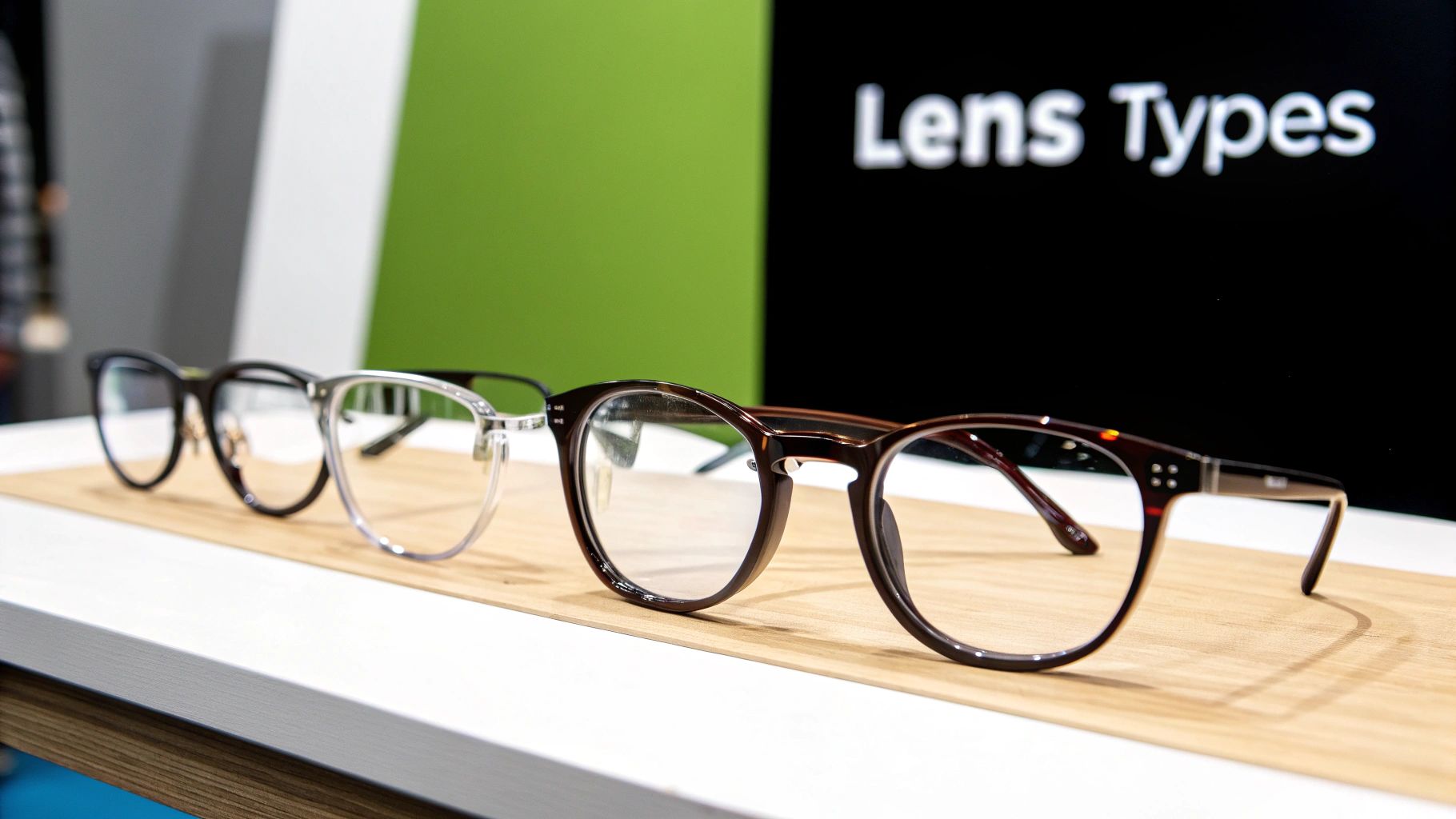
Diving into the world of lenses doesn't have to be complicated. Just think of it as a two-part decision. First, how does the lens need to correct your sight? Second, what material is best for your lifestyle? This simple approach is the key to protecting your eyes and ensuring your glasses can keep up with you.
For example, a uni student probably just needs a straightforward pair of single-vision lenses to see the whiteboard clearly, but they’d want them made from tough polycarbonate to survive being thrown in a backpack. An electrician, on the other hand, needs durable safety-rated bifocals to read fine wiring diagrams up close and then look up to survey their work area.
It’s all about finding that perfect match for your specific needs, and it's a choice many Aussies are making. The Australian spectacles market recently pulled in USD 3,780.3 million in revenue, with lenses making up the biggest piece of that pie. It's even expected to climb to USD 4,848.6 million by 2030. Clearly, getting the right lenses is a big deal for both vision and eye health and safety.
Understanding the Lens Categories
To make things easier, let's break down the options into a few simple groups. Think of this as your roadmap for the rest of this guide. We’ll explore each of these in more detail, so you'll know exactly what you're looking at.
Here's a quick summary to get us started.
Overview of Eyeglass Lens Categories
This table gives you a bird's-eye view of how lenses are categorised, helping you see how function, material, and extra features come together.
| Category | Primary Use | Key Feature |
|---|---|---|
| By Vision Correction | Correcting specific refractive errors like nearsightedness or astigmatism. | Focuses on single, multiple, or seamlessly blended focal powers. |
| By Material | Providing durability, comfort, and eye health and safety for different lifestyles. | Determines the lens's weight, thickness, and impact resistance. |
| By Coatings & Tints | Adding protective features and enhancing visual comfort. | Includes anti-glare, blue light filtering, and photochromic options. |
This framework shows that the best eyewear solution isn't off-the-shelf; it's a personalised combination of prescription, material, and coatings that fits your life perfectly.
The best eyewear solution is a personalised one. It’s about finding the perfect synthesis of prescription accuracy, material science, and functional coatings that match your daily life. We can customise an eyewear package to suit your requirements, ensuring your vision and eye health and safety are always at their best.
Getting these basics down is the first step. For instance, some lenses automatically adjust to sunlight—a feature you can learn more about in our guide comparing photochromic lenses vs Transitions. Now that we have this foundation, let's dive deeper into each option with real-world examples to help you feel confident in your choice.
Finding Your Focus With Vision Correcting Lenses
Once you’ve got the basics down, the next step is connecting your prescription to the right lens design. This is all about how the lens is shaped to bend light, making sure it lands perfectly on your retina for that crisp, clear picture. Think of it as choosing the right tool for a specific job—some are built for one task, while others give you more versatility.
Each lens type has a different job, tied directly to what your eyes need. Protecting your long-term eye health and safety isn't just about seeing clearly; it's about picking a design that cuts down on eye strain during your daily grind. Let’s break down the most common designs.
Single Vision Lenses: The Specialists
By far the most common prescription lens out there is the single vision lens. Just like the name implies, it has one optical prescription to correct your vision at a single, specific distance—either up close, far away, or somewhere in between.
Think of it like a fixed-focus camera. It’s built to take perfectly sharp photos of things at a set distance, and it does that one job brilliantly. That's exactly how single vision lenses work for your eyes.
- For Nearsightedness (Myopia): A practical example is a taxi driver who needs these lenses to get a crisp, clear view of distant road signs and traffic lights, ensuring their eye health and safety on the road.
- For Farsightedness (Hyperopia): These sharpen vision for close-up tasks. A librarian, for instance, would use them to read the fine print on book spines and catalogue entries for hours without strain.
- For Astigmatism: They can also correct for the irregular shape of the eye that makes things look blurry at any distance.
A great real-world example is a graphic designer who needs flawless vision for their computer screen all day. A pair of single vision glasses set for that intermediate distance would give them the clearest, most comfortable view, helping to keep strain and headaches at bay.
Bifocal Lenses: The Classic Two-in-One
As we get older, many of us find our eyes struggle to focus on things up close. This is a condition called presbyopia, and it’s where lenses with multiple prescriptions step in. Bifocals are the classic solution, offering two different prescriptions in a single lens.
You can always spot bifocals by the distinct line that separates the two viewing zones. The top part of the lens is for seeing things in the distance, while the smaller segment at the bottom is for close-up work like reading.
Think of bifocals like a split-screen. You have one view for looking far away and a completely separate one for what's in your hands. It's functional, but you have to make an abrupt jump between the two fields of vision.
While they get the job done, that visible line can take some getting used to. A practical example is a plumber who might use the top part to see across a room to diagnose an issue and the bottom part to work on tiny fittings up close. But for some people, that "image jump" when their eyes cross the line can feel a bit disorienting.
Progressive Lenses: Seamless Vision for a Dynamic Life
For a more modern, seamless experience, we have progressive lenses. Unlike bifocals, progressives have no visible lines. Instead, they provide a smooth, gradual shift between prescriptions for near, intermediate, and distance vision.
Imagine a photograph with a smooth gradient blending from a bright sky to a dark landscape—that’s the idea behind progressives. They merge multiple prescriptions into one lens, letting you see clearly at any distance just by slightly adjusting your head position.
This design is a perfect match for the dynamic pace of modern life. A practical example is an office manager who needs to look at their computer monitor (intermediate), read a document on their desk (near), and then glance up to chat with a colleague across the room (distance). Progressive lenses make these transitions feel completely smooth and natural.
Choosing between these multifocal options really comes down to your daily routine. For a deeper dive into how they stack up, you might find our guide on progressive lenses vs bifocals helpful. In the end, the goal is to find a lens that feels like a natural extension of your sight. Whatever your needs, we can customise an eyewear package to suit your requirements, ensuring a perfect fit for both your vision and your lifestyle.
Choosing the Right Lens Material for Your Lifestyle

Beyond your prescription, the actual material your lenses are made from has a massive impact on their performance, your comfort, and most importantly, your eye health and safety. Glass lenses were once the only option, but modern materials have completely changed the game, offering choices that are lighter, stronger, and safer than ever before.
Choosing the right material isn’t about what’s "best," but what’s best for you. Your decision should be guided by your prescription, daily activities, and what you value most—whether that’s maximum durability for an active lifestyle or a sleek, lightweight feel for all-day office wear.
Polycarbonate Lenses: The Impact-Resistant Champion
When safety is the top priority, nothing beats polycarbonate lenses. This material is remarkably tough—up to 10 times more impact-resistant than standard plastic lenses—yet it's also significantly lighter. This unique combo of strength and minimal weight makes it an essential choice for certain people.
For instance, polycarbonate is the non-negotiable, go-to material for kids' eyewear. Children run, fall, and play hard, and their glasses need to keep up while protecting their eyes from potential injury. The same goes for anyone who plays sports or works in a hazardous environment. A practical example is a carpenter on a construction site who relies on polycarbonate lenses for essential protection from flying debris.
Polycarbonate isn't just a lens material; it's a piece of safety equipment. Its built-in impact resistance and inherent 100% UV protection offer a fundamental layer of defence for the most vulnerable eyes, making it a cornerstone of protective eyewear and crucial for eye health and safety.
High-Index Lenses: Thinner, Lighter, and More Attractive
For those with stronger prescriptions, thick and heavy lenses can be a real drag, often leading to that dreaded "coke-bottle" effect. This is where high-index lenses come in. They’re crafted from a special plastic material that bends light much more efficiently.
Think of it like compressing a large digital file. A high-index lens packs the same powerful prescription into a much slimmer, more compact package. This means the edges of your lenses are noticeably thinner, they feel much lighter on your face, and they create a far more aesthetically pleasing look.
A practical example is a professional who wants a polished, sophisticated appearance for client meetings. High-index lenses help them avoid the distortion that can make eyes look unnaturally small or large through thick lenses, creating a more natural and confident profile.
A Side-by-Side Look at Lens Materials
To help you decide, let's look at how the most common materials stack up against each other. The right choice often comes down to balancing optical clarity, weight, durability, and cost. Each material brings something different to the table, tailored for different lifestyles and vision needs.
Here’s a quick comparison to help you weigh up your options.
Lens Material Comparison
| Material | Key Benefit | Best For | UV Protection | Impact Resistance |
|---|---|---|---|---|
| Standard Plastic (CR-39) | Excellent optical clarity and low cost. | Mild prescriptions and budget-conscious individuals. | Requires an added coating. | Low |
| Polycarbonate | Superior impact resistance and lightweight. | Children, sports, and safety eyewear. | Built-in 100% | Very High |
| High-Index Plastic | Thinnest and lightest profile available. | Strong prescriptions for a sleek, comfortable fit. | Built-in 100% | Moderate |
| Trivex | Combines impact resistance with superior optical clarity. | Active lifestyles wanting sharp vision and safety. | Built-in 100% | Very High |
Ultimately, the right material will make your glasses feel like they were made just for you. Whether you need the robust protection of polycarbonate for weekend sports or the lightweight elegance of high-index lenses for the boardroom, we can customise an eyewear package to suit your requirements.
Enhancing Your Vision with Lens Coatings
Think of your spectacle lenses as the foundation, and coatings as the high-performance upgrades. While the lens material itself is what gives you clear vision, coatings add specialised layers that protect your eyes, make wearing glasses more comfortable, and even extend their lifespan.
They’re much more than optional extras; they're essential treatments that solve real-world problems. From cutting down distracting glare on a rainy night drive to filtering harsh light from your computer screen, these invisible layers make a very visible difference to your day-to-day life and eye health and safety.
Anti-Reflective Coating for Ultimate Clarity
An anti-reflective (AR) coating, often just called an anti-glare coating, is easily one of the most popular and beneficial treatments you can get. Its job is to eliminate the distracting reflections you see on the front and back of your lenses.
Think about a high-end camera lens. It’s coated to let the maximum amount of light through, which is how you get such a crisp, vibrant photo. An AR coating does the exact same thing for your glasses, allowing more light to reach your eyes for sharper, clearer vision.
This brings some huge practical benefits:
- Safer Night Driving: It drastically cuts down the glare from oncoming headlights and streetlights, which can be a serious source of discomfort and a hazard on the road. A practical example is a long-haul truck driver who relies on AR coating to reduce eye fatigue and improve reaction times during night shifts.
- A More Natural Look: By getting rid of reflections, people can see your eyes clearly. This makes face-to-face chats feel more natural and ensures you look your best in photos.
- Reduced Eye Strain: Less glare means your eyes don’t have to work as hard, which is a massive relief when you’re under harsh office lights or staring at a computer screen all day.
Scratch-Resistant Coating: Your First Line of Defence
Let's be realistic—no lens material is completely scratch-proof. That’s where a scratch-resistant coating comes in, adding a much-needed layer of toughness. It’s a hard, clear coating that makes the lens surface more resilient against the minor scuffs and scratches that inevitably happen.
Accidentally dropping your glasses or wiping them with your shirt can easily create micro-scratches that get in the way of your vision. This coating acts as a protective shield, preserving the clarity of your lenses and helping you get more life out of your investment. It's an absolute must-have for kids' eyewear and essential for maintaining long-term eye health and safety.
A scratch-resistant coating is your eyewear's best defence against daily wear and tear. It’s a simple addition that significantly prolongs the life and clarity of your lenses, ensuring your vision remains unobstructed.
Blue Light Filters for Our Screen-Filled Lives
We’re spending more time glued to screens than ever before—phones, tablets, computers, you name it. These devices all emit high-energy visible (HEV) blue light, which is linked to digital eye strain, messed-up sleep patterns, and general fatigue. This is exactly why a blue light filtering coating has become so important for our eye health and safety.
This special coating is designed to selectively filter out a portion of that harsh blue-violet light, easing the burden on your eyes during long stretches of screen time. A practical example is a student researching an essay late at night or a professional working on a laptop; this coating can help reduce symptoms like dry eyes, blurred vision, and headaches. You can dive deeper in our complete guide to the benefits of blue light filters.
The growing need for this is clear. Blue light protection is a major focus in the Australian eyewear market, which is projected to grow by 5.86% between 2025 and 2033, driven largely by the demand for glasses that help with our digital lives. You can read more about these trends and the Australian eyewear market growth on imarcgroup.com.
Adaptive and Speciality Coatings
Beyond the core essentials, other coatings offer dynamic solutions for specific needs and environments.
- Photochromic Lenses: You might know them by the brand name Transitions. These clever lenses automatically darken when they’re exposed to UV light and turn clear again when you go back indoors. They’re the perfect two-in-one solution if you’re constantly moving between inside and outside. A practical example is a real estate agent who is constantly going from indoor viewings to outdoor property tours.
- Polarised Lenses: An absolute non-negotiable for good sunglasses. Polarisation specifically targets and eliminates the blinding glare that reflects off flat surfaces like wet roads, water, or snow. A practical example is a fisherman who can see right through the surface of the water, or a driver who gets a safer, more comfortable view on a sunny day.
Each of these coatings adds a specific function tailored to a specific need. Once you understand what they do, you can build the perfect pair of glasses. At Prescript Glasses, we can customise an eyewear package to suit your requirements, making sure you get the ideal mix of lens, material, and coatings for your lifestyle.
Making the Right Choice for Your Eyes and Budget
Choosing the perfect lenses goes way beyond just picking a frame you like. It's about really digging into what your eyes need and finding a solution that doesn't blow your budget. This is where your prescription becomes your best friend. Think of it as the blueprint for your vision, and learning to read it gives you the power to make smarter choices for your eye health and safety.
Your script has a few key terms. Sphere (SPH) is the main power of your lens; a minus sign (-) means you're nearsighted, while a plus sign (+) means you're farsighted. Cylinder (CYL) and Axis are a team that corrects for astigmatism, which just means your eye isn't perfectly round.
Another number you absolutely need is your Pupillary Distance (PD). It's simply the distance between the centres of your pupils, and getting it right is non-negotiable. An accurate PD ensures the sweet spot of your lenses lines up perfectly with your eyes, giving you that crystal-clear, comfortable vision you're after.
Balancing Performance and Price
The final price tag on your new glasses comes down to two things: the lens material and any coatings you decide to add. If you have a really strong prescription, splurging on high-index lenses is almost always money well spent. They're much thinner and lighter, so you can avoid that chunky "coke-bottle" look and feel way more comfortable.
On the other hand, if your prescription is on the milder side, a standard lens material will probably do the job just fine and be a lot kinder to your wallet. The trick is to put your money towards the features that will actually make a difference in your day-to-day life. For example, a delivery driver would benefit more from a durable, polarised lens than an expensive high-index one.
To make things easier, this chart breaks down which coatings match up with common goals, like cutting down on screen fatigue or seeing better outdoors.
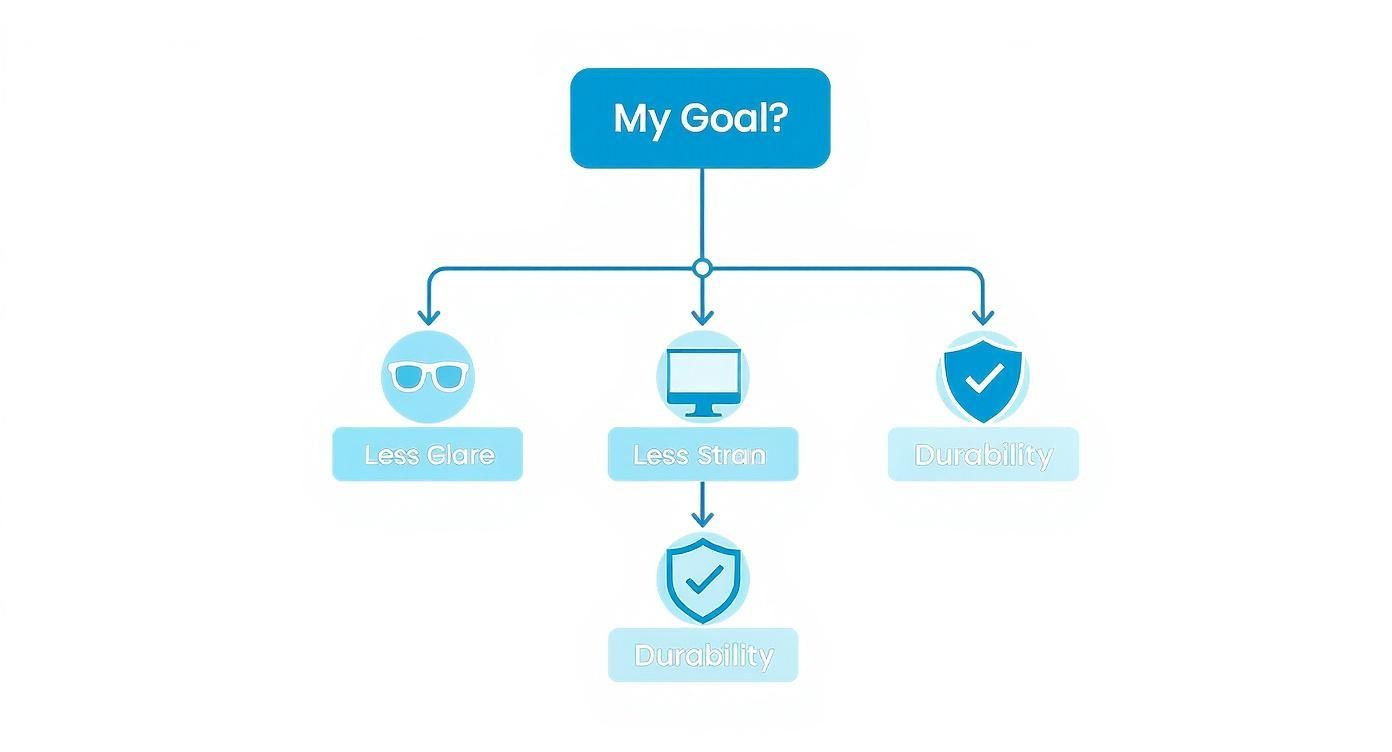
As you can see, there's a clear path from your personal goal—like wanting less glare or strain—to the lens treatment that will get you there. It really helps you focus on what's most important for your personal eye health and safety.
Creating Your Perfect Eyewear Solution
At the end of the day, there’s no single "best" lens for everyone. The right choice is deeply personal, boiling down to your prescription, your lifestyle, and your budget. Once you understand these pieces, you can confidently pick out a pair of glasses that deliver amazing clarity and comfort without costing a fortune.
The most effective eyewear is one that feels made just for you. It's about combining precise vision correction with materials and coatings that support your lifestyle and protect your eyes.
Your needs are unique, and your glasses should be too. A student might get the most out of a blue light filter and a tough scratch-resistant coating, while someone who drives a lot will find polarised and anti-reflective coatings to be game-changers.
As you shop for new specs, it’s also worth looking into how new tools like virtual try-on technology for glasses are making the whole process easier. This tech helps you see exactly how different frames will look on you, so you can find the perfect match for your carefully chosen lenses.
The goal is always to find that sweet spot between performance and value. No matter what you need, we can customise an eyewear package to suit your requirements, ensuring you walk away with the perfect combination of clarity, comfort, and protection.
Got Questions About Lenses? We've Got Answers.
To wrap things up, let's tackle some of the most common questions people have when picking out new lenses. Getting clear, straightforward answers to these practical concerns will help you make a final decision with total confidence, ensuring your new glasses are a perfect fit for both your vision and your life.
Your glasses are a real investment in your daily well-being. It’s a huge part of healthcare in Australia, with the optometry industry reaching a market size of AUD 5.0 billion. This shows just how many of us rely on getting our vision correction spot on. You can read more about the Australian optometry industry insights on ibisworld.com.
How Often Should I Replace My Lenses?
As a rule of thumb, optometrists recommend a comprehensive eye exam every one to two years. You should always update your lenses when your prescription changes—it’s crucial for maintaining clear vision and preventing unnecessary eye strain. Simply put, good eye health and safety depend on wearing an accurate, up-to-date script.
Even if your prescription hasn't changed, you might want to consider replacing your lenses if they get badly scratched. Scratches don't just look bad; they can impair your vision and create distracting glare. Plus, those protective coatings wear down over time, so a fresh pair of lenses can bring back that crisp, anti-glare performance you first loved. A practical example is if you notice more glare during night driving than you used to; it might be a sign your AR coating is wearing off.
Are More Expensive Lenses Always Better?
Not necessarily. The "best" lens is the one that perfectly matches your prescription and your daily routine. For example, if you have a very mild prescription, there's little reason to splash out on a pricey high-index lens. A standard material will give you fantastic clarity without the extra cost. Prioritising your eye health and safety means choosing what is appropriate, not what is most expensive.
Price is usually a reflection of the lens material, the brand, and the coatings you add on. While a higher price can get you a thinner lens or a premium coating, the most critical factor is getting the vision correction right. That said, investing in high-quality anti-reflective and scratch-resistant coatings is almost always a worthwhile upgrade for day-to-day comfort and durability.
The real value isn't in the price tag but in how the lenses perform for you. A well-chosen lens package addresses your specific visual needs, offering the clarity, comfort, and protection that genuinely enhances your daily life.
Can I Put New Lenses in My Old Frames?
Yes, you absolutely can! In most cases, this is a great, sustainable option known as "reglazing." It lets you hold onto a pair of frames you love while updating the lenses to your new prescription. It's the perfect way to blend your personal style with your current vision needs.
The main thing to check is the condition of your frames. If they’re old, brittle, or showing serious signs of wear and tear, an optician might advise against it. The process of fitting new lenses puts stress on the frame, and a fragile one could break. It's always best to have a professional assess your frames first to make sure they’re up to the task and that reglazing won't compromise your eye health and safety.
At Prescript Glasses, we know that everyone's vision is unique. That’s why we can customise an eyewear package to suit your requirements, ensuring you get the perfect blend of lens type, material, and coatings for your lifestyle. Upload your prescription and let us build the ideal glasses for you at https://www.prescriptglasses.com.