A Complete Guide to Glasses Lens Replacement in Australia

If you love your current frames but your vision has changed, you don't have to say goodbye to them. Glasses lens replacement is a simple, smart service that lets us fit brand-new, updated lenses into the frames you already own and love. It's the perfect fix if your prescription is outdated, your lenses are scratched, or you just want to add some new tech to your specs for better eye health.
Why Put New Lenses in Your Favourite Frames?
Think of your favourite pair of glasses like a classic car. When the tyres wear down, you don't get rid of the whole car—you just get new tyres to keep it running smoothly and safely. Glasses lens replacement is the exact same idea. It lets you hang on to the frames that define your style while upgrading the most important part: the lenses that help you see. This isn't just about being thrifty; it’s about making your eye health and safety a priority.
Sticking with an old prescription or trying to see through scratched lenses has real consequences. It makes your eyes work overtime just to focus, which can kick off a whole host of uncomfortable and annoying symptoms. For example, wearing scratched lenses while driving at night can cause light to scatter, creating dangerous glare from streetlights and oncoming cars, which directly impacts your safety on the road.
Look After Your Vision and Well-being
Your eyes are always adjusting, and clear, correct lenses are the tools they need to do their job properly. When your lenses aren't up to scratch, you're putting your entire visual system under stress. That stress can show up in ways that really affect your day-to-day comfort.
Worn-out lenses aren't just a minor inconvenience; they can be the direct cause of physical discomfort. Pushing through with them can lead to chronic eye strain, recurring headaches, and a frustrating drop in how clearly you can see, especially when the lighting isn't great.
For instance, a professional who spends all day at a computer might blame their constant headaches on work stress, but the real culprit could be the tiny, almost invisible scratches on their lenses blurring the text. In the same way, a student might find themselves squinting to see the whiteboard, not realising their prescription has shifted just enough to make a difference. A lens replacement can resolve these issues, improving both their comfort and performance.
The Power of a Custom Solution
Upgrading your lenses opens up a whole world of modern technology built to protect your eyes and match your lifestyle. This isn't a one-size-fits-all deal; it’s all about creating a personalised solution.
Here are the key reasons to make the switch:
- Updated Prescriptions: Your eyesight changes. A new prescription needs new lenses to make sure you’re seeing the world as clearly and safely as you can.
- Repairing Damage: Scratches, cracks, and peeling coatings don't just look bad—they mess with your vision and weaken the lens, potentially reducing its UV protection and leaving your eyes vulnerable.
- Getting New Tech: You can add features like blue light filtering to fight off digital eye strain or get photochromic lenses that automatically adapt to the light around you.
At the end of the day, we can build a customised eyewear package that fits you perfectly. Whether you're a gamer who needs to block screen glare or a driver who wants polarised sunglass lenses for the road, replacing your lenses lets you create the ideal pair of glasses without giving up your favourite frames.
Signs It’s Time for New Lenses
Knowing when you need a glasses lens replacement is about more than just an outdated prescription. Your eyes are pretty good at sending subtle—but important—clues that your current lenses just aren't cutting it anymore. If you ignore these signs, you’re often just setting yourself up for unnecessary discomfort and strain.
The most obvious signal is physical damage. Day-to-day life eventually leaves its mark on your lenses, and that directly impacts how you see the world. It’s crucial to sort this out to keep your vision clear and your eyes safe.
Visible Scratches and Coating Damage
Even tiny, seemingly insignificant scratches can mess with the way light reaches your eye. This causes little distortions that force your eyes to work overtime just to see clearly. You might find yourself constantly wiping your glasses, only to realise those annoying smudges are actually permanent scuffs blurring the words on your screen.
It’s a similar story with the special coatings on your lenses, like the anti-reflective or UV protection layers. Over time, they can start to peel or bubble. Not only does this look messy, but it also means you’re losing the very protection you paid for, leaving your eyes more vulnerable to glare and harmful UV rays, which can contribute to long-term eye health issues.
Paying attention to these physical signs is a key part of proactive eye care. Damaged lenses don't just compromise your vision; they can contribute to a cycle of eye strain and headaches that affects your daily productivity and comfort.
This focus on eye health is becoming more and more common across Australia. The local eyewear market is actually projected to hit USD 3,590.6 million in 2025, with lenses being the biggest piece of that pie. This growth really highlights how much people are realising that quality vision correction is vital for overall well-being. You can explore more data about the Australian eyewear market to see these trends for yourself.
Persistent Eye Strain and Headaches
Finishing your workday with tired, aching eyes or a nagging headache? Before blaming the long hours, take a closer look at your lenses. An old prescription or damaged lens surfaces force the tiny muscles in your eyes to constantly refocus, which can lead directly to that physical discomfort.
Think about a student who starts getting headaches during lectures. They might just put it down to stress, but the real culprit could be that their prescription has shifted slightly. Their eyes are straining to see the board clearly through their old lenses. A simple lens upgrade can often make the problem disappear entirely, improving their ability to learn safely and comfortably.
Changes in Your Vision Clarity
Sometimes, your vision needs can change so gradually you barely notice. If you find yourself squinting more often, or if driving at night feels a lot harder because of the glare from headlights, that’s a massive clue that your lenses are no longer a perfect match for your eyes.
See if any of these common scenarios sound familiar:
- Difficulty with Night Driving: Oncoming headlights create starbursts or halos, making it tough to focus on the road.
- Blurry Vision Up Close: You have to hold your phone further away than you used to just to read a text message.
- General Lack of Sharpness: The world just doesn't seem as crisp and defined as it once did.
These aren't just minor annoyances; they're direct feedback from your eyes telling you it's time for an update. A straightforward glasses lens replacement can bring back that sharpness and make daily tasks easier and safer. We can customise an eye wear package to suit your requirements, ensuring your new lenses fix these issues perfectly.
Choosing the Right Lenses for Your Lifestyle
Picking new lenses for your favourite frames goes way beyond just matching your prescription. It’s a chance to seriously upgrade your vision for the way you actually live. Think of it like choosing the right tyres for your car—you wouldn’t put slick city tyres on a 4x4 you plan to take bush-bashing. In the same way, the right glasses lens replacement can make a massive difference to your comfort, safety, and even performance in your day-to-day activities.
Modern lens tech is packed with features designed to handle specific challenges, from the harsh glare of your computer screen to bright Aussie sunlight. Getting to know these options means you can create a pair of glasses that’s truly personalised to support your eye health. At the end of the day, it's all about matching the right lens features to your personal and professional needs.
The best part? We can customise an eyewear package to suit your requirements, making sure you get the perfect mix of materials, coatings, and lens types. Whether you’re stuck in an office, always outdoors, or a bit of both, there's a lens setup made just for you.
Decoding the Different Lens Types
The type of lens you choose is the foundation of your new glasses. Each option is engineered for a specific job, either helping you adapt to different environments or protecting your eyes from certain kinds of light.
Let's break down the most popular choices:
- Standard Clear Lenses: These are your reliable, straightforward choice for everyday vision correction. Made with high-quality materials, they deliver crisp, clear sight for all your usual indoor activities.
- Photochromic Lenses: Often known by the brand name Transitions, these are the chameleons of the eyewear world. They’re perfectly clear inside but automatically darken when hit with UV light, turning into sunglasses the moment you step outside.
- Blue Light Filtering Lenses: An absolute essential in our screen-filled world. These lenses have a special coating that filters out a chunk of the blue light coming from digital devices, which can help cut down on digital eye strain and make long hours in front of a screen more comfortable.
- Bluecromic Lenses: This is the ultimate all-in-one solution. It brings together the smart adaptive tech of photochromic lenses with the protective power of blue light filtering. You get one pair of glasses that’s perfect for both screen time and outdoor adventures.
- Sunglass Lenses: You can also turn any frame you love into a pair of prescription sunnies. We can tint them to your favourite shade and even add polarisation to slash the harsh glare that bounces off surfaces like water, roads, and other cars.
These advanced options are a big reason why the Australian eyewear market is changing. More and more, people are looking for specialised features. Innovations like blue light filters and better UV protection are driving major growth. In fact, the premium eyewear market—which includes these advanced lenses—is growing at a rate of 7.0% per year. This shows a clear demand for products that help reduce the impact of our screen-heavy lives.
Finding the Perfect Match for Your Activities
To make the right call, have a think about what your typical day involves. Your daily routine is the best guide for picking a lens that will actively make you more comfortable and protect your vision for the long haul.
To help you decide, here are a few real-world scenarios:
For the Dedicated Office Pro or Uni Student
If your day means eight or more hours staring at a computer, digital eye strain is a very real problem.
- Best For: Easing screen fatigue, headaches, and that sore, tired-eye feeling.
- Practical Example: A graphic designer who spends their entire day glued to a monitor chooses Blue Light Filtering lenses. This helps them minimise eye strain, so they can stay focused on detailed work for longer without feeling wrecked by the end of the day. It's a core part of their strategy for staying productive and keeping their eyes healthy.
For the Outdoor Enthusiast
For someone who is constantly moving between inside and outside, you need a lens that can keep up without you having to think about it.
- Best For: Seamlessly adjusting to different light conditions without ever needing to swap your glasses.
- Practical Example: A real estate agent who is in and out of properties all day goes for Photochromic lenses. Their glasses automatically darken for outdoor viewings under the bright sun and then go clear again once they’re back inside, giving them constant UV protection and visual comfort.
For the Ultimate All-Rounder
This is the person who juggles serious screen time with an active outdoor lifestyle and wants one pair of glasses that can do it all.
- Best For: Total protection from both digital screens and the sun, all in one package.
- Practical Example: A uni student spends their mornings in lectures on a laptop and their afternoons playing sport on the oval. They pick Bluecromic lenses as a single, convenient solution that filters blue light in the classroom and provides full sunglass-level protection on the field.
To get a better sense of how these lens technologies stack up for different users, check out the comparison table below.
Lens Technology Comparison for Different User Needs
This table breaks down the various lens technologies to help you pinpoint the best option based on what you do every day and your main eye health concerns.
| Lens Type | Primary Benefit | Ideal for Users Like... | Practical Example of Use |
|---|---|---|---|
| Blue Light Filtering | Reduces digital eye strain and fatigue from screens. | Office workers, students, gamers, heavy smartphone users. | An accountant using them during tax season to reduce headaches and keep their vision sharp while looking at spreadsheets. |
| Photochromic | Automatically adjusts from clear indoors to dark outdoors. | People who move frequently between indoor and outdoor settings. | A landscape gardener whose glasses darken to sunglasses while working outside and clear up when they go inside for lunch. |
| Bluecromic | Combines blue light filtering with photochromic technology. | The "all-rounder" who needs both screen and sun protection. | A tech consultant who visits client sites, works on a laptop, and enjoys outdoor hobbies on the weekend. |
| Polarised Sunglass | Eliminates harsh glare from reflective surfaces like water and roads. | Drivers, boaters, fishers, and anyone sensitive to glare. | A fisherman who can see clearly into the water without the blinding glare, spotting fish more easily. |
| Standard Clear | Provides straightforward, high-clarity vision correction. | Primarily indoor users with no specific light sensitivity. | A librarian who needs crisp vision for reading books and working in a consistently lit indoor environment. |
Ultimately, choosing a lens is about finding the technology that fits your life, not the other way around. To learn more about all the options, you can explore our comprehensive guide on the different types of lenses for eyeglasses.
Essential Add-Ons: Lens Coatings and Materials
Beyond the main lens type, coatings and materials give you another layer of customisation and protection. These are the finishing touches that are vital for making your lenses last longer and keeping your vision as clear as possible.
The right coatings aren't just optional extras; they're essential for protecting your investment and getting the best possible vision. An anti-scratch coating, for example, is a non-negotiable for maintaining the quality and lifespan of your new lenses.
Make sure you consider these crucial options:
- Anti-Scratch Coating: This is a tough, protective layer that helps fend off the minor scratches and scuffs that happen with everyday wear and tear, keeping your vision clear and unobstructed.
- Anti-Glare (Anti-Reflective) Coating: This coating cuts down on annoying reflections from both the front and back of your lenses. It massively improves vision clarity—especially for night driving—and makes your eyes more visible to others.
- Polycarbonate Material: For anyone with an active lifestyle, or for kids' glasses and safety specs, polycarbonate is the go-to choice. It is up to 10 times more impact-resistant than standard plastic lenses, offering fantastic protection for your eyes.
How to Order Your Replacement Lenses Online
Thinking about ordering a glasses lens replacement online? It might sound a bit technical, but we’ve made the whole thing a straightforward, step-by-step process. Honestly, it’s designed to be easy and accurate, so you can feel confident from start to finish.
Think of it as a clear roadmap to getting your favourite frames fitted with perfect new lenses, all from the comfort of home. The journey starts with your frames and your prescription. From there, it's just a matter of making a few key choices to get your ideal specs.
Step 1: Tell Us About Your Frames
First things first, we need to know what kind of frames you'll be sending us. The way our technicians fit new lenses depends entirely on the style of your glasses, so getting this right is the crucial first step. It guarantees a secure, perfect fit.
You'll just need to choose from one of these common types:
- Full-Rim: The lens is completely surrounded by the frame material. This is the most common and sturdy style out there.
- Semi-Rimless: The lens is held in place by a thin, barely-there wire along the bottom or top, with the rest encased by the frame.
- Rimless: The lenses are attached directly to the bridge and arms of the glasses with tiny screws. This style is all about precision drilling.
Picking the right option ensures we handle your beloved frames with the exact care they need, setting the stage for a flawless lens installation.
Step 2: Upload and Understand Your Prescription
Next up is your prescription. This is the blueprint our optical technicians use to craft lenses that correct your vision perfectly. All you have to do is upload a photo or a scanned copy from your optometrist.
Don't let all the numbers and letters intimidate you. Your prescription has just a few key values:
- SPH (Sphere): This is the main strength of your lens. A minus sign (–) means you're short-sighted, while a plus sign (+) means you're long-sighted.
- CYL (Cylinder) & AXIS: If you see numbers here, it just means you have astigmatism, a super common condition where the eye is shaped a bit more like a footy than a perfect sphere. CYL is the power needed to correct it, and AXIS is the angle of that correction.
- ADD (Addition): This value is for multifocal or bifocal lenses, telling us the extra magnifying power you need for reading.
For instance, if your script shows a CYL value of -1.25, our technicians will shape your lens to precisely counteract the astigmatism at the specified axis, giving you crisp, clear vision without distortion.
Step 3: Measure Your Pupillary Distance
One of the most vital measurements for any glasses lens replacement is your Pupillary Distance (PD). It’s simply the distance in millimetres between the centres of your pupils. An accurate PD makes sure the optical centre of your new lenses aligns perfectly with your eyes, which is the secret to clear, comfortable vision.
While your optometrist can give you this number, measuring it at home is surprisingly easy. You just need a ruler with millimetre markings and a mirror.
An accurate PD is non-negotiable for effective vision correction. Even a small error can shift the optical centre of the lens, potentially causing eye strain, headaches, or blurry vision. Taking a moment to measure it carefully is one of the most important things you can do for your eye health.
The process is simple: look straight into a mirror and measure the distance from the centre of one pupil to the other. To nail the accuracy, it helps to close one eye at a time to line up the ruler correctly. For a detailed walkthrough, check out our guide on how to measure your pupillary distance. It breaks down the whole process with easy-to-follow steps and tips.
Step 4: Choose Your Lenses and Coatings
Here’s the fun part where you get to personalise your eyewear. Based on your daily routine and visual needs, you'll pick the lens type and any extra coatings that will serve you best. This final step is all about customisation, making sure your new lenses actively improve your comfort and protect your eyes.
This little guide shows how different lifestyle factors point to your ideal lens choice.
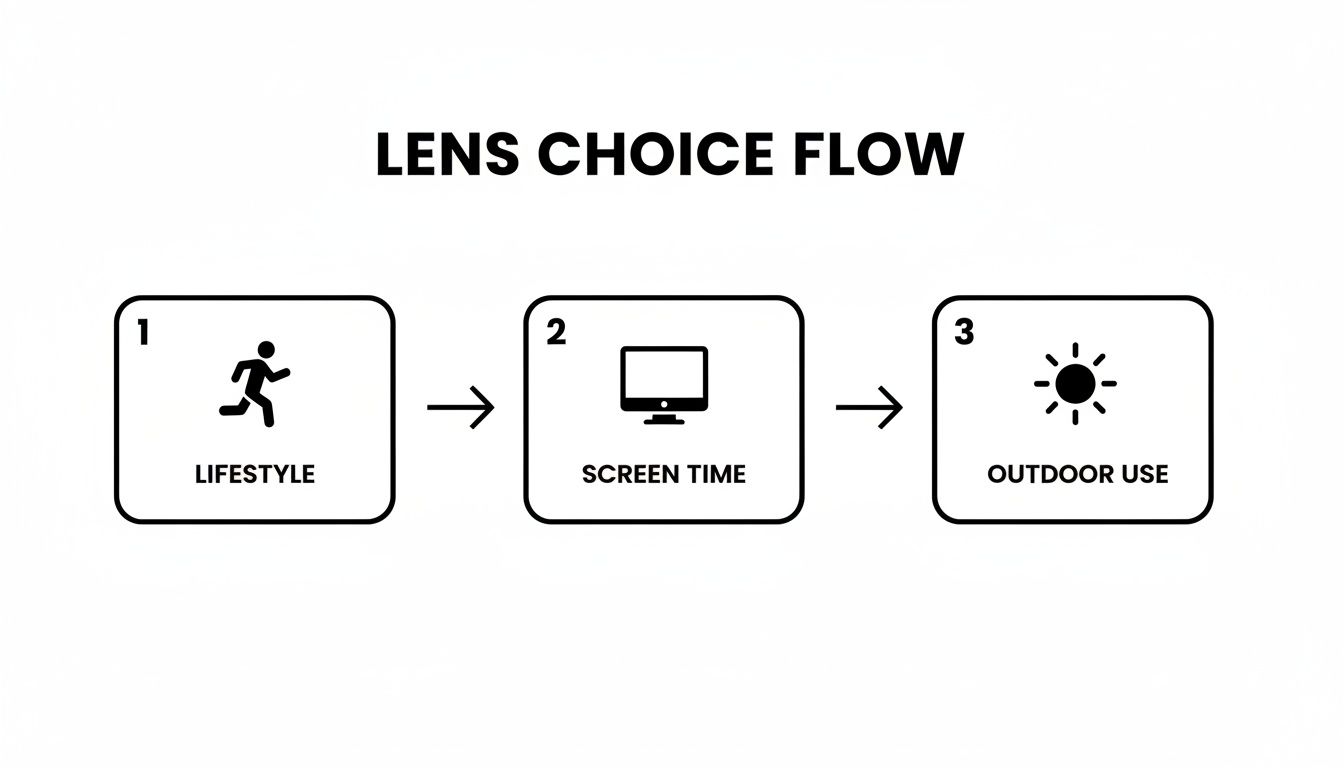
As you can see, the best lenses for you are a direct reflection of your daily habits, from your work life to your weekend adventures.
Now, you just select what you need from our menu. Spend hours staring at a computer? A BlueRay filter is a brilliant choice. Constantly moving between indoors and out? Photochromic lenses will adapt for you. We can customise an eyewear package to suit your requirements, so feel free to combine features like an anti-scratch coating with a Bluecromic lens for the ultimate all-in-one solution.
Once you've made your selections, you’re all set to finalise your order and get your frames ready to send our way.
So, What Happens After You've Ordered?
Once you’ve sent us your frames and locked in your glasses lens replacement order, our skilled optical technicians get right to work. We think it’s important you know exactly what’s happening behind the scenes, so here’s a peek into the journey your glasses take before they land back on your doorstep, fitted with sparkling new lenses.
The magic starts the moment your frames arrive at our lab. Before we even think about making your lenses, we give your frames a thorough inspection to make sure they're in top shape for the new fitting. This first step is crucial—it's our way of ensuring your frames can securely hold your new prescription lenses, keeping your eyes safe and your vision sharp.
Crafting and Fitting Your Lenses
Every pair of lenses we create is a custom piece of medical equipment, so the time it takes can vary. Think of it like a tailored suit versus one off the rack. A few things can influence the turnaround time, from how complex your prescription is to the specific coatings you’ve picked out. We always choose precision over speed, making sure every detail is spot on.
Here’s a quick rundown of what can affect the timeline:
- Prescription Complexity: A straightforward, single-vision prescription is usually the quickest to get through the works.
- Lens Type and Coatings: Multifocal lenses or lenses with several advanced coatings need extra steps and more curing time.
- Lens Material: Some materials require more specialised crafting techniques than others.
To give you a real-world example, a high-index lens for a strong prescription might take a bit longer. That's because it needs meticulous grinding and polishing to get it beautifully thin and lightweight without sacrificing any optical clarity. This extra care is what guarantees maximum comfort and performance.
Quality Checks for Your Peace of Mind
Before we even think about packing up your glasses, they go through a serious quality assurance process. This isn't just a quick glance—it's a multi-point inspection to guarantee your new lenses meet Australia’s strict standards for optical devices. Our technicians double and triple-check that the prescription, pupillary distance (PD), and lens alignment are all absolutely flawless.
This obsession with precision is all about protecting your eye health. Lenses that are even a tiny bit misaligned can cause eye strain, headaches, and fuzzy vision. Our quality checks completely eliminate this risk by making sure the optical centre of each lens is perfectly positioned for your eyes.
Finally, we package your glasses securely for their safe journey back to you. From start to finish, the entire process is designed to deliver a product that doesn't just meet your expectations but blows them away. After all, we can customise an eyewear package to suit your requirements perfectly.
Caring for Your New Lenses to Maximise Their Lifespan
You’ve invested in your vision, and your new lenses are a big part of that. To get the most out of your glasses lens replacement, looking after them properly is key. The right care routine does more than just keep your view clear—it protects the special coatings and technology that make your lenses work so well.
Picking up a few simple habits can make a huge difference in how long your lenses last and how well they perform. It's not just about cleaning; it's about protecting them from the bumps and scrapes of daily life. After all, we can customise an eyewear package to suit your requirements, and we want you to enjoy that investment for years to come.
The Do's and Don'ts of Lens Care
Good lens care really comes down to using the right tools and avoiding a few common mistakes. It's easy to accidentally damage lenses with things that seem harmless but are actually quite abrasive.
What to Do:
- Always Use a Microfibre Cloth: This is non-negotiable. Microfibre cloths are designed to lift oil and smudges without scratching or leaving lint behind.
- Grab a Proper Cleaning Solution: For greasy fingerprints or stubborn spots, a spray made for optical lenses is your best friend. A quick spritz is all it takes to break down grime safely.
- Store Them in a Hard Case: When you’re not wearing your glasses, the safest place for them is a hard-shell case. This is your number one defence against being crushed, dropped, or scratched in a bag.
What to Avoid:
- Don't Use Your Shirt (or a Tissue): Wiping your lenses on your shirt, a paper towel, or a tissue is a recipe for disaster. The fibres in these materials are surprisingly rough and will create tiny micro-scratches that build up over time, eventually clouding your vision.
- Avoid Extreme Heat: Never leave your glasses on the dashboard of your car. The intense heat can damage lens coatings and even warp the shape of your frames.
- Never Place Them Lens-Down: It's a simple habit to get into: always set your glasses down with the lenses facing up. This prevents direct contact with surfaces that could cause scratches.
For a deeper dive into keeping your specs spotless, check out our guide on how to clean glasses properly.
Special Care for Sunglass Lenses
Prescription sunglasses are an essential bit of kit for protecting your eyes, especially in sunny Australia. It’s a big deal—the sunglasses market is projected to hit AUD 508.6 million in 2025, with more and more people buying quality eyewear online. Discover more insights about the Australian sunglasses market on ibisworld.com.
Protecting your polarised or tinted sunglass lenses from scratches is incredibly important. A scratch isn't just an annoying mark in your vision; it can actually compromise the lens's ability to block UV rays and cut through glare. Keeping them in top condition means your eyes stay properly protected from long-term sun damage.
FAQ About Glasses Lens Replacement
Thinking about giving your favourite frames a new lease on life? It's a smart move, but it's natural to have a few questions. To make sure you're completely confident, we’ve answered some of the most common queries we get about safety, cost, and the nitty-gritty of the process.
Can You Put New Lenses in Any Frames?
For the most part, yes! Almost all frames are good candidates for a lens replacement. Whether you've got full-rim, semi-rimless, or even the trickier rimless styles, our technicians have the skills to fit them with fresh, custom lenses. We handle frames made from metal, acetate, and all sorts of modern materials every day.
But there are a few exceptions where it’s just not safe or practical.
- Old or Brittle Frames: Some older plastic frames can get brittle over time and might crack under the pressure of inserting new lenses. It's a risk we don't like to take.
- Unique or Complex Shapes: Super stylised or unusual frame shapes can sometimes be a real challenge for cutting and fitting lenses with the precision your eyes need.
- Signs of Damage: If your frames already have cracks, weak solder points on the metal, or just look a bit worn out, they might not be sturdy enough to handle a reglaze.
Before we even think about starting your order, we give every pair of frames a thorough assessment to make sure they're up to the task. It's all about safety and making sure your finished glasses are durable, secure, and perfectly aligned for your vision.
How Much Does Glasses Lens Replacement Cost in Australia?
The cost of a glasses lens replacement here in Australia really depends on what you need. There's no one-size-fits-all price because it’s tailored specifically for you. The final cost comes down to your prescription, the type of lens you go for, and any extra coatings you decide on.
A standard pair of clear, single-vision lenses is always going to be the most budget-friendly option. But as you add in more advanced tech—like our Bluecromic lenses that tackle both blue light and UV rays—the price will naturally reflect that extra layer of protection and complexity.
Think of it less as a fixed price and more like building a personalised package for your eyes. The cost is a direct reflection of the features you choose to protect your eyes and fit your daily life.
This is where the customisation really shines. For example, a student might just need a simple, clear lens with a good anti-scratch coating. On the other hand, a professional who spends hours on the computer and drives a lot might invest in a polarised, anti-glare lens. We can customise an eyewear package to suit your requirements, so you’re only paying for the features that genuinely benefit your eye health.
Is It Safe to Order Prescription Lenses Online?
Absolutely, provided you’re working with a reputable company that’s serious about accuracy and quality. The safety and effectiveness of your new lenses all come down to two crucial bits of information you give us: an up-to-date prescription from your optometrist and an accurate Pupillary Distance (PD) measurement.
Once we have those details, our job is to turn them into a perfectly crafted medical device for your eyes. Our process isn't just a simple cut-and-fit job; it involves multiple verification stages and strict quality control. Our skilled technicians use your exact prescription to craft the lenses, ensuring the optical centre lines up perfectly with your pupils.
Getting this right is non-negotiable for your eye health. An improperly made lens can cause everything from eye strain and headaches to distorted vision. By sticking to these strict standards and double-checking every detail, we make sure your online lens replacement is not just convenient, but completely safe and effective for your vision.
Ready to give your favourite frames a new lease on life? At Prescript Glasses, we make it simple to get high-quality, custom lenses fitted to your frames. Upload your prescription today and build your perfect eyewear package.