How to Clear Glasses for Flawless, Crystal-Clear Vision

The absolute best way to get your glasses spotless is surprisingly simple: rinse them under lukewarm water, add a tiny drop of lotion-free dish soap to your fingertips, and gently rub both sides of the lenses. Rinse them again, and dry with a clean, dedicated microfibre cloth. That's it. This method safely cuts through oils and grime without scratching your lenses or stripping away special coatings, ensuring your eye health and safety are prioritized.
Your Guide to Consistently Clear Vision
We’ve all been there. Trying to lead a video conference, focus on a lecture, or win a critical gaming match through a haze of smudges and streaks. It’s more than just annoying; it’s a genuine barrier to performance and can quickly lead to frustrating eye strain. This guide is all about giving you proven, reliable methods to maintain spotless lenses, so you can leave those temporary, ineffective fixes behind for good.
Why Proper Cleaning Is Essential for Eye Health
Keeping your glasses clean is about far more than just a clear view—it's a crucial part of your eye health and safety. Grime and bacteria love to build up on nose pads and frames, which can lead to skin irritation or even infections. More critically, smudged lenses make your eyes work overtime to focus, often resulting in headaches, fatigue, and what we call digital eye strain. For example, a doctor trying to read a patient's chart through smudged lenses could misinterpret vital information, highlighting how clear vision is a cornerstone of safety and accuracy.
Keeping your lenses spotless is one of the easiest ways to support your visual health. A clean lens allows light to pass through correctly, reducing the cognitive load on your brain as it tries to interpret a blurry image.
Here in Australia, the need for clean eyewear has never been more obvious. A recent Australian study revealed that 87% of adults aged 18-44 spend over 7 hours a day on screens. A staggering 62% of them reported blurred vision caused by smudges and residue on their lenses. The link is clear: unclean glasses directly impact visual performance during demanding tasks. You can explore more about the growing Australian eyewear market and its trends.
Protecting Your Investment
Modern glasses are a significant investment, especially with advanced lens coatings like BlueRay filters or anti-reflective layers. Using the wrong cleaning methods—like your shirt tail or a paper towel—can strip these coatings, permanently damaging your lenses and ruining their protective benefits. A practical example is using a tissue on anti-reflective lenses; the wood pulp fibres create micro-scratches that cause starbursts around headlights, making night driving more dangerous.
Here’s a quick look at why getting it right matters:
- Maintaining Lens Integrity: Correct cleaning preserves the sophisticated coatings that reduce glare and filter out harmful blue light.
- Preventing Micro-Scratches: Your shirt or a tissue might seem soft, but they create countless tiny scratches that scatter light and degrade your vision over time.
- Ensuring Peak Performance: Whether it’s for work or play, consistently clear glasses mean you can perform at your best without visual distractions holding you back.
At Prescript Glasses, we believe high-quality lenses deserve high-quality care. While we can customise an eyewear package to suit your requirements, arming you with the right knowledge for maintenance is just as important. The simple, effective techniques you'll learn here are fundamental to preserving both your vision and your glasses.
For a quick reference, here are the essential do's and don'ts for getting spotless lenses every time.
The Right Way to Clear Your Glasses Instantly
| Action | Why It Matters for Your Vision & Eye Safety |
|---|---|
| Do rinse with lukewarm tap water. | Washes away abrasive dust and debris before you start wiping, preventing scratches that impair vision. |
| Don't use hot water. | Can damage lens coatings over time, compromising their protective qualities. |
| Do use lotion-free dish soap. | Gently cuts through skin oils and grease without leaving residue, ensuring an unobstructed view. |
| Don't use your shirt, paper towels, or tissues. | These materials are abrasive and cause micro-scratches that increase glare and eye strain. |
| Do dry with a clean, dedicated microfibre cloth. | Lifts away water and smudges without spreading dirt or bacteria that could irritate your eyes. |
| Don't use glass cleaner or household chemicals. | Harsh chemicals can strip away anti-reflective and other coatings, making your glasses less safe and effective. |
Following these simple rules will make a huge difference in the clarity and lifespan of your glasses.
The Best Daily Method for Streak-Free Lenses
Getting that perfectly clear, invisible-lens feeling isn't about harsh chemicals or aggressive scrubbing. It’s all about a quick, simple daily habit that takes less than a minute. Think of it as the gold standard for getting rid of the day’s grime—dust, fingerprints, and oils—without damaging your lenses or their special coatings. It’s a tiny bit of effort for a huge payoff in clarity and lens lifespan.
The whole thing starts with one crucial, and often skipped, first move: rinsing your glasses under lukewarm tap water. This isn’t just to get them wet; it's a non-negotiable step. Rinsing washes away tiny dust and grit particles. If you skip this and wipe them dry, you’re basically grinding fine sandpaper across your lenses, creating a web of micro-scratches that will permanently cloud your vision.
Once they're rinsed, it's time to clean. You can forget the expensive, special-purpose sprays for daily cleaning. The best tool for the job is probably already sitting by your kitchen sink: a simple, lotion-free dish soap.
Why Lotion-Free Dish Soap Is Your Best Friend
It might feel wrong to put dish soap on something as precise as your glasses, but it’s designed to do one thing incredibly well: cut through grease and oil. That’s exactly what’s needed to break down the smudges left behind by your skin's natural oils.
The catch is that it must be "lotion-free." Many dish soaps add moisturisers to be kind to your hands. While nice for your skin, those additives will leave a smeary, hazy film on your lenses, completely defeating the purpose. Always check the label for a basic, no-frills formula. To truly get that crystal-clear finish, understanding how to clean glass without streaks is key, and the same principle applies right here to your eyewear.
Just put a single, tiny drop of the soap on your fingertip and gently work it over both sides of each lens. Your fingertips are the perfect tool—they're soft enough not to scratch and let you feel the surface, so you know you’ve covered every corner without using too much force.
The Art of Rinsing and Drying Perfectly
After a gentle lather, it's time to rinse again. Hold your glasses under a gentle stream of lukewarm water until every trace of soap is gone. Any leftover suds will dry into streaks. And please, don't be tempted to use hot water; extreme temperatures can damage sensitive lens coatings over time.
Now for the most critical part: drying. Put down the tea towel. Step away from the paper towel. And definitely don't use the corner of your shirt. These materials might feel soft, but their fibres are surprisingly coarse and can easily scratch your lenses. They’re also usually loaded with dust, fabric softener, and dirt that you’ll just smear right back onto your clean glasses.
The only thing you should ever use to dry your lenses is a clean, lint-free microfibre cloth. Microfibre is engineered with ultra-fine fibres that grab water and oil without leaving lint or scratches behind.
Gently blot the lenses and frame dry. There's no need for aggressive rubbing; a light touch is all it takes. It’s a great idea to keep a few of these cloths stashed where you need them—one in your bag, one at your desk, and another at home—so you're never tempted to grab the wrong thing in a pinch.
Think about it in the real world. A graphic designer needs perfect colour accuracy. A tiny, greasy smudge can distort hues and lead to expensive mistakes. By taking 60 seconds each morning to follow this routine, they guarantee their vision is completely unobstructed. The same goes for a driver at night—streak-free lenses mean far less glare from oncoming headlights, which is a direct boost to their safety. This little routine is more than just cleaning; it’s about maintaining peak visual performance for whatever your day throws at you.
Cleaning and Care for Specialised Lens Coatings
These days, glasses are far more than just curved bits of glass in a frame. They're high-tech optical tools, often featuring specialised coatings that sharpen your vision and protect your eyes. Whether it's a layer that filters out harsh blue light for late-night work or one that cuts down glare on a sunny day, these coatings are doing a lot of heavy lifting. But all that technology means you can't just use a one-size-fits-all cleaning method. In fact, that's a surefire way to cause permanent damage.
Figuring out how to clean glasses with special coatings is all about knowing that what works for one lens type can ruin another. The wrong cleaner can strip an anti-reflective coating right off, leaving you with more glare than you started with. It can also degrade the molecules that let your photochromic lenses darken in the sun. It really comes down to protecting your investment and making sure your lenses keep working as they should.
Caring for Anti-Reflective Lenses
Anti-reflective (AR) coatings are an absolute game-changer for cutting down glare from screens and oncoming headlights, which is why so many professionals and night drivers swear by them. The trade-off? They make smudges and fingerprints stand out like a sore thumb. Cleaning them properly is all about being gentle and consistent.
These coatings are especially sensitive to harsh chemicals. Alcohol-based cleaners, window spray, and even some pre-moistened wipes can slowly eat away at the AR layer. This can cause it to peel or develop a crazed, web-like pattern across the lens. Once that happens, there's no going back.
- Best Practice: Just stick to the daily method. A bit of lukewarm water and a single drop of lotion-free dish soap is all you need.
- Essential Tool: Always, always use a clean, high-quality microfibre cloth. An old or dirty cloth just drags tiny abrasive particles across that delicate coating.
- Common Mistake: Never "top up" a lens spray bottle with tap water. The minerals will leave behind deposits on the AR coating, creating a hazy film that's tough to get off.
This simple decision tree is a great visual reminder of the basic steps for safely cleaning your glasses every time.
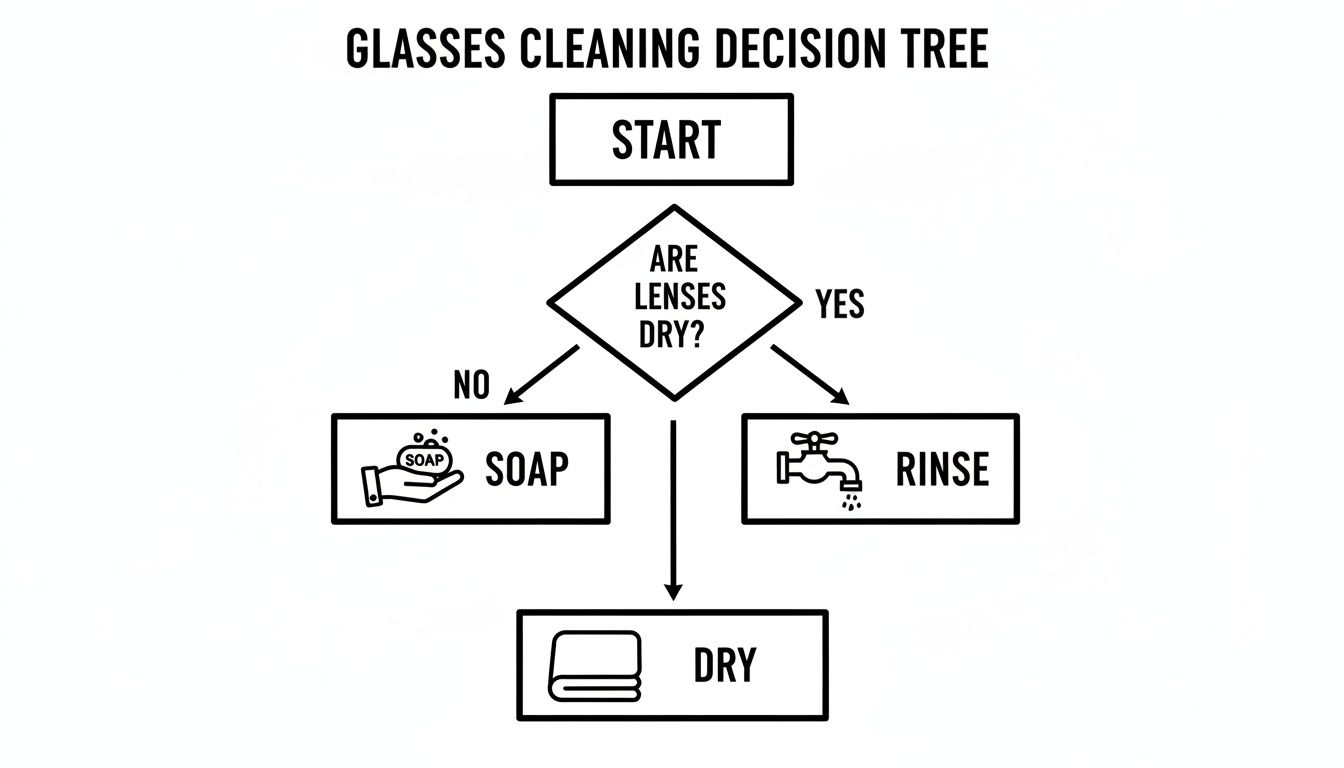
As the flowchart shows, whether you're dealing with a bit of dust or oily smudges, the process always ends with a safe drying method to keep scratches at bay.
Protecting Your Blue-Light Filtering Lenses
If you're a gamer, student, or office worker staring at a screen for hours on end, blue-light filtering lenses are a must for reducing eye strain. The irony is that their constant use makes them magnets for smudges. A dirty blue-light lens can diffuse the light from your screen, which can actually add to the eye fatigue you’re trying to avoid.
The good news? Most blue-light filters are pretty tough because they're integrated right into the lens material. This makes them less vulnerable to chemical damage than surface coatings like AR. Still, you need to keep them clean to maintain that crystal-clear view.
Think about it from a gamer's perspective. A single fingerprint can create a distracting light bloom right in the middle of a dark scene, completely breaking their immersion. A quick daily clean keeps their field of view sharp and free of annoying distortions, which can make all the difference to their performance.
This isn't just an annoyance; it has a real economic impact. With so many Aussie professionals and students relying on screens, those smudges are costing the economy an estimated $1.2 billion a year in lost productivity. One report found that 71% of office workers in major Australian cities suffer from 'computer vision syndrome', which is only made worse by dirty glasses. Fingerprints alone can reduce light transmission by up to 18%. And with 92% of students using tablets daily, improper cleaning with generic wipes is now linked to coating damage on 64% of premium lenses. For more insights, you can check out the latest trends in the Australian eyewear market on IBISWorld.
Maintaining Photochromic (Transitions) Lenses
Photochromic lenses, the ones that darken automatically in sunlight, work because of trillions of light-sensitive molecules embedded in the lens. To keep them transitioning smoothly, you have to shield them from extreme temperatures and certain chemicals that can break those molecules down over time.
A classic mistake is leaving photochromic glasses on the car dashboard on a hot day. That intense heat can permanently cook the molecules, ruining their ability to switch between light and dark. When it comes to chemicals, stay away from anything containing ammonia or acetone, as they can interfere with the photochromic process.
Your Go-To Cleaning Guide for Specialised Lenses
To make things easy, I've put together a quick guide on what’s safe and what’s not for each main lens type. Following these tips is the best way to protect your glasses and make sure they perform their best for years to come.
Safe Cleaning Agents for Your Specific Lens Type
| Lens Type | Recommended Cleaners | Cleaners to Avoid |
|---|---|---|
| Anti-Reflective | Lukewarm water, lotion-free dish soap, dedicated AR-safe lens sprays. | Alcohol-based cleaners, ammonia (Windex), acetone, vinegar, paper towels. |
| Blue-Light Filtering | Lukewarm water, lotion-free dish soap, microfibre cloths. | Abrasive cloths (t-shirts, tissues), harsh household detergents. |
| Photochromic | Lukewarm water, lotion-free dish soap, approved lens cleaners. | Ammonia, acetone, extreme heat (e.g., leaving them in a hot car). |
When you understand the specific needs of your lenses, you shift from just cleaning your glasses to actively caring for them. This mindful approach ensures you get every bit of value out of their advanced features. If you're interested in the nitty-gritty, you can learn more about the different types of lenses for eyeglasses and what makes each one tick.
Proper maintenance is really a cornerstone of good eye health and safety. Because we can customise an eyewear package to suit your requirements, we want you to have the knowledge to protect that personalised investment for the long haul.
Common Cleaning Mistakes That Damage Your Glasses
Knowing the right way to clean your glasses is only half the battle. Just as important is knowing what not to do. Many of us fall into well-intentioned but destructive habits that can permanently damage our lenses and frames, turning a quick fix into a costly mistake.
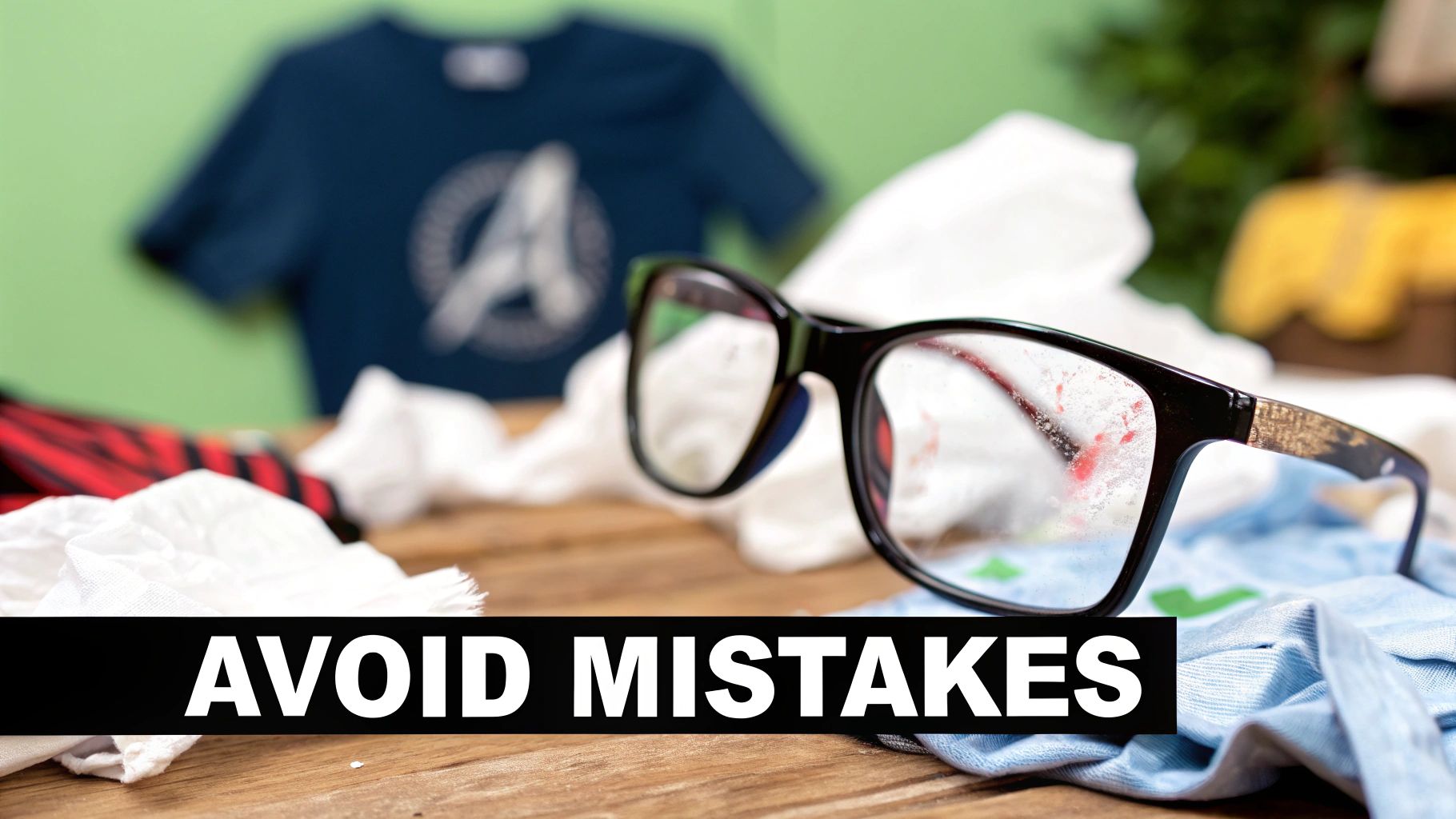
You might think a quick wipe on your t-shirt is harmless, but it's one of the fastest ways to ruin your eyewear. These everyday mistakes can strip away delicate lens coatings, introduce scratches that cloud your vision, and compromise the integrity of your glasses. Let's break down the common pitfalls I see all the time.
The Problem with Using Your Shirt or a Tissue
It's an almost automatic reflex for many glasses wearers: notice a smudge, grab the corner of your shirt, and give it a quick polish. While convenient, this is a recipe for disaster.
The fabric of your clothes, even if it feels soft to you, contains abrasive fibres that act like fine sandpaper on your lenses. The same goes for paper towels and tissues. These products are made from wood pulp, and their surfaces are surprisingly rough. Each wipe grinds trapped dust and debris directly into your lenses, creating a web of micro-scratches that build up over time. These tiny scratches scatter light, which increases glare and permanently degrades your visual clarity.
Think of it this way: a photographer would never dream of cleaning their camera lens with a paper towel. Your eyeglass lenses are just as delicate and require the same level of care.
Why Household Cleaners Are a No-Go
Reaching for the window cleaner under the sink might seem logical—after all, it's for glass, right? Unfortunately, household cleaners are far too aggressive for modern eyewear. These formulas often contain harsh chemicals like ammonia, which can have a devastating effect on specialised lens coatings.
Using these cleaners can strip away anti-reflective, blue-light filtering, and UV-protective layers, rendering them useless. Vinegar and rubbing alcohol are also common culprits; their high acidity and solvent properties can cause coatings to bubble, peel, or craze, leaving you with a distorted and cloudy view.
Protecting your lenses from chemical damage is crucial. Once a coating is stripped or damaged, it can't be repaired. The only solution is a costly lens replacement.
For a deeper dive into what happens when scratches appear and what your options are, you can read our guide on how to handle scratches in glasses.
Other Common Bad Habits to Break
Beyond using the wrong materials, a few other habits can silently sabotage your eyewear. Being mindful of these will help you keep your glasses in top condition for much longer.
- Breathing on Your Lenses: That quick "huff" of breath before wiping does more harm than good. The moisture is acidic and full of bacteria, which you then smear across the lens. It also does nothing to lift away grease or grime effectively.
- Wiping Lenses When Dry: Never, ever wipe your lenses without first rinsing them or using a proper lens spray. Wiping a dry lens grinds existing dust directly into the surface—this is a leading cause of scratches.
- Leaving Glasses Unprotected: Tossing your glasses onto a desk, into a bag, or on your car's dashboard leaves them vulnerable to all sorts of damage. Get into the habit of always using a hard-shell case when they're not on your face.
The key to avoiding these mistakes is simple preparation. Keep a dedicated microfibre cloth and a small bottle of lens-safe cleaner in your car, laptop bag, and at your desk. This one step ensures you always have the right tools on hand, so you're never tempted to reach for your shirt again. Remember, proper care ensures your investment serves you well for years to come.
Advanced Maintenance and Long-Term Eyewear Care
Daily cleaning is great for getting rid of smudges, but keeping your glasses in top shape long-term means going a bit deeper. Over time, things like skin oils, dead skin cells, and makeup residue find their way into all the hard-to-reach spots—think hinges, nose pad arms, and the tiny crevices where the lenses meet the frame. This gunk isn't just gross; it can cause skin irritation and give your glasses that perpetually greasy feel, making them slide down your nose.
To really look after your glasses, you need to think beyond the lenses and give the whole frame some love. It’s all about total eyewear hygiene, making sure your specs are not only clear but also comfortable and clean against your skin all day, every day.
Giving Your Frames a Deep Clean
You know that person who’s always pushing their glasses up their nose? While it could be an issue with the fit, more often than not, it's just a build-up of slippery oils on the nose pads and earpieces. A good deep clean can fix that in a heartbeat.
All you need is a soft-bristled brush (an old, clean toothbrush is perfect) and the same lotion-free dish soap you use for your lenses.
- Hit the key spots: Really focus on the nose pads, the grooves around the lenses, and the hinges where grime loves to hide.
- Be gentle: Use the soapy brush to gently scrub these areas and lift all that built-up gunk.
- Rinse like you mean it: Run the whole frame under lukewarm water until every last bit of soap is gone.
Doing this simple routine every few weeks stops that build-up in its tracks, keeping your glasses sitting firmly and comfortably where they belong. It’s a small step that makes a huge difference to your comfort and eye health.
The Power of an Ultrasonic Clean
For a truly professional-level clean you can do at home, nothing beats an ultrasonic cleaner. These clever devices use high-frequency sound waves to create microscopic bubbles in a water solution. When these bubbles pop, they create a gentle but powerful scrubbing action that gets dirt out of every tiny crevice, screw, and hinge—places a brush could never hope to reach.
This method is a game-changer, especially for gamers and anyone who spends a lot of time in front of a screen. For Prescript users, particularly gamers blocking emissions from PCs, a UNSW study on 1,200 pairs found ultrasonic cleaners reduce residue 92% better than manual methods. With 76% of Aussies over 30 needing vision correction, fingerprints can block up to 15% of light, but a quick, proper clean restores it instantly. Using approved kits and methods can even extend the life of your lenses by 40%.
An ultrasonic cleaner is basically a spa day for your glasses. It rejuvenates them, clearing out months of hidden grime in just a few minutes and bringing back that fresh-from-the-optometrist feeling.
Proper Storage: The Ultimate Protection
The single best thing you can do to protect your glasses long-term is also the easiest: keep them in a hard case whenever they're not on your face.
Tossing them on a desk, into a handbag, or onto your car's dashboard is asking for trouble. It exposes them to dust, debris, and the very real risk of getting scratched or crushed. A solid case is their best defence against the accidents of daily life.
This one habit is crucial for protecting your investment. Lenses can get damaged beyond repair, but you do have options. To figure out when it's time for an update, check out our guide on replacing lenses in your favourite frames.
Ultimately, great vision is a partnership between quality eyewear and excellent care. At Prescript Glasses, we can customise an eyewear package to suit your requirements, providing you with high-performance lenses that deserve the best maintenance to ensure they last.
Your Partner in Lasting Visual Health
Think of keeping your vision crystal-clear as a daily practice, not a one-time fix. We've walked you through the simple, effective habits that protect your eye health and extend the life of your glasses. By dodging those common cleaning mistakes and sticking to the right techniques, you're making sure your lenses perform exactly as they should, day in and day out. That flawless clarity isn’t just a luxury—it’s essential for everything from nailing your work to staying safe on the road.
At Prescript Glasses, we see ourselves as your dedicated partner on this journey. After all, high-quality, precision-engineered lenses deserve the same level of care. We get that everyone's vision needs are different, which is why we can customise an eyewear package to suit your requirements, building lenses to the exact prescription from your eye care professional. Looking after them properly is the final, crucial step in getting the most from that investment.
"Protecting your eyewear is an extension of protecting your vision. The small habits you build today ensure your glasses provide optimal performance and comfort for years to come, directly supporting your long-term eye health and safety."
Your glasses are more than just a tool; they are quite literally your window to the world. Keeping them pristine ensures that view stays sharp, vibrant, and free from annoying distractions. We invite you to explore our huge range of stylish frames and advanced lens options, confident that you now have the expert know-how to care for them properly from day one.
Your commitment to good maintenance, paired with our commitment to quality, is the perfect partnership for lasting visual health.
Got Questions About Cleaning Your Glasses?
We get asked all the time about the little details of keeping eyewear in top shape. Here are some of the most common questions that come our way, with straightforward answers to help you see clearly.
How Often Should I Be Cleaning My Glasses?
For the best possible vision and to protect your lenses, a quick daily clean is the gold standard. A simple wash every morning is enough to lift away the skin oils, dust, and general grime that builds up. If you let it sit, that buildup can actually start to wear away at your lens coatings over time.
Of course, your day-to-day life matters. If you're working in a dusty workshop, you might need a quick rinse mid-day just to see safely. But if you're in an office environment, once a day is usually perfect.
Are Those Pre-Moistened Lens Wipes Safe to Use?
Many of them are, but you have to be a bit picky. The only ones you should consider are wipes made specifically for coated optical lenses. It's absolutely crucial to check that they are alcohol-free. Why? Because alcohol-based formulas are notorious for stripping away anti-reflective and other protective coatings, ruining your expensive lenses.
While they’re handy when you’re out and about, nothing beats the method we trust most: a quality microfibre cloth paired with an approved lens spray or a drop of lotion-free dish soap. It’s the safest and most effective way to care for your glasses long-term.
Honestly, the best approach is always prevention. A proper daily clean and always storing your glasses in a protective hard case when you're not wearing them is the single most effective way to avoid permanent damage.
Can I Buff Out Small Scratches on My Lenses?
Unfortunately, once a scratch is on your lens, it's there for good. You'll see products out there claiming to "fill in" or "buff out" scratches, but they simply don't work. More often than not, they just make the problem worse by smearing a hazy film across the lens or damaging the surrounding coatings.
How Can I Stop My Glasses Fogging Up When I Wear a Mask?
That frustrating fog happens when your warm breath escapes from the top of your mask and hits your cooler lenses. The best fix is getting a really snug fit over the bridge of your nose. Look for a mask with a mouldable metal nose piece—it makes a world of difference in creating a good seal.
For a quick fix, you can also try washing your lenses with soapy water and letting them air-dry. This leaves behind a super-thin film that can help prevent fog from forming.
At Prescript Glasses, we believe that when you know better, you can care for your vision better. We hope these tips help you keep your eyewear in perfect condition. Remember, if you're looking for the ideal lenses for your lifestyle, we can customise an eyewear package to suit your requirements.
Explore our full collection today at https://www.prescriptglasses.com.