A Practical Guide to Single Vision Lenses

When it comes to glasses, single vision lenses are the workhorse. They’re the most common type of lens out there, and for good reason: they do one job, and they do it brilliantly.
Simply put, a single vision lens has one prescription power across its entire surface. It's designed to correct your vision at one specific distance—either for seeing things far away, close up, or at an arm's-length distance. This focus on a single distance is key to ensuring your eye health and safety by reducing the strain that comes from trying to see clearly.
A Clear Look at Single Vision Lenses

Think of your eye as a camera that’s struggling to focus. A single vision lens acts like a perfectly calibrated prime lens, locking in a sharp, clear image for that specific distance. This makes them the go-to solution for the most common vision problems, promoting both clarity and eye health.
Unlike multifocal lenses, which cram different prescriptions into one lens, single vision lenses are specialists. They’re prescribed for two main conditions:
- Myopia (Nearsightedness): You can see your phone perfectly, but the street sign down the road is a blur. A practical example is a university student who can read their lecture notes but can't make out what the professor is writing on the whiteboard.
- Hyperopia (Farsightedness): You can read that street sign just fine, but the words on this screen look fuzzy. For instance, a tailor might see patterns across the room clearly but struggle to thread a needle up close.
They’re also used to correct astigmatism, an issue caused by an unevenly shaped cornea that makes vision blurry at any distance.
To give you a quick overview, here's how they break down.
Single Vision Lenses At a Glance
| Feature | Description | Ideal For |
|---|---|---|
| Corrective Power | One single, uniform prescription across the entire lens. | People who need correction for one specific distance (near, intermediate, or far). |
| Vision Problems | Primarily corrects myopia (nearsightedness) and hyperopia (farsightedness). | Anyone diagnosed with common refractive errors, including astigmatism. |
| Field of View | Provides a wide, uninterrupted, and consistent field of vision. | Activities requiring a constant focus, like driving, reading, or computer work. |
Essentially, they offer a straightforward, reliable fix for the most common vision needs, which is a cornerstone of maintaining good eye health.
Who Benefits Most From These Lenses?
In Australia, the need for clear vision is huge. An incredible 56.7% of us—that's about 14.4 million people—are dealing with at least one long-term eye condition. This is why reliable solutions like single vision lenses are so crucial and why the optometry industry is projected to hit $5.0 billion in revenue by 2025. You can get more insights from IBISWorld's industry report on the Australian eye care market.
These numbers aren't just statistics; they represent millions of people whose daily lives depend on clear, comfortable vision. The beauty of single vision lenses lies in their simplicity, making them a perfect fit for lifestyles where consistent focus at one distance is key.
Just think about who this helps:
- Students and Professionals: Hours spent staring at textbooks or a monitor can be brutal on the eyes. Single vision lenses lock in that perfect focus, dramatically reducing eye strain. A practical example is an accountant who needs to focus on spreadsheets for eight hours a day without getting headaches.
- Gamers: In the world of gaming, seeing every detail crisply can be the difference between winning and losing. These lenses give you that edge-to-edge clarity for total immersion.
- Heavy Smartphone Users: All that endless scrolling and texting adds up. A pair of single vision glasses, especially with a protective coating, makes screen time much easier on your eyes.
The core strength of single vision lenses is their ability to deliver an uninterrupted, crystal-clear field of view for a primary activity. Whether driving, reading, or working at a desk, they provide reliable performance without the visual adjustments required by multifocal lenses.
If your day-to-day routine involves focusing on a single distance for long stretches, these lenses are almost certainly your best bet. We can customize an eye wear package to suit your requirements, ensuring your vision is perfectly matched to your life. Getting this right is about more than just seeing clearly—it's about long-term comfort and eye health.
Choosing Your Perfect Lens Materials and Coatings
Picking the right single vision lenses is about so much more than just matching the numbers on your prescription. It’s about building a pair of glasses that actually fits into your life. Think of it this way: the frames are the car's body, but the lenses are the engine. They’re what determines how well you see, how comfortable you feel, and how protected your eyes are.
Your eyes are working hard all day, every day. Choosing the right lens material and coating is a huge step in creating glasses that don't just help you see, but actively look after your vision and safety.
Good lenses can shield your eyes from harsh UV rays and ease the strain that comes from staring at screens all day—something most of us do for work and play. We're not just correcting your vision; we're giving you a protective tool for one of your most important senses.
This focus on eye health is a big reason why Australia's eye care market is growing so fast. It was valued at USD 1,041.6 million in 2023 and is expected to hit USD 1,679.8 million by 2030. That growth comes from people like you looking for better solutions, like single vision lenses with advanced coatings, especially here in Australia where we juggle an outdoor lifestyle with hours of screen time.
Your Lens Options Explained
So, what are your choices? Each lens type we offer is designed for different situations and lifestyles, letting you create a setup that’s just right for your daily grind. We can customize an eye wear package to suit your requirements, making sure your vision is sharp, safe, and comfortable, no matter what you're doing.
Here’s a quick rundown of the main options:
- Clear Lenses: The classic, go-to choice. Made from top-quality materials, they give you crisp, clear vision for general indoor use. They're a solid, reliable foundation for any pair of specs.
- Photochromic Lenses: Think of these as smart lenses for your eyes. They’re perfectly clear when you're inside, but step out into the sun and they automatically darken to become sunglasses. This provides crucial protection against harmful UV rays.
- BlueRay Lenses: Built for our screen-heavy world. These have a special filter that blocks a portion of the high-energy blue light coming from your computer, phone, and tablet, helping to fight off digital eye strain.
- Bluecromic Lenses: This is the ultimate hybrid. It combines the smart-tinting tech of photochromic lenses with the screen protection of BlueRay lenses. They darken outside and filter blue light everywhere—indoors and out, prioritizing eye safety.
- Sunglass Lenses: These are your dedicated outdoor lenses, permanently tinted to cut down glare and protect your eyes from bright sunlight. Perfect for driving, beach days, or just enjoying the Aussie sun.
Getting to know the differences is the first step. For an even deeper look, check out our guide on the different types of lenses for eyeglasses.
Comparing Prescript Glasses Lens Types
To make things even clearer, here’s a simple table that breaks down each lens type, its main feature, and who it’s best for. It’s a great way to quickly see which option lines up with your lifestyle.
| Lens Type | Key Feature | Best For (Lifestyle) | Eye Health & Safety Benefit |
|---|---|---|---|
| Clear | Standard, all-purpose clear lenses. | Everyday indoor use, office work, students. | Provides foundational vision correction. |
| Photochromic | Automatically darkens in sunlight, clear indoors. | People who move between indoors and outdoors frequently. | Automatic UV protection and reduced glare for eye safety. |
| BlueRay | Filters blue light from digital screens. | Gamers, professionals, heavy smartphone/computer users. | Reduces digital eye strain and potential sleep disruption. |
| Bluecromic | Combines Photochromic and BlueRay features. | The ultimate all-rounder for screen-heavy, active lives. | All-in-one UV protection, glare reduction, and blue light filter. |
| Sunglass | Permanently tinted for sun protection. | Driving, outdoor sports, beach-goers, sunny climates. | Maximum glare reduction and UV protection in bright conditions. |
This table should help you pinpoint the best engine for your new glasses, making sure they're perfectly tuned for your life's demands.
Real-World Scenarios and Practical Examples
Okay, that’s the theory. But how does this play out in real life? Let's walk through a couple of common scenarios to see how the right lens can make a huge difference to your eye health and comfort.
Take a graphic designer who spends eight hours a day glued to a high-res monitor. By 3 PM, they’re usually fighting a dull headache and their eyes feel tired and gritty, making it tough to focus on the tiny details.
- Ideal Solution: BlueRay lenses. These single vision lenses would filter out that constant stream of blue light from their screen, cutting down on digital eye strain and helping them stay comfortable and focused all day.
Now, picture an architect who is constantly moving from their office desk, where they draft plans on a computer, to outdoor construction sites. They need crystal clear vision indoors but instant sun protection the second they step outside.
- Ideal Solution: Photochromic or Bluecromic lenses. Standard photochromic lenses would give them that seamless switch from clear to sunglass, offering automatic UV protection. But if they're also spending hours on CAD software, Bluecromic lenses would be the perfect upgrade, adding that crucial blue light filtering on top of the auto-tinting for comprehensive eye safety.
Eye Health Takeaway: The best lens for you does more than just correct your vision—it proactively shields it from the stresses of your environment. Matching your lens choice to your daily routine is one of the smartest things you can do for the long-term health and safety of your eyes.
By lining up the right lens tech with your lifestyle, you transform your glasses from a simple necessity into a high-performance tool that keeps you comfortable and protected.
Protecting Your Vision in a Digital World
Let's face it, our days are dominated by screens. From the morning phone check to that last episode we stream at night, our eyes are constantly locked onto a digital device. This isn't just a minor habit; it's a huge shift in how we live, and it's creating a whole set of challenges for our eyes, often bundled under the term "digital eye strain."
This isn't just a small inconvenience. It's a real health and safety issue that can sap your focus and comfort. Picture a student cramming for exams, their concentration slipping away as their eyes start to burn. Or think about a serious gamer finishing a long session with a pounding headache and blurry vision. These are the real-world consequences of our eyes working overtime to handle all that screen time.
This is where the right pair of single vision lenses steps in. They're not just for correcting your vision anymore—they're essential protective gear for your modern life. It's all about being proactive and looking after your long-term eye health and safety.
Understanding the Blue Light Challenge
So, what’s really going on with our eyes? Digital screens pump out a lot of high-energy visible (HEV) light, which most of us know as blue light. Unlike the balanced, full-spectrum light we get from the sun, this concentrated blue light scatters more easily, forcing our eyes to work much harder to maintain focus. This constant effort is what leads to that familiar feeling of fatigue, dryness, and those nagging headaches.
Imagine you're trying to read a book, but someone is pointing a bright, flickering blue torch at the page. Your eyes would be straining like mad just to make out the words. That’s a pretty good analogy for what your unprotected eyes go through during hours of screen time.
Now, imagine the same situation, but this time you're wearing glasses with a specialised filter. That harsh glare is instantly softened, the words on the page look sharper, and your eyes can finally relax and focus properly. That's the real, tangible difference a protective lens coating can make for your eye safety.
Your Shield Against Digital Strain
This is exactly why we've poured so much effort into developing advanced lens options like our BlueRay and Bluecromic lenses. They're specifically engineered to be a smart filter, carefully managing the light that gets to your eyes so you can work and play more comfortably and safely.
-
For the Dedicated Indoor User: If your day is spent in front of a monitor—whether you're a professional in an office, a student hitting the books, or a gamer deep in a session—BlueRay lenses are your first line of defence. They specifically target and filter out a portion of the blue light spectrum, which makes a noticeable difference in reducing eye fatigue and keeping you focused for longer.
-
For the Versatile Lifestyle: If you’re constantly moving between your desk and the great outdoors, Bluecromic lenses are the perfect all-in-one solution. Indoors, they give you the same fantastic blue light filtering as our BlueRay lenses. But the moment you step outside, they automatically tint to provide full UV protection, ensuring total eye safety.
Choosing a lens with a blue light filter is a smart investment in your daily comfort and your long-term well-being. It’s not about ditching your screens; it’s about giving your eyes the right tools to handle them safely.
This decision tree infographic makes it simple to figure out which lens is right for you based on your daily routine.
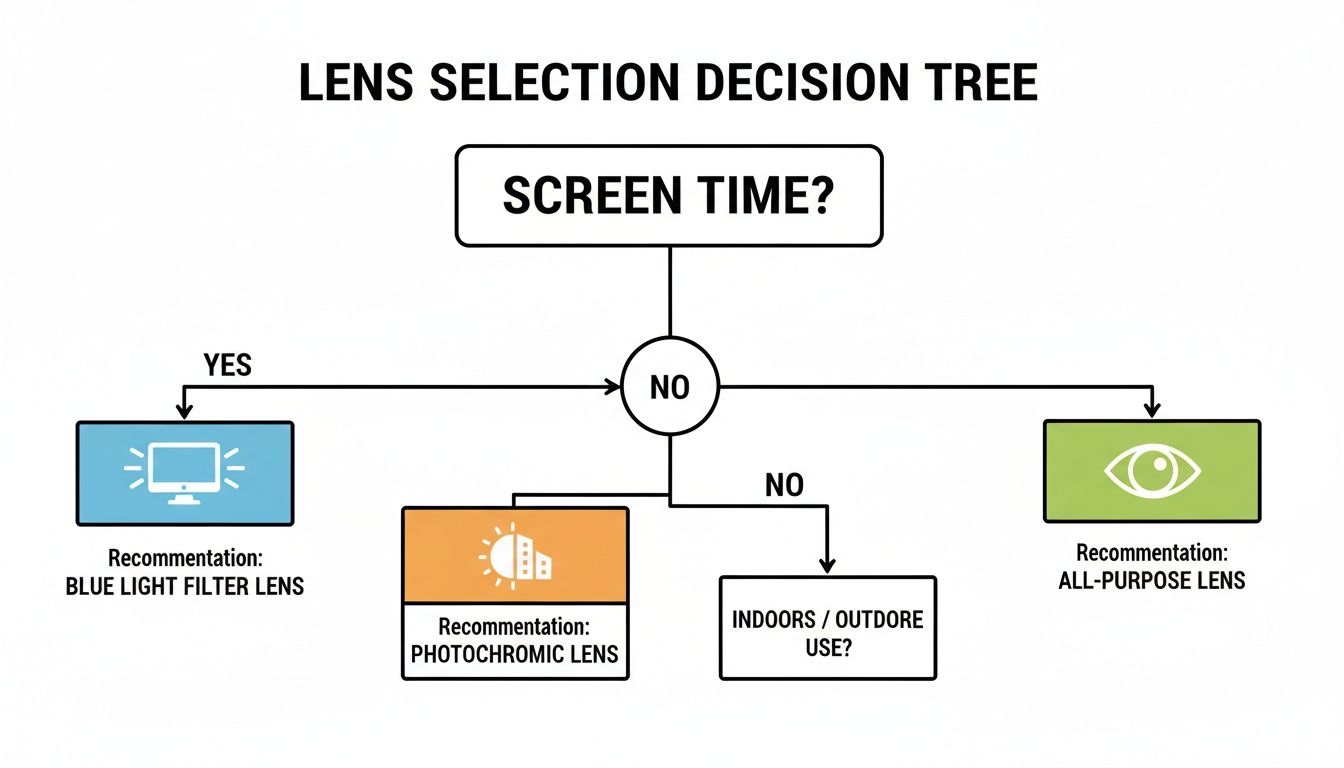
The key takeaway here is simple: your lifestyle should dictate the lens technology you choose to keep your eyes healthy and safe.
The benefits are immediate. With the right protective lenses, that student can study longer without the strain, and that gamer can stay sharp and comfortable, without a headache ruining their focus. It's about boosting your performance by putting your health first. If you want to get into the nitty-gritty of the science, you can learn more about blue light filters in our detailed article.
Ultimately, looking after your vision is a personal choice, and we can customize an eyewear package to suit your requirements. By matching your lens tech to your screen habits, you can be sure your glasses are doing more than just helping you see—they're actively working to keep your eyes safe and healthy for years to come.
How to Read Your Prescription and Choose a Lens Index
Your optical prescription can look pretty intimidating at first glance. It’s full of abbreviations and numbers that feel like a secret code. But once you know how to read it, you’ll have the key to getting glasses that give you perfectly clear vision. Think of it as a precise map for your eyes—and learning to read it puts you in the driver’s seat.
Getting a handle on these details helps you understand exactly what your eyes need and why certain lens options are recommended. It’s the first step to making sure your new glasses are comfortable, clear, and promote long-term eye health.
Decoding Your Prescription Details
When you look at your prescription slip, you’ll see a grid with a few key terms. Each one tells the lab exactly how to craft your lenses. Let's break them down.
- Sphere (SPH): This is the main strength of your lens. A minus sign (–) means you’re nearsighted (myopic), while a plus sign (+) means you’re farsighted (hyperopic). The further the number is from zero, the stronger your prescription.
- Cylinder (CYL): If you’ve got a number here, it means you have astigmatism. This is super common and just means your eye is shaped a bit more like a footy than a perfect sphere. This value corrects the blurriness caused by that unique shape.
- Axis: This number always goes with a CYL value. It’s measured in degrees from 1 to 180 and pinpoints the exact angle to position the astigmatism correction on your lens.
For example, a prescription reading SPH -2.50 / CYL -1.00 / AXIS 90 means the person is nearsighted with a moderate amount of astigmatism. Getting these numbers spot-on is everything when it comes to clear, strain-free vision.
What Is a Lens Index and Why Does It Matter?
Now for the next big decision: the lens index. In simple terms, the index number tells you how efficiently the lens material bends light. A higher index number means the material is better at its job, which allows your lenses to be made much thinner and lighter.
Your lens index has a huge impact on the thickness, weight, and overall look of your glasses. If you have a stronger prescription, choosing a higher index is a game-changer for both comfort and style—it’s what helps you avoid that thick, "coke bottle" look.
For those with a fairly mild prescription (say, between +2.00 and -2.00 SPH), a standard 1.50 or 1.56 index is usually perfectly fine. But as your prescription gets stronger, the benefits of a higher-index lens really start to stack up.
Let’s look at a real-world example: a university student with a prescription of -6.00 SPH.
- With a standard 1.50 index lens, their glasses would be noticeably thick and heavy at the edges. This could feel clunky on their face during long study sessions and create a bit of a distorted look from the side.
- By upgrading to a high-index 1.67 or 1.74 lens, their glasses would be dramatically thinner and lighter. This isn't just about looking better; it means they’ll be more comfortable to wear all day long and have a much sleeker profile.
Choosing the right index is a big part of getting your glasses right, as heavy or poorly balanced specs can lead to discomfort and even headaches. We can customize an eyewear package to suit your requirements, making sure your lens index is perfectly matched to your prescription for the best possible result.
Ordering Your Custom Eyewear Package
You’ve explored the options and have a good idea of what you need; now it’s time for the fun part—creating your perfect pair of glasses. Ordering online is designed to be refreshingly simple, putting you in the driver's seat to build a truly custom solution. We've made sure the process is straightforward, so you can move from selection to checkout with total confidence.
Your prescription is the single most important piece of the puzzle. Before you start, grab your script from your optometrist. Just make sure it’s current (usually that means it’s less than two years old) and that all the key details, like your pupillary distance (PD), are easy to read. Getting this right is the first step towards crystal-clear vision and protecting your eye health.
Building Your Glasses Step-by-Step
Creating your ideal eyewear really just comes down to three simple steps. It's all about merging your personal style with your specific vision needs.
-
Choose Your Frames: First things first, find a style you absolutely love. Think about what works with your face shape, what you do every day, and frankly, what makes you feel great. Whether you need a rugged frame for a busy lifestyle or a barely-there design for all-day comfort, the right foundation makes all the difference.
-
Select Your Lenses: This is where everything you've just learned comes into play. Based on your daily routine, pick the best lens type for you—Clear, Photochromic, BlueRay, Bluecromic, or Sunglass. This decision is crucial for your long-term eye health and comfort. A student burning the midnight oil online, for example, should seriously consider BlueRay lenses to fight off digital eye strain.
-
Upload Your Prescription: Finally, it's time to add your vision details. You can easily upload a photo or a scanned copy of your prescription. Just do a quick double-check to make sure the image is clear and has all the necessary info, including your full name and your optometrist's details.
We believe everyone deserves eyewear that perfectly fits their life. That’s why we can customize an eyewear package to suit your requirements, putting you in complete control of building glasses that are uniquely yours.
This simple process closes the gap between knowing what you need and actually holding your finished glasses in your hands.
Let's Walk Through an Example
Imagine Sarah, a marketing coordinator who spends her weekdays on video calls and her weekends hiking.
First, Sarah finds a stylish but durable frame that looks just as good in the office as it does on a trail. Next, she chooses Bluecromic lenses. Why? Because they filter out blue light during her work week and automatically darken into sunglasses when she’s out in the sun on Saturday. It's the perfect two-in-one solution for her eye health and safety.
Finally, she uploads a clear photo of her recent prescription. She gives all the details a final look, confirms her order, and that's it—she's designed the perfect all-in-one solution for her busy life.
This personalised approach means everyone, no matter where they are, gets the exact eyewear they need. For a more detailed walkthrough, you can learn more about how to order custom prescription glasses online in our complete guide.
Caring for Your Single Vision Lenses
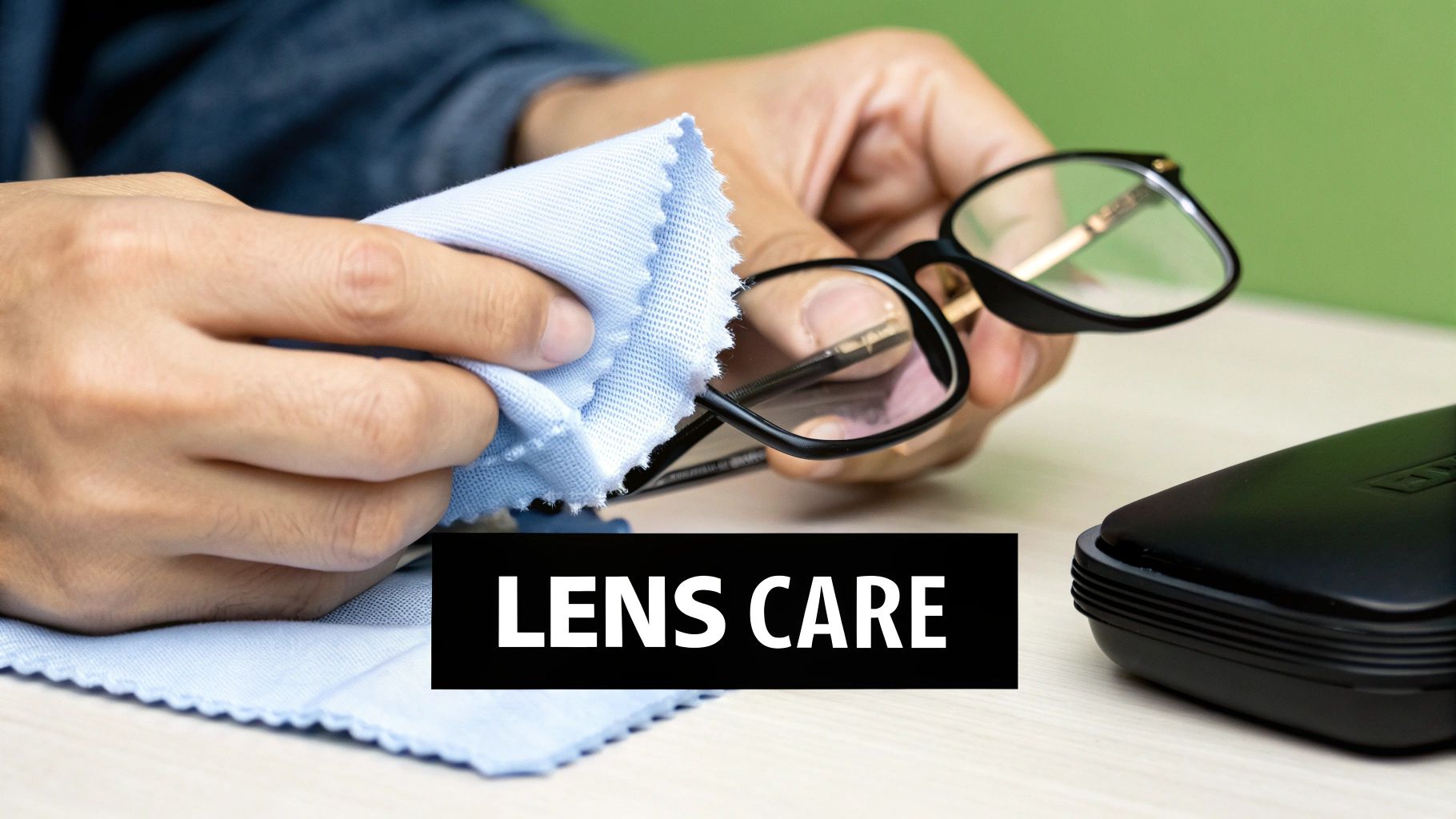
You've invested in a great pair of single vision lenses to sharpen your world, and a little TLC will go a long way in keeping them that way. Think of them like any high-quality tool – they need a bit of upkeep to perform at their best.
Proper care is about more than just a clear view; it protects those advanced coatings you've chosen and seriously extends the life of your glasses. Building a few simple habits can make all the difference, preventing the tiny scratches and smudges that get in the way of crisp, clean vision and compromise your eye safety.
Smart Cleaning and Storage Habits
Keeping your lenses pristine comes down to using the right tools and the right technique. A great first step is to always rinse your glasses under lukewarm water before wiping them. This washes away any dust or grit that could scratch the surface.
- Stick to Proper Cleaner: Only use a spray that’s specifically made for eyeglass lenses. Household products like window spray or anything with ammonia are far too harsh and can actually strip away the protective coatings on your lenses.
- Microfibre Is Your Best Friend: A clean microfibre cloth is the only thing you should use to wipe your lenses. Steer clear of paper towels, tissues, or the hem of your shirt – these materials feel soft but are abrasive enough to cause permanent micro-scratches.
- Give Them a Safe Home: When you’re not wearing your glasses, their protective case is the safest spot for them. Getting into the habit of putting them in their case on your nightstand before bed is a simple way to prevent accidental drops, bends, and scratches.
One of the most common ways people damage their lenses is by leaving them in a hot car. Extreme heat can warp the frames and cause the lens coatings to crack or ‘craze’—a web of fine lines that permanently clouds your vision.
Following these simple tips protects the clarity and durability you paid for. We can customize an eyewear package to suit your requirements, and these habits will help you care for that investment, ensuring you enjoy fantastic vision for years to come.
Frequently Asked Questions
Jumping into the world of prescription glasses can sometimes feel like learning a new language. To make sure you're feeling totally confident, we’ve put together answers to some of the most common questions we hear about single vision lenses.
What Is the Difference Between Single Vision and Multifocal Lenses
The easiest way to think about it is to compare them to camera lenses. Single vision lenses are like a specialist prime lens. They have one, single prescription power across the entire lens, designed to give you a massive, perfectly clear field of vision for one specific distance—whether that's up close for reading, intermediate for computer work, or far away for driving.
Multifocal lenses, on the other hand, are the zoom lens of the eyewear world. They pack multiple prescription strengths into one lens so you can see clearly at different distances. It’s a handy trick, but the trade-off is that your viewing area for any single distance is smaller, and it can take a bit of time for your eyes to get used to finding the sweet spot. A practical example where single vision is better is for a long-haul truck driver who needs a wide, uninterrupted view of the road ahead for maximum safety.
How Do I Know if I Need a Blue Light Filter
A good rule of thumb is to take a quick audit of your daily screen time. If you’re spending hours glued to a computer, tablet, or smartphone for work, study, or even a serious gaming session, a blue light filter is a genuinely smart move for your eye comfort and long-term health.
Think about these real-world scenarios:
- You're an office worker whose eyes feel tired, dry, and gritty by the end of the day.
- You're a student pulling an all-nighter on your laptop, and a nagging headache is making it hard to focus.
- You're a programmer who stares at lines of code for hours and finds your vision blurring in the afternoon.
If any of those sound a bit too familiar, you’ll likely feel a real difference from the reduced eye strain and greater comfort that our BlueRay or Bluecromic lenses offer.
Can I Use My Contact Lens Prescription to Order Glasses
That's a definite no for safety reasons. It might seem like they should be interchangeable, but contact lens and glasses prescriptions are fundamentally different, and it all comes down to one thing: distance.
A contact lens sits right on the surface of your eye, while a glasses lens is positioned a small distance away. This gap, however small, actually changes the physics of how the light is corrected. Because of this, the numbers for the sphere, cylinder, and axis are often different. Using a contact lens script for glasses will lead to blurry vision and could give you some serious eye strain. Always use a current, dedicated glasses prescription from your optometrist to ensure your vision is both sharp and safe.
How Often Should I Update My Glasses Prescription
For most adults, getting a comprehensive eye exam and updating your prescription every one to two years is the standard recommendation. This ensures your single vision lenses are always giving you the most accurate vision correction, which is vital for your eye health.
It's easy to miss the small, gradual changes in your vision over time. Regular check-ups aren't just about tweaking your prescription; they're a vital part of proactive health, helping to spot other potential eye health issues early on.
Of course, if you notice your vision getting blurrier, find yourself getting more headaches, or feel like your eyes are constantly strained, don't wait. Book an appointment with your optometrist sooner rather than later. Keeping that prescription up-to-date is the key to clear, comfortable, and safe sight.
At Prescript Glasses, we’re all about making sure you get eyewear that fits your vision and your life perfectly. We can customize an eye wear package to suit your requirements, so you get the absolute best solution. Ready to see the difference? Explore our full range of frames and lenses today and find your perfect pair at https://www.prescriptglasses.com.