
A Guide to Glasses for Eye Strain

If you've ever wrapped up a long day staring at a screen and felt that gritty, tired, or achy sensation in your eyes, you've met digital eye strain. It's an incredibly common side effect of our screen-filled lives, and specialised glasses are designed to tackle it head-on. They work by filtering out harsh, high-energy blue light and cutting down the glare from digital screens, prioritizing your long-term eye health and safety.
This targeted approach can make a world of difference, easing symptoms like exhausted eyes, persistent headaches, and even that frustrating end-of-day blurry vision. For anyone spending hours in front of a computer, tablet, or smartphone, they're a practical way to deal with the root causes of digital discomfort and protect your vision.
What Is Digital Eye Strain and How Can Glasses Help?
Think about how your eyes feel after reading a physical book versus how they feel after hours on a laptop. It's a different kind of tired, right? That's because our eyes have to work much harder to focus on screen pixels, which have less defined edges and are constantly refreshing.
This non-stop effort, combined with the intense glare and high-energy blue light beaming from our devices, leads to a whole host of uncomfortable symptoms. It’s not just about your eyes feeling worn out; digital strain can trigger headaches, a stiff neck, and make it difficult to concentrate. Protecting your eye health is not just about comfort—it's about ensuring your vision stays sharp and healthy for years to come.
This isn't a niche problem—it's everywhere. In Australia, the massive increase in screen time has directly contributed to a national rise in eye strain. This trend is fuelling demand for eyewear that can keep up, with the Australian market already valued at AUD 229 million in 2024 and projected to grow even more. You can dive deeper into the Australian eyewear market's growth over at ResearchAndMarkets.com.
Common Triggers for Digital Eye Strain
Figuring out what's causing your discomfort is the first step to feeling better. Eye strain isn't just a vague feeling; it's your body's direct response to specific habits and environmental factors.
Here are a few of the most common culprits behind that daily eye fatigue:
- Long Stretches of Screen Time: Spending hours staring at a computer or phone without taking breaks keeps your eye muscles locked in a state of tension. Practical example: An office worker glued to spreadsheets for eight hours straight without looking away is forcing their eye muscles into a marathon, leading to fatigue and strain.
- Bad Lighting and Glare: Working in a dim room or under harsh overhead lights that reflect off your screen creates a distracting glare. This makes your eyes work overtime just to see what's on the screen, leading to quicker burnout.
- The Wrong Viewing Distance: Hunching too close to your monitor or holding your phone right up to your face puts a huge amount of stress on your eyes' focusing muscles.
- Uncorrected Vision Problems: Even a minor vision issue you might not have noticed can become a major source of discomfort when you add hours of screen time into the mix.
At its core, the problem is simple: our eyes weren't designed for the constant, close-range focus that screens demand. Specialised glasses act like a buffer, filtering out the harshest parts of screen light to give your eyes the relief they desperately need and safeguard your long-term eye health.
To help you pinpoint if your symptoms are screen-related, we've put together a quick guide.
Quick Guide to Digital Eye Strain Symptoms
Use this table to quickly identify if your daily screen habits are causing digital eye strain and see how specialized glasses can provide relief.
| Symptom You Might Feel | Common Daily Cause | How Eye Strain Glasses Help |
|---|---|---|
| Tired, Heavy, or Aching Eyes | Hours of focusing on a screen without breaks, forcing eye muscles to stay tense. | Lenses are optimised for screen distance, reducing the focusing effort required. |
| Headaches or Migraines | Constant exposure to bright screen glare and high-energy blue light. | Blue light filters and anti-glare coatings reduce the light intensity hitting your eyes. |
| Dry, Itchy, or Watery Eyes | We blink less when staring at screens, which dries out the surface of the eye. | Anti-glare coatings minimise reflections, reducing the visual "noise" that can cause you to stare intently and forget to blink. |
| Blurry Vision (at end of day) | Eye muscles are exhausted from holding focus for too long. | By making the screen clearer and less harsh, glasses help your eyes relax, preventing focus fatigue. |
| Neck and Shoulder Pain | Hunching over to see a poorly positioned or glaring screen. | With clearer vision, you're less likely to adopt poor posture to compensate for screen glare or small text. |
If any of these sound familiar, a pair of glasses designed for screen use could be a game-changer.
A Practical Solution for Your Eye Health
This is exactly where glasses for eye strain come in. They are built from the ground up to fight the main culprits of digital viewing, acting as a crucial tool for eye health and safety. By using technologies like blue light filters and anti-reflective coatings, these glasses go straight to the source of screen-related discomfort.
A student pulling an all-nighter, for example, will find that blue light filtering lenses can reduce that feeling of visual burnout and might even help them get to sleep easier afterwards. Likewise, a professional who lives in video meetings can benefit from an anti-glare coating that cuts out distracting reflections from lights and windows.
Getting familiar with the different symptoms of digital eye strain is the best way to figure out if this solution is right for you. We know everyone's situation is different, which is why we can customize an eye wear package to suit your requirements, making sure you get the exact support your eyes need to stay comfortable and healthy.
The Science Behind Anti-Strain Lenses
To really get why glasses for eye strain are so effective, we need to go beyond the frames and look at the technology baked right into the lenses. This isn't just a simple piece of glass; it's smart tech designed to actively shield your eyes from the daily onslaught of digital screens, focusing on your long-term eye health and safety.
Each feature is engineered to tackle the main culprits of digital fatigue head-on. Whether it's filtering out specific types of light or cutting down on visual noise, the science all points to one thing: making your screen time feel a whole lot easier on your eyes. Let’s break down the key technologies that make these glasses a must-have.
This focus on advanced lens tech is a huge deal in the eyewear world. The global market for spectacles is booming and is tipped to hit USD 108.71 billion in 2025. Here in Australia, we're right at the centre of this growth, thanks to high rates of urban myopia and a real appetite for health-focused technology. It’s the perfect climate for specialised glasses for eye strain to shine.
The Blue Light Filter Shield
The feature that gets the most attention in anti-strain glasses is the blue light filter. The easiest way to think of it is as a bouncer for light, only letting the good stuff through. Our digital screens pump out a heap of high-energy visible (HEV) light—what we all know as blue light—which scatters more than other light, making it tricky for our eyes to focus properly.
This constant struggle to process scattered blue light is a massive reason for digital eye strain, that tired feeling, and can even mess with your sleep. Lenses with a blue light filter are treated with a special polymer that either absorbs or bounces off a portion of this harsh light before it even gets near your eyes, acting as an essential safety measure.
Practical example: A graphic designer burning the midnight oil will notice that these lenses dial down that buzzing, overstimulated feeling their eyes get. The filter essentially "warms up" the light from the screen, making it less intense and giving their eye muscles a chance to relax. To dive deeper into the nuts and bolts, check out our guide that explains how blue light filters work in more detail.
Anti-Reflective Coatings For Crystal Clear Vision
Next up is the anti-reflective (AR) coating, which you might also hear called an anti-glare coating. Picture trying to chat with someone through a window pane that’s reflecting everything behind you. You’d have to squint and strain to see their face clearly. That’s exactly what’s happening when your glasses catch the glare from an overhead light or a sunny window.
An AR coating is an ultra-thin, multi-layered film applied to the lens that cancels out these reflections. By doing this, it lets more light pass straight through to your eyes, giving you sharper, clearer vision without the distractions.
- Practical Example: For a student in an online lecture, an AR coating means they won’t be staring at the reflection of their own desk lamp. It’s a small tweak that makes a world of difference, cutting out the visual "static" so they can focus entirely on the lesson without their eyes working overtime.
By minimising reflections, anti-glare coatings improve visual acuity and reduce the squinting and eye fatigue that come from fighting distracting glare all day.
Subtle Magnification For Close-Up Work
The final piece of the puzzle, especially for heavy computer users, is a slight magnification boost. These are often called "computer" or "office" lenses. When we stare at things up close—like a monitor or phone—for hours on end, the tiny ciliary muscles in our eyes are in a constant state of tension to hold that focus.
These specialised lenses have a very subtle magnification power that helps those eye muscles chill out. It’s not a dramatic change like you’d get with full-blown reading glasses. Instead, think of it as a gentle helping hand that reduces the effort your eyes need to make to keep things sharp.
This feature is a game-changer for anyone whose job involves staring at a screen all day. Practical example: An accountant looking at a complex spreadsheet would find this gentle boost helps keep the numbers crisp with far less effort, preventing that all-too-familiar blurry vision at the end of the day. Because everyone's work is different, we can customize an eye wear package to suit your requirements, making sure you get the perfect level of support.
Finding the Right Glasses for Your Daily Life
Choosing the right glasses for eye strain isn't about finding one magical "best" pair. It's really about matching the right lens technology to what you do all day, with a focus on your personal eye health and safety. The demands on your eyes are completely different when you're staring down a spreadsheet compared to battling it out in a video game or just scrolling through your phone.
Once you pinpoint your main activities, you can pick features that will give you real, noticeable relief.
This personalised approach is more important than ever. According to the Australian Bureau of Statistics’ National Health Survey (2022), a staggering 14.4 million Australians live with one or more long-term eye conditions. This huge need for better vision is what powers Australia’s $5 billion optometry industry, and it underscores just how critical it is to find a solution that fits you.
The Office Professional Staring at Spreadsheets
If you spend your nine-to-five parked in front of a computer, you know the struggle. You’re juggling multiple monitors, weird office lighting, and endless video calls, all of which team up to exhaust your eyes. The goal here is simple: make your work environment less of a battle for your vision.
A slight magnification boost, often built into "computer" or "office" lenses, is a total game-changer. It subtly dials back the focusing effort your eyes have to put in for hours on end, which helps stop that classic end-of-day blurriness from setting in.
For the office pro, the perfect glasses are a combo of anti-reflective coatings to kill screen glare and a gentle magnification to let the eye's focusing muscles relax during long stretches of close-up work.
The Dedicated Gamer Seeking an Edge
Gaming isn’t passive viewing. It demands intense focus, lightning-fast eye movements, and the ability to spot tiny details in chaotic environments. For gamers, your average eye strain glasses just won't cut it. You need something that boosts your visual performance while protecting your eyes from the fatigue of marathon sessions in front of a high-refresh-rate monitor.
Practical example: A competitive gamer needs to see an opponent hiding in a dark corner of the screen. This is where specialised lens tints, usually with a yellow or amber hue, come into play. These tints crank up the contrast, making it way easier to spot enemies lurking in the shadows. They also filter out a hefty chunk of the most intense blue light, which cuts down on visual noise and makes everything on screen look sharper and more defined. You can dive deeper into the options in our guide to the best blue light blocking glasses.
The Diligent Student Balancing Books and Laptops
A student's life is a constant visual workout. One minute you're decoding a dense textbook, the next you're banging out an essay on a laptop, and then you're tuning into a lecture on a tablet. All this switching between different distances and light sources puts a unique kind of strain on your eyes.
For students, the most crucial feature is a top-notch blue light filter. It helps take the harsh edge off screen light during those late-night study sessions, which not only reduces eye fatigue but can also help you maintain a more regular sleep schedule. An anti-reflective coating is also a must-have to fight glare from library lights or a desk lamp bouncing off your screen.
The Social Media Enthusiast on the Go
If your screen time is mostly spent scrolling social media on a small smartphone, your visual challenges are different again. The tiny text and bright, pocket-sized display force your eyes to work overtime just to stay in focus. It’s the fast track to squinting and that tired, gritty feeling we all know too well.
For the heavy phone user, the biggest win comes from a premium anti-reflective coating. It slashes the distracting glare from your surroundings, making that small screen much easier to look at. Pair that with a blue light filter to soften the intense light beaming from your phone, and you'll find those long scrolling sessions become a lot more comfortable.
Matching Lens Features to Your Lifestyle
Finding the right combination of features can feel tricky, so we've put together this quick guide to help you match our lens technology to your daily grind.
| Your Profile | Primary Screen Activity | Top Recommended Feature | Secondary Feature to Consider |
|---|---|---|---|
| Office Professional | Spreadsheets, documents, video calls on multiple monitors. | Gentle Magnification (Office Lenses) | Anti-Reflective Coating |
| Dedicated Gamer | Fast-paced gaming on high-refresh-rate monitors. | Contrast-Enhancing Tint | Premium Blue Light Filter |
| Diligent Student | Switching between books, laptops, and tablets. | High-Quality Blue Light Filter | Anti-Reflective Coating |
| Social Media User | Scrolling on a small, bright smartphone screen. | Premium Anti-Reflective Coating | Standard Blue Light Filter |
Remember, this is just a starting point. Because everyone's eyes and habits are unique, we can customize an eye wear package to suit your requirements, ensuring you get the perfect setup for your lifestyle.
Creating Your Perfect Custom Eyewear Package
Getting the right glasses for eye strain shouldn't be a chore. We’ve made the process of building your ideal pair online simple and clear, putting you firmly in the driver's seat of your own eye health. The whole idea is to get you from browsing to a perfectly configured pair of glasses in just a few quick steps.
Because everyone’s vision and style are unique, we can customize an eye wear package to suit your exact requirements. This means every single element—from the frame that sits on your face to the coatings that shield your eyes—is chosen by you, for you.
Step 1: Select a Frame That Matches Your Style
First things first, let's find you a frame. This is more than just a holder for your lenses; it's a piece of your personality and a massive part of your daily comfort.
Practical example: A professional in a corporate office might lean towards a sleek, minimalist metal frame that looks sharp in meetings. A student, on the other hand, might want a bold, durable acetate frame that can handle being tossed in a backpack between classes. Have a look through the different shapes, materials, and colours and think about what will feel good after hours of wear and what style just feels like you.
Step 2: Easily Upload Your Prescription
Once you’ve landed on the perfect frame, it’s time for the most important bit: your prescription. This is what ensures your vision is corrected with precision, which is the foundation for kicking eye strain to the curb. We know this step can seem a bit daunting, but it’s incredibly straightforward.
Your optometrist gives you all the details you need—like Sphere (SPH), Cylinder (CYL), and Axis—after an eye exam. You can simply upload a photo or a scanned copy of that document straight to our site.
- Practical Example: Just grab your smartphone and take a clear photo of your prescription paper. When you get to this step in the ordering process, you'll be prompted to select that image from your phone's gallery to upload. Our system takes it from there, making sure every detail is captured perfectly for your new lenses.
Step 3: Choose Your Ideal Lens Type
Next up is picking the lens type that fits your vision. For most people, this comes down to two main options, and the good news is both work perfectly with our anti-strain tech.
- Single Vision Lenses: These are the go-to for most people. They correct for one field of vision—either for distance, intermediate tasks (like computer work), or near vision (for reading).
- Progressive Lenses: If you need help seeing at multiple distances, these are for you. Often called "no-line bifocals," they give you a smooth, seamless transition from near to far vision without any distracting lines.
Step 4: Add Essential Lens Coatings
This is the final, crucial step where you arm your glasses with the features that actively fight digital eye strain. Think of these coatings as the powerhouse of your eyewear, turning a standard pair of corrective lenses into a specialised tool for screen-heavy life and a key part of your eye safety strategy.
The right coatings are non-negotiable for anyone serious about protecting their eyes from digital fatigue. They act as a shield, filtering out the harsh elements of screen light that cause discomfort and long-term strain.
You’ll be able to add key protective layers like:
- Blue Light Filtering: This is a must-have for cutting down the high-energy light from screens that leads to eye fatigue and can mess with your sleep.
- Anti-Reflective Coating: This brilliant addition gets rid of annoying glare from overhead lights and screen reflections, giving you a much clearer, more comfortable view.
By following these four steps, you end up with a completely personalised eyewear package. This hands-on approach empowers you to build a solution from the ground up that tackles your specific eye health and safety concerns with total confidence.
Ensuring a Perfect Fit for Maximum Comfort
Let's be honest: even the most technically advanced lenses are pretty useless if the frames are sliding down your nose all day. A poor fit doesn't just feel annoying—it can cause real discomfort and completely undermine the visual clarity you're trying to achieve. Think of a perfect fit as the final, crucial piece of the puzzle. It’s what makes your glasses for eye strain truly wearable and effective from morning to night.
Getting the fit right is about more than just comfort; it's a matter of optical science and eye safety. If the centre of the lens doesn't line up perfectly with your pupil, your eye has to work harder to see clearly. This can actually create more strain, undoing all the good work of your carefully chosen lenses and coatings. That’s why a few simple measurements are so important to get right.
The visual guide below breaks down the simple, four-step journey of creating a custom pair of glasses, from the moment you choose a frame to adding the final protective coatings.
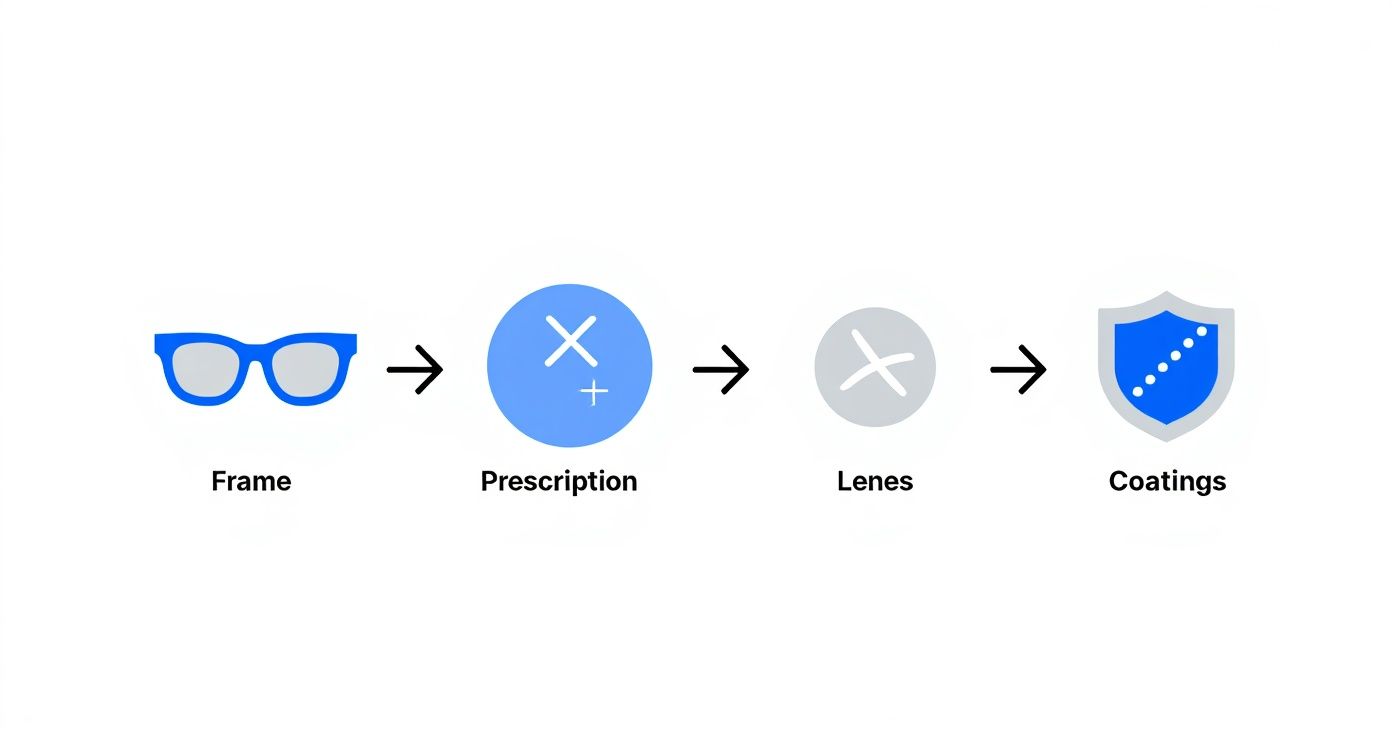
As you can see, each step builds on the last, coming together to create a pair of glasses designed just for you and your vision needs.
Mastering Key Frame Measurements
You don’t need to be an optometrist to understand frame sizing. It all comes down to three numbers, usually printed right on the inside of the temple arm (the bit that goes over your ear).
- Lens Width: This is the horizontal measurement of a single lens in millimetres. It tells you how wide the lenses will look on your face.
- Bridge Width: This is the gap between the two lenses. It's the key to making sure the glasses sit comfortably on your nose without pinching or slipping.
- Temple Length: This is the full length of the arm, from the hinge to the tip. It ensures the glasses hook securely and comfortably over your ears.
Practical example: You might see a frame marked 52-18-140. This means it has a 52mm lens width, an 18mm bridge, and 140mm temple arms. The easiest way to find a great fit online is to check these numbers on a pair you already own and love, then find a new frame with similar dimensions.
The Importance of Pupillary Distance
There’s one other number that’s absolutely critical for any prescription glasses: your Pupillary Distance (PD). It’s simply the distance, in millimetres, between the centres of your pupils.
Getting your PD measurement correct is non-negotiable for optical accuracy. It ensures the exact centre of each lens is placed directly in front of your pupil, providing the clearest and most comfortable vision possible.
Your optometrist will measure your PD during an eye test and include it on your prescription. When you order glasses, entering this number accurately ensures your lenses are made precisely for your eyes. A correct PD is a cornerstone of effective eye strain relief, while an incorrect one can lead to headaches and visual discomfort.
Caring for Your New Glasses
Once you have your perfectly fitted glasses, a little TLC will keep them in top condition for years. This is especially true for lenses with special coatings, like anti-reflective and blue light filters, which need a gentle touch.
Here are a few practical tips to keep them looking and working their best:
- Always use a microfibre cloth. Paper towels, tissues, or the hem of your shirt feel soft, but they contain rough fibres that can cause micro-scratches on your lens coatings.
- Use a dedicated lens spray. Steer clear of harsh chemicals like window cleaner or ammonia-based products. These can strip away the protective coatings you paid for.
- Store them safely in their case. The case is your glasses' best friend. Tossing them onto a desk or into a bag is an open invitation for scratches, smudges, or bent frames.
Because everyone’s eyes and needs are unique, we can customize an eye wear package to suit your requirements, ensuring you get the perfect combination of fit, function, and features right from the start.
Healthy Habits to Complement Your New Glasses
While getting the right pair of glasses is a huge step toward fighting digital eye strain, they really shine when you back them up with some solid, healthy habits. Think of your new eyewear as a powerful shield; these habits are the smart tactics that keep you from needing that shield quite so often, forming a complete eye health and safety plan.
The best part? These practices are simple, totally free, and you can start weaving them into your daily routine today. The goal is to simply ease the workload on your eyes, which lets your glasses do their job even more effectively.
Adopt the 20-20-20 Rule
One of the most powerful tricks in the book for beating eye fatigue is the 20-20-20 rule. It’s a simple memory aid designed to give your hard-working focusing muscles a genuine break.
The idea couldn’t be easier: for every 20 minutes you spend staring at a screen, take a moment to look at something about 20 feet (that's roughly 6 metres) away for at least 20 seconds. This small act lets your eye muscles, which have been tensed up focusing on things up close, finally relax.
This isn't just a nice idea; it's a practical exercise that directly counters the muscle fatigue built up from staring at screens without a pause. Practical example: Set a recurring timer on your phone or computer to pop up every 20 minutes, reminding you to look out the window at a distant tree for half a minute before diving back into your work.
Optimise Your Workspace Ergonomics
Your physical setup plays a surprisingly big role in how your eyes feel at the end of the day. A few small tweaks to your desk and environment can dramatically cut down on strain.
- Position Your Monitor Correctly: Your screen should be about an arm's length from your face, with the top of the monitor sitting at or just below your eye level. This stops you from craning your neck or holding your eyes in a weird, strained position.
- Control Room Lighting: Try to position your screen so you don’t get annoying glare from windows or harsh overhead lights. Softer, ambient lighting is much kinder to your eyes than a single, bright spotlight.
- Adjust Device Settings: Don’t be afraid to bump up the font size to something more comfortable. You should also adjust your screen’s brightness to match the ambient light in your room—it shouldn't feel like you're staring into a lamp.
While glasses are a fantastic first line of defence, it's worth looking into comprehensive strategies to reduce eye strain from computers, which cover even more detail on monitor and lighting adjustments.
Remember, think of your new glasses as a key player in your eye care team, not the only player. By combining them with these simple habits, you’re taking full control of your visual comfort. And because everyone’s needs are different, we can customize an eye wear package to suit your requirements, making sure your new glasses fit perfectly into your healthier screen routine.
Common Questions About Glasses for Eye Strain
Dipping your toes into the world of specialised eyewear can bring up a few questions. To help you feel completely confident in your choice, we’ve put together some straightforward answers to the queries we hear most often. Let's clear up any lingering doubts you might have about protecting your eyes.
Do I Need a Prescription for These Glasses?
It really just depends on your current vision. You can get a fantastic pair of non-prescription (plano) glasses that have all the important coatings, like blue light filters and anti-glare. These are the perfect solution if your eyesight is fine but you still want relief from screen fatigue.
However, if you already wear glasses for distance or reading, it's crucial to have your prescription built into your new lenses. Using the wrong prescription—or skipping it altogether when you need it—can actually make eye strain worse, which is a risk to your eye health and safety.
Is It Okay to Wear Blue Light Glasses All Day?
Absolutely. Wearing glasses with a blue light filter all day is perfectly safe. In fact, it can be quite helpful, especially if you’re constantly moving between different digital devices and artificially lit rooms. The filtering tech is designed to be selective, cutting down your exposure to the harshest blue light waves without messing with your colour perception.
Think of it like sunscreen for your eyes—it’s a protective layer that helps shield you from that constant, low-level exposure you get all day long.
How Are Custom Glasses Different From Cheaper Options?
The main difference comes down to precision and quality. Those generic, one-size-fits-all blockers you see online often use a lower-grade coating that can peel or scratch easily. They can also create a noticeable yellow or brown tint that distorts colour.
A professionally customised pair is built around your specific prescription and pupillary distance. This optical accuracy ensures the lenses are perfectly centred for your eyes, providing the clearest vision and most effective strain relief possible. This precision is a key factor in long-term eye health and safety.
When Should I See an Optometrist for Eye Strain?
While the right glasses and some healthy habits can solve most issues, certain symptoms are a red flag for your eye health. If your eye strain just won't go away, feels severe, or comes with things like double vision, floaters, or sharp pain, it’s time to book an eye exam. These could be signs of an underlying condition that needs a professional look.
And remember, beyond just wearing the right glasses, sorting out your workspace lighting can make a huge difference. You might want to consider adding an ambient LED backlight strip for your PC monitor to create a softer, more balanced viewing environment.
At Prescript Glasses, we get that no two pairs of eyes are the same. That's why we make it simple to build the perfect eyewear for your digital life. We can customize an eye wear package to suit your requirements, ensuring you get all the features you need for comfortable, clear vision.
Ready to see the difference? Design your custom glasses today!