
How can i tighten my glasses: Simple Fixes for Metal & Plastic Frames

It's one thing to fix a loose pair of glasses, but it's another to understand why they started slipping in the first place. You can often get away with a quick fix—tightening a hinge screw, tweaking the arms, or adjusting the nose pads—but for a real, long-term solution, you need to get to the root of the problem and appreciate why a secure fit is so important for your eyes.
Why Your Glasses Keep Slipping (and Why You Should Care)
If you’re constantly pushing your glasses back up your nose, that’s not just a minor annoyance—it’s a clear signal your eyewear isn't doing its job properly. Over time, things like daily wear, temperature fluctuations, and even how you take them off can cause the frame to lose its original shape. For example, leaving your plastic frames on the dashboard of your car on a hot day can cause them to expand slightly. Metal frames can bend out of alignment, and plastic ones can stretch just enough to start that frustrating slide down your face.
This isn't just about irritation, though. It's a real issue for your Eye Health and Safety. When your glasses aren't centred correctly on your face, the optical centre of the lens no longer aligns with your pupils. This misalignment forces your eyes to work overtime just to focus, a bit like trying to read a book while someone is constantly jiggling it.
This can lead to some pretty frustrating symptoms:
- Digital Eye Strain: That familiar feeling of tired, dry, or blurry eyes gets a whole lot worse.
- Headaches: Your brain is working harder to compensate for the wonky vision, often triggering tension headaches.
- Reduced Visual Clarity: Simply put, you're not getting the crisp, clear vision your prescription was designed to deliver.
For anyone staring at a screen all day, whether you're a professional on a deadline or a student hitting the books, these problems can seriously get in the way of comfort and productivity.
The Foundation of Good Vision is a Customised Fit
A perfect fit isn't a luxury; it's the absolute foundation of effective eyewear. It guarantees your lenses are positioned for optimal vision, giving you the clarity you paid for without causing any strain or discomfort. This is particularly crucial in Australia, where our screen-heavy lifestyles have contributed to a noticeable rise in vision problems.
In fact, the Australian Bureau of Statistics' National Health Survey 2022 revealed that a massive 14.4 million Australians (56.7%) have at least one long-term eye condition, and digital eye strain is a huge part of that story.
A well-fitted pair of glasses should rest comfortably on the bridge of your nose and feel secure behind your ears without pinching or pressure. You shouldn't even notice you're wearing them.
While a quick DIY adjustment is great for a minor slip, the best approach is always starting with a frame that’s perfectly suited to you from the get-go. Before you even think about adjustments, it's worth understanding what glasses suit your face to make sure you have the best possible foundation.
We believe everyone deserves eyewear that feels like it was made just for them. That’s why we can customize an eyewear package to suit your requirements, building your glasses from your prescription up to ensure lasting comfort and perfect alignment right out of the box.
Quick Fix Reference Guide for Loose Glasses
To help you quickly identify the right fix for your specific problem, here's a handy table summarising the common issues and the best DIY methods we'll cover in this guide.
| Common Problem | Best DIY Method | Frame Type | Difficulty |
|---|---|---|---|
| One side feels higher than the other | Bending the Temple Arms | Metal & Plastic | Easy |
| Glasses slide down your nose | Adjusting Nose Pads/Arms | Metal & Plastic | Easy |
| Screws on hinges are loose | Tightening Hinge Screws | Metal & Plastic | Very Easy |
| Frame feels too wide overall | Heat Adjustment (Carefully!) | Plastic | Medium |
This table is a great starting point, but remember to read the detailed instructions for each method to avoid damaging your frames. Now, let's get into the specifics.
Getting Your Toolkit Ready for a Safe Adjustment
Before you even think about touching a screwdriver to your glasses, the first step is always getting your tools and workspace sorted. This isn't about tracking down specialist optometry gear; chances are, you've got everything you need hiding in a drawer at home. Setting yourself up properly is a huge part of Eye Health and Safety, as it prevents those accidental slips that can lead to a scratched lens or a bent frame. A simple mistake, like trying to tighten a screw on an unstable surface, could cause the screwdriver to slip and permanently scratch your lens.
First, find a clean, well-lit spot to work. A desk or kitchen table is perfect. The most important thing is to lay down a soft towel or cloth on the surface. This gives you a safe, non-slip area for your glasses and, trust me, it’ll stop those tiny hinge screws from bouncing off into oblivion.
Your At-Home Adjustment Kit
You really don't need much. A good DIY adjustment kit is all about precision and protection. Here’s what you should have on hand:
- An Eyeglasses Screwdriver Set: These are cheap as chips and a must-have. They usually come with a couple of different heads (flat-head and Phillips) to fit the tiny screws used in most frames.
- Needle-Nose or Soft-Jawed Pliers: These are for making gentle tweaks to metal frames. The golden rule here is to wrap the tips in electrical tape or a bit of soft cloth. This simple trick gives you the grip you need without marking or scratching the finish.
- A Microfiber Cloth: This is non-negotiable. You'll use it for holding the frames steady without getting fingerprints everywhere, and of course, for giving the lenses a good clean when you're done. For the best results, pair it with a quality eyeglass cleaner spray and microfiber cloth.
- A Gentle Heat Source (for plastic frames only): All you need is a hairdryer on a low, warm setting or a bowl of warm water. The key word here is warm, not boiling! This will make the plastic just pliable enough to adjust.
A classic mistake I see all the time is people grabbing their standard household pliers and going straight for the frame. Without padding, this almost always scratches the finish, turning a five-minute fix into a permanent blemish.
With these simple tools laid out, you’re ready to tackle those minor adjustments with confidence. A little prep work goes a long way in showing you how you can tighten your glasses safely and properly, protecting both your vision and your investment in good eyewear. And remember, if you're ever in doubt, we can customize an eyewear package to suit your requirements, ensuring you get that perfect fit right from the start.
Getting Your Metal Frames to Fit Just Right
One of the best things about metal frames is their durability and how easy they are to adjust. But knowing how to tighten your glasses correctly is the secret to avoiding any accidental damage. When your specs start sliding down your nose, it's usually a quick fix you can handle right at home. The golden rule? Make small, gentle changes, not forceful bends.
Let's break down the three main spots you can tweak on your metal frames: the hinge screws, the temple arms, and the nose pads.
Think of an office worker whose glasses keep slipping during an important video call. It's a daily annoyance that can often be sorted in less than a minute with the right technique, bringing back that professional look and clear vision without needing a trip to the optician.
This simple process flow lays out the essential prep for any adjustment: get your tools, protect your lenses, and set up a proper workstation.
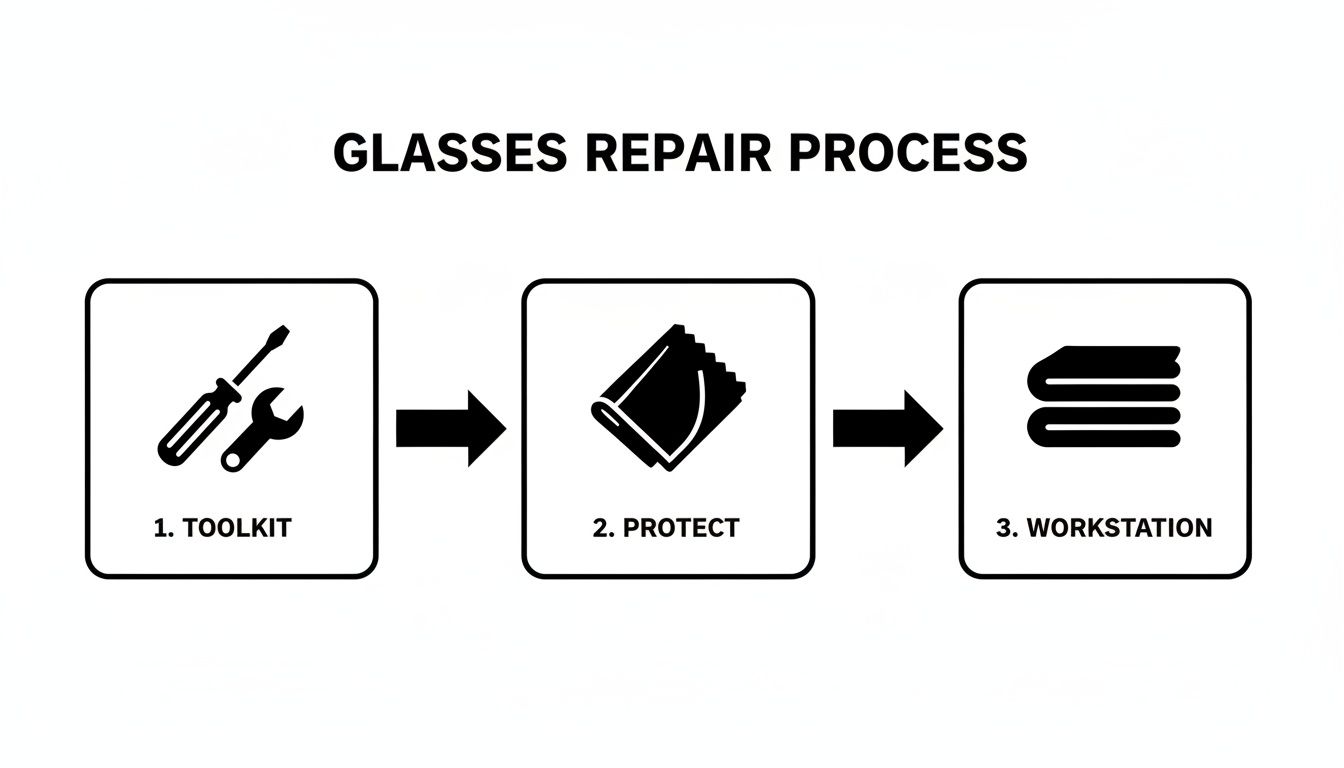
Following these three foundational steps—Toolkit, Protect, and Workstation—is the key to making sure every adjustment is safe and effective, protecting your eyewear investment.
Fine-Tuning the Temple Arms
If your glasses feel a bit loose or sit crooked on your face, the temple arms are the first place to look. This is all about changing the angle where the arms curve behind your ears. For example, if the right side of your glasses sits too high, you would gently bend the left temple arm down at the hinge.
To tighten metal frames properly, grab a pair of needle-nose pliers and wrap the tips in a soft cloth to prevent scratches. Then, apply very gentle pressure to the hinges. Adjusting the drop angle so it follows the natural curve of your ear is crucial. In fact, research shows that misaligned frames can cause 25% more temple pressure, leading to slippage in 35% of users after just six months.
For our Prescript Glasses customers, who often upload their prescriptions for custom builds with Bluecromic or Photochromic lenses, this little DIY fix can provide great relief while they wait for their perfectly fitted new pair to arrive.
Adjusting Nose Pads for Better Grip
The nose pads are the main contact points keeping your glasses from taking a nosedive. If your frames are slipping, the pads are probably sitting too wide.
- For a tighter fit: Use your thumb and forefinger to gently nudge the nose pads closer together.
- For a looser fit: Gently push them slightly further apart.
Make tiny movements, then try the glasses on. The goal is a snug feel without any pinching. It’s amazing what a massive difference this small tweak can make to your daily comfort.
The All-Important Screw Tightening
More often than not, the real culprit behind loose glasses is a wobbly hinge screw. Luckily, this is also the easiest fix of all.
Grab your eyeglasses screwdriver and simply turn the screw clockwise until you feel a little bit of resistance.
Don’t go overboard and overtighten the screw. You still want the arm to move smoothly, not feel stiff or locked up. A snug fit is all it takes to bring back the frame's tension.
If you find a screw keeps coming loose no matter what, it might be time for a professional to take a look. For more detailed tips on sorting out different frame issues, check out our guide on how to fix a glasses frame.
These simple steps put you back in control of how your glasses fit. Just remember, small, careful tweaks are the secret to getting that secure, comfortable fit that feels like it was made just for you. And if you’re after a permanent solution, we can customize an eyewear package to suit your requirements, ensuring a perfect fit right from the start.
Safely Shaping Plastic and Acetate Frames
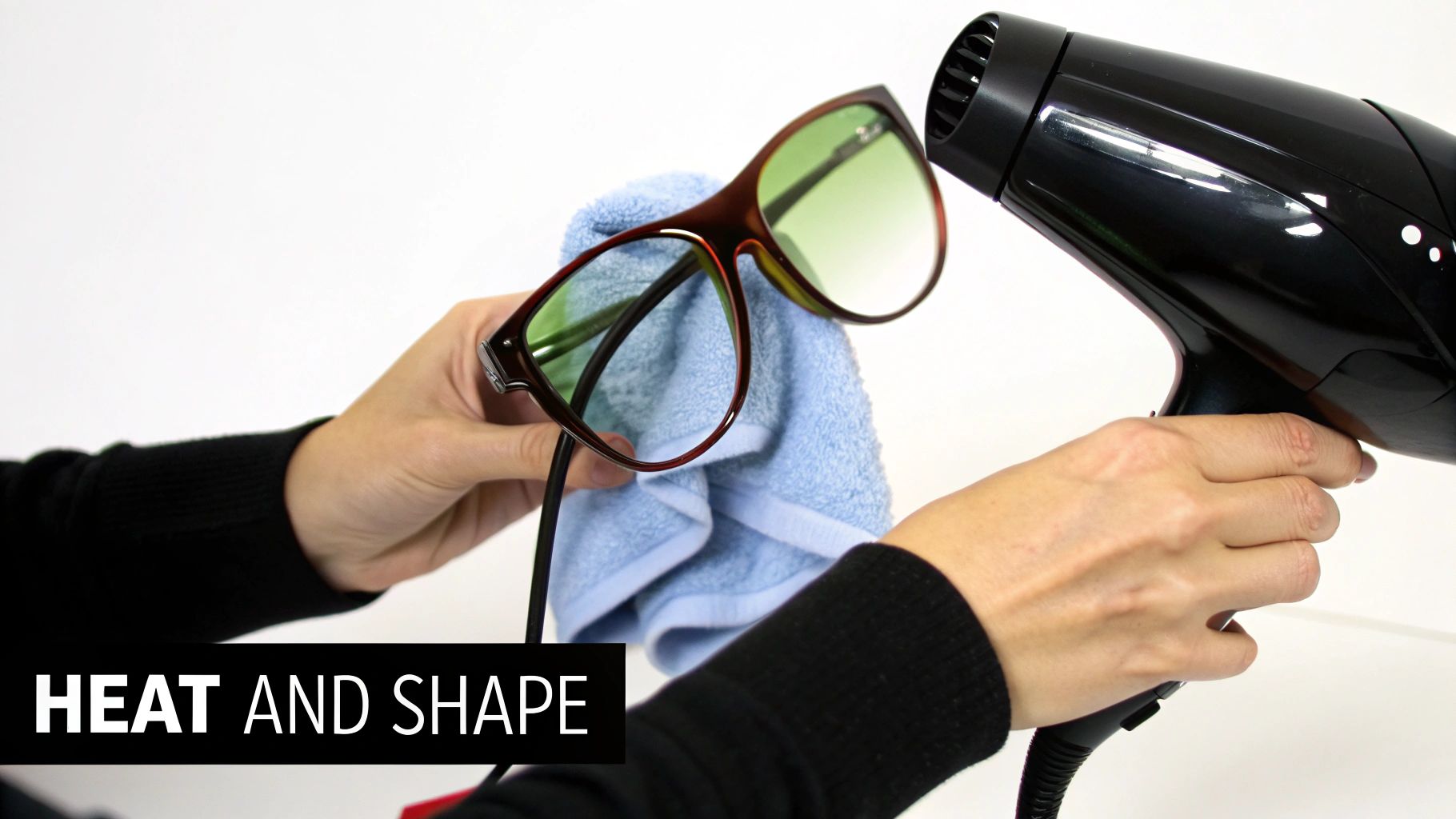
Unlike metal frames, plastic and acetate need a bit of warmth to become pliable enough for adjustments. Getting this right is crucial for your Eye Health and Safety, because applying too much heat can completely ruin your frames and lenses. Let's walk through two safe methods for adjusting your plastic frames to get that perfect, comfortable fit.
The trick is to apply gentle, indirect heat only to the specific parts you need to bend—usually the temple arms or the bridge. It's incredibly important to keep the heat well away from your lenses. Heat can easily damage special coatings like anti-glare or blue light filters. This is all about making careful, subtle adjustments, not forcing the material into a new shape.
Using Warmth for a Custom Fit
Picture this: your favourite acetate frames have stretched out over a warm summer, and now they’re constantly sliding down your nose. It’s a common problem, but thankfully, it’s one you can fix at home with a bit of controlled heat. Your goal is simply to make the plastic just flexible enough to be reshaped.
There are two reliable ways to do this:
- The Hairdryer Method: Grab your hairdryer and set it to its lowest heat setting. Hold it about 15-20 centimetres away from the frame, moving it back and forth over the area you want to adjust (like the temple arm) for about 30-60 seconds.
- The Warm Water Method: Fill a bowl with warm water—it should feel warm to the touch, not steaming hot. Submerge the part of the frame you're adjusting for about one minute until it feels a little more flexible.
Before you start bending, always test the temperature of the frame. It should feel warm, never too hot to handle comfortably.
Making Precise Adjustments
Once the frame is warm and pliable, you can start making your adjustments. Hold the frame securely and apply slow, steady pressure to bend it into the shape you need.
Let’s say your glasses feel too wide and are slipping off. You’d gently heat one of the temple arms. Then, holding the frame firmly, you would carefully bend that arm inwards right at the curve that sits behind your ear. This simple tweak creates a much tighter, more secure grip.
After making the bend, hold the frame in its new position for at least 60 seconds while it cools down. This is what "locks in" the adjustment. To speed things up, you can even run it under cool tap water. Just remember to repeat the process on the other side, making sure both arms are symmetrical for a balanced fit.
Precision is everything when you're adjusting acetate. To tighten your frames, soak them in warm water for 1-2 minutes, then gently massage the temples inward. This matters because frames can expand by 0.5-1mm in humid conditions, according to optical studies. For our Prescript Glasses users—especially gamers relying on specialised lenses to block blue light during long sessions—this technique keeps their custom prescription perfectly snug. Learn more about the safety eyewear market in Australia.
Whatever you do, never use brute force. If the frame isn't bending easily, it just means it needs a little more warmth. Rushing this step is the fastest way to cause stress marks or even snap the plastic. And if you’re looking for a perfect fit without the fuss, remember that we can customize an eyewear package to suit your requirements.
Knowing When to Call in a Professional
Doing a few DIY adjustments is great for minor tweaks, but sometimes you can do more harm than good trying to fix things at home. Knowing how to tighten your glasses is one thing; knowing when a problem is beyond a simple fix is another. It’s a skill that protects both your Eye Health and Safety and the lifespan of your frames.
Certain issues just need the specialised tools and expertise you'll only find with a professional optician. Forcing an adjustment can lead to permanent damage, quickly turning a small annoyance into a costly replacement. It's time to step back and seek expert help if you notice any of these red flags.
Warning Signs Your Glasses Need an Expert
If you run into any of these problems, your best bet is to visit an optician rather than risk damaging your eyewear.
- Stripped Screws: Is your screwdriver just spinning in place without tightening anything? The screw or the hinge threading is probably stripped. An optician can often re-tap the thread or use a slightly larger screw to fix it securely.
- Creaking or Straining Sounds: Hearing a creaking noise when you try to adjust your frames is a major warning sign. That sound means the material—especially plastic or acetate—is under extreme stress and might be about to snap.
- Visible Stress Marks: Take a close look for tiny white or cloudy lines around the hinges or bridge, particularly on plastic frames. These are stress fractures that will only get worse with more pressure.
- Loose or Damaged Lenses: If a lens feels wobbly in its frame, don't try to force it back into place. A professional can secure it without chipping the lens or scratching its coatings. Handling lenses is a delicate process, which you can learn more about in our guide on replacing lenses in glasses.
A classic example of a DIY fix gone wrong is when someone with a stripped hinge screw reaches for super glue. This not only seizes the hinge permanently but can also ruin the frame's finish and seep onto the lens, destroying it completely.
The Best Solution is a Perfect Fit from the Start
While these DIY tips are handy for maintenance, they really highlight one thing: the immense value of starting with a perfectly fitted pair of glasses. If you're constantly making adjustments, it’s a strong sign the frames were never quite right for your face in the first place.
Instead of battling with slipping frames and recurring issues, the ultimate fix is eyewear that fits you perfectly from day one. We can customize an eyewear package to suit your requirements, building it from your specific prescription to ensure optimal vision, lasting comfort, and a secure fit that feels like it was made just for you.
Still Got Questions About Keeping Your Glasses Snug?
Even with the best tips, a few questions always pop up when it comes to getting that perfect, secure fit. That's totally normal. Let's tackle some of the most common ones we hear, so you can keep your glasses comfortable and exactly where they should be.
How Often Should I Check if My Glasses Are Loose?
There’s no hard and fast rule, but making it a habit to give them a quick once-over every couple of months is a smart move. If you live in your glasses day in and day out, you'll probably feel them start to loosen up a bit quicker than someone who only uses them for reading.
Here's a simple test: tilt your head forward and give it a gentle shake. If your glasses slide down your nose or feel wobbly, it’s time for a little tweak. More than anything, just listen to your instincts. If you catch yourself constantly pushing your frames back up, they're definitely telling you they need an adjustment.
Don't forget that keeping your frames clean helps, too. Natural oils from your skin can build up on the nose pads and arms, making them slippery. A quick wipe-down each day can make a world of difference.
Can I Safely Tighten Rimless or Semi-Rimless Glasses Myself?
Honestly, we'd really advise against it. These aren't like your standard full-frame glasses. Rimless and semi-rimless styles are held together by a surprisingly delicate system of mounts and thin nylon cords threaded directly through your lenses.
Even a little bit of pressure in the wrong spot can easily chip or crack a lens, and that's a frustrating and expensive fix. Your Eye Health and Safety are tied to the integrity of your lenses, and a DIY slip-up just isn't worth the risk. For example, trying to tighten a nose pad arm on a rimless frame could put direct stress on the drill hole in the lens, causing a fracture.
Professional opticians use specialised tools and have the right touch to adjust these delicate frames without damaging them. For the sake of your eyes and your eyewear, this is one job best left to the pros.
What Are the Biggest Mistakes to Avoid When Tightening Glasses?
The number one mistake we see? Using way too much force. It’s always better to make small, gentle adjustments rather than trying to fix it all in one big, forceful bend. Patience really is your best friend here.
Here are a few other common missteps to watch out for:
- Heating the lenses directly. This is a huge one. Heat can completely ruin the special coatings on your lenses, like anti-glare or blue light filters, making them useless. If you're warming plastic frames, make sure the heat is only aimed at the arms or the bridge.
- Forgetting to protect metal frames. If you’re using pliers on metal frames, you absolutely have to wrap the tips in a soft cloth or tape. If you don't, you're almost guaranteed to end up with ugly scratches on the finish.
- Overtightening the screws. The little screws in the hinges should be snug, not strangled. You want the arms to be secure, but they should still open and close smoothly without a fight.
Are There Any Quick Fixes for Loose Glasses?
Absolutely! If you need a temporary fix, there are some great accessories out there. Silicone ear grips (sometimes called temple hooks) are a fantastic, easy solution. They're just small grips that slide onto the ends of the arms and tuck securely behind your ears. Imagine you're about to go for a run and don't have time for a full adjustment; these can be a lifesaver.
Another clever trick is to use an eyewear-specific wax balm. You just apply a tiny bit to your nose pads, and the extra friction will stop them from slipping right away. These are perfect for when you're on the go or if your frames are just a tiny bit loose.
But remember, while these are great in a pinch, nothing beats a proper frame adjustment for true, long-term comfort and the best vision.
A perfect fit shouldn't be a daily battle. At Prescript Glasses, we believe your eyewear should feel like it was made just for you. That's why we can customize an eyewear package to suit your requirements, building your glasses with precision based on your prescription for a fit that lasts.
Explore our collection and feel the difference of perfectly fitted glasses today at https://www.prescriptglasses.com.