how do i tighten my glasses: quick at-home fixes

If your glasses are constantly slipping down your nose, you’ve come to a safe and practical guide. More often than not, the fix is surprisingly simple. We’re usually dealing with a loose hinge screw, misaligned temple arms, or out-of-place nose pads.
Nine times out of ten, a tiny screw at the hinge is the culprit, and a quick turn with the right screwdriver solves the problem in seconds.
Why Your Glasses Keep Slipping and How to Fix Them

Loose glasses are more than just a minor annoyance; they can actually mess with your vision and overall eye health. When your frames slide down, the optical centre of your lenses moves with them. This shift can lead to eye strain, headaches, and even blurred vision, which is why a snug, secure fit is so critical for both comfort and clarity.
The good news? You don't always need to make a trip to the optician. Many of these common fit issues are things you can sort out yourself at home with a bit of care and the right tools. The first step is figuring out exactly what's causing the slip.
Identifying the Core Problem
Before you start twisting and bending, take a moment to play detective and pinpoint why your glasses feel loose. Daily wear and tear is a big one, but so is how you store them or even just taking them off with one hand. Over time, these little habits can cause screws to loosen or frames to bend out of shape.
Here are the usual suspects:
- Wobbly Arms: This almost always points to a loose screw in the hinge that connects the arm to the frame front.
- Slipping Down Your Nose: This could be due to the temple arms being too wide, or your nose pads might need a simple adjustment.
- Feeling Crooked: If one side of your glasses sits higher than the other, one of the temple arms is likely bent out of alignment.
If this sounds familiar, you're not alone. Nearly 49.5% of the Australian population wears glasses or contact lenses, and a huge number of us have to deal with frames that don't fit right. Some reports suggest that between 35-40% of glasses-wearers have dealt with loose screws or slipping frames, which really highlights how common this is. You can dig into more Australian eyewear trends over at MarketResearch.com.
Focus on Eye Health and Safety: Always use gentle, controlled movements when adjusting your glasses. Applying too much force is a fast track to stripping a screw, scratching a lens, or snapping the frame. That turns a simple fix into a much more costly professional repair. Your vision is precious; treat your eyewear with care.
Quick Fixes for Common Loose Glasses Problems
To make things even easier, here's a quick reference table. Use it to match what's happening with your glasses to the most likely cause and the best way to fix it at home.
| Symptom | Most Likely Cause | Actionable Solution |
|---|---|---|
| Glasses feel too wide and slide down your face | The temple arms have splayed outwards. | Gently bend the temple arms inwards at the hinge or curve for a tighter fit. |
| One arm feels loose and wobbly | The hinge screw has loosened over time. | Use an eyewear repair screwdriver to tighten the screw. Turn clockwise until snug. |
| Frames sit too low or pinch your nose | The nose pads are misaligned. | Carefully adjust the nose pad arms with your fingers to fit the bridge of your nose. |
| One lens is higher than the other (crooked fit) | One temple arm is bent out of shape. | Identify the misaligned arm and gently bend it up or down to match the other side. |
This table should help you quickly diagnose the problem and grab the right tool for the job. Remember to be gentle and make small adjustments
Getting a Grip on Wobbly Arms by Tightening Hinge Screws
When your glasses start to feel loose, it's almost always the arms that give it away. That tiny screw holding the temple arm to the frame's hinge is the usual suspect. It's not your fault; the simple, repetitive motion of opening and closing your glasses every day can slowly work it loose. The good news is that a quick tighten is all it takes to get that secure, like-new fit back.
Before you jump in, you absolutely need the right tool for the job. An eyeglass repair kit is your best mate here. These kits come with a precision screwdriver—usually a 1.0mm or 1.2mm flathead—that’s perfectly sized for those minuscule screws. Whatever you do, don't reach for a standard household screwdriver. They’re way too big and will almost certainly slip, scratching a lens or, even worse, stripping the delicate screw head.
The Right Way to Tighten
First, find a spot with good lighting. Lay a soft microfibre cloth on a table or desk to protect your lenses from any accidental scratches. Go ahead and open the temple arm of your glasses so you have clear access to the hinge screw.
Now, hold the frame firmly with one hand so it stays put. With your other hand, carefully insert the tip of the precision screwdriver into the screw head. You'll want to turn it clockwise using gentle, controlled pressure. The key here is not to force it. Just turn until you feel a bit of resistance. If you overtighten, you risk stripping the screw, which makes any future adjustments a real headache.
Why a Good Fit Matters for Your Eyes: This isn't just about comfort—it's crucial for your vision. A loose hinge means the lens can tilt or sit at the wrong angle in front of your eye. This slight misalignment is enough to distort your vision and can lead to eye strain or even headaches. Protecting your vision starts with a proper fit.
Real-World Fixes for a Secure Fit
Picture this: you're reading a book, you tilt your head down, and whoosh—your glasses slide right off your face. That’s a classic sign of a loose hinge screw. The fix is that simple clockwise turn until the arm feels stable but can still open and close without a struggle.
Another common culprit is taking your glasses off with one hand. We all do it, but that habit puts uneven stress on one hinge, causing that side to loosen up faster. If you notice one arm feels a lot floppier than the other, you’ve found the one that needs a tweak.
Here’s a quick mental checklist for the perfect adjustment:
- Get the Right Tool: Always, always use a screwdriver from an optical repair kit.
- Create a Safe Workspace: Use a soft cloth to protect your lenses from scratches.
- Gentle Does It: Turn the screw clockwise just until it feels snug, not forced.
- Test the Motion: The arm should fold smoothly without being stiff or wobbly.
For a longer-lasting fix, you could add a tiny drop of low-strength, non-permanent thread-locking fluid to the screw threads before you tighten it. This little trick can help stop it from coming loose again from daily wear and tear. Here at Prescript Glasses, we know a perfect fit is everything, which is why we can customise an eyewear package to suit your requirements, making sure your frames are perfectly adjusted from day one.
Adjusting Temple Arms for a Perfect Fit
Sometimes, you’ve tightened the hinge screws perfectly, but your glasses still insist on sliding down your nose. Frustrating, right? When this happens, the culprit usually isn't the hinge but the fit of the temple arms themselves.
Adjusting these arms is a simple fix that makes a world of difference in comfort and stability. It just requires a gentle touch and knowing what material you're working with.
A proper fit isn’t just about comfort, though. The correct alignment ensures your pupils are perfectly centred through the lenses—a crucial detail for clear vision. To get a better sense of why this is so important, check out our guide on how to measure your pupillary distance. When your lenses are off-kilter, it can lead to some serious eye strain and even headaches.
This infographic breaks down the basic steps to get your glasses sitting just right.
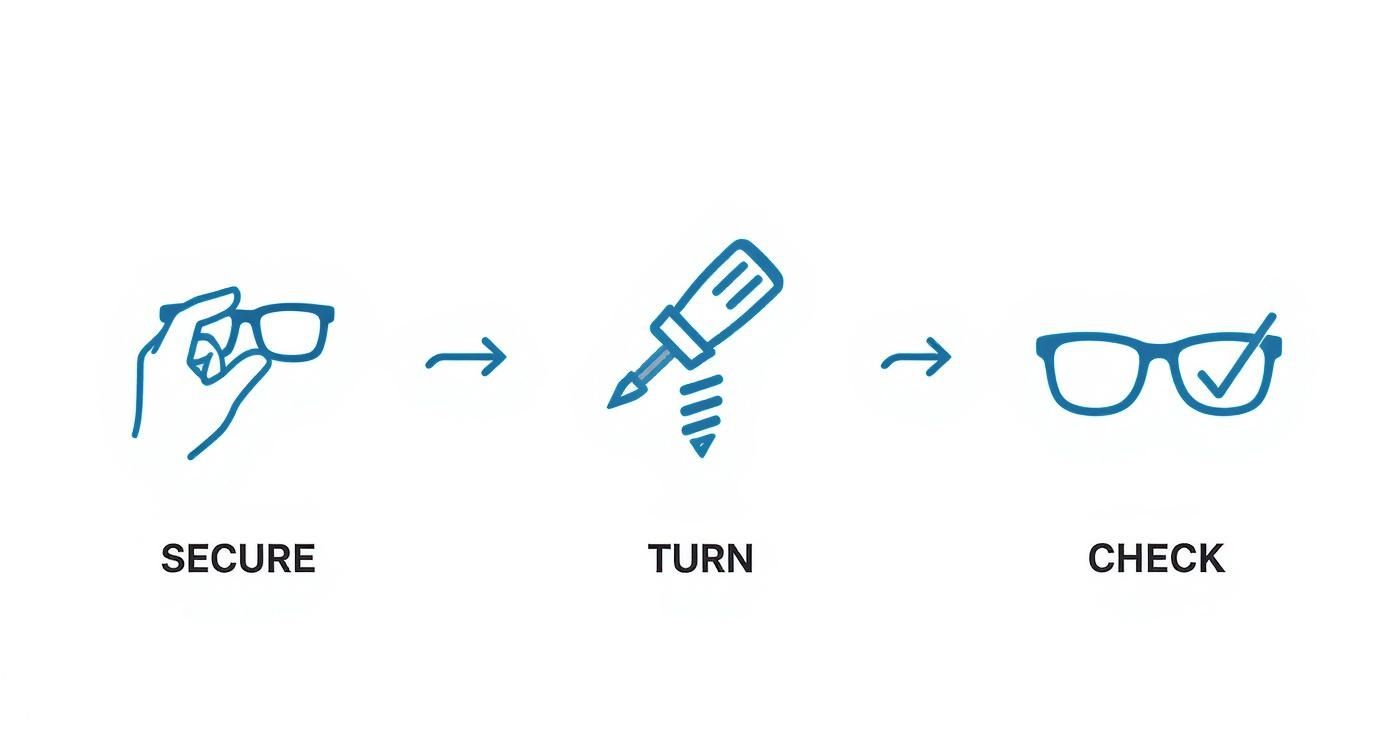
Ultimately, it's a three-part dance: secure the frame, make a small adjustment, and check the fit. Repeat as needed.
Modifying Plastic Frames with Gentle Heat
Plastic frames, especially those made from acetate, can be reshaped with a little bit of warmth. The idea is to make the material just pliable enough to bend without causing any damage. Your best tool for this job? A hairdryer on its lowest heat setting.
Hold the hairdryer about 15 centimetres away from the temple arm, aiming the warm air at the curved part that sits behind your ear. Keep it moving back and forth for around 30 to 60 seconds. You’ll notice the plastic feeling a little softer and more flexible.
Once it's ready, use your fingers to apply gentle, steady pressure and bend the arm inward. This creates a tighter curve that will hug your head more securely, keeping your specs in place.
Let's say your glasses slip every single time you look down at your phone. By applying a bit of heat and bending the temple arm inward, you create that snug fit behind your ear that stops the slippage instantly.
Focus on Eye Health and Safety: Whatever you do, never use boiling water or an open flame to heat your frames. Too much heat can warp the plastic, ruin lens coatings, or even make the frame brittle enough to snap. Always stick to the lowest heat setting and take it slow to protect your investment and your eyes.
Adjusting Metal Frames Without Heat
Metal frames are even easier to adjust because they don't need any heat. They do, however, require firm and even pressure to make sure you don't create any sharp, uncomfortable angles. Your thumbs are all you need for this.
Hold the frame securely and place your thumbs on the part of the temple arm you want to bend. To get a tighter fit, you’ll want to increase the curve at the end of the arm. Apply firm but gentle pressure, pushing inward to make a more pronounced hook that will sit nicely behind your ear.
A couple of quick tips:
- If they feel too wide: Apply pressure right at the hinge to bend the whole arm inward.
- If they slide down: Focus on increasing the curve at the very end of the arm for a better grip.
Make tiny, incremental changes, trying on your glasses after each little adjustment to see how they feel. This approach prevents any risk of heat damage while still giving you that custom, secure fit.
At Prescript Glasses, we know a perfect fit is non-negotiable. It's why we can customise an eyewear package to suit your requirements, giving you optimal comfort and vision from the moment you put them on.
Fine-Tuning Nose Pads to Prevent Slipping
So, you've tightened the screws and the temple arms feel fine, but your glasses are still doing that slow, annoying slide down your face. It's time to turn your attention to the nose pads. These little guys are the unsung heroes of a good fit, and a tiny tweak here can make a world of difference.

It’s not just about keeping your frames in place. Properly positioned nose pads make sure the optical centre of your lenses is perfectly aligned with your pupils. This is absolutely critical for sharp, clear vision. When that alignment is off, you’re looking through the wrong part of the lens, which can lead to eye strain and headaches.
How to Adjust Metal Pad Arms
If your frames have those little metal arms holding the nose pads, you’re in luck—they give you the most control. The process is surprisingly simple, and all you really need are your thumbs and a steady hand.
Hold your glasses securely and use your thumbs to gently nudge the small metal arms.
- Glasses sitting too low or sliding? Carefully push the nose pads a little closer together. This narrows the gap, helping the frames sit higher and much more securely on your nose.
- Glasses pinching your nose or sitting too high? Gently push the nose pads slightly further apart. This widens the bridge, taking the pressure off and letting your frames settle down into a more natural position.
Think of it as customising the fit for the unique shape of your nose. For a practical example, if you wear bifocal or multifocal lenses, you need the frames to sit high enough so your eyes naturally look through the bottom reading portion of the lens without you having to awkwardly tilt your head down. A quick inward nudge of the pads can fix this instantly.
A Quick Word on Safety: Go slow. Always make small, gradual adjustments. If you use too much force, you risk snapping the delicate pad arm, which turns a simple home fix into a mandatory trip to the optician. Pop them on after each tiny tweak to see how it feels. Patient, gentle adjustments are key to protecting your eye health and your eyewear.
What About Moulded Plastic Nose Pieces?
Frames made from plastic or acetate with built-in nose pieces don't have the same bendable parts, but that doesn't mean you're out of options. With these, the goal is to add grip rather than trying to bend the actual frame.
Self-adhesive silicone nose pads are a fantastic, easy solution. These are small, soft pads that stick right onto the frame’s moulded nose piece. They provide instant grip to stop slipping from sweat or skin oils and can even give a little lift if your glasses tend to sit too low.
No matter what kind of frames you have, getting a secure fit is the key to comfort and visual clarity. That's why we can customise an eyewear package to suit your requirements, ensuring every last detail, right down to the nose pads, is absolutely perfect for you from day one.
Knowing When to See a Professional Optician
While at-home fixes are great for a slightly loose arm or a wobbly nose pad, there are definitely times when a DIY approach can do more harm than good. Knowing your limits is key to protecting your glasses and, more importantly, your eye health.
Some problems just demand an expert's touch. If you're dealing with a stripped screw that just spins in place, a snapped hinge, or frames that are severely bent out of shape, it's time to step away from the repair kit. Trying to force a fix on these issues almost always leads to a bigger, more expensive headache. Remember, a poor adjustment doesn't just look off—it can actively compromise your vision and lead to nasty, persistent headaches.
Delicate Materials and Serious Misalignment
Specialty frame materials, in particular, need professional care. You might think you're just making a small tweak, but you could be causing irreparable damage without the right tools and techniques.
- Titanium Frames: These are incredibly durable, but they have a breaking point. Try to bend them cold without the proper tools, and they can snap clean in two.
- Rimless or Semi-Rimless Frames: The mounting points where the lenses connect to the frame are extremely fragile. A little too much pressure in the wrong spot, and you've got a cracked lens on your hands.
- Memory Metal Frames: They might be flexible, but they need to be handled in a specific way to adjust them without wrecking their unique, shape-retaining properties.
A professional optician has the specialised equipment and, crucially, the hands-on experience to work with these materials safely. They can make precise adjustments that feel perfect on your face without risking any damage. Sometimes a part simply needs replacing, and an optician can source the exact component for your specific model. If you find yourself in this situation, our guide on replacing lenses in your glasses can offer more insight into what's involved.
Your vision is too important to risk with a shaky at-home repair. If an adjustment feels forced or you're just not sure, seeking professional help is always the safest and smartest choice for your long-term eye health.
The Australian eyewear market is booming, with revenue projected to hit US$2.89 billion by 2025. This isn't just about more people wearing glasses; it reflects a huge demand for premium frames with advanced lens technologies. As you can read in these Australian eyewear market trends on eyetalk.com.au, many of these sophisticated glasses use delicate, high-tech materials that really need a pro's touch.
To ensure you get a perfect fit from day one, we can customise an eyewear package to suit your requirements, which always includes complimentary professional adjustments. Trusting an expert is the best way to ensure your glasses last as long as they should and continue to support your eye health perfectly.
Common Questions About Tightening Glasses
We get a lot of questions about DIY glasses adjustments, so let's clear up some of the most common ones. Knowing how to handle these specific situations will give you the confidence to make small fixes without accidentally damaging your frames or lenses.
Can I Use a Regular Screwdriver to Tighten My Glasses?
Please don't. While it might seem tempting to grab the closest screwdriver, household tools are far too big and clumsy for the tiny screws in your glasses. It’s incredibly easy for them to slip, which can gouge a deep scratch into your lens or strip the screw head entirely. Once that happens, future adjustments become a nightmare.
If you’re dealing with lens damage, our guide on how you can get scratches out of eyeglasses has some helpful tips.
A small investment in an eyeglasses repair kit pays for itself. These kits come with the right-sized precision tools that make adjustments safe and effective. Using the proper tool is the single best way to protect your eyewear.
How Do I Know if My Glasses Are Too Tight After Adjusting?
A perfectly fitted pair of glasses should feel secure but not noticeable. If you see red marks on the bridge of your nose, feel a pinching sensation behind your ears, or get a headache from pressure on your temples, they are definitely too tight.
The goal is a snug fit where the glasses stay put when you gently shake your head, but you practically forget you're even wearing them. Comfort is just as important as stability.
Is It Safe to Use a Hairdryer on Any Plastic Frame?
Absolutely not. Not all plastics are the same, and this is where you can do real damage if you're not careful. Most standard acetate frames will become pliable with a little bit of gentle, low heat, allowing for minor adjustments. However, other plastics can become brittle, discolour, or warp permanently when heated.
Focus on Eye Health and Safety: If you're even slightly unsure about your frame's material, it's always safer to take them to an optician. An expert can identify the material and adjust it safely, protecting your investment and your vision. It's just not worth the risk of ruining them.
How Often Should I Check if My Glasses Need Tightening?
It’s a great habit to give the hinge screws a quick check about once a month. The simple act of taking your glasses on and off—especially with one hand—gradually loosens those screws over time. A quick monthly check can prevent a temple arm from becoming wobbly or, worse, falling off when you least expect it.
At Prescript Glasses, we understand that a perfect fit is essential for clear vision and all-day comfort. We can customise an eyewear package to suit your requirements, ensuring your new glasses are perfectly adjusted for you from the start. Explore our collection and find your perfect fit today.