
How to Change Lenses in Glasses: A Complete Guide

Sometimes, the decision to change lenses in glasses is less about a quick fix and more about a strategic upgrade for your vision. It's a clever, cost-effective way to hang onto those frames you absolutely love while adapting your eyewear for a new prescription or different daily demands, all while prioritising your eye health and safety.
Unlocking Better Vision and Style
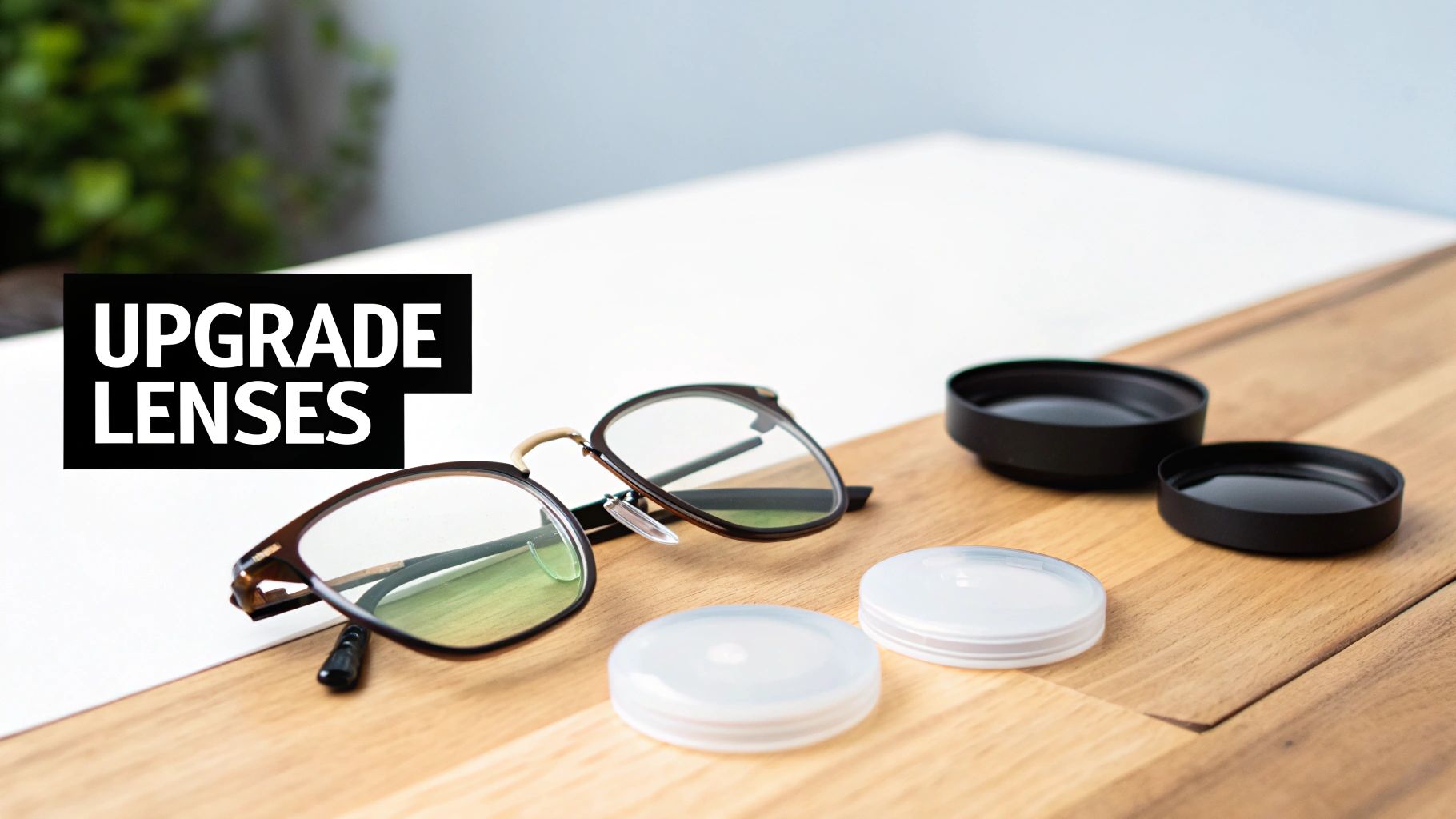
Often, the first clue you need new lenses is a change in your prescription. Are you starting to hold your phone further away? Squinting at the restaurant menu? That’s your eyes telling you it's time for an update. Keeping your prescription current is crucial for your eye health and safety, helping you avoid unnecessary strain and those nagging headaches. An out-of-date prescription can cause dizziness and visual fatigue, so a regular eye check is a vital part of your health routine.
But it’s not always about a new script. Your lifestyle is a huge factor. You might have the perfect frames, but the lenses just aren’t keeping up with your day-to-day life. This is where swapping your lenses becomes a real game-changer.
Adapting Lenses to Your Daily Life
Just think about how a simple lens swap could make a world of difference in these practical, everyday situations:
- For the Office Pro: Someone spending their day jumping between spreadsheets and video calls can switch to BlueRay lenses. For example, an accountant staring at detailed financial reports for hours will find these lenses significantly reduce the harsh glare, preventing end-of-day eye fatigue and improving focus.
- For the Outdoor Adventurer: If you're a keen gardener who is constantly moving between the greenhouse and the garden, Photochromic lenses are a fantastic choice. They darken automatically in the sun, acting like sunglasses when you need them and clearing up when you're back indoors, protecting your eyes from harmful UV rays without a second thought.
- For the Serious Gamer: Long gaming sessions demand intense focus. Upgrading to specialised lenses helps cut down on visual fatigue and protects your eyes from constant screen exposure. Imagine a competitive gamer during a tournament; specialised lenses can mean the difference between sharp focus and blurred vision after several hours.
This kind of adaptability is fuelling a major trend. The Australian eyewear market is tipped to hit USD 3,590.6 million by 2025, and a big part of that is the growing demand for specialised lenses. It makes sense—with many Aussies spending an average of 7.2 hours on screens every day, the need for protective options like blue light filters has never been higher. You can read more about this growing trend on eyetalk.com.au.
Reglazing your favourite frames isn't just a repair; it’s a strategic choice for your vision and eye safety. It allows you to tailor your eyewear precisely to your needs, whether that means adding sun protection, reducing screen glare, or simply seeing the world more clearly.
Choosing to simply change the lenses in your glasses is both an economical and sustainable move. You get to keep the frames you feel great in while fitting them out with the latest in lens technology. At Prescript Glasses, we can customize an eye wear package to suit your requirements, making sure your glasses perform perfectly for you.
Getting Your Workspace Ready for a Safe Lens Swap
Before you even think about touching a screw, let's talk about setting up your space. This is easily the most important step for eye health and safety, and rushing it is how you end up with a scratched lens, a bent frame, or—worst of all—a tiny screw that vanishes into the carpet, never to be seen again. Your main goal here is to protect your glasses and your eyes, and that starts with a clean, organised workspace.
First off, find yourself a stable, flat surface. A desk or a kitchen table is perfect. Just make sure you've got good lighting. I can't stress this enough; you'll be dealing with minuscule parts, and trying to do this in the dark is a recipe for disaster and potential eye strain. Natural light is best, but a decent desk lamp will do the trick.
Next, lay down a soft, light-coloured towel or a microfibre cloth. This isn't just for show. It does two things brilliantly: it gives your lenses a soft landing spot to prevent scratches, and it makes finding that rogue screw a whole lot easier. A tiny silver screw on a dark table is practically invisible, but on a white towel? It sticks out like a sore thumb.
The Essential Toolkit
You don't need a professional optician's lab, but a few key items will make this job go from frustrating to smooth. Think of this as your personal lens-swapping kit, designed for safety and precision.
- Precision Screwdriver Set: This is your MVP. Eyeglass screws are ridiculously small, and using a driver that's even slightly the wrong size will strip the head in a heartbeat. A cheap set with a few magnetic heads is one of the best investments you can make for your glasses.
- Microfibre Cloth: Have at least one on hand, separate from the one you’re using as a mat. Never, ever use a paper towel or the corner of your t-shirt to wipe your lenses. They’ll leave tiny scratches you won’t see until the light hits them just right, impairing your vision.
- A Small Bowl: An absolute lifesaver for holding onto those tiny screws and parts. Without one, they have a magical ability to roll off the table and into another dimension.
Taking a few minutes to set up properly is your first line of defence for your eye health. A secure, correctly fitted lens is crucial for proper alignment, which is everything when it comes to clear, strain-free vision.
Know Your Frame Type
Alright, before you start unscrewing anything, take a good look at your frames. How the lenses come out depends entirely on the type of frame you have. Are they a full-rim metal frame with tiny screws by the temples? Or a plastic frame that looks like the lens just snaps in? Maybe they're semi-rimless glasses frames, held in by a thin, clear nylon cord at the bottom.
Figuring this out now will save you a lot of guesswork later. Each style requires a slightly different touch. Knowing what you're working with prepares you for a successful swap, ensuring the new lenses we send from Prescript Glasses will fit perfectly into your specific frames.
Getting to Grips with Different Frame Types
Alright, let's get into the practical side of things. Swapping your lenses successfully really boils down to knowing your frame type inside and out. Each design has its own little quirks and requires a specific touch. It’s definitely more about finesse than force, and getting it right protects both your frames and your long-term eye health.
Before you even think about touching a lens, get your workspace sorted. A clean, organised setup is half the battle won for a safe lens change.
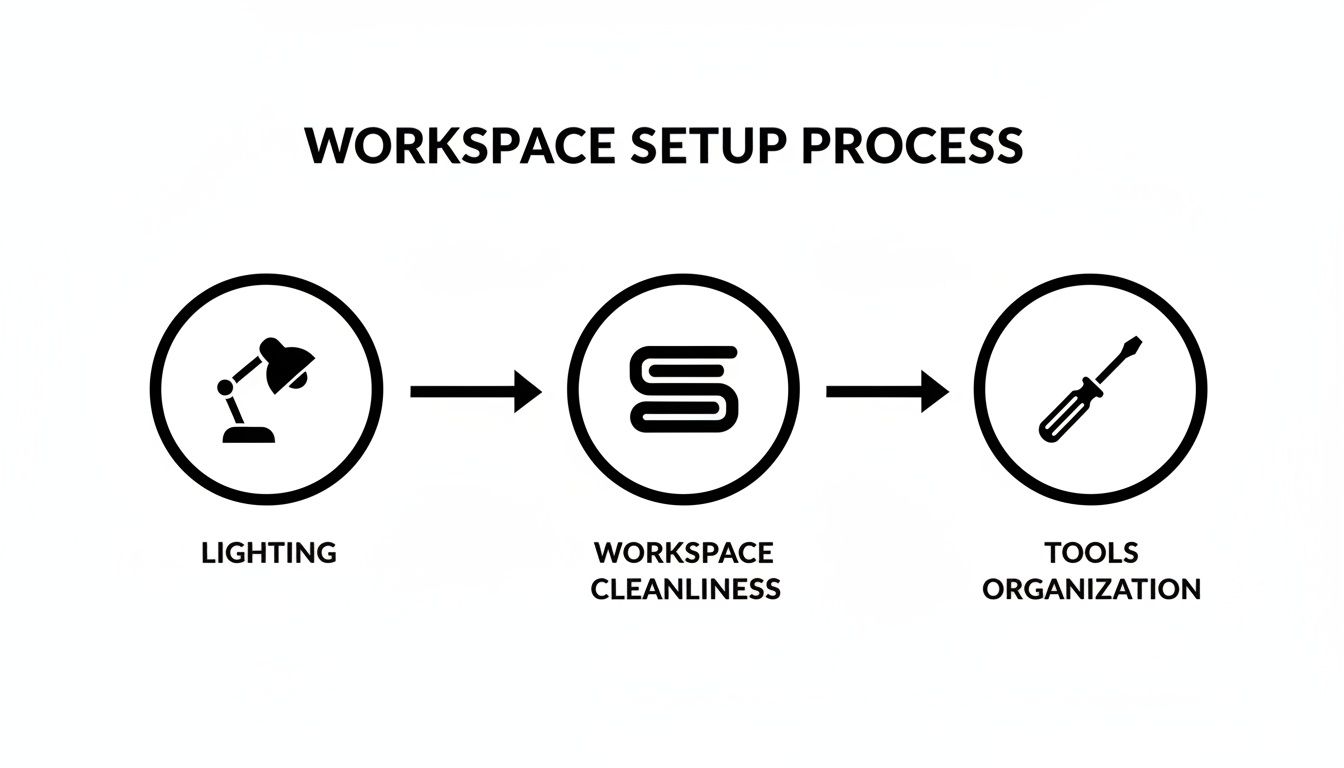
This little guide is a great reminder of the three essentials: good lighting, a soft surface to work on, and having all your tools within reach. Follow this, and you’ll drastically reduce the chances of scratching a lens or losing a tiny, irreplaceable screw, ensuring a safe outcome.
To make things easier, here's a quick cheat sheet for the most common frame types you'll encounter.
| Frame Type | Primary Tool | Key Technique | Practical Example |
|---|---|---|---|
| Full-Rim Metal | Precision Screwdriver | Loosen the tension screw. | Like unscrewing a watch battery cover—just a few turns to release pressure. |
| Snap/Pressure-Fit Plastic | Hairdryer (low setting) | Gentle heat to make the frame pliable. | Think of warming plasticine to make it soft; the same principle applies to the frame. |
| Semi-Rimless (Nylon Cord) | Fingernail or Soft Tool | Unhook the nylon cord. | Similar to carefully unhooking a fine fishing line from a snag. |
This table gives you a bird's-eye view of what to expect, but remember that the feel and technique are what truly matter for a successful swap.
Full-Rim Metal Frames
Metal frames are incredibly common and usually the most straightforward, but they still demand a gentle hand. You'll almost always find a tiny screw on the outer edge of each eyepiece, usually hiding near the temple hinge. This little guy holds all the tension that keeps the lens locked in.
Your best friend here is a precision screwdriver. Make sure you've got the right size head before you start turning; stripping that screw is an easy mistake that turns a simple job into a massive headache.
Start by gently turning the screw anti-clockwise. You don't need to take it all the way out—just a few turns will do. You’ll feel the frame’s grip loosen right away. Once it does, you can use your thumbs to carefully push the old lens out from the back. Apply slow, even pressure, and it should pop right out.
To pop the new one in, just line it up with the frame’s groove and ease it into place. Once it's sitting flush, tighten the screw until it's snug. Don't go overboard and overtighten it; this can stress the frame or lens.
Plastic Frames (Pressure Fit)
Plastic or acetate frames are a completely different beast. They’re designed with a bit of flex, using pressure to hold the lenses in place. Trying to brute-force a lens out of a cold, rigid plastic frame is a surefire way to hear a sickening snap.
The trick the pros use? A little bit of gentle heat. A hairdryer on its lowest setting is perfect for this. Hold it about 15-20 centimetres away from the frame and warm one eyepiece for about 30 seconds. This just makes the material pliable enough to work with.
Once it's warm, hold the frame securely and use your thumbs to push the lens out from behind. It should release with a satisfying "pop." Do the same thing when inserting the new lens: warm the frame, line up the new lens, and press it firmly into place with your thumbs until you feel it click in securely.
An Important Note on Eye Health: A properly seated lens is absolutely crucial for correct visual alignment. If your lens feels loose or rattles after you've put it in, it’s not secure. This can mess with how your prescription works and might lead to eye strain, headaches, or distorted vision. Your safety depends on a secure fit.
Semi-Rimless Frames
Semi-rimless frames look sleek, but they can be the trickiest to work with. They use a thin nylon cord (often called a supra cord) to hold the bottom of the lens in place. It's a delicate system that requires extra care.
First, find the small notch or loop where the cord is anchored into the frame. Your goal is to gently unhook the cord from this groove to release the lens. Sometimes a fingernail is all you need, but a thin, non-sharp tool can also help you tease the cord out.
With the cord free, the old lens will come out without any fuss. Putting the new one in is where the patience comes in:
- First, seat the top edge of the new lens into the metal part of the frame.
- Next, carefully stretch the nylon cord around the bottom edge of the lens.
- Finally, guide the cord back into the lens groove and secure it back into its original notch.
This process can be a bit fiddly, so take your time. If you want a deeper dive, you can learn more about the nuances in our guide to semi-rimless glasses frames.
No matter what frame you have, the end goal is always the same: a secure fit that supports your vision perfectly. Here at Prescript Glasses, we can customize an eye wear package to suit your requirements, ensuring the lenses you receive are a perfect match for both your prescription and your frames. That kind of attention to detail is what protecting your eye health is all about.
Ordering the Perfect Lenses for Your Frames
So you’ve mastered the art of popping lenses in and out. Fantastic! Now comes the fun part: picking the perfect new lenses to give your favourite frames a serious upgrade. This is where you can truly customise your glasses to fit your life, turning them into a high-performance tool for your vision and safety.
It’s about more than just a new prescription. It's about choosing lens technology that makes a real difference to your day-to-day comfort and eye health.
Choosing Your Ideal Lens Type
First, think about your daily routine. Do you spend your days staring at a monitor, or are you a dedicated gamer clocking serious screen time? If that sounds familiar, our BlueRay lenses are exactly what you need. They're specifically designed to filter out the high-energy blue light that causes digital eye strain and that worn-out feeling at the end of the day.
Maybe your day is more varied, constantly moving from indoors to outdoors. For that, Photochromic options are an absolute game-changer. They darken automatically in the sun and turn clear again inside, giving you crisp vision and UV protection without ever needing to fumble for a pair of sunnies.
We've got an option for every situation:
- Clear Lenses: The classic choice for sharp, reliable vision correction for everyday wear.
- BlueRay Lenses: A must-have for professionals, students, and anyone who spends a lot of time in front of a digital screen.
- Photochromic Lenses: The ultimate convenience for people who want their glasses and sunglasses all in one.
- Bluechromic Lenses: The best of both worlds, giving you both blue light filtering and photochromic technology in a single lens.
- Sunglass Lenses: The perfect way to transform any frame you love into a pair of high-quality prescription sunglasses.
How to Place Your Order
Getting your new lenses is incredibly straightforward. The only thing you absolutely need is your current prescription from a qualified eye health professional. During the order process, you just need to upload a clear photo or a digital copy of your script. This ensures your lenses are made to the exact specifications needed for your eye health.
If you need a bit more of a walkthrough, check out our guide on how to order custom prescription glasses online.
This modern, direct-to-you approach is quickly becoming the new normal. The Australian spectacles market, valued at a massive USD 3,780.3 million in 2024, has seen lenses become the top revenue-generating segment. A big reason for this is how easy online customisation has become. With a staggering 72% of Australian adults reporting digital eye strain, it’s no surprise that the demand to change lenses in glasses to more specialised types is growing.
At Prescript Glasses, we know that one size never fits all. That's why we can customize an eyewear package to suit your requirements, making sure your chosen frames are fitted with lenses that are a perfect match for your prescription, your lifestyle, and your eye safety needs.
Common Issues and When to Call a Professional
Even with the best tools and a steady hand, swapping lenses can sometimes throw you a curveball. It’s completely normal, but knowing how to handle these little hiccups is what separates a successful DIY from a trip to the optician with a broken frame. Prioritising your eye health means knowing when to stop.
One of the most common snags is a screw that just won't budge. Before you start cranking on it and risk stripping the head, grab some penetrating oil. A tiny drop is all you need. Let it work its magic for a few minutes, then try again with firm, steady pressure. It usually does the trick.
Plastic frames can present their own challenge. If a new lens feels just a fraction too tight to snap in, whatever you do, don't force it. This is where a little heat becomes your best friend. A quick, gentle blast from a hairdryer on a low setting can make the frame just pliable enough to safely pop the lens into place.
Knowing When to Stop
DIY is fantastic, but there’s a definite line in the sand. Your vision is not something to gamble with. If you run into any of the following issues, it's time to put the tools down and seek an expert's help for your safety.
- A Bent or Twisted Frame: If your frames look wonky after the swap, something’s not right. A professional has the right tools to realign them correctly without causing more damage. We cover how to spot this in more detail in our article on how to fix your glasses frame.
- A Loose or Rattling Lens: A lens that isn't seated securely is a major problem for your eye health. It can affect the accuracy of your prescription and might even fall out at the worst possible moment. This is a clear sign the fit is off.
- Visible Gaps or Stress Marks: Take a close look around the edge of the lens. See any gaps? On a plastic frame, do you notice any little white stress marks? These are tell-tale signs of a poor fit that needs professional adjustment.
The most critical red flag of all is any change in your vision. If you put your glasses on and things seem blurry, distorted, or you feel instant eye strain, take them off immediately. An improperly seated lens can throw off the optical centre, directly impacting how you see and leading to headaches and serious discomfort. This is a direct risk to your eye health.
Looking after your eye health means knowing the limits of a home repair. While the goal is to make this process as easy as possible, a perfect, secure fit is non-negotiable for clear vision. At Prescript Glasses, we can customize an eyewear package to suit your requirements, but for tricky fitting issues, a skilled optician is always your best bet.
Final Checks for Flawless Vision and Comfort
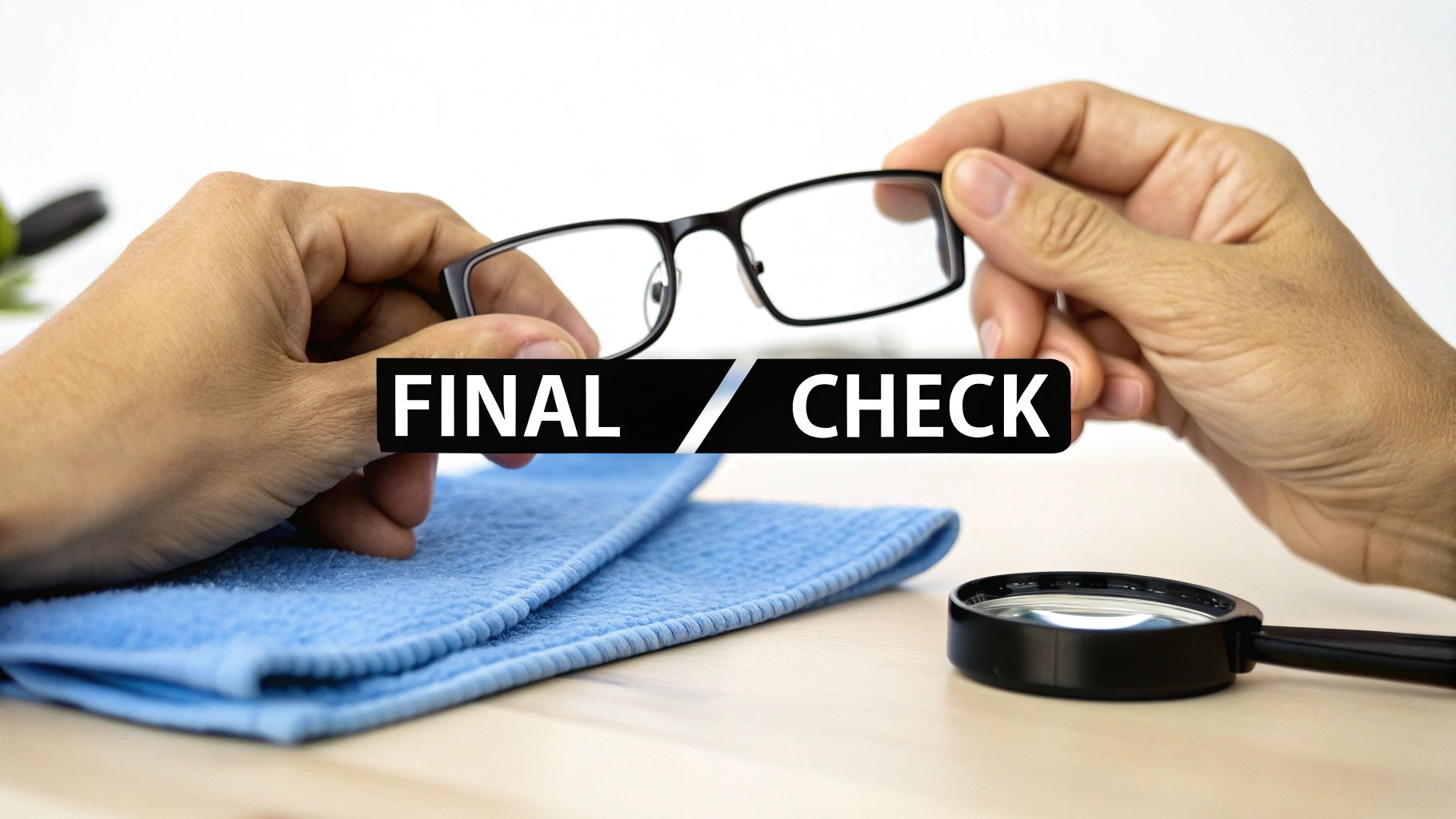
Alright, your new lenses are in. Now for the final, and most important, part of the job: a quick quality check to make sure everything is perfect for your visual health and safety.
First, hold your glasses up to a light source. Have a good look around the entire edge of each lens. You're looking for any tiny gaps between the lens and the frame. If you spot one, it’s a sign the lens might not be fully seated, so it's worth giving it another gentle press to see if it clicks into place.
Next up is the 'wobble test'. Just pop your glasses down on a flat, hard surface like a table. Both arms should rest evenly. If one arm is hovering in the air, even slightly, it could mean a lens is putting a bit of tension on the frame and twisting it out of alignment. For example, if the right arm lifts off the table, the frame might be slightly warped, which can affect how they sit on your face and impact your vision.
Prioritising Your Eye Health
The ultimate test, of course, is how they feel on your face. Put them on and look around. Does your vision feel clear and natural? Any immediate signs of blurriness, strange distortions, or eye strain are red flags that something isn't quite right.
A perfect fit isn't just about comfort; it's critical for accurate vision and overall eye health. Taking care of your eyes by upgrading your lenses is a smart move, and it's a growing trend across Australia as more people focus on their health.
This shift is huge. While the market for frames is projected to hit US$888.09 million by 2025, it's the lenses that are really driving the growth in the spectacles market. You can read more about Australian eyewear trends over at Statista.
Remember, when we can customize an eye wear package to suit your requirements, our goal is to give you that flawless, comfortable vision you deserve.
Still Have a Few Questions?
Thinking about reglazing your favourite frames but have a few lingering questions? You're not alone. Here are the answers to some of the most common queries we get about popping new lenses into existing glasses.
Can I Really Put New Lenses in Any Old Frames?
Almost always, yes! As long as your frames are still in good shape and aren’t too brittle from age, you can definitely give them a new life with fresh lenses.
For a practical example, we’ve seen customers take a beloved pair of vintage acetate frames they’ve had for years and fit them with modern BlueRay lenses for screen use. The only real requirement is that the frame is structurally sound enough to handle the lens fitting process without risking cracks or breaks.
Is It Cheaper to Replace Lenses Than Buy a Whole New Pair?
Absolutely. Reglazing your frames is one of the smartest, most cost-effective ways to update your eyewear.
You save a significant amount by not having to pay for new frames. That frees up your budget to invest in higher-quality lenses with coatings and features that directly benefit your vision and eye health. It’s a great way to get a premium visual experience without the premium price tag.
Once the new lens is in, give it a gentle push from behind with your thumb. It should feel completely solid, with no movement or rattling. A secure fit is crucial for keeping the lenses perfectly aligned for clear, strain-free vision, which is a cornerstone of good eye health.
What if I Accidentally Scratch a Lens During Installation?
It happens, but unfortunately, a scratch on a prescription lens can't just be buffed out. Trying to polish it will almost certainly distort the prescription in that area, which is worse for your eye health than the scratch itself.
If a mishap occurs, the best and safest option for your eye health is simply to order a replacement lens. It’s the only way to guarantee your vision stays crisp, clear, and accurate.
At Prescript Glasses, we believe everyone deserves perfect vision without compromise. We can customize an eyewear package to suit your requirements, from high-performance BlueRay lenses to versatile Photochromic options.
Find your perfect lens upgrade and give your favourite frames a new lease on life by visiting Prescript Glasses.