How Much Is an Eye Exam in Australia? A Complete Cost Guide

Figuring out the cost of an eye exam shouldn't be a mystery. In Australia, a standard check-up can be fully covered by Medicare (meaning it’s bulk-billed at no cost to you), or it could set you back over $100 out-of-pocket. It really all comes down to the optometrist you see, what specific tests your eyes need, and your level of insurance cover.
Your Guide to Eye Exam Costs in Australia

While the numbers can vary, getting a handle on the typical price ranges helps you plan for this super important part of your healthcare. The key is to see it less as a cost and more as an investment in your long-term eye health and safety.
Let’s be clear: an eye exam is so much more than just figuring out if you need glasses. It’s a crucial health screening that can spot serious conditions like glaucoma or cataracts. For example, by looking at the blood vessels in the back of your eye, an optometrist can detect early signs of high blood pressure or diabetes—often before you notice any other symptoms. That proactive approach is exactly why it’s worth every cent.
Typical Australian Eye Exam Costs at a Glance
To give you a clearer picture, let’s break down what you might expect to pay. Costs often differ between the big retail chains, which frequently offer bulk-billed services, and independent optometrists, who might provide more specialised care for a higher fee.
This table gives you a quick snapshot of the landscape.
| Exam Type | Typical Cost Range (AUD) | Potential Out-of-Pocket Expense |
|---|---|---|
| Bulk-Billed Exam | $0 - $30 | Usually nothing for the basic exam, but you might pay extra for advanced scans. |
| Standard Exam | $70 - $120 | This is the common range if you don't qualify for bulk-billing or you choose a private practice. |
| Contact Lens Fitting | $100 - $200+ | This fee typically covers the standard exam plus specific measurements and a trial pair of contacts. |
| Specialised Imaging | $40 - $100+ | This is an add-on for services like retinal photography or OCT scans that give a deeper look at your eye health. |
As you can see, there’s a bit of a range, so it pays to ask about costs upfront when you book.
"Think of an eye exam not as an expense, but as insurance for your sight. Early detection of potential issues is the single most effective way to protect your vision for a lifetime."
Ultimately, the goal is to find the right balance between cost and quality of care. A bulk-billed option is fantastic, but it's smart to double-check that it includes all the tests you need based on your age and health profile.
Once your exam is done, that's where we come in. Whether you just need a simple prescription update or a comprehensive solution for complex vision needs, we can customize an eye wear package to suit your requirements. Getting that exam is the fundamental first step to protecting your vision and overall wellbeing.
What Really Determines Your Eye Exam Price
Ever wondered why the price of an eye exam can vary so much from one optometrist to another? It might seem a bit random, but there’s a clear logic behind it. The final cost you see on the bill is a mix of the provider's business model, where they're located, and exactly what your eyes need.
Think of it like getting your car serviced. A quick oil change at a big chain has a set price. But if you're taking an older, classic car to a specialist mechanic for a full diagnostic, you expect to pay more for their expertise and the deeper investigation. It’s the same with your eyes. The price is tied directly to the depth and complexity of the tests needed to ensure your eye health and safety are properly looked after.
Provider Type and Location
Where you get your eyes checked makes a huge difference to the price tag.
-
Retail Chains vs. Independent Clinics: Big retail chains often use low-cost or even bulk-billed exams to get people in the door, hoping they’ll then buy glasses. Independent optometrists, on the other hand, might charge a higher fee for the exam itself. This often reflects a bigger focus on specialised care, more advanced diagnostic tech, or simply more one-on-one time with you.
-
Geographic Location: Just like a cup of coffee costs more in the city, the running costs for an optometry practice change depending on the postcode. For a practical example, an optometrist in Sydney's CBD might charge $90 for a standard exam due to high rent, while a similar practice in a regional town like Bendigo might only charge $70. That difference naturally gets baked into their pricing.
The Complexity of Your Eye Exam
This is the big one. Not all eye exams are created equal, and the specific tests you need are the biggest driver of the final cost. Different tests require different equipment, time, and expertise from your optometrist.
A young adult who just needs a straightforward prescription update for their glasses will probably only need a standard comprehensive exam. It’s a routine check-up covering vision and basic eye health.
But an older patient with a family history of glaucoma? That’s a completely different story. Their exam will need to include specialised tests, like measuring the pressure inside the eye and taking advanced scans of the retina to spot early signs of disease. These diagnostic services are essential for preventing serious, irreversible vision loss, and they add to the cost. Similarly, getting fitted for contact lenses involves extra measurements and trial lenses, so it’s always more expensive than a standard glasses check.
To really get the full picture, it helps to understand the operational side of things, including how practices use healthcare cost containment strategies to manage their expenses while still providing top-notch care.
Ultimately, your eye exam is tailored to you. Once you have that all-important prescription, we can customize an eye wear package to suit your requirements, making sure that investment in your health translates into perfect vision.
Making Sense of Medicare and Private Health Insurance
Figuring out your health cover is the first step to getting a handle on eye exam costs. It might seem like a maze of Medicare rules and private health insurance policies, but once you know the basics, you can save a decent amount of money while keeping your eyes in top shape. Protecting your vision is a key pillar of your overall eye health and safety.
In Australia, Medicare helps out by offering rebates for standard eye exams. If you're under 65, you can generally claim a benefit for a full eye test once every three years. For anyone 65 and over, that changes to once a year, which makes sense given the need for more frequent check-ups as we get older.
The Medicare Gap Explained
The part that trips most people up is the "gap" payment. It’s simply the difference between what your optometrist charges and what Medicare gives you back.
Here’s a practical example: say your optometrist’s fee for a comprehensive exam is $85. Medicare might offer a rebate of $59.30 for that service. That means you’ll need to cover the remaining $25.70 yourself. This gap exists because Medicare rebates haven’t quite kept up with the actual cost of running a modern optometry practice.
A recent analysis found that while recommended exam fees can be anywhere from $65 to $132, Medicare rebates lag behind. This has led to an average out-of-pocket increase of over $30 in real terms over the last decade, making it harder for many people to afford regular check-ups.
This decision tree gives you a quick visual breakdown of what really influences the final price of an exam.
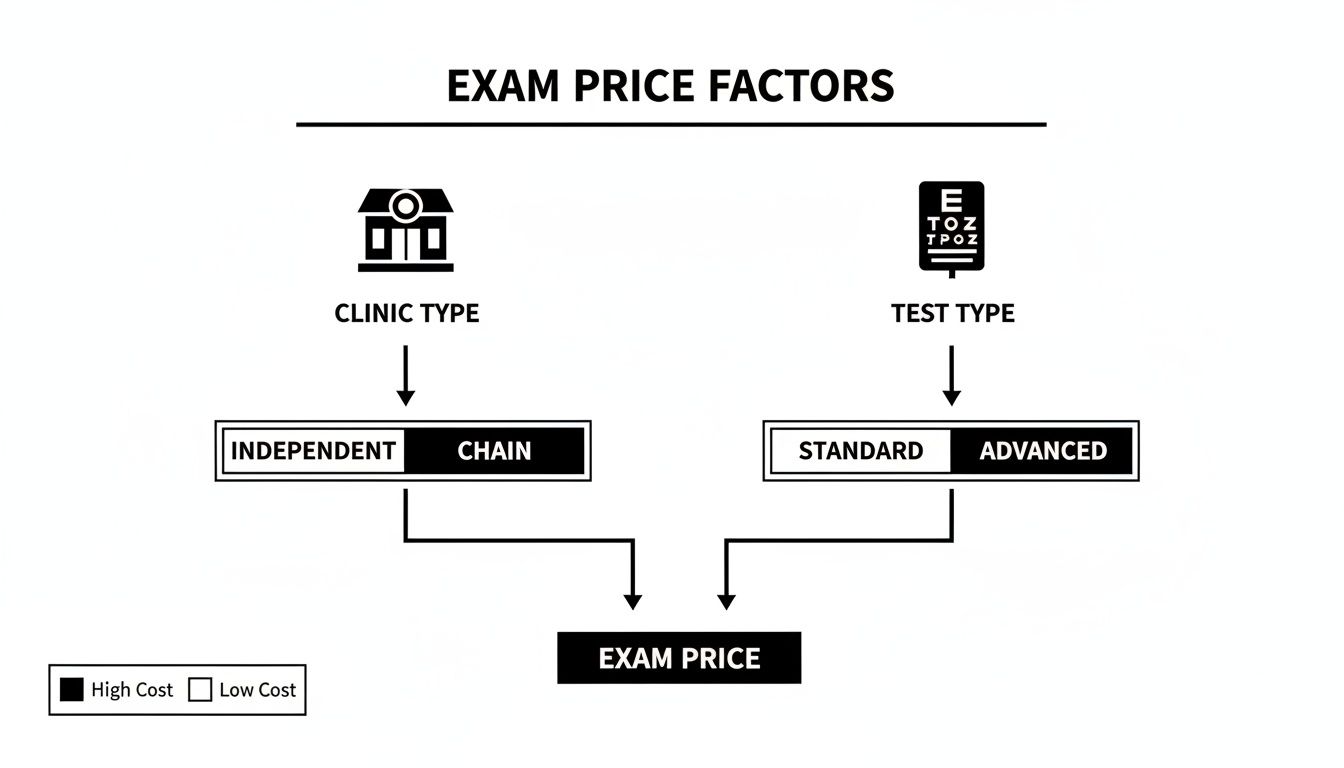
As you can see, every choice—from the type of clinic you visit to the specific tests you need—plays a role in what you'll end up paying.
How Private Health Insurance Steps In
This is where your private health insurance can be a real lifesaver. Most "extras" or "ancillary" policies include benefits for optical services that pick up where Medicare leaves off.
- Covering the Gap: Your private health fund can help pay for that gap, which could reduce—or even completely wipe out—your out-of-pocket cost for the exam itself.
- Eyewear Benefits: It also usually comes with a yearly allowance for prescription glasses or contact lenses. For instance, your policy might give you $200 per year towards new glasses. This benefit can make a huge difference to the cost of new eyewear. To really stretch this allowance, check out our guide on finding affordable prescription glasses online.
Once you’ve got your prescription and you know what your insurance covers, we can customize an eye wear package to suit your requirements without breaking the bank.
What Happens During a Comprehensive Eye Exam
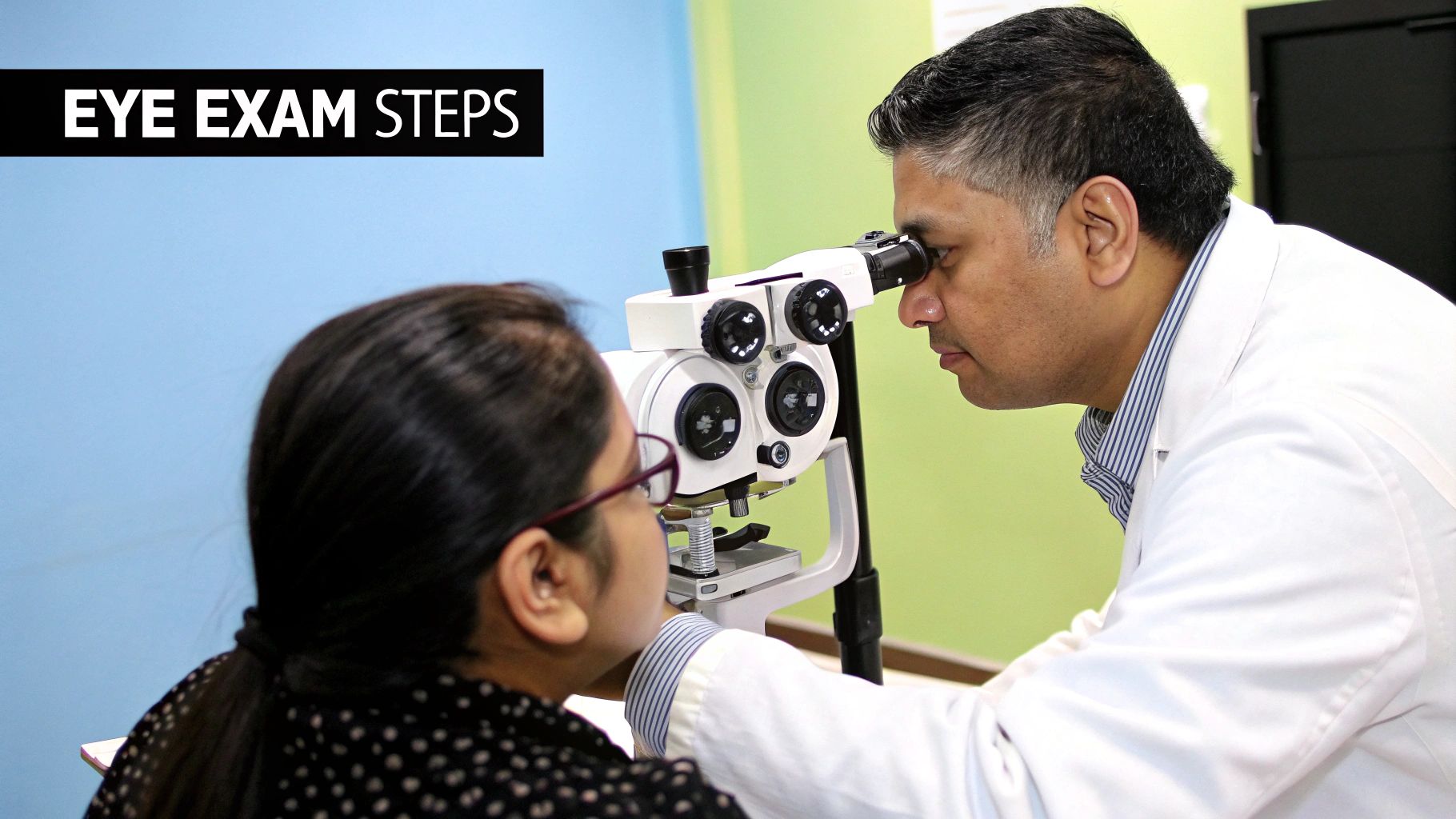
It’s easy to think an eye exam is just about reading letters off a chart, but there's so much more to it. Think of it less as a simple vision test and more as a detailed health screening for your eyes. This is why it's a critical investment in your eye health and safety.
The value packed into the price of an exam really becomes clear when you understand what’s involved. Your optometrist will usually start with a chat about your health and your family's medical history. Conditions like diabetes or a family history of glaucoma can have a direct impact on your sight, so this initial conversation helps them tailor the exam to your specific needs and risks.
Key Stages of an Eye Examination
After the initial chat, your optometrist will guide you through a series of tests, each designed to check a different aspect of your vision and eye health. The exact order might change, but a thorough check-up generally covers these core components.
- Visual Acuity Test: This is the classic letter chart (also known as a Snellen chart) that everyone recognises. It’s a straightforward way to measure how clearly you can see at different distances and gives a baseline for your vision.
- Refraction Assessment: You’ll look through a large, mask-like instrument called a phoropter, which holds tons of different lenses. By flipping through them, your optometrist can pinpoint the exact lens power you need to correct for nearsightedness, farsightedness, or astigmatism.
- Eye Muscle Coordination: The optometrist will also check how well your eyes work as a team. This test looks at tracking, focus, and depth perception—all crucial for comfortable, clear vision.
More Than Just a Prescription
A huge part of a comprehensive eye exam is preventative health. Many serious eye conditions don't have obvious symptoms in their early stages. Tests like the intraocular pressure check—often called the "puff of air test"—are vital for screening for glaucoma, a condition that can cause irreversible vision loss if left untreated.
Here's a practical example: a patient suffering from frequent headaches might assume it’s just stress. However, a refraction test during their eye exam could reveal they have a slight astigmatism, causing eye strain that triggers the pain. This turns the exam into a powerful diagnostic tool for their overall wellbeing.
This comprehensive process ensures nothing is overlooked. For an even deeper dive into what to expect, check out our guide on preparing for an eye check-up.
Once your exam is done and you have your updated prescription in hand, we can customize an eye wear package to suit your requirements. That way, you can turn that smart investment in your health into crystal-clear vision.
Understanding Costs for Specialised Eye Care and Surgery
Sometimes, your eye health journey takes a turn that goes beyond a standard check-up, heading into the world of specialised treatments or even surgery. When this happens, getting a handle on the potential costs is absolutely crucial for your long-term eye health and safety. Conditions like cataracts, which are incredibly common as we get older, follow a completely different financial path than a simple prescription update.
The price tag for surgical procedures in Australia can be all over the map, and it really hinges on how you decide to get the care you need. Take cataract surgery, for example. You’ve basically got three main routes you can go down, and each one strikes a different balance between what you pay and how quickly you get seen. Knowing your options helps you make a smart call that fits both your health needs and your wallet.
Comparing Your Surgical Options
Thinking about the cost of a routine eye exam often opens up bigger questions, especially when surgery is on the table. The financial commitment for a procedure like cataract surgery looks dramatically different depending on whether you go through the public system, use private insurance, or fund it yourself.
- Public System: If you go through a public hospital, Medicare typically covers the surgery, meaning it’s essentially free. The big trade-off here is time. Waiting lists can be notoriously long.
- Private Health Insurance: With the right level of hospital cover, your out-of-pocket costs can shrink dramatically. You’ll get more say over who your surgeon is and when the procedure happens, but be prepared for potential gap payments for the surgeon and anaesthetist.
- Self-Funding: Paying for everything yourself gives you the ultimate control over timing and your choice of specialist. As you’d expect, though, it’s also the most expensive route.
A closer look at Australian eye care costs reveals this clear three-tiered structure for surgery. For instance, if you self-fund cataract surgery, you could be looking at a bill anywhere from AUD 2,800 to AUD 4,500 per eye. In contrast, those with private insurance might pay between $0 and $1,500. It’s a huge difference that really highlights the economic reality of accessing timely surgical care. To see a full breakdown of these figures, you can learn more about cataract eye surgery prices.
Of course, once your vision is crystal clear again, the final piece of the puzzle is getting the right eyewear to match. Whatever your new prescription calls for, we can customize an eye wear package to suit your requirements, making sure your investment leads to sharp, comfortable vision for years to come.
Turning Your Prescription into the Perfect Eyewear
So, you’ve got a fresh prescription in hand. Congratulations! You've just ticked off the most crucial step for your vision. That piece of paper isn't just a clinical record; it’s the exact blueprint for your new glasses and a key part of looking after your long-term eye health and safety.
Now for the fun part: turning those numbers into a pair of glasses that you’ll love to wear. Whether you enjoy the personal touch of an in-store fitting or the endless choice of shopping online, this is where your investment really starts to pay off.
From Exam Room to Eyewear
Your optometrist is legally required to give you a copy of your prescription, so don't feel shy about asking for it. This document holds all the vital stats—like sphere, cylinder, axis, and pupillary distance—that are needed to craft your lenses with pinpoint accuracy.
Getting your head around these terms is incredibly empowering. It means you can make smart decisions about your eyewear, whether you're choosing lens coatings in-store or uploading your details to an online provider. If you want a full breakdown of how to navigate this, our Ultimate Guide to Buying Prescription Glasses Online is a fantastic resource.
Think of a prescription like a tailored suit measurement, but for your eyes. Every number is essential for creating a lens that bends light in just the right way, making sure what you see is sharp, clear, and comfortable.
Choosing your frames and lenses is a personal journey. The best choice always comes down to your lifestyle. A professional staring at a screen for hours on video calls will probably want blue light filtering lenses. On the other hand, someone who’s always outdoors might go for photochromic lenses that adapt to changing light.
A Few Practical Examples:
- For the Student: Someone spending long nights studying and staring at a laptop would find lenses with a blue light filter invaluable. It helps reduce digital eye strain and makes those late-night study sessions a bit more comfortable.
- For the Outdoor Enthusiast: If you love hiking or spend a lot of time driving, polarised sunglasses are a game-changer. They cut right through glare, protect your eyes from damaging UV rays, and make your surroundings appear sharper.
Ultimately, the goal is to find a solution that fits your life perfectly. At Prescript Glasses, we can customize an eye wear package to suit your requirements, making sure your new glasses deliver the best possible vision, protection, and style.
Your Top Questions About Eye Exam Costs Answered
Let's wrap things up by tackling some of the most common questions we hear about eye exam costs. Getting straight answers helps you feel confident about managing your eye care budget and, most importantly, looking after your health.
Understanding these costs has never been more critical. A staggering 14.4 million Australians are living with a long-term eye condition, which makes regular, affordable check-ups essential. Yet, recent data shows a worrying drop in subsidised eye exams, pointing to the financial hurdles many are facing. If you're interested in the deeper trends shaping the eye care industry, you can read the full analysis on ibisworld.com.
Can I Really Get a Free Eye Exam?
Yes, you often can—and the magic word you’re looking for is “bulk-billing.” When an optometrist bulk-bills, they accept the Medicare rebate as the full payment for a standard eye test. For you, that means zero out-of-pocket cost.
Many of the big retail chains offer bulk-billed exams as a standard service to get people in the door. It’s always a good idea to double-check exactly what’s covered, though. More advanced scans, like retinal photography, might still come with an extra fee.
How Often Should I Get My Eyes Checked?
Think of your eye exam schedule as a key part of your proactive eye health and safety plan. How often you need one really comes down to your age and any personal risk factors.
- Adults Under 40: If your vision is stable and you don’t have any major risk factors, popping in every two years is a solid rule of thumb.
- Adults 40 to 64: It’s smart to get checked every one to two years. This is the age when early signs of conditions like presbyopia (needing reading glasses) and glaucoma tend to show up.
- Seniors 65 and Over: An annual exam is highly recommended. This allows your optometrist to keep a close eye on age-related conditions like cataracts and macular degeneration.
An eye exam is so much more than just a script update; it’s a crucial health screening. Regular check-ups are your best defence for catching and managing issues that could otherwise lead to serious, irreversible vision loss.
Is a Contact Lens Exam More Expensive?
It sure is. A contact lens consultation and fitting will always cost more than a standard exam for glasses, and for good reason—it’s a much more involved process.
On top of the comprehensive eye health check, your optometrist has to take very specific measurements of your eye’s surface, like the exact curvature of your cornea. The fee also covers the cost of trial lenses and the follow-up appointments needed to make sure the contacts fit perfectly, feel comfortable, and give you crystal-clear vision. It’s a specialised service to ensure the lenses are both safe and effective for your unique eyes.
Once you have that fresh prescription in hand, the next step is finding the perfect pair of glasses. At Prescript Glasses, we make that part easy. You can simply upload your prescription, and we can customize an eye wear package to suit your requirements, whether you need advanced blue light filtering lenses, stylish frames, or both. Get started today at https://www.prescriptglasses.com.