What Does 20/20 Vision Mean for Your Eyesight

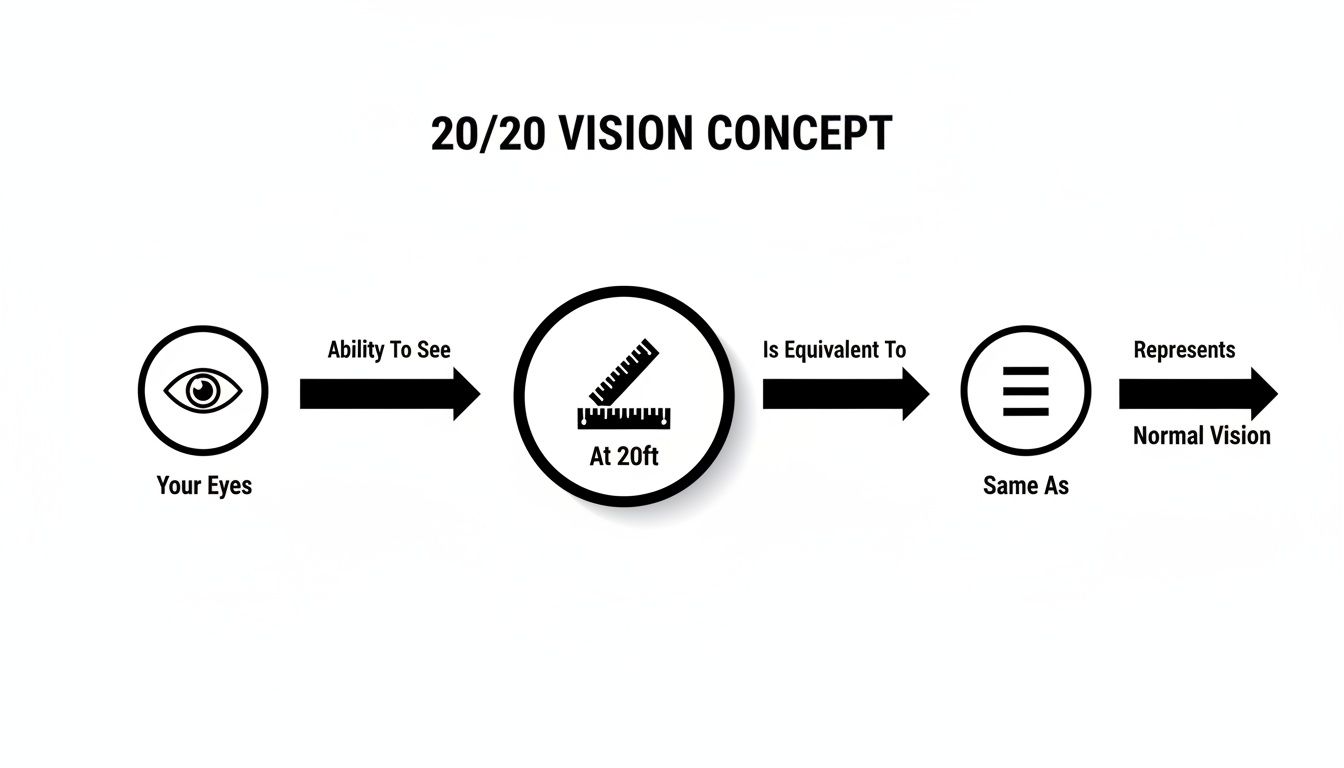
Let's be honest, 20/20 vision is the gold standard we all hear about. But what does it actually mean? Think of it this way: you can stand 20 feet away from a sign and read it as clearly as someone with "normal" eyesight. It's the baseline for visual sharpness, but it's far from the whole picture of your eye health.
Decoding What 20/20 Vision Really Means
When you're sitting in the optometrist's chair, squinting at letters on a distant chart, you're undergoing a visual acuity test. The result, like 20/20, is simply a score that describes how sharp and clear your vision is from a set distance. It's a quick, effective way to gauge how well your eyes can pick out details and shapes.
This measurement gives us a starting point for understanding your eyesight. For instance, if you find yourself struggling to read street signs or see the whiteboard in a meeting room, that's a real-world clue your acuity might be below the standard. If you've been wondering about your own vision clarity, it’s a good idea to learn how to know if you need glasses.
Your Vision in a Metric World
While the term "20/20 vision" is understood almost everywhere, the way it's written changes depending on where you are. Here in Australia, and in other countries using the metric system, we call the same standard of normal vision 6/6 vision.
It’s the exact same principle, just with different units. 6/6 vision means you can clearly see something at 6 metres that a person with normal eyesight can also see from 6 metres. This standard simply converted the imperial 20-foot distance used in places like the US after Australia went metric back in the 1970s.
It's crucial to remember that a 6/6 or 20/20 score doesn't mean you have perfect eyes. It’s just one piece of the puzzle, telling us only about your distance sharpness.
To help put these numbers into context, here’s a quick breakdown of what different visual acuity scores mean in Australia.
Understanding Visual Acuity Numbers in Australia
This table breaks down common visual acuity measurements, explaining what each score signifies for your eyesight compared to the 6/6 standard.
| Visual Acuity Score | What It Means for You | Practical Example |
|---|---|---|
| 6/5 | Better than standard vision. You can see details at 6 metres that most people need to be 5 metres away to see. | Reading the smallest line on an eye chart with ease. |
| 6/6 | Standard vision. This is the benchmark for normal visual sharpness in Australia. | You can clearly read a standard-sized street sign from the expected distance. |
| 6/9 | Slightly below standard vision. You need to be at 6 metres to see what someone with normal vision can see from 9 metres away. | You might need to move a bit closer to the TV to read subtitles clearly. |
| 6/12 | Moderately below standard vision. You must be at 6 metres to see what a person with normal vision sees at 12 metres. | Whiteboards in classrooms or presentations at work may appear blurry from the back of the room. |
| 6/60 | Legally blind. You can only see at 6 metres what someone with standard vision can see from 60 metres away. | You can only make out the largest letter on the Snellen eye chart. |
As you can see, the second number is the key. A larger second number means your distance vision is less sharp than the 6/6 standard.
Focusing on Total Eye Health and Safety
Your visual acuity score is just the beginning of the conversation. A key part of Eye Health and Safety involves understanding all aspects of your sight. There are other critical skills your eyes need for navigating the world safely, like peripheral (side) vision, depth perception, and how well your eyes work together. These are essential for everything from driving a car to simply walking down a busy footpath without bumping into people.
A proper, comprehensive eye exam looks far beyond the letter chart. It checks that all these different aspects of your vision are functioning correctly. After all, seeing clearly is one thing, but seeing comfortably and safely is what truly matters.
How We Measure Your Vision with the Snellen Chart
If you’ve ever had an eye test, you’ll definitely recognise the Snellen chart. It’s that iconic poster with rows of capital letters that get smaller and smaller the further down you go. It might seem simple, a brilliantly effective tool for measuring your visual acuity—basically, the sharpness of your vision.
This classic chart is still the gold standard for figuring out how well you see fine details from a distance. During an eye check up, your optometrist will ask you to read the smallest line you can make out, first covering one eye and then the other.
Breaking Down the Numbers
The result you get from a Snellen test comes in the form of a fraction, like 6/6 or 6/12. These numbers aren't just pulled out of thin air; they have a very specific meaning that tells us a lot about your sight.
- The Top Number: This is the distance you stand from the chart. In Australia, the standard is 6 metres. This number almost never changes during the test.
- The Bottom Number: This tells us the distance at which someone with "normal" or standard vision could read the same line of letters you just read.
Let's make that practical. If your vision is 6/12, it means you need to be 6 metres away to clearly see what a person with standard vision can easily read from 12 metres away.
On the flip side, if you have 6/5 vision, your sight is actually sharper than average. You can see details at 6 metres that most people would need to move closer, to 5 metres, to see.
Understanding these numbers is the key to feeling in control during your eye test. They give a straightforward, objective measure of how your vision stacks up against the established standard.
While the Snellen chart is fantastic for measuring sharpness, a complete eye exam goes much deeper. That initial test is just the starting point, from which we can customize an eye wear package to suit your requirements perfectly.
Why Sharpness Is Not the Whole Story
Nailing a 6/6 score on a vision test feels like a win, but it only really measures one tiny piece of the puzzle: your visual acuity. True, healthy vision is so much more than just reading distant letters clearly. A complete picture of your eyesight is essential for your overall well-being and day-to-day safety.

There are a bunch of other visual skills that are absolutely critical for navigating life safely and easily. All these abilities have to work together to give you a complete sense of the world around you—something the classic Snellen chart just can't measure on its own.
Key Skills Beyond the Eye Chart
Think about what it takes to drive a car. You're not just staring straight ahead at the car in front. You’re constantly scanning your surroundings, checking mirrors, and anticipating movement. This requires a whole suite of visual skills that go way beyond simple sharpness.
- Peripheral Vision: This is your side vision. It's what lets you see things out of the corner of your eye, like a car merging into your lane or a pedestrian about to step off the kerb. It's your early-warning system.
- Depth Perception: This skill is all about judging distances and seeing the world in three dimensions. It’s what keeps you from tripping on stairs, lets you pour a drink without spilling, and helps you catch a ball.
- Eye Coordination: Your eyes have to work together as a seamless team. They need to focus on objects, track movement smoothly, and shift focus from your phone screen to something far away. When they don't, you end up with eye strain and headaches.
- Colour Vision: Being able to tell colours apart is crucial for everything from correctly reading traffic lights to simply appreciating the vibrant world around you.
A comprehensive eye exam is about more than just getting a new prescription. It's a vital health check for the inside of your eyes. An optometrist looks for early signs of conditions like glaucoma, macular degeneration, or diabetic retinopathy, which often sneak up with no symptoms at all.
Practical Examples of Whole-Picture Vision
Imagine playing a game of tennis. Your sharp 6/6 vision helps you see the ball clearly, but it's your depth perception that tells you exactly how far away it is and when to swing. Your peripheral vision tracks where your opponent is on the court, and your eye coordination ensures you can follow the ball's blistering pace. If any one of those skills is off, your game will suffer.
Even something as simple as cooking relies on this incredible teamwork. You use depth perception to chop vegetables without nicking a finger, eye coordination to glance from a recipe book to the pot on the stove, and colour vision to tell if your food is perfectly cooked.
This focus on complete Eye Health and Safety is why we believe in finding the right solution for every person. When you need glasses, we can customize an eye wear package to suit your requirements, addressing not just sharpness but also visual comfort and protection for your specific lifestyle.
What Your Eyes Can Really Do: The Full Spectrum of Sight
When we talk about vision, the number 6/6 (or 20/20 in some parts of the world) often comes up as the gold standard. It’s what we consider "perfect" sight. But here's the thing: it’s not the limit of what our eyes can do. It's just one point on a huge spectrum of human vision.
Some people naturally have eyesight that’s far sharper than 6/6. This isn't just luck of the draw; it’s a fascinating mix of genetics, where you live, and what you do every day. Your lifestyle can genuinely hone your visual skills, which just goes to show that there’s no single definition of ‘normal’ when it comes to sight.
Beyond 6/6: Eyesight in the Real World
Want a powerful example of what superior vision looks like? We only need to look at compelling research into Australian Aboriginal communities. For thousands of years, their lifestyles demanded exceptional long-distance sight for hunting and navigating vast, open landscapes—and their vision adapted.
Studies from the Centre for Eye Research Australia (CERA) found that Indigenous Australians in some remote areas had an average visual acuity of 6/7.5, which is significantly sharper than their non-Indigenous peers. You can read more about these remarkable vision findings here.
What this tells us is that vision we might consider "superhuman" can actually be the everyday norm in an environment where sharp sight offers a real advantage for survival.
Understanding this full spectrum is key. Good vision isn’t just about hitting a number on a chart; it's about making sure your eyes are performing their best for your life. That’s why we can customize an eye wear package to suit your requirements, whether that’s for pinpoint clarity at your desk or protecting your eyes on a weekend adventure. Our focus on Eye Health and Safety means your vision gets the support it needs, no matter what your personal benchmark is.
Practical Steps for Protecting Your Vision
Knowing your vision score is one thing, but taking active steps to protect your eyesight is what truly matters for your long-term health. The good news? The most effective strategies are often simple daily habits you can start right now.
One of the best-known tricks for fighting digital eye strain is the 20-20-20 rule. It’s brilliant in its simplicity: for every 20 minutes you spend staring at a screen, take a 20-second break to look at something at least 20 feet (that’s about 6 metres) away. This tiny pause gives your eye muscles a much-needed chance to relax, helping to fend off fatigue and dryness.
Everyday Habits for Better Eye Health
Beyond just managing your screen time, a few other daily choices can make a huge difference. Protecting your eyes from the world around you is just as crucial as protecting them from your devices.
- Wear UV-Blocking Sunglasses: Here in Australia, the sun doesn't mess around. Make sure your sunnies block 99% to 100% of both UVA and UVB rays. Consistent use is one of your best defences against long-term damage like cataracts and macular degeneration.
- Use Safety Eyewear: Whether you're doing a bit of gardening or tackling a home repair project, don't skip the safety glasses. A practical example is wearing certified eyewear while using a line trimmer to prevent stones from hitting your eye. This simple step can prevent serious injuries.
- Eat for Your Eyes: Loading up on foods rich in vitamins C and E, zinc, and omega-3 fatty acids gives your macular health a real boost. Think leafy greens, citrus fruits, and oily fish like salmon.
Proactively caring for your eyes is one of the best investments you can make in your overall wellbeing. Small, consistent actions add up to a lifetime of healthier vision.
For a deeper dive into maintaining your eye health over the long haul, check out these expert insights on improving and protecting your eyes.
Here's a quick guide to weaving these actions into your daily life.
Daily Habits for Healthy Eyes
A quick reference guide outlining simple actions you can take every day to protect your vision and reduce eye strain in the modern world.
| Common Activity | Recommended Action | Why It Protects Your Eyes |
|---|---|---|
| Working on a computer | Follow the 20-20-20 rule | Relaxes focusing muscles and reduces digital strain. |
| Spending time outdoors | Wear quality UV-blocking sunglasses | Shields eyes from harmful rays that cause long-term damage. |
| Doing DIY or gardening | Put on certified safety glasses | Prevents physical injuries from debris or splashes. |
| Planning your meals | Add leafy greens and oily fish | Provides essential nutrients to support retinal health. |
Ultimately, a proactive approach is always best. If you start noticing persistent eye strain or any changes in your vision, that's your cue to seek professional advice. When you have the right information, we can customize an eye wear package to suit your requirements, ensuring your eyes get the specific support they need for both clarity and protection.
Finding Your Perfect Eyewear Solution
For many of us, getting to that crisp 6/6 vision mark means finding the right pair of glasses or contact lenses. These aren't just tools to fix common issues like nearsightedness or farsightedness; they're about bringing your world into focus with comfort and clarity. But today's eyewear goes way beyond a simple prescription. It’s about protecting your eyes and enhancing your vision in every part of your life.
This is where a personalised approach to your eyewear really makes a difference. Think about your day-to-day. If you spend hours staring at a computer screen, you’ve probably felt that tired, gritty feeling of digital eye strain. Blue light filtering lenses can be a game-changer here, helping to ease that discomfort so you can get through your workday more comfortably.
Custom Lenses for Your Lifestyle
The best eyewear should feel like it was made just for you—because it can be. Once we understand what you need, we can customize an eye wear package to suit your requirements, making sure your vision is supported no matter what you're doing. This is all about picking the right lens features that give you both sharp vision and solid protection.
Here are a couple of practical examples:
- Photochromic Lenses: You know them as transitions. These clever lenses darken automatically when you step into the sun and clear up when you're indoors. You get seamless UV protection without ever having to swap your glasses.
- Polarised Sunglasses: An absolute must for driving or days by the water. These lenses are engineered to slice through the harsh, reflective glare that bounces off roads and water, which seriously improves safety and stops you from squinting.
The real goal is to build a solution that not only enhances how you see but also protects your eyes for the long run. The right lenses make everything you do safer and more enjoyable.
Choosing the perfect eyewear all starts with knowing what your options are. To get a better feel for what's out there, you can dive deeper into the various types of lenses for eyeglasses and figure out what fits your life.
Of course, nothing beats a comprehensive eye exam. It's the essential first step to getting the precise prescription needed to craft a solution that’s truly customised for your unique eyes.
Common Questions About Visual Acuity
Can Your Vision Be Better Than 20/20?
Absolutely. Think of 20/20 as the benchmark for normal, healthy vision—not the pinnacle of human sight. A score like 20/15 (or 6/5 in Australia) means your vision is actually sharper than average.
Essentially, you can clearly see something from 20 feet away that a person with normal vision would need to be 15 feet away to see just as clearly. It’s considered exceptional eyesight.
Does 20/20 Vision Mean I Don't Need Glasses?
Not always. It’s a common misconception that 20/20 vision equals perfect eyes. You might have fantastic distance vision but still struggle to read a menu up close, a sign of age-related presbyopia.
Plus, a comprehensive Eye Health and Safety check can uncover other issues like astigmatism or digital eye strain. In these cases, glasses aren’t just about seeing clearly—they’re about providing comfort and relieving fatigue.
Is My Vision the Same in Both Eyes?
It's actually quite common for each eye to have a slightly different level of sharpness. That’s why a full eye exam tests each eye on its own before checking how they perform together.
This individual testing ensures we can craft a prescription that helps both your eyes work as a seamless team, giving you the clearest and most comfortable vision possible.
At Prescript Glasses, we can customize an eye wear package to suit your requirements. Just bring in your prescription, and we’ll help you build the perfect pair of lenses for your lifestyle. Explore all your options at https://www.prescriptglasses.com.