
Kids Eye Test: A Parent's Guide to Your Child's First Checkup

Regular kids eye tests are one of the most important health check-ups you can schedule for your child. It’s the only way to be certain they’re seeing the world clearly, which is absolutely fundamental for their learning, development, and overall safety.
Kids often have no idea their vision is different from anyone else’s, so a professional exam is the only real way to catch and correct issues early on. It’s a simple, painless process that can make a world of difference in the classroom and on the playground, contributing directly to their long-term eye health and safety.
The Unseen Hurdle in Your Child’s Learning Journey
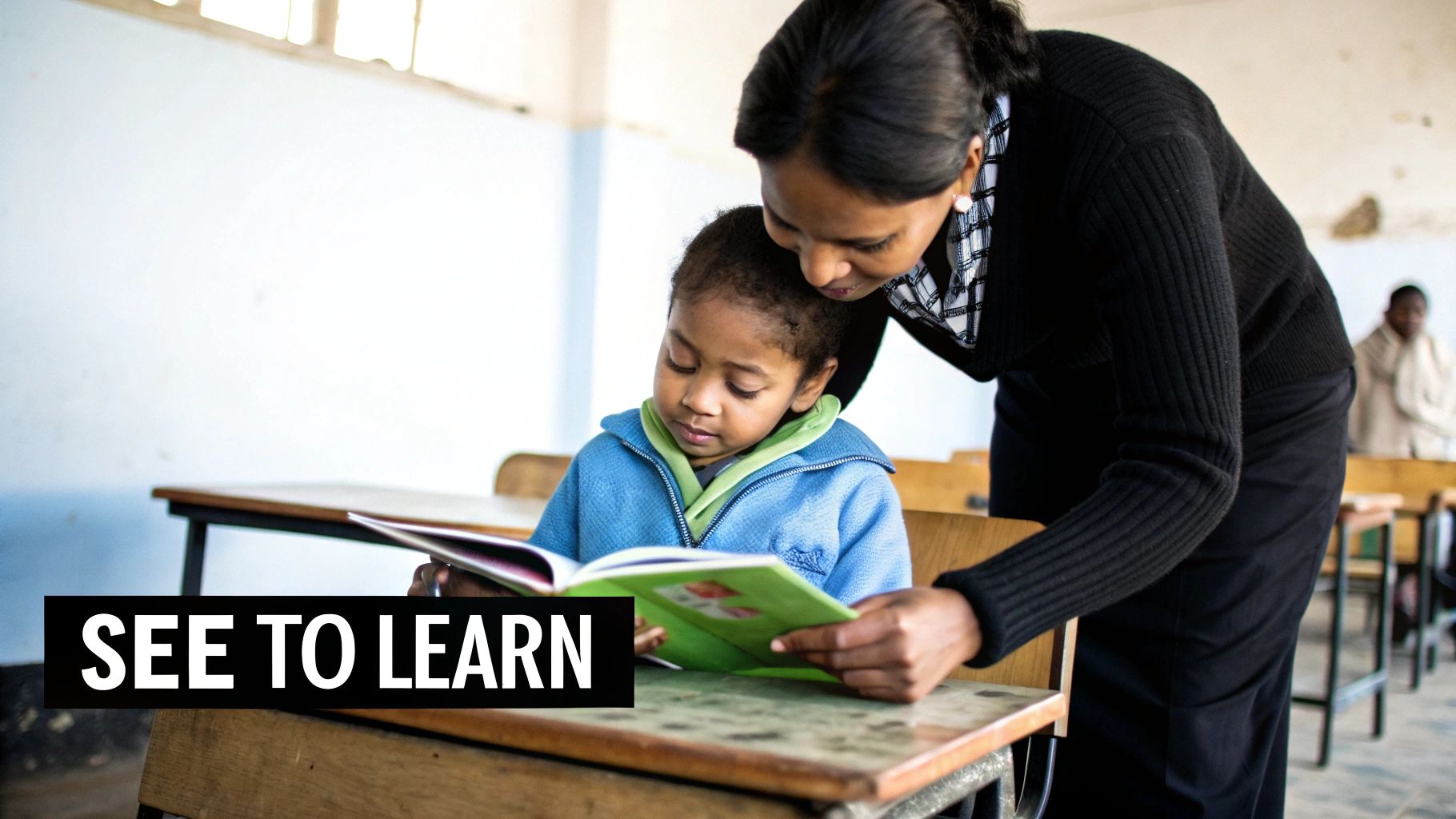
Imagine trying to solve a puzzle, but all the pieces are blurry. That’s what school can feel like for a child with an undiagnosed vision problem. Staring at a page of words is tough enough, but what if those words are fuzzy or seem to jump around? This is a daily reality for so many kids who struggle in silence, mostly because they just don't have the words to explain what's happening.
A massive 80% of what a child learns during their formative years comes through their eyes. From reading their first book to figuring out maths problems on the whiteboard, clear vision is the bedrock of their education. An uncorrected sight issue can become a huge, yet completely invisible, barrier to their progress.
Why Kids Don't Complain About Blurry Vision
It’s a common myth that kids will tell you if they can’t see properly. The thing is, if a child has had blurry vision their whole life, they just assume that’s how everyone sees the world. They have no other frame of reference for what "clear" vision even looks like, so they just get on with it and adapt.
Think about these real-life, practical examples:
- A child might hold a book right up to their nose, thinking that’s just how you’re supposed to read.
- Another might always tilt their head to watch TV, not realising it’s a way of compensating for misaligned eyes.
- Those frequent headaches after school? It’s easy to dismiss them as tiredness when they’re actually caused by eye strain.
These subtle clues are exactly why a professional kids eye test is as essential as a trip to the dentist. It’s a proactive step to protect their eye health and give them the best possible shot at thriving.
A child’s inability to see clearly can be easily mistaken for a lack of focus or even a learning disability. A routine eye test provides the clarity needed to distinguish between a vision problem and other developmental challenges.
Proactive Care for Lifelong Success
At the end of the day, prioritising your child’s vision is an investment in their future. Catching common issues like short-sightedness (myopia) or astigmatism early can prevent years of frustration and unlock their full potential.
With the right support, they can focus on what really matters—learning, playing, and just being a kid. And when it’s time to find the perfect pair of glasses, we can customise an eyewear package to suit your requirements, ensuring their new specs are comfy, durable, and ready for anything.
Spotting the Subtle Clues Your Child Might Have Vision Problems
When you think of a kid who needs glasses, you probably picture them squinting at the whiteboard in class. That’s the classic sign, right? But more often than not, the real clues are much sneakier and can easily be mistaken for something else entirely, like a learning difficulty or even just being a bit naughty.
The thing is, kids often don't realise their vision isn't "normal." They have nothing to compare it to, so they can't tell you something is wrong. That's where parents and carers come in. You have to become a bit of a detective, piecing together the small hints that point towards an underlying vision issue.
Catching these signs early is a game-changer for their development and success at school. A simple kids eye test can get to the bottom of their struggles, offering a fix that can make a world of difference. To help you connect the dots, we’ve put together a quick guide on what to look for at home and at school.
Physical Signs to Watch For
The most obvious clues often come from your child's physical habits. These are the things they do automatically—without even thinking—to try and make the world a little less blurry. Think of it as their body’s way of asking for help.
Keep an eye out for these common physical signs:
- Frequent Eye Rubbing: Sure, it can just mean they're tired. But if they're constantly rubbing their eyes, it could be a sign of frustration from eye strain or irritation.
- Excessive Blinking or Watery Eyes: This might be their body trying to clear away blurriness or deal with discomfort.
- Head Tilting or Covering One Eye: This is a classic trick kids use to compensate. They might tilt their head to change their viewing angle or cover one eye to let the stronger one do all the work, especially when they're focusing on a book or a screen.
- Extreme Sensitivity to Light: Does your child complain about bright sunlight or even normal indoor lighting? It could point to an issue with how their eyes process light.
For instance, you might notice your child always angles their head in a certain way when watching TV. It’s easy to dismiss as a quirky habit, but it could be their unconscious effort to line up their eyes just right to get a single, clear image. Paying attention to these little physical cues is the first step in looking after their eye health and safety.
Behavioural and Coordination Clues
Sometimes, a vision problem shows up in a child's behaviour rather than their eyes. When everyday tasks are a struggle, it can lead to frustration, clumsiness, or just plain avoidance.
Ask yourself if your child does any of the following:
- Avoids "Near" Activities: Do they seem completely uninterested in reading, drawing, or puzzles? It might not be boredom. The discomfort and strain of close-up tasks could be turning them off.
- Seems Unusually Clumsy: A child who constantly trips over things, bumps into furniture, or can’t seem to catch a ball might have poor depth perception. This is a key part of eye health and safety, as it can lead to accidents.
- Sits Too Close to Screens: If your child practically has their nose pressed against the TV or holds a tablet right up to their face, that’s a massive red flag that they're struggling to see from a normal distance.
Think about a child who always gets frustrated trying to build with LEGOs and gives up. It's easy to label that as a short attention span. But what if they just can't see the small pieces clearly enough to snap them together? The fun is gone, and only the frustration remains.
School and Learning Struggles
For school-aged kids, the classroom is often where vision problems really come to light. The demands of reading fine print, writing in lines, and looking up at a board can quickly expose difficulties that might have been missed at home.
A child struggling with their vision may be labelled as "inattentive" or "disruptive," when in reality, they are simply unable to engage with the visual material presented to them. Scheduling a kids eye test can provide much-needed answers.
Here’s a quick reference guide to help you spot the signs that your child might be struggling with their vision.
Common Signs Your Child Might Need an Eye Test
| Category | Sign to Watch For | Practical Example |
|---|---|---|
| Physical Signs | Head Tilting or Turning | Consistently angling their head to one side when reading a book or looking at a screen. |
| Frequent Eye Rubbing or Blinking | Rubbing their eyes vigorously after only a few minutes of homework or screen time. | |
| Watery or Red Eyes | Their eyes often appear irritated or teary, especially after concentrating on a task. | |
| Behavioural Clues | Avoiding Close-Up Tasks | Showing a strong preference for outdoor play over activities like colouring or puzzles. |
| Unusual Clumsiness | Often tripping on stairs or misjudging distances when reaching for objects. | |
| School Struggles | Losing Their Place While Reading | Using a finger to track words on a page but still skipping lines frequently. |
| Difficulty Copying from the Board | Taking an unusually long time to copy notes, with many mistakes or omissions. | |
| Poor or Messy Handwriting | Struggling to write on the lines or form letters consistently due to poor visual-motor skills. |
If you’re nodding along and recognising a few of these signs in your child, there’s no need to panic. It’s simply a prompt to take the next step and book them in for a professional kids eye test.
And if it turns out they do need glasses, remember that we can customise an eyewear package to suit your requirements. We'll make sure your child gets the perfect combination of function, comfort, and style they'll love to wear.
What to Expect During a Kids Eye Test
Taking your child for their first proper kids eye test can feel a bit daunting. If you’re picturing the sterile, intimidating exams from your own childhood, you can relax. A modern paediatric eye exam is a whole different ball game. It’s designed to be fun and engaging, feeling more like a series of games than a clinical test.
Optometrists who work with children are absolute pros at making them feel comfortable and cooperative. They use clever tricks and kid-friendly language to get all the information they need without a hint of stress. Forget the boring old letter chart; they’ll turn the process into an adventure with fun lights, colourful pictures, and interactive challenges. The entire visit is built around both eye health and safety and making sure your child leaves with a smile.
Preparing Your Child for the Visit
A little bit of prep work can make a world of difference in ensuring the eye test goes smoothly. The key is to frame it as an exciting new experience, not a scary medical appointment.
Here are a few simple ways to set them up for success:
- Talk About It Positively: Let them know they’re visiting a special "eye doctor" who will play fun games to check on their "superhero eyes." Keeping it light and positive works wonders.
- Time It Right: Try to schedule the appointment for a time when your child is usually at their best—well-rested and happy, maybe after a nap or a good meal. Avoid times when you know they’ll be tired or cranky.
- Bring Their Favourite Toy: Having a familiar comfort item on hand can make any new environment feel much safer and less intimidating.
This positive approach helps build their confidence, making it far easier for the optometrist to conduct a thorough and accurate kids eye test.
The Fun and Games of an Eye Exam
Once you’re in the exam room, the optometrist will lead your child through several checks, each cleverly disguised as a game. They’re not just looking for a prescription; they’re assessing the entire visual system from top to bottom.
Some of the common "games" you might see include:
- Picture Charts (Visual Acuity): Instead of the classic letter chart, your child might be shown LEA symbols—simple shapes like an apple, a house, or a square. They’ll be asked to name or match the pictures, which is a great way to test how clearly they can see from a distance.
- Magic Pen Light (Eye Tracking): The optometrist might use a small light or a puppet and ask your child to follow it with their eyes. This simple game checks for smooth eye movements and proper muscle coordination.
- 3D Glasses Fun (Depth Perception): Your child might get to wear special "magic glasses" (3D glasses) and point to pictures that seem to "pop out" from the page. This is a fun way to test for depth perception, which is vital for coordination and safety during play.
- Special Photos (Retinoscopy): For very young children who can't give verbal answers, the optometrist can use a special instrument called a retinoscope. By shining a light into the eye, they can objectively measure the eye's refractive error without needing the child to say a single word.
The infographic below shows how an optometrist pieces everything together, connecting what they see physically with your child's behaviour and even how they’re doing at school.
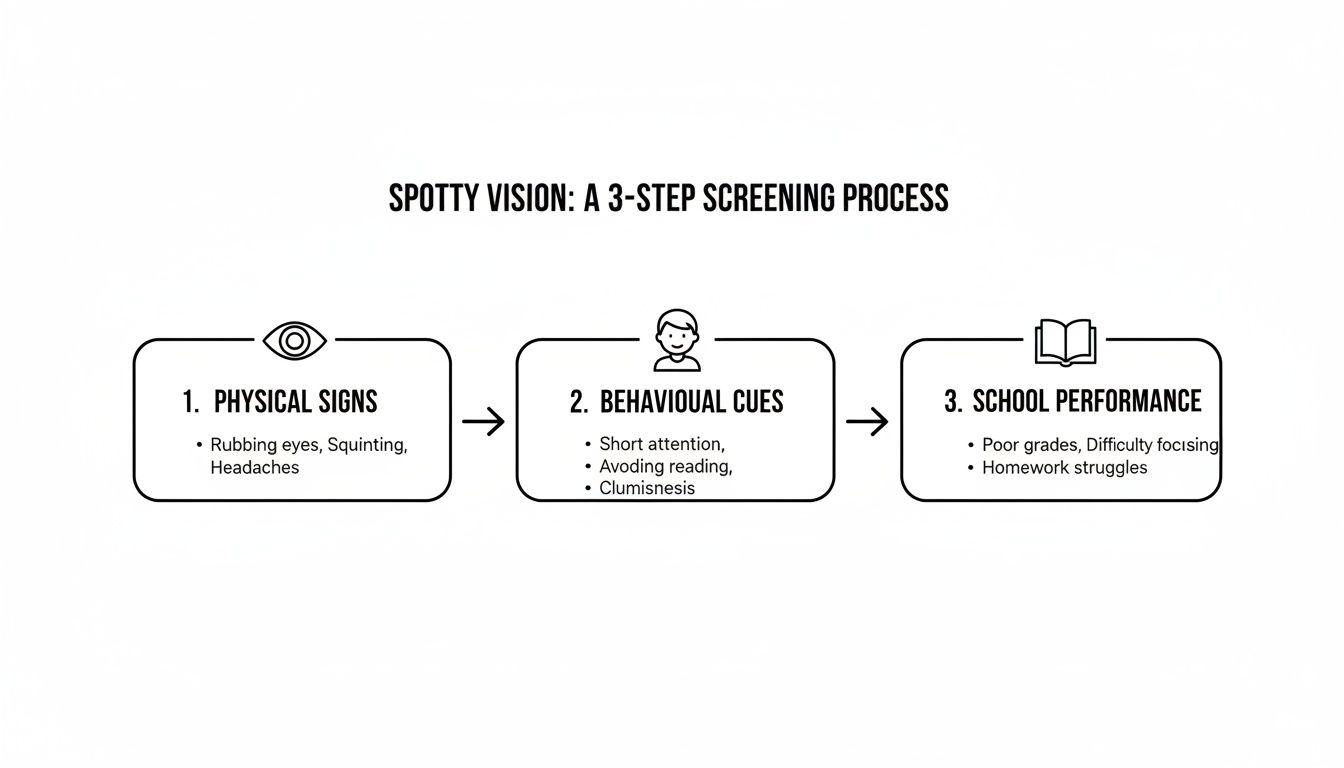
This process shows how a complete picture of a child’s vision is built by observing their physical actions, behavioural cues, and academic performance. For a really deep dive into everything from early development to ongoing care, this comprehensive children's eye exam guide is a fantastic resource.
Checking for Common Vision Issues
A huge part of a kids eye test is screening for common refractive errors. One of the biggest concerns in Australia right now is myopia, or short-sightedness. It's on the rise. Recent data from Specsavers, looking at over 2.6 million patient records, found that myopia in children jumped from 24.6% in 2017 to 28.8% in 2022.
Even more concerning, the average age of a first diagnosis dropped from 14.6 to just 13.3 years old in that same period. It’s a clear sign that with increasing screen time, we need to be vigilant about early screening.
But it's not just about clear vision. The optometrist will also carefully check eye alignment to rule out conditions like strabismus (crossed eyes) and amblyopia (lazy eye). Catching these early is absolutely critical, as treatment is much more effective when started young.
The optometrist also does a thorough health check of the eyes, looking at the retina, optic nerve, and other internal parts to make sure everything is developing as it should. This commitment to eye health and safety gives you complete peace of mind. To get a better feel for what a full examination involves, have a look at our guide on what to expect during an eye check up. And if it turns out glasses are needed, remember that we can customise an eyewear package to suit your requirements, ensuring the perfect fit for your child.
Decoding the Prescription and Choosing the Right Glasses
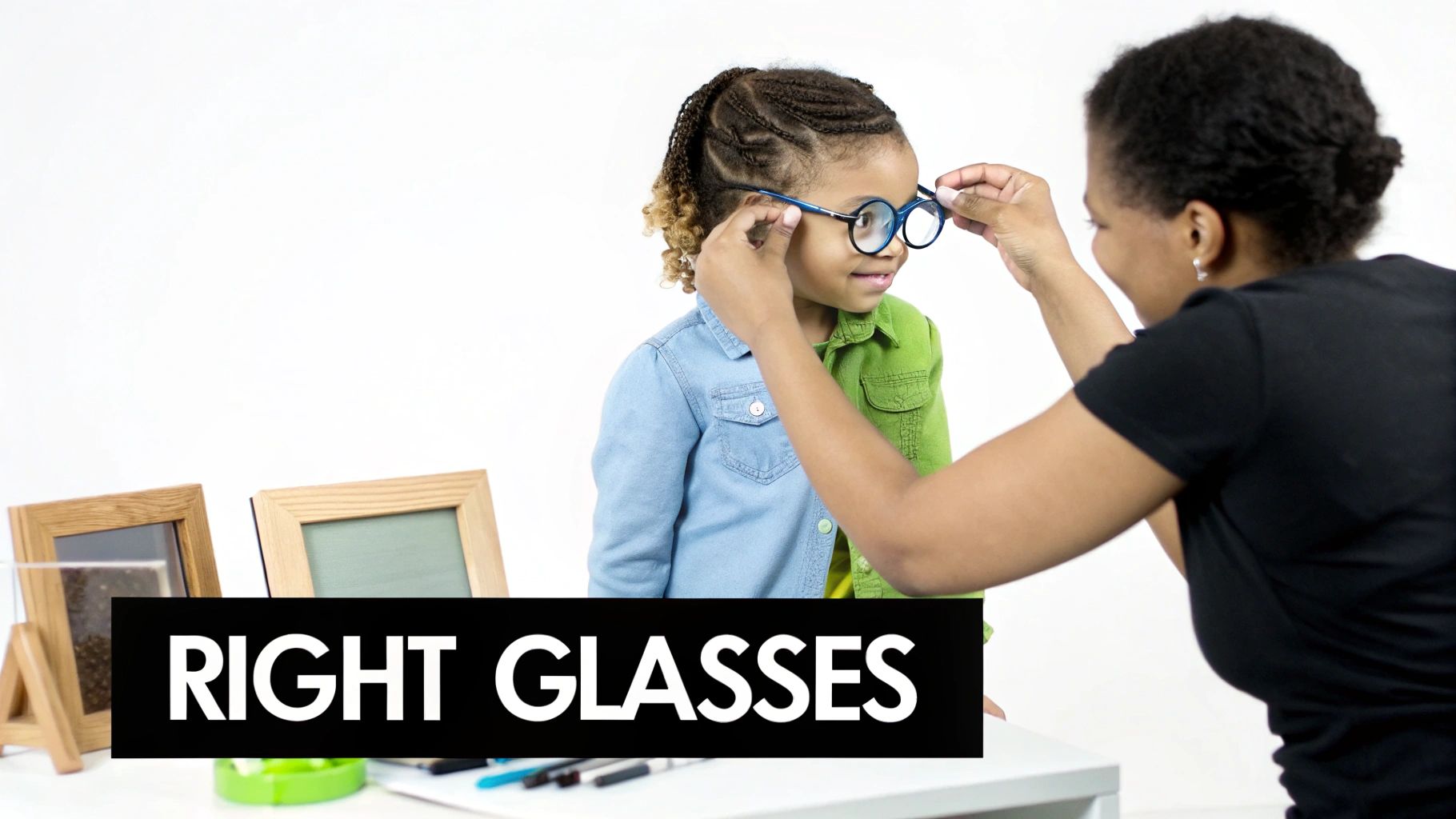
After a successful kids eye test, your optometrist might hand you a piece of paper that looks like a secret code. Seeing a jumble of letters and numbers like SPH, CYL, and AXIS can be a bit intimidating, but figuring out what they mean is the first step toward getting your child the clear vision they deserve.
Think of the prescription as a precise instruction manual for crafting the perfect lenses. Every number and abbreviation tells a specific story about how your child's eyes focus light, and we'll break it down into simple, practical terms.
Translating the Numbers into Real-World Vision
At its heart, a prescription corrects what are known as refractive errors. This just means the shape of your child’s eye prevents light from focusing correctly on the retina—the "screen" at the back of the eye.
Here’s a look at the most common conditions and what they actually mean for your child, with practical examples:
-
Myopia (Short-Sightedness): Your child can see things up close perfectly, but objects in the distance are blurry. On their prescription, the "SPH" number will have a minus sign (-). For example, they might have no trouble reading a book but can’t quite make out the words on the classroom whiteboard. Glasses will act like a zoom-out lens, bringing the distant world into sharp focus.
-
Hyperopia (Long-Sightedness): This one is a little trickier. While distant objects might be clear, their eyes have to work extra hard to see things up close, which can lead to strain and headaches. The "SPH" number will have a plus sign (+). A child with hyperopia might complain that their eyes feel tired after drawing or using a tablet, even if they don't say anything is blurry. Their glasses will do the heavy lifting, making close-up tasks feel effortless.
-
Astigmatism: This happens when the eye is shaped more like a footy than a perfectly round soccer ball, causing blurriness at all distances. The "CYL" and "AXIS" numbers on the prescription tackle this. A child with astigmatism might see letters like 'H' and 'N' as jumbled or struggle to tell similar shapes apart. Glasses for astigmatism fine-tune their vision, making everything crisp and clear.
For a deeper dive into all the terms, our guide on understanding your eye prescription can help clear up any lingering questions.
From Prescription to Perfect Glasses
Once you have that piece of paper, the next step is finding the right glasses. Correcting these vision issues is incredibly important. Recent Australian vision screening programs found that of 164,890 children screened, 7.4% were referred for further testing, revealing thousands with refractive errors that could get in the way of their learning.
Turning that prescription into the right pair of glasses is a crucial step for your child's eye health and safety. The good news is, it’s simpler than you might think. With a platform like Prescript Glasses, you can easily upload a photo of the script or just type in the details yourself.
Choosing glasses is no longer just about vision correction; it's about protecting and supporting your child's eyes in every situation, from the classroom to the playground.
Customising an Eyewear Package for Your Child
Every child is different, and their eyewear should match their unique lifestyle. That’s why customisation is so important. We can customise an eyewear package to suit your requirements, ensuring the final product is a perfect fit.
Think about what your child does every day. Are they spending a lot of time on tablets for school or gaming? Are they always running around outside?
-
BlueRay Lenses: These are designed to filter out the blue light from digital screens. Adding this feature can help reduce digital eye strain, which often leads to tired eyes and headaches after screen time.
-
Photochromic Lenses: You might know them as transition lenses. They automatically darken when they’re hit with UV light and lighten again indoors. They are a brilliant two-in-one solution, providing clear vision inside and full sun protection outside without needing a separate pair of sunnies.
By choosing the right frames and lens options, you’re not just giving your child clearer vision—you’re equipping them with a tool that supports their learning, protects their eyes, and boosts their confidence.
The Link Between Vision, Screen Time, and School Performance
Think of clear vision as the engine that powers a child’s entire academic journey. When they can easily see the board, read their books, and focus on their work without strain, they’ve got the fundamental tools to succeed. But an undetected vision problem can quietly throw a spanner in the works, creating frustrating and unnecessary hurdles in the classroom.
Imagine a kid who is bright and eager to learn but just can’t seem to keep up. They might get labelled as inattentive, disruptive, or lazy, when the real problem is that the words on the page are just a blurry mess. This scenario is far, far more common than most parents realise.
When Vision Problems Are Mistaken for Learning Difficulties
It’s incredibly easy for an undiagnosed vision issue to mimic the signs of a learning disability or behavioural problem. Why? Because a child who is struggling to see will often act out in ways that look like a lack of focus.
Here are some practical examples of how this can play out in the real world:
- The "Daydreamer": A child with hyperopia (long-sightedness) has to work incredibly hard just to focus on close-up tasks like reading. This constant muscle strain is exhausting, often causing them to lose concentration and just stare out the window to give their eyes a break.
- The "Clumsy" Kid: Poor depth perception can make a child seem uncoordinated. They might struggle with handwriting, have trouble spacing their words on a line, or find it nearly impossible to catch a ball during sport.
- The "Frustrated" Learner: If reading consistently gives a child a headache or makes them feel nauseous, they’ll naturally start avoiding it. This isn't a lack of interest in learning; it's a physical response to the discomfort of eye strain.
A professional kids eye test is the critical first step if your child is struggling at school. Before jumping to other conclusions, ruling out a vision problem provides essential clarity and is often the simplest solution.
The Modern Challenge of Digital Eye Strain
Today’s students are surrounded by screens. It’s unavoidable. From interactive whiteboards and school tablets to gaming consoles and smartphones at home, digital devices are part of their world. This introduces a very modern challenge for young eyes: digital eye strain.
This condition pops up because our eyes simply have to work harder when focusing on screens. We tend to blink less, which dries them out, and the high-energy blue light blasting from our devices can contribute to fatigue and general discomfort.
For a child, this can show up as:
- Dry, itchy, or watery eyes
- Complaints of frequent headaches
- Blurred vision after using a device
- Increased sensitivity to light
This is where proactive eye health and safety measures become so important. While you're looking at ways to reduce eye strain, it's also worth exploring productive screen habits, as covered in this great piece on making screen time count for learning.
Proactive Solutions for Protecting Young Eyes
Fortunately, there are simple and effective ways to protect your child’s vision in our screen-filled world. The first, and most important, step is to book them in for regular, comprehensive eye exams. Shockingly, a huge number of Aussie kids are missing out on this vital health check.
In 2023, only 19.5% of Australian children aged five to 14 had a comprehensive vision exam billed to Medicare. With over 1.6 million kids in that age group, this means a staggering 80.5% of children may have unchecked vision issues that could be holding them back.
Beyond scheduling that kids eye test, choosing the right eyewear can make a massive difference. For children who spend hours on digital devices for schoolwork or fun, lenses with a blue light filter are an excellent protective measure.
At Prescript Glasses, our BlueRay lenses are specifically designed to filter a portion of the blue light from screens, helping to reduce eye strain and increase comfort. You can learn more in our guide on how blue light filters can protect your eyes. Investing in the right eyewear is a direct investment in your child’s comfort and their future success. And remember, we can customise an eyewear package to suit your requirements, ensuring their glasses provide the exact protection they need.
Got Questions About Your Child's Eye Health? We’ve Got Answers.
Even after you’ve booked that first kids eye test, it's completely normal to have a few lingering questions. Navigating your child's vision care can feel a bit overwhelming, but the answers are usually more straightforward than you think. We’ll walk you through the most common queries, giving you clear, practical information to help you feel confident every step of the way.
From figuring out the right time for that first appointment to choosing the perfect pair of glasses, we’re here to support your child’s journey to clear vision and great eye health and safety.
At What Age Should My Child Have Their First Eye Test?
Here’s the golden rule from Optometry Australia: book a comprehensive eye test for your child before they start school, usually around age three or four. Why so early? Because early detection is everything. It’s the key to successfully treating common conditions like amblyopia (lazy eye), which responds best to treatment when kids are young.
A basic school screening is a nice start, but it can easily miss subtle yet significant issues that only a full examination can pick up. An optometrist does a much deeper dive, checking your child’s overall eye health, alignment, and all the essential visual skills they need for learning.
After that first check-up, appointments are generally recommended every two years. Of course, if your child has specific risk factors or their vision is changing, your optometrist will set up a more frequent schedule to keep a close eye on their progress.
Are Kids Eye Tests Covered by Medicare in Australia?
Yes, they usually are! In most cases, a standard kids eye test with an optometrist is bulk-billed directly to Medicare. This means you often won't have any out-of-pocket expenses for the examination itself.
Medicare typically covers one comprehensive consultation every three years for anyone under 65. If your child has a condition that needs more regular check-ins, like progressive myopia, your optometrist can justify extra visits that will also be covered.
It’s always a smart move to double-check the clinic's billing policy when you book. Just remember, while the test is covered, glasses and contact lenses aren't. However, you might be able to claim a rebate for those through your private health insurance extras cover.
What if My Child Is Too Young or Anxious to Read Letters?
This is a really common worry for parents, but rest assured, paediatric optometrists are pros at making eye tests feel more like a fun game than a medical appointment. They have a whole bag of tricks with specialised, child-friendly tools that don't depend on your child knowing their ABCs.
A skilled optometrist can figure out a child's prescription with amazing accuracy, even without a single word of feedback from them. It's all about careful observation and objective measurements, making sure the experience is stress-free for everyone.
For instance, instead of a standard letter chart, they might use:
- LEA Symbols: These are simple shapes a child can easily recognise, like an apple, a house, a square, and a circle. They can just name or point to what they see.
- Picture Charts: Who doesn’t love a matching game? These charts use fun pictures of animals or objects to test vision in an engaging way.
For very young or non-verbal kids, optometrists use clever tools like a retinoscope. This instrument shines a gentle light into the eye, and by watching how the light reflects off the retina, the optometrist can measure the prescription perfectly. The whole process is designed to be playful, often using toys and lights to keep your child comfortable and happy.
How Do I Choose Durable and Safe Glasses for My Child?
When you’re picking out glasses for an active kid, eye health and safety should be your top priorities. You need frames and lenses that can handle everything from playground adventures to classroom concentration.
Look for frames made from flexible but tough materials that can take the inevitable bumps and tumbles of childhood. A proper fit is also non-negotiable—the frames need to sit securely on their face without pinching their nose or constantly sliding down.
For the lenses, polycarbonate or Trivex materials are the gold standard for children. They're incredibly impact-resistant, which makes them much safer than standard plastic, and they come with built-in UV protection. A practical example of their benefit is during sports; these lenses are far less likely to shatter upon impact, protecting the child's eyes from injury.
This is where a little customisation makes a huge difference. We can customise an eyewear package to suit your requirements, making sure your child gets exactly what they need. For example, you could add our BlueRay filter to protect their eyes during screen time or choose Photochromic lenses that automatically darken in sunlight—a brilliant two-in-one solution for indoor and outdoor life.
At Prescript Glasses, we make it easy to get high-quality, customised eyewear for your child. Just upload their prescription, browse our durable frames, and pick the lens features that fit their lifestyle. Explore our options and build the perfect pair today at https://www.prescriptglasses.com.