Understanding your eye prescription: A Simple Guide to Glasses and Contacts

At first glance, your eye prescription can look like a secret code. It's that piece of paper filled with numbers and cryptic abbreviations that details exactly what your eyes need to see clearly. Think of it as the custom blueprint for your lenses, telling the optical technician the precise power required to fix issues like nearsightedness (when distant objects are blurry) or farsightedness (when close-up vision is a struggle). An accurate prescription is the first and most important step in ensuring your eye health and safety.
Your Prescription Decoded
Feeling a bit lost trying to figure out the technical jargon on your optical script? You're definitely not alone. Those abbreviations are the key to unlocking sharper vision and better eye health, and it's easier than you think. Let's break it down.
This handy guide breaks down the three main parts you'll find on almost every single prescription.
As the infographic shows, SPH (Sphere), CYL (Cylinder), and AXIS all work together. Each number has a specific job in shaping your lenses to give you the crispest focus and clarity possible.
To make things even simpler, here's a quick reference table.
Eye Prescription Terms at a Glance
This quick summary table will help you instantly decode the main terms on your optical prescription.
| Term (Abbreviation) | What It Means | What It Corrects |
|---|---|---|
| Sphere (SPH) | The main lens power for distance or near vision. | Nearsightedness (-) or Farsightedness (+) |
| Cylinder (CYL) | The amount of correction needed for astigmatism. | Astigmatism (unevenly shaped cornea) |
| Axis | The orientation of the Cylinder correction (in degrees). | The specific direction of your astigmatism |
| Add | Additional power for reading or close-up work. | Presbyopia (age-related difficulty with near vision) |
| Prism | Corrects for eye alignment issues. | Double vision or muscle imbalances in the eyes |
| PD | The distance between your pupils. | Ensures the lenses are correctly centred in the frame |
Understanding these terms puts you in control, helping you have more informed conversations with your optometrist about your vision needs.
Why This Matters for Your Eye Health
Knowing what these numbers mean is about more than just ordering a new pair of glasses; it’s a crucial part of looking after your eye health and safety. Think about it: if you're a gamer or a professional in a busy city like Sydney, you’re probably staring at a screen for hours on end. Your eyes start to ache, and your vision might get a little fuzzy. That's digital eye strain, and it's a massive issue across Australia where our screen time has gone through the roof.
In fact, the Australian Bureau of Statistics' National Health Survey 2022 found that a massive 56.7% of Australians—that’s around 14.4 million people—are living with at least one long-term eye condition. Many of these are linked directly to our love for digital devices. For anyone who spends a lot of time in front of a screen, like students and gamers, understanding your prescription is vital. It tells you exactly how your eyes handle focus at different distances, especially when you add the strain from blue light into the mix. You can find more insights on the state of optometry in Australia at ibisworld.com.
Customising Your Vision Solution
Your prescription gives us the essential data, but it's your lifestyle that really tells us what kind of lenses you need. A student cramming for exams all night needs a different solution than a professional who’s always on the road.
Here are a few practical examples:
- For the Gamer: If your prescription shows even a small correction, long gaming sessions can really amplify eye strain. We can add a blue light filter to your lenses to help cut down on fatigue.
- For the Student: Constantly switching your focus from a textbook to a laptop is tiring for your eyes. If you have an ADD value on your script, we can craft lenses that make that near-work much more comfortable.
- For the Outdoor Professional: Got strong SPH values and love spending time outside? No problem. We can build UV protection and sunglass tints right into your prescription lenses.
The goal is always to translate those numbers on the page into a personalised tool that works for your daily life. We can customize an eyewear package to suit your requirements, making sure your glasses don't just correct your vision, but actively protect it, too.
Decoding Sphere Cylinder and Axis

Let's break down the three most important numbers on your script: Sphere (SPH), Cylinder (CYL), and Axis. Think of your eye as a high-tech camera that needs a few precise adjustments to focus perfectly. These three values are the core settings your optometrist uses to give you a crystal-clear view of the world. Getting your head around what they mean is the first step to appreciating the science behind your sight.
Every number on your script is a measurement of your eye's refractive error, recorded in a unit called dioptres. Getting this right is absolutely vital for your visual comfort and long-term eye health. Here in Australia, with our indoor lifestyles and ever-increasing screen time, an accurate prescription is a real game-changer.
In fact, the Australian Institute of Health and Welfare reports that a massive 53.7% of the population deals with long-term eye conditions, and nearly half of us—49.5%—rely on glasses or contacts to get by. You can dive deeper into the Australian eyewear market stats over at expertmarketresearch.com.au.
Sphere: The Main Focusing Power
The Sphere (SPH) value is the headline act—it’s the primary focusing power of your lens. This number corrects for either nearsightedness (myopia) or farsightedness (hyperopia), and it’s the one you’ll almost always see on a script.
A minus sign (–) next to your SPH value means you’re nearsighted, while a plus sign (+) tells you you’re farsighted. The bigger the number gets (whether it's plus or minus), the stronger the lens you need.
-
Practical Example (Nearsightedness): A script with SPH -2.50 means you can probably see your phone screen just fine, but things in the distance—like road signs or a whiteboard in a meeting—are a blurry mess. Your glasses need to correct your focus for objects far away.
-
Practical Example (Farsightedness): If your script shows SPH +1.75, you might find that distant objects are clear, but you squint and struggle to read a book or a restaurant menu. Your lenses need that extra power to bring anything up close into sharp focus.
Cylinder and Axis: Sharpening for Astigmatism
While Sphere handles the main focus, Cylinder (CYL) and Axis are the fine-tuning specialists. They work together to correct for astigmatism.
Astigmatism happens when the front surface of your eye (the cornea) is shaped more like a footy than a perfectly round soccer ball. This irregular curve causes light to focus at multiple points inside your eye, leading to blurry or distorted vision at all distances.
Think of it like tuning an old radio. The SPH dial gets you to the right station, but there’s still a bit of static. The CYL and Axis are the fine-tuning knobs that eliminate that static completely, giving you a perfectly clear signal.
The Cylinder (CYL) value tells us how much power is needed to correct the astigmatism. Just like Sphere, it can be a minus or plus number and is measured in dioptres. If this box is blank on your script, congratulations—you have little to no astigmatism!
The Axis, on the other hand, is always a number between 1 and 180. It pinpoints the orientation or angle of the astigmatism. It’s like a set of coordinates that tells the lab exactly where on the lens to place the cylindrical correction to counteract your eye’s unique shape.
Key Takeaway: Cylinder and Axis are a team; you can't have one without the other. The Axis value directs exactly where to apply the Cylinder's corrective power. Together, they make sure light focuses perfectly on your retina, giving you that crisp, clear vision you're after.
Astigmatism is pretty common, affecting an estimated 15-20% of Australians. That makes the CYL and Axis values critical for a huge portion of the population. These numbers ensure that whether you're reading code on a screen or watching the sunset, the image is sharp, not stretched or distorted. Our job is to use this data to create the perfect lenses for you, which is why we can customize an eyewear package to suit your requirements and get your vision as clear as it can possibly be.
Getting to Grips with PD, ADD, and Prism
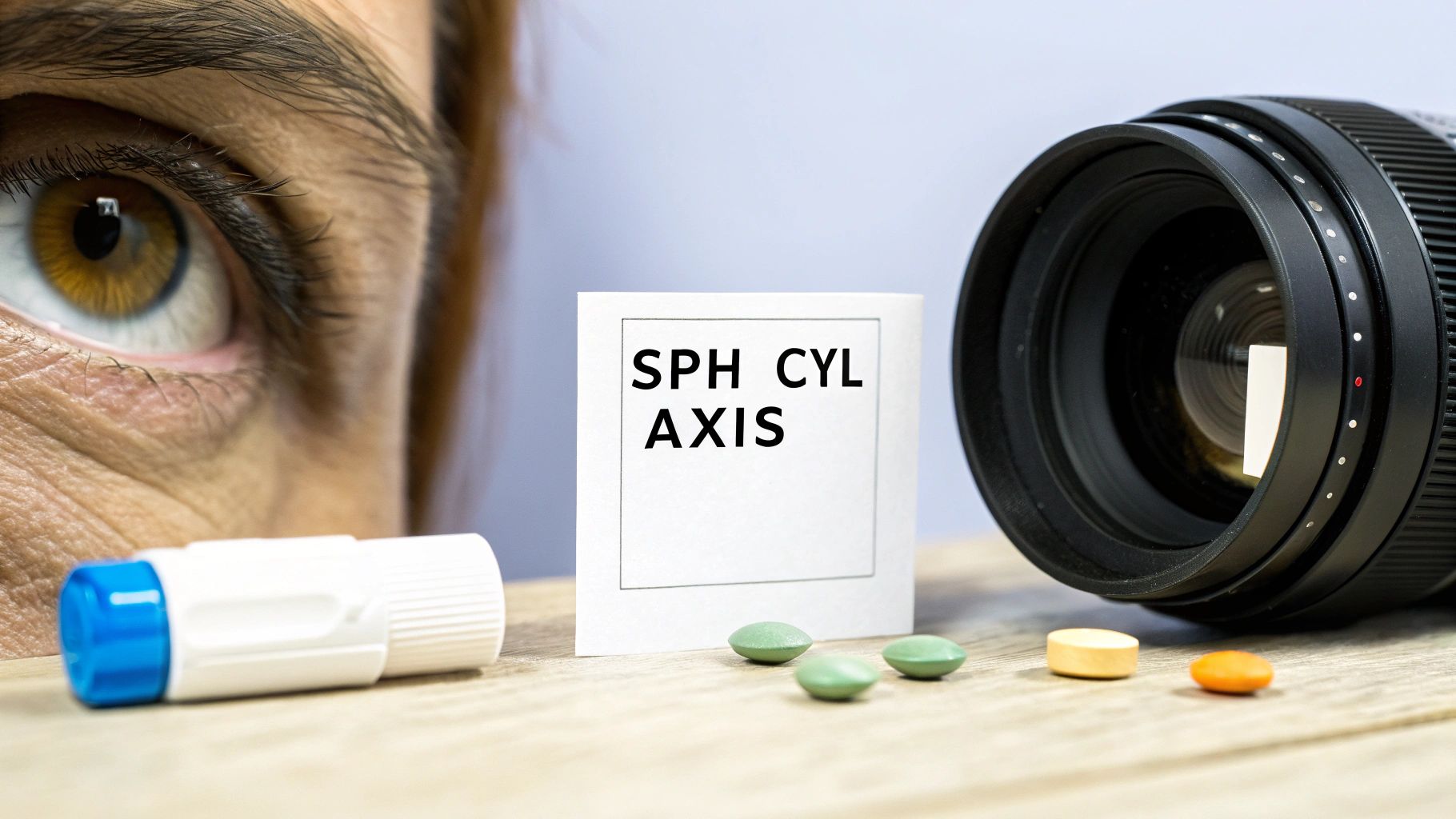
While Sphere, Cylinder, and Axis form the core of your vision correction, your script might have a few other specialised numbers. Think of these as the finishing touches that take a good pair of glasses and make them great — ensuring perfect alignment, comfortable reading, and unified vision. Let's demystify Pupillary Distance (PD), ADD, and Prism.
Getting these values right is non-negotiable for your overall eye health and safety. When measured and applied correctly, they’re your best defence against the headaches, eye strain, and general discomfort that come from poorly made glasses. They are absolutely crucial for a comfortable and effective experience.
Pupillary Distance: The Blueprint for Alignment
Your Pupillary Distance (PD) is simply the measurement in millimetres between the centres of your pupils. Imagine you’re trying to align the headlights on your car. If they're aimed even slightly off-centre, your view of the road is compromised, no matter how bright the bulbs are. It’s the exact same principle for your glasses.
An accurate PD makes sure the optical centre of each lens—its most powerful and precise point—sits directly in front of your pupil. This alignment is what gives you the clearest vision possible. Get it wrong, and you’re setting yourself up for eye strain, blurry vision, and headaches as your eyes work overtime to compensate.
Interestingly, many prescriptions from optometrists don't include the PD, as it’s often taken when the glasses are being made. Not to worry! It’s a simple measurement you can take yourself. For a straightforward guide, check out our detailed article on how to measure your pupillary distance.
ADD Power: The Boost for Close-Up Vision
If you spot an ADD value on your prescription, this stands for the "additional" magnifying power you need for close-up tasks like reading. It's most common for people over 40 who are dealing with presbyopia—that natural, age-related difficulty focusing on things up close.
The ADD value is always a positive number (like +1.50) and is identical for both eyes. It's the key ingredient for creating multifocal lenses, such as bifocals or progressives.
- Practical Example: You’re a professional who needs to switch between looking at a computer screen (intermediate distance) and reading a document on your desk (near distance). An ADD value allows us to craft progressive lenses where the top part corrects your distance vision, while the bottom seamlessly adds the extra power you need to see that document with perfect clarity.
Prism: The Fix for Eye Teamwork
A Prism correction is less common, but for those who need it, it’s a game-changer. It’s prescribed to correct eye alignment problems, where your eyes don't quite work together as a team. This misalignment can lead to double vision (diplopia) or some pretty severe eye strain.
Prism lenses work by bending light before it even hits your eye, effectively redirecting the image so both eyes perceive it in the same spot. This allows your brain to fuse the two images into one clear, single picture. The prescription will show both the amount of prism (in prism dioptres) and the direction it's applied (Base Up, Down, In, or Out).
A Focus on Safety: Prism correction is a perfect example of a prescription directly protecting your eye health. By helping your eyes work in sync, it eliminates the muscular strain that causes headaches and fatigue, making everyday tasks safer and far more comfortable.
Ultimately, understanding every number on your prescription empowers you to make smarter choices for your vision. Whether it's nailing the alignment with your PD or getting the right reading boost from an ADD value, these details really do matter. It's why we can customize an eyewear package to suit your requirements, turning that script into perfect, comfortable vision.
Choosing the Perfect Lenses for Your Prescription
Getting your prescription numbers is just step one. The real magic is turning that script into the perfect pair of lenses for your actual, real life. This isn't just about sharp vision; it's about making smart choices that protect your eyes for the long haul. Your eye health and safety are at the centre of every decision we make, guiding us as we match your specific needs to the right lens technology.
We need to look past the raw numbers and think about how you live. Are you a student pulling late-nighters? A professional staring at spreadsheets all day? Someone who’s constantly moving between the bright outdoors and the office? Each scenario calls for a different kind of lens to make sure your eyes aren't just corrected, but properly protected.
High-Index Lenses for Stronger Prescriptions
If your prescription has higher Sphere (SPH) or Cylinder (CYL) numbers—say, something like -5.00 or +4.50—standard lenses can get pretty thick and heavy. This is where high-index lenses come in and completely change the game. They’re made from a special material that bends light way more efficiently, so the lenses can be much thinner and lighter than their standard plastic cousins.
Here's a practical example:
Let's say your script is -6.00 SPH. With standard lenses, you’d probably end up with that classic "coke bottle" look where the edges are noticeably thick. High-index lenses can slash that thickness by up to 40%, giving you way better comfort and a much cleaner look without sacrificing an ounce of clarity.
Protecting Your Eyes in a Digital World
In Australia, it feels like we spend half our lives staring at screens, from our phones to our work computers. All that exposure to high-energy visible (HEV) blue light can really do a number on our eyes, leading to digital eye strain—think dry eyes, headaches, and fuzzy vision. This is exactly why we have specialised lenses to fight back.
Our BlueRay lenses are engineered to filter out a huge chunk of that harmful blue light. This isn't just about feeling more comfortable at the end of the day; it's a proactive move to protect your long-term eye health.
By cutting down the amount of blue light that hits your retina, these lenses help take the edge off digital eye strain. They can even help you get better sleep, since blue light is notorious for messing with your body’s natural sleep cycle.
Seamless Transitions with Photochromic Lenses
For anyone who’s constantly popping in and out of doors, Photochromic lenses are an incredible bit of tech. You might know them as "transition" lenses. They automatically darken when you step into UV light and fade back to clear the moment you're back inside. No more fumbling to switch between your regular glasses and sunnies.
Here's a practical example:
Picture a busy professional running errands on their lunch break. With photochromic lenses, their vision stays crisp and comfortable whether they're at their desk or walking in the bright Aussie sun. That nonstop UV protection is a huge win for maintaining great eye health and safety.
A great lens choice often comes down to your daily routine. To make it easier, we've put together a quick comparison to help you figure out which lens type fits your lifestyle best.
Which Lens Is Right For Your Lifestyle?
| Lens Type | Ideal For | Key Benefit |
|---|---|---|
| High-Index | Stronger prescriptions (above +/-4.00) | Thinner, lighter, and more comfortable lenses. |
| BlueRay | Students, gamers, office workers | Filters harmful blue light to reduce digital eye strain. |
| Photochromic | People who move between indoors and outdoors | Automatically adapts to light, providing UV protection. |
| Sunglasses | Drivers, outdoor enthusiasts, everyone | Maximum UV protection to prevent long-term sun damage. |
Choosing the right lens is all about matching the technology to your needs, ensuring both comfort and protection throughout your day.
The Essential Role of Sunglasses
You just can't compromise on proper UV protection. Over time, too much exposure to the sun’s ultraviolet rays is directly linked to serious eye conditions like cataracts and macular degeneration. That's why a good pair of dedicated sunglass lenses with full UV protection is an absolute must-have. We can fit sunglass lenses to almost any prescription, so your eyes are shielded without giving up on sharp vision.
Whether you're behind the wheel, hitting the beach, or playing sport, prescription sunglasses give you the best of both worlds: crisp vision and critical protection from damaging radiation.
Your Customised Eyewear Solution
Think of your prescription as the blueprint and your lifestyle as the final design. The amazing thing about modern lens technology is just how adaptable it is. We don't do "one-size-fits-all" because every person—and every daily grind—is completely different. You can dive deeper into the different lens options in our detailed guide on prescription glasses lenses.
At the end of the day, our goal is to fuse your unique visual needs with the best protective tech out there. We can customize an eyewear package to suit your requirements, turning a complex script into a perfect, protective, and comfortable pair of glasses that genuinely enhances how you see the world.
How to Submit Your Prescription Online
Alright, you've figured out what all those numbers on your script mean and picked out the perfect lenses. Now for the final, easy bit: getting that information to us so we can start making your glasses.
Ordering custom glasses online should be simple, and we’ve made sure our process is exactly that. It's secure, straightforward, and designed to give you complete peace of mind.
Our commitment to your eye health and safety is our top priority. That’s why a real human from our team personally verifies every single prescription we receive. This double-check guarantees total accuracy before we even think about crafting your lenses.
A Simple Step-by-Step Guide to Uploading
Getting your prescription to us is a breeze, whether you have a crisp paper copy or just a quick photo of it on your phone.
Here’s how it works:
- Select Your Frames and Lenses: The fun part first! Browse our collection, find a pair of frames you love, and pair them with your chosen lens type, like BlueRay or Photochromic.
- Choose How to Send It: When you get to the checkout, we'll ask for your prescription. You’ve got options: upload a file right then and there, type in the details manually, or simply choose to email it to us later.
- Upload Your File: If you're uploading a photo or scan, just hit the ‘Upload Prescription’ button. We accept all the usual file types, like JPG, PNG, and PDF.
- Make Sure It's Clear: This is the most important step! Make sure the photo of your script is clear, bright, and shows everything from corner to corner. We need to see all the numbers and your optometrist's details to get it right. After all, understanding your eye prescription is pointless if we can’t read it!
Once you hit submit, our work begins. We pore over every detail to make sure your new glasses are absolutely perfect for you.
Data Security and Our Verification Process
We know that sending personal health information online requires trust. We take that trust seriously, handling your prescription details with the highest level of care and security. If you're curious about what makes for safe data handling, it's worth reading up on HIPAA compliant document sharing practices.
Our verification process is a crucial part of our promise to look after your eye health and safety.
- Initial Review: First, we check the uploaded file to make sure it's legible and has all the necessary info.
- Data Cross-Check: Next, our optical technicians manually cross-reference the details on your script with your order to confirm they match perfectly.
- Expiration Date Check: We also make sure your prescription is still valid. Using an old script can lead to the wrong lenses and unnecessary eye strain, so we always check the date.
This hands-on process catches any potential errors and guarantees the glasses you receive give you the exact vision correction you need. Your satisfaction and safety are what matter most to us.
Ready to get started? The easiest way is to head over to our portal to upload your prescription and finish your order. We can customize an eyewear package to suit your requirements, creating a pair of glasses that feels like it was made just for you.
Frequently Asked Questions About Prescriptions
Jumping into the world of optical prescriptions can feel like you’re trying to crack a code. We get it, and we believe that understanding your vision is the first step to owning it. This section is here to clear up some of the most common questions we hear, giving you straightforward answers so you can feel totally confident in your eye care choices.
Our number one priority is always your eye health and safety. By breaking down these topics, we want to empower you to make smart decisions for your sight. Let's get into it.
How Long Is My Prescription Valid For?
This is probably one of the most critical questions, and for good reason. In Australia, a prescription for glasses is generally valid for one to two years. Your optometrist will print the exact expiry date right there on your script.
It’s really important to stick to this timeframe. Your eyes can change more than you’d think in a year or two, and using an old prescription can lead to fuzzy vision, nagging headaches, and a whole lot of unnecessary eye strain. Think of regular eye exams as a crucial part of your health check-up, making sure your lenses are always perfectly tuned to your needs.
Can I Use My Glasses Prescription for Contact Lenses?
It’s a common mix-up, but the answer here is a definite no. A prescription for glasses and one for contact lenses are two completely different things, and you can’t swap them. Getting this right is non-negotiable for your eye health and safety.
Here’s an easy way to think about it: your glasses sit about 12 millimetres away from your eyes, while contacts sit directly on them. That tiny distance changes everything.
- A glasses prescription calculates how light needs to bend through a lens that’s positioned a short distance from your eye.
- A contact lens prescription needs extra details, like the base curve (to match your eye’s shape) and the lens diameter. The power is often different too, because it’s sitting right on your cornea.
Trying to order contacts with your glasses script would lead to a terrible fit and wrong correction. At best, it's uncomfortable; at worst, it could actually harm your eyes. Always get a separate fitting and a dedicated prescription from your optometrist for contacts.
Why Is My Prescription Different from My Friend's?
Even if you and a friend seem to have similar vision problems, your prescriptions will never be identical. Your script is a unique blueprint for your eyes, fine-tuned to your specific visual needs.
So, why the difference? A few things come into play:
- The Type of Refractive Error: You might be nearsighted (myopia), while your friend is farsighted (hyperopia). These conditions require opposite types of lens power (minus vs. plus).
- The Strength of Correction: Your Sphere (SPH) value shows how much correction you need. A -1.50 is a world away from a -4.00.
- Astigmatism: If you have an astigmatism, your script will have Cylinder (CYL) and Axis values to correct the slightly irregular shape of your cornea. Your friend might not have one at all.
- Reading Needs: As we get older, many of us need a little help with close-up vision. If that’s you, your script will have an ADD value for multifocal lenses, something a younger person likely won’t have.
Think of your prescription like a fingerprint—it’s a precise map of your eyes' unique landscape. That’s why a one-size-fits-all approach just doesn’t work for eyewear.
What If I Don't Have My Pupillary Distance (PD)?
It’s actually quite common for an optometrist to leave the Pupillary Distance (PD) off your prescription. The PD is simply the distance between the centres of your pupils, measured in millimetres. It’s absolutely essential for centring your lenses perfectly in your frames.
If the PD is wrong, the optical centre of the lenses won’t line up with your pupils. This can cause blurry vision, eye strain, and headaches. While it might be missing from your script, getting it is easy. We have a simple guide that shows you exactly how to measure it at home. Nailing this measurement is a key step to making sure your new glasses feel just right.
Here’s a practical example:
Imagine looking through binoculars that aren't adjusted properly. You see two fuzzy, separate circles. An incorrect PD creates a similar (though more subtle) effect. Your eye muscles strain to merge the two images, leaving you with tired eyes. The correct PD ensures you’re looking through the "sweet spot" of each lens, giving you one sharp, effortless image.
Ultimately, every single number on your prescription matters. Understanding what it all means—from its expiry date to why it’s yours and yours alone—puts you in control of your eye care. From there, we can customize an eyewear package to suit your requirements, turning that piece of paper into a perfect pair of glasses.
At Prescript Glasses, we blend expert knowledge with stylish, high-quality frames and lenses to deliver eyewear that’s built for you. Start creating your perfect pair today at https://www.prescriptglasses.com.