A Guide to Migraine Eye Glasses for Managing Light Sensitivity

If you've ever dealt with migraines, you know how debilitating they can be. Often, the world just feels too bright. That’s where migraine glasses come in—they're a bit like noise-cancelling headphones, but for your eyes. They’re designed to filter out the harsh, specific wavelengths of light that can trigger a migraine or make an existing one feel so much worse.
What Are Migraine Glasses and How Do They Work?
Think of these glasses as a shield. They're not a cure, but they are an incredibly useful tool for managing one of the most common migraine triggers: photophobia, or extreme sensitivity to light. For someone with photophobia, a brightly lit office, the supermarket, or even a sunny day can feel like an assault on the senses.
So, how do they do it? The magic is in the lenses. They selectively block out the most problematic parts of the light spectrum—specifically, certain blue and amber wavelengths. Research has shown that these particular types of light are notorious for activating the pain pathways in the brain that lead to migraine attacks.
To get a bit more technical, it's all about managing the light that reaches your eyes. A key concept here is to understand Visible Light Transmission (VLT), which is just a measure of how much light a lens allows to pass through. By carefully controlling VLT and filtering specific colours, these glasses create a protective buffer, calming the visual "noise" before it overwhelms your brain.
More Than Just Light Filtering
While blocking harsh light is their main job, these glasses are really part of a bigger strategy for your eye health and safety. They help ease the constant eye strain and neurological stress that light-sensitive people put up with every day. If you struggle with photophobia, the first step is knowing what can help. We've put together a detailed guide on photophobia eye glasses that dives deeper into your options.
It's really important to see these glasses as one part of a complete migraine management plan. They work best when you combine them with other strategies from your doctor, building a proactive defence against your known triggers.
This is a huge deal here in Australia. A 2018 Deloitte report revealed that a staggering 4.9 million Australians live with migraine. What's more, 86% of them are of working age. That’s a massive number of professionals, students, and even gamers who are constantly exposed to the exact kind of artificial light and screen glare that can set off an attack. Protective eyewear isn't a luxury; it's a practical necessity. You can read more about the burden of migraine in Australia to get the full picture.
Here at Prescript Glasses, we know that no two people experience light sensitivity the same way. That's why we can customize an eye wear package to suit your requirements, making sure you get the exact level of protection you need to live your life more comfortably.
The Science Behind Why Light Triggers Migraines
Ever wondered why the fluorescent lights in your office or the glow from your laptop screen can feel physically painful during a migraine attack? That intense sensitivity to light, known as photophobia, isn’t just in your head—it's a very real neurological response. There's a direct connection between certain types of light and migraine pain, and it all comes down to a specific pathway from your eyes to your brain.
Tucked away deep in the retina of your eye are specialised, light-sensitive cells. These aren't the same cells you use for everyday vision. Known as intrinsically photosensitive retinal ganglion cells (ipRGCs), their main job isn't to help you see clearly, but to detect the intensity of the light around you and send signals straight to the brain.
This is where the trouble begins for people who get migraines. The signals from these ipRGCs travel along a pathway that links directly to the trigeminal nerve. Think of this nerve as the command centre for head pain—it's a major player in migraine attacks.
When specific wavelengths of light, especially those in the harsh blue-violet part of the spectrum, hit these ipRGCs, they get overstimulated. It's like they're sounding an alarm that activates the trigeminal nerve, which can either kick off a migraine or make an existing one much, much worse.
A Practical Example of Light Triggers
Let's picture a uni student cramming for exams under the harsh, flickering fluorescent lights of a library. The light bombarding their eyes is packed with the exact blue light wavelengths that these ipRGCs are most sensitive to.
- The ipRGCs in their eyes go into overdrive from the intense, specific light.
- These over-activated cells fire off a cascade of signals straight to the student's already sensitised trigeminal nerve.
- The nerve interprets this bombardment as a threat, which can either trigger a brand-new migraine or dial up the pain of an existing one, turning a study session into an agonising ordeal.
This physiological chain reaction is exactly why migraine eye glasses are so effective. They aren't just about dimming the light; they're designed to selectively filter out those very specific, problematic wavelengths. They act as a protective barrier, calming those signals before they can overwhelm your brain's pain centres. If you want to dive deeper into how this works, you can explore the science-backed benefits explained in our article on blue light glasses.
Photophobia is a defining symptom of migraine, and modern life is filled with triggers. This isn't just an inconvenience; it's a significant barrier for many at work and home.
Here in Australia, the link between lighting and migraines is crystal clear. A 2022 national survey revealed that among women experiencing migraines at work, a staggering 63% identified office lighting as a common trigger. For countless Australian professionals, students, and gamers, this just highlights the daily battle against artificial light. At Prescript Glasses, we can customize an eyewear package to suit your requirements, providing targeted filtering to help you manage these environmental triggers effectively.
Comparing the Different Types of Migraine Lenses
Trying to figure out which migraine glasses are right for you can feel a bit like navigating a maze. There are so many options, and not all lenses are created equal. Each type filters light differently, which means some are better for certain situations and triggers than others. Getting this choice right is crucial for your comfort and eye health and safety.
Think of it like choosing the right tool for a job. You wouldn't use a hammer to turn a screw. In the same way, the best lenses for staring at a computer screen all day probably aren't the best choice for driving on a bright, sunny afternoon. Let’s break down the most common options to help you find your perfect fit.
The Proven Performer: FL-41 (Rose Tint)
The FL-41 tint is one of the most trusted and heavily researched options out there for photophobia. It was first developed to take the edge off harsh fluorescent lighting, and its gentle rose colour is precision-engineered to block a specific slice of the light spectrum that’s known to aggravate migraines—specifically, the harsh blue-green light around 480–520 nanometres.
- Best For: Indoor settings with nasty artificial lighting, like offices, classrooms, or big-box retail stores.
- Practical Example: Picture an office worker who spends their day under buzzing fluorescent lights. FL-41 lenses can dial down that visual stress, reducing eye strain and helping them power through the day with fewer headache symptoms.
The Digital Defender: BlueRay Filter Lenses
BlueRay lenses (you might also hear them called blue light filtering lenses) are your go-to for tackling digital eye strain. Their mission is simple: target the high-energy visible (HEV) blue-violet light that beams out of our screens—computers, smartphones, and tablets.
While they don't filter the same broad spectrum as FL-41, they’re brilliant for easing the visual fatigue and sleep cycle disruption that comes from too much screen time.
- Best For: Anyone who clocks serious hours in front of a digital device. We're talking gamers, students, and remote workers.
- Practical Example: A university student pulling a late-night study session with BlueRay lenses on will likely notice their eyes feel less dry and gritty. Plus, by cutting down on that stimulating blue light, they'll find it easier to wind down and get to sleep afterwards.
The Adaptive All-Rounder: Photochromic Lenses
Photochromic lenses are the chameleons of the eyewear world, offering a clever two-in-one solution. Indoors, they’re perfectly clear. Step outside into the sun, and they automatically darken to become sunglasses.
This adaptability is incredibly convenient, though it's worth noting their main job is UV protection, not filtering the specific indoor light wavelengths that often trigger migraines. If you want a deeper dive, check out our guide comparing photochromic lenses vs Transitions.
- Best For: People who are constantly moving between indoors and outdoors and want a single pair of glasses to do it all.
- Practical Example: A teacher who splits their time between a bright classroom and a sunny playground gets seamless comfort. The lenses adjust on their own, so there’s no need to constantly switch glasses. It's good to understand the full picture, and learning about the pros and cons of photochromic lenses can help you decide if this technology fits your life.
The Glare Reducer: Polarised Sunglasses
While you wouldn't typically wear them inside, a good pair of polarised sunglasses is an absolute non-negotiable for managing light sensitivity outdoors. They’re specifically engineered to wipe out the intense, blinding glare that reflects off surfaces like water, snow, and wet roads.
This makes for far greater visual comfort and clarity in bright sunlight compared to your average pair of non-polarised sunnies.
To make things even clearer, here’s a side-by-side look at how these different lens technologies stack up. This should help you pinpoint the best option for your lifestyle and specific light triggers.
Detailed Lens Comparison for Migraine Sufferers
| Lens Feature | FL-41 (Rose Tint) | BlueRay Filter | Photochromic | Polarised Sunglasses |
|---|---|---|---|---|
| Primary Use | Indoor artificial light | Digital screens | Indoor/Outdoor transition | Bright outdoor sunlight |
| Key Benefit | Blocks migraine-triggering light wavelengths | Reduces digital eye strain & improves sleep | Adapts to changing UV light | Eliminates reflective glare |
| Best Environment | Offices, classrooms, stores with fluorescent lights | In front of computers, phones, or tablets | Moving between inside and outside | Driving, beach, snow, water activities |
| Light Filtering | 480-520nm (blue-green) | High-energy blue-violet light | UV light (darkens outdoors) | Blocks horizontal glare |
| Indoor Tint | Noticeable rose tint | Clear or very faint yellow tint | Completely clear | Too dark for indoor use |
Ultimately, finding the right lens isn’t about picking the single "best" one. It's about matching the right technology to your personal triggers and your daily routine.
Choosing the right lens isn't about finding the 'best' one overall; it's about matching the technology to your unique triggers and daily activities.
Here at Prescript Glasses, we get that everyone's situation is different. That’s why we can customize an eyewear package to suit your requirements, whether that means the targeted filtering of FL-41, the digital defence of a BlueRay filter, or the all-in-one convenience of photochromic lenses. Once you identify your main sources of light-related pain, you can build a solution that truly supports your eye health.
Finding the Right Glasses for Your Lifestyle
Choosing the right migraine glasses isn't just about picking a lens technology; it’s about making that tech work for your daily life. The specific triggers you face—the lights at your job, the screen you study on, the glare at home—play a massive role in figuring out which eyewear will give you the most relief.
Ultimately, it’s about finding a solution that fits your unique challenges. A pair of glasses that’s a lifesaver for someone glued to a computer screen might not be the best choice for someone who’s constantly moving between bright sunlight and indoor artificial lighting. Let's walk through a few real-world examples to see what I mean.
The Office Professional
Picture Sarah, an accountant spending eight hours a day under harsh, flickering fluorescent lights while staring at two computer monitors. Her main triggers are that relentless overhead glare and the intense blue light blasting from her screens.
For her, a pair of FL-41 tinted glasses would be perfect for turning down the visual "noise" from the office environment. Adding a BlueRay filter would then specifically tackle the digital eye strain from her monitors, giving her a powerful two-pronged defence.
The University Student
Now, let's think about Liam, a uni student. His days are a mixed bag: brightly lit lecture halls, dim library corners, and long nights hammering out essays on his laptop. He needs something versatile. A pair of glasses with a BlueRay filter is non-negotiable for those late-night study sessions, helping to protect his eyes and keep his sleep cycle in check.
This simple decision tree can help you visualise the choice between different lenses based on your environment.
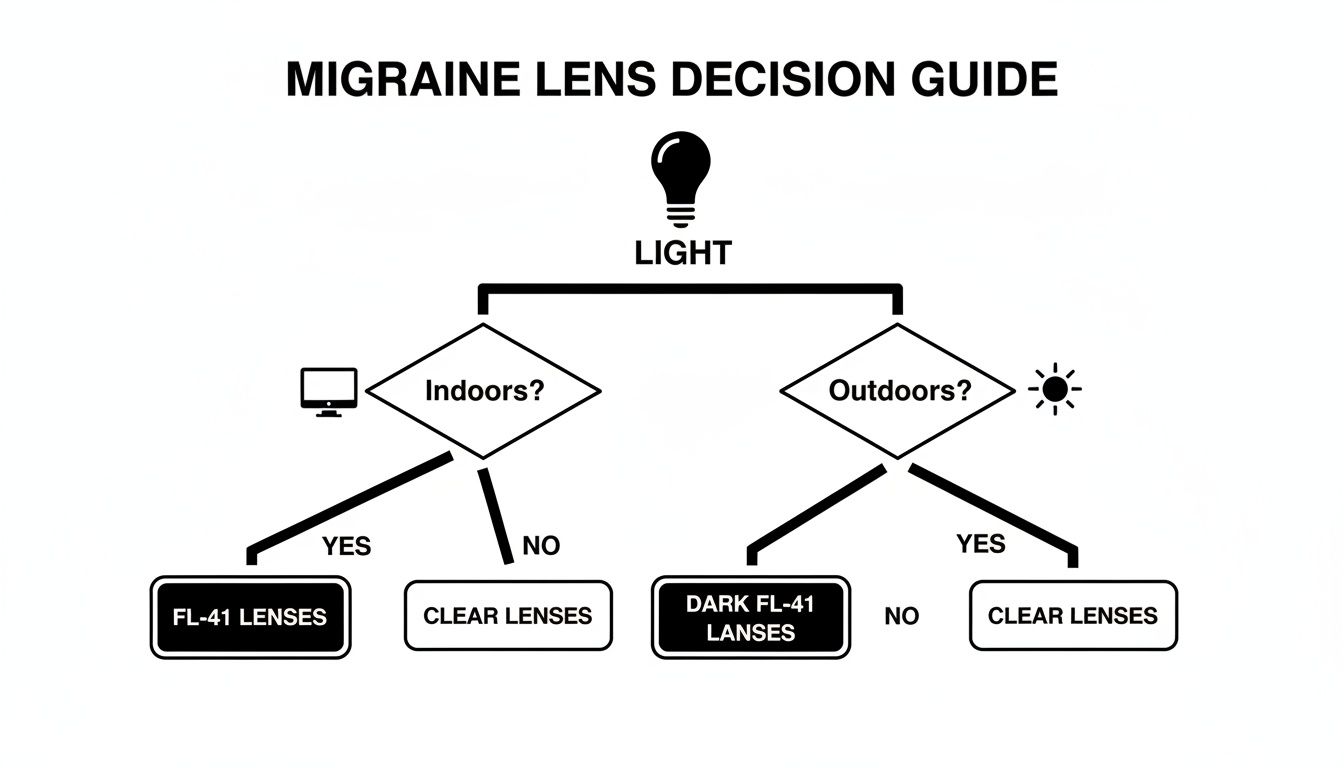
As you can see, the first step is always figuring out where you're exposed to the most triggering light—indoors or outdoors.
The Avid Gamer
Finally, consider Chloe, a dedicated gamer who dives into fast-paced, high-contrast digital worlds for hours at a time. The constant flickering and intense blue light from her gaming setup are major sources of eye fatigue and can easily spark a migraine.
Her best bet? A solid pair of migraine glasses with a strong BlueRay filter. These are designed to cut screen glare and block the most disruptive wavelengths, letting her enjoy longer, more comfortable gaming sessions without paying for it later.
It's a critical point to consider, especially here in Australia, where a staggering 86% of migraine sufferers are of working age. This means millions of us are stuck in the exact office, study, and gaming environments where the right optical solution can make a world of difference.
The scale of this issue isn't small, with productivity losses hitting $16.3 billion every year because of migraine. You can read more in this socioeconomic analysis of migraine in Australia. Understanding how these everyday situations contribute to the problem is the first step toward finding real relief. At Prescript Glasses, we can customize an eyewear package to suit your requirements, making sure your glasses are a perfect match for your lifestyle.
How to Order Your Custom Migraine Glasses
Ready to get some relief from harsh, painful light? Ordering a custom pair of migraine glasses is actually pretty simple. We've designed the process to be straightforward, so you get exactly what your eyes need.
Before we even get to frames and lenses, the most important first step is your eye health and safety. That means starting with a current prescription from your optometrist.
An up-to-date prescription is non-negotiable for a couple of big reasons. First, it ensures your vision correction is spot-on, which helps cut down on eye strain—a notorious trigger for headaches. More importantly, a recent eye exam is crucial for ruling out any underlying health problems that could be causing your headaches or light sensitivity in the first place.
Once you’ve got that sorted, you can move on to the fun part: building your perfect pair.
Step 1: Choose Your Frame
Picking the right frame is about so much more than just looking good; it's about comfort and coverage. You'll want a frame that fits snugly without pinching or sliding down your nose, because any little annoyance can create tension you just don't need.
For the best protection against light sneaking in from the sides, think about getting larger frames or even a wraparound style. A good fit means you'll actually want to wear your glasses when a migraine strikes. Think about your day-to-day life, too. If you’re a serious gamer, you might want a super lightweight frame. If you're heading into the office, maybe a more professional look is your go-to.
Step 2: Select Your Ideal Lens
This is where the magic happens. You get to match the lens technology directly to your personal triggers. Based on what we've talked about, you can zero in on the best fit for your lifestyle.
- Practical Example 1: A graphic designer staring at a high-res monitor all day? They'd get the most out of our BlueRay filter lenses to fight off that digital eye strain.
- Practical Example 2: Someone working in a big retail store under endless rows of fluorescent lights would find huge relief with the proven FL-41 tint.
- Practical Example 3: A project manager who’s constantly moving from indoor meetings to outdoor site visits could opt for Photochromic lenses, which adapt on the fly to changing light.
Just remember, everyone’s sensitivity is different. Here at Prescript Glasses, we can customize an eyewear package to suit your requirements, mixing and matching features to build your perfect solution.
Step 3: Upload Your Prescription
The final piece of the puzzle is getting us your prescription details. Our online system makes it a breeze—just upload a clear photo or scanned copy from your optometrist. Double-check that all the numbers are easy to read, especially your pupillary distance (PD), which is essential for lining up the lenses perfectly.
Getting your prescription details right is the key to creating glasses that don't just filter light properly but also give you crystal-clear vision. We're sticklers for precision because it's central to your overall eye health and comfort.
Once you’ve locked in your frame, chosen your lens, and uploaded your script, you’re done! We take it from there, crafting your custom migraine glasses to your exact specs and shipping them right to your doorstep.
Getting the Most Out of Your New Glasses
Like any new pair of specs, there's a small adjustment period as your eyes and brain get used to the change. The good news? With migraine glasses, this is usually very brief. You might notice colours look a little different for the first day or two, but your brain adapts incredibly quickly.
The real key to making them work for you is to be proactive. Think prevention, not reaction. Don't wait for the eye strain or headache to kick in. Instead, get into the habit of putting your glasses on before you dive into an activity with known light triggers.
When Should You Wear Your Migraine Glasses?
Treat your glasses like a preventative shield for your eyes. You’ll see the biggest difference when you wear them consistently in situations that you know can cause problems.
- At the Office: Before you even switch on your computer for the day, pop on your FL-41 or BlueRay glasses. This is especially true if you work under harsh fluorescent lights or stare at multiple screens. It stops the light from fatiguing your eyes before it even has a chance.
- For Students: Heading into a brightly lit lecture hall or settling down for a long study session at the library? Put your glasses on from the start. This protects you from that slow, cumulative build-up of harsh lighting that can leave you feeling drained.
Simple Care for Long-Lasting Relief
Keeping your lenses in top shape is simple, but it's crucial. Always use a microfibre cloth and a proper lens cleaning spray to wipe them down—this helps you avoid tiny scratches that can distort your vision. When you’re not wearing them, store them safely in their protective case. It’s a small habit that protects your investment and keeps your view crystal clear.
A quick reminder: your new glasses are a fantastic supportive tool, but they work best as one part of a complete migraine management strategy. Always stick to the guidance from your healthcare provider for your overall health.
This proactive approach to eye health and safety is what makes migraine glasses so effective. By making them a regular part of your routine, you can seriously reduce the impact of light sensitivity on your daily life. Here at Prescript Glasses, we can customize an eyewear package to suit your requirements, making sure you feel confident and back in control.
Your Questions Answered
Jumping into the world of specialised eyewear can feel a bit overwhelming, and it's natural to have a few questions. To make sure you feel totally confident, we’ve put together some straightforward answers to the things people ask us most about migraine glasses.
Can I Get Migraine Glasses Without a Prescription?
Yes, you absolutely can. If your vision is spot on or you wear contact lenses, you can simply order our frames with non-prescription (or 'plano') lenses. You still get the full benefit of our specialised tints like FL-41 or BlueRay.
This is a great option for anyone who doesn't need vision correction but is serious about protecting themselves from painful light triggers.
Are These the Same as Regular Blue Light Glasses?
That’s a great question, and the short answer is no. While they both tackle blue light, migraine glasses with tints like the FL-41 are a much more specialised tool.
Think of it this way: standard blue light glasses are designed to filter the blue-violet light from digital screens. Migraine glasses, on the other hand, are engineered to block a broader, more precise range of light wavelengths—including specific shades of blue, amber, and even red light that are well-known migraine triggers. They’re targeted for maximum relief.
How Long Until I Notice a Difference?
This really varies from person to person. Many people tell us they feel relief almost instantly, especially when they put them on under harsh fluorescent office lights or in front of a glaring screen.
For others, the magic happens over a few days. As the cumulative eye strain starts to melt away, they notice fewer end-of-day headaches and less fatigue. The key is to wear them consistently whenever you're in an environment that usually causes you trouble.
For example, an office worker might notice their eyes feel less tired by the end of their first day wearing FL-41 lenses. Within a week, they might realise those nagging after-work headaches have significantly dropped off.
Can I Claim These on My Australian Private Health Insurance?
If you have optical cover as part of your policy and you’re ordering prescription lenses, then yes, you can often claim a rebate from your private health fund.
The exact amount you get back will depend on your provider and your level of cover. We always suggest giving your health fund a quick call to confirm what your entitlements are for prescription optical appliances.
Finding the right way to manage your light sensitivity can honestly be a game-changer. At Prescript Glasses, we get that everyone's journey is different. That’s why we’re here to help you customise a pair of glasses that perfectly suits your needs and helps you find some lasting comfort.
Ready to see the difference? Explore your options and build your perfect pair at Prescript Glasses.