
Replace Lenses in Existing Frames Australia: Quick Guide to Affordable, Trusted Service

Absolutely. Here in Australia, you can definitely get new lenses put into your favourite frames. It's a really popular option that lets you keep the glasses you love, update your prescription, save a bit of money, and be kinder to the planet.
Give Your Favourite Frames a Second Life
Found that perfect pair of glasses? The ones that just work – they fit your face perfectly, nail your style, and feel like they’re barely there. When your prescription changes, the thought of parting with them is a real downer. But you don't have to.
Plenty of Aussies are making a smarter, more sustainable choice. Instead of buying a whole new set of glasses, they're simply swapping out the lenses. It's not just easier on the wallet; it lets you hold onto that unique vintage find or the designer pair you've become attached to.
Why More Australians Are Choosing to Reglaze
The shift towards reglazing is driven by reasons both practical and personal. For some, it’s about keeping an accessory that feels like part of their identity. For others, it’s a conscious decision to reduce their environmental footprint.
Here’s why it makes so much sense:
- Cost Savings: Popping new lenses into your old frames is almost always cheaper than buying a completely new pair.
- Sustainability: Reusing your frames is a great eco-friendly move that cuts down on landfill waste.
- Comfort and Style: You get to stick with the fit and look you already know and love.
This isn't just a trend; it's part of a bigger move towards more personalised and sustainable choices. It gives you the power to create eyewear that fits your life and vision needs perfectly, without any compromises. We can put together a custom package just for you, focusing on exactly what you need.
This change is also a reflection of what's happening in the wider Australian eyewear market. Valued at AUD 229 million in 2024, the market is growing fast, thanks to greater awareness of eye health and amazing new lens technologies. With an ageing population and rising rates of myopia—which is expected to affect nearly 50% of Australians by 2050—the need for updated vision solutions is booming. Lens replacement is a huge part of this, as people want advanced options like blue light filters and progressive lenses without the hefty price tag of new frames. You can explore more market insights on the growth of Australian eyewear to see the full picture.
Focusing on Your Eye Health and Safety
Choosing to replace your lenses is also a smart move for your well-being. An old, out-of-date prescription can cause eye strain, headaches, and blurry vision, which can seriously affect your day-to-day life.
Think about someone who has recently started working from home and now spends all day staring at a screen. Their old lenses probably don't have a blue light filter, leading to that tired, gritty feeling of digital eye strain. By just replacing the lenses, they can add this protective coating and instantly improve their comfort and safety, all while keeping the frames they love. It's a simple update that makes a massive difference.
Are Your Frames Suitable for New Lenses?
Before you get too excited about popping new lenses into your favourite frames, it’s worth taking a moment to play detective. The first, most crucial step is giving your frames a really good once-over.
Not every pair of glasses can handle the reglazing process, and sending in a pair that's not up to scratch can lead to disappointment or, worse, a broken frame. Checking the condition now is key for a successful lens swap and, more importantly, for your own eye health and safety.
A dodgy frame isn’t just a cosmetic problem—it can seriously mess with your vision. If a frame is bent, brittle, or weakened, it might not hold the new lenses in the precise alignment your eyes need. This can cause everything from annoying eye strain and headaches to distorted vision, which completely defeats the purpose of getting your new prescription. Think of it this way: your frames are the foundation for clear, comfortable sight.
Inspecting Your Frames for Red Flags
Right, grab your glasses and let’s take a close look. You're searching for any signs of wear and tear that might make them a poor candidate for new lenses. A few minutes of inspection now can save you a world of hassle later on.
Here’s what to keep an eye out for:
- Material Condition: Look closely at the frame itself. For plastic or acetate frames, check for tiny stress fractures, particularly around the hinges and nose bridge. If the plastic feels unusually stiff or brittle, that’s a major red flag. It could easily snap when a technician tries to fit the new lenses.
- Metal Frame Integrity: On metal frames, pay attention to the solder points where the pieces are joined. See any cracks or signs of corrosion? Also, check the screws. If they're stripped or won't tighten properly, they might not secure the new lenses.
- Hinge Functionality: Gently open and close the arms. They should move smoothly but still feel firm and secure. If the hinges are wobbly, loose, or far too stiff, it could point to internal wear that weakens the whole structure.
Pro Tip: Not sure if your frames will make the cut? A quick way to get a professional opinion is to take a few clear photos. Snap some shots from the front, the side, and of any specific bits you're worried about. Many online services in Australia will happily take a look at your photos and give you an expert assessment before you even post them.
If you spot an issue but think it might be a simple fix, our guide on common glasses frame repairs has some great insights to help you make an informed call.
This handy decision tree breaks down the process of whether to reglaze or replace.
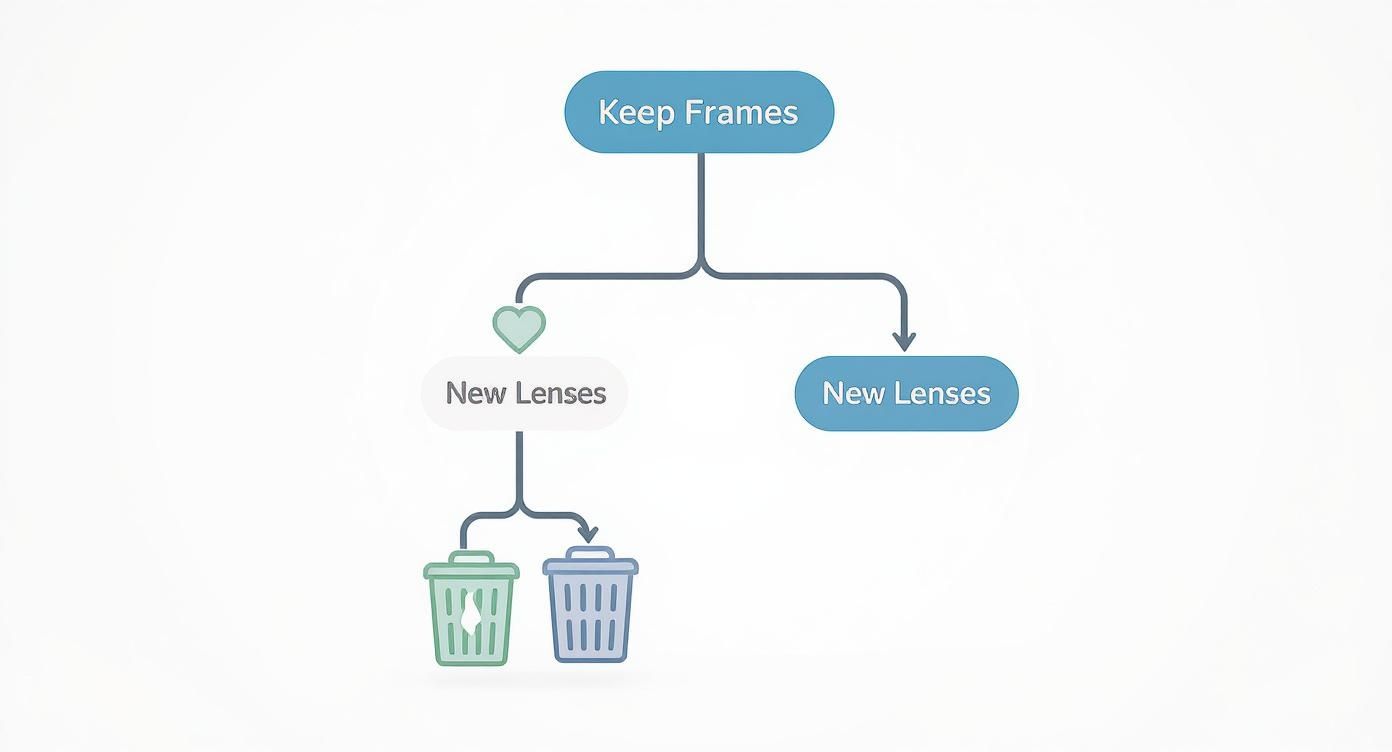
As you can see, if your frames are in good nick, keeping them and just updating the lenses is a fantastic, sustainable choice.
Ideal vs. Risky Frame Types
The style and material of your frames also play a huge part in whether they're suitable for reglazing. Some designs are built tough and are a breeze to work with, while others are a bit more delicate and carry a higher risk of damage during the lens fitting process.
To help you figure out where your frames stand, here's a quick checklist.
Frame Compatibility Checklist for Lens Replacement
This table gives you a quick-reference guide to see how likely your frames are to be suitable for a lens replacement service.
| Frame Type | Suitability for Reglazing | Key Considerations |
|---|---|---|
| Full-Rim (Metal/Acetate) | High | The full rim provides excellent support, making it the safest and easiest option for reglazing. |
| Screw-In Metal Frames | High | The ability to open the rim with a screw minimises stress on the frame during lens insertion. |
| Semi-Rimless | Medium | Possible, but requires precise drilling. Older frames may have worn mounts that won't hold new lenses securely. |
| Rimless | Medium to Low | Very delicate work. The frame's structural integrity relies entirely on the drilled holes in the lenses. |
| Wraparound/High-Curve | Low | Difficult to fit standard prescription lenses without distortion. Often requires specialised lenses and fitting. |
| Old/Vintage Plastic | Low | The plastic can become extremely brittle over time and may crack under pressure, even if it looks okay. |
Ultimately, some frames are just better built for a second life than others.
Good Candidates for Lens Replacement:
- Full-Rim Acetate or Metal Frames: These are your best bet. The rim goes all the way around the lens, providing maximum support and making the removal and insertion process much safer.
- Frames with Screw-in Lenses: Many metal frames have a tiny screw that lets the rim be opened up. This design is a technician's dream, as it allows them to swap lenses without putting much pressure on the frame at all.
Frames That Carry More Risk:
- Rimless or Semi-Rimless Frames: Because these styles require drilling directly into the lens, they demand absolute precision. Reglazing is definitely possible, but there's a risk that the mounting points on older frames have worn down and won't grip the new lenses tightly.
- Heavily Curved or Wraparound Styles: The intense curve of these sports-style frames makes it tricky to fit new prescription lenses without causing visual distortion. They usually need specialised, custom-made lenses and an expert touch.
- Old or Vintage Plastic Frames: Over the years, the plasticisers that keep old frames flexible can leach out, leaving the material incredibly brittle. A cool pair of vintage frames might look perfect, but they could easily snap under the pressure of lens insertion. For example, a beloved pair from the 1980s that feels rigid is a prime candidate for cracking.
By giving your frames a thorough check and understanding which types are best suited to replace lenses in existing frames in Australia, you can move forward with confidence, knowing your favourite pair will get a new lease on life.
Finding the Right Lens Replacement Service in Australia
So, your favourite frames have passed their health check. The next big question is: where do you get the new lenses fitted? Australia has a great mix of options for replacing lenses, each offering a different balance of convenience, cost, and hands-on care. Your best choice will really come down to your prescription, your budget, and how involved you want to be in the process.
The Aussie optical industry is a massive, well-established network. With the optical dispensing sector tipped to bring in around AUD 5 billion in 2025 and roughly 56.7% of Australians dealing with a long-term eye condition, the need for reliable vision correction is always there. This healthy market means you’ve got a competitive field of over 3,400 businesses to pick from. You can dive deeper by checking out these insights on the Australian optometry and optical dispensing industry.
Your Local Optometrist or Optical Dispenser
For a lot of people, their trusted local optometrist is the first port of call. It’s the traditional, face-to-face approach, and for good reason. You get a level of personalised service that’s hard to replicate, which is absolutely vital for your eye health.
Imagine you have a complex multifocal prescription. For these lenses to work properly, getting the pupillary distance (PD) and optical centre measured with absolute precision is non-negotiable. A local optometrist uses specialised gear to nail these measurements, making sure your new lenses are perfectly lined up. This simple step avoids all the nasty side effects like eye strain, headaches, or dizziness that come from poorly centred lenses.
Large Optical Chains
You’ll see the big names like Specsavers, OPSM, and Bailey Nelson in just about every shopping centre. They offer a very structured and often budget-friendly service, mixing the in-person experience with the efficiency of a massive company.
- The upside: They usually have sharp pricing, package deals, and stores everywhere. You can just drop your frames off and let an expert handle everything from start to finish.
- The downside: The experience can sometimes feel a bit less personal than at an independent practice. Some chains also have policies that push you towards buying new frames, and they might be a bit reluctant to work on glasses you didn't buy from them.
Dedicated Online Reglazing Services
The arrival of online-only labs has completely changed the game, especially for people looking for convenience and a great price. These services do one thing and do it well: putting new lenses into your existing frames. The process is simple – you mail in your frames and get them back with your new prescription lenses all fitted and ready to go.
Here at Prescript Glasses, this is exactly what we specialise in. We get that your frames are more than just a medical device—they’re a core part of your style. That's why we can customise an eyewear package to suit your requirements, whether you need high-tech blue light filtering for long days at the computer or tough, polarised lenses for your weekend adventures.
Going the online route does require a bit more from you, though. You'll need to provide an accurate PD measurement. While most online services have guides and tools to help you measure it, the final responsibility for getting it right is yours. For a simple, single-vision script, this is usually no drama. But for high-power or progressive lenses, even a tiny mistake can throw everything off.
A good example is a uni student needing a basic single-vision update. They can easily measure their PD at home, upload their script, pop their frames in the post, and save a fair bit of cash compared to a full-service optometrist. The convenience and lower cost are a perfect match for their needs.
Comparing Your Options at a Glance
Choosing between these providers is all about balancing what's most important to you. Here’s a quick breakdown of how they stack up:
| Service Provider | Cost | Convenience | Turnaround Time | Expert Service |
|---|---|---|---|---|
| Local Optometrist | Higher | Moderate | Fast (often days) | High (in-person fitting) |
| Large Optical Chain | Moderate | High | Moderate (1-2 weeks) | High (in-person fitting) |
| Online Reglazing Lab | Lower | Highest | Slower (incl. postage) | Moderate (self-measured) |
At the end of the day, deciding where to replace lenses in existing frames in Australia is a personal call. If you have a tricky prescription or really value that face-to-face expert advice, your local optometrist is the safest bet. If you’re looking for a good middle ground of cost and convenience with professional oversight, a large chain is a solid choice. And if your prescription is straightforward and you’re confident taking your own measurements, an online service offers unbeatable value and flexibility.
Choosing the Perfect Lenses for Your Lifestyle
This is the best part of the whole process—picking the lenses that will genuinely improve your day-to-day life. It’s about much more than just matching the numbers on your script; it’s about understanding how modern lens tech can make you more comfortable and protect your eyes. The goal is to create a pair of glasses that feel like they were made just for you.
Before we dive in, you’ll need an up-to-date optical prescription from your optometrist. This is the blueprint for your new lenses and is essential for getting that crystal-clear vision you're after.
Decoding Your Optical Prescription
At first glance, your script might look a bit like hieroglyphics, full of abbreviations and numbers. But don't worry, it's actually a pretty simple map that tells us exactly how to craft your lenses.
Here’s a quick rundown of what you’ll see:
- Sphere (SPH): This number shows the main strength of your lens in dioptres. A minus sign (–) means you’re short-sighted (trouble seeing things far away), while a plus sign (+) means you’re long-sighted (difficulty with close-up vision).
- Cylinder (CYL) & Axis: You'll see these if you have astigmatism, which is just a common imperfection in your eye's shape. The CYL is the corrective power needed, and the Axis shows its orientation in degrees.
- Pupillary Distance (PD): This is a super important measurement of the distance between your pupils. Getting this right ensures the optical centre of your lenses sits directly in front of your eyes, which is critical for clear, strain-free vision.
Finding the Right Lens Type for Your Vision
With your prescription sorted, it's time to think about how you actually use your eyes all day. Your daily routine is the single best guide for choosing the right type of lens.
If you only need glasses for one thing—like reading a book or for driving—then single-vision lenses are your straightforward, go-to solution. They provide a single, consistent prescription across the whole lens.
But what if you need help seeing at multiple distances? That’s where progressive lenses, sometimes called multifocals, come in. They offer a smooth, invisible transition between near, intermediate, and far vision, all without those old-fashioned bifocal lines.
For a deeper dive, our guide on the different types of lenses for eyeglasses breaks down all the options in more detail.
"Your lenses should work for your life, not the other way around. Think about your daily activities—from your morning commute to your evening screen time—and choose features that directly address those needs. This focus on practical application is key to ensuring both your visual comfort and long-term eye health."
Customising Your Lenses with Coatings and Add-Ons
Now for the fun part: tailoring your lenses to solve real-world problems. Modern lens coatings are designed to tackle everything from the glare of your computer screen to the harsh Aussie sun. These aren't just fancy extras; they are vital for your comfort and eye health.
Imagine a graphic designer staring at a high-res monitor for eight hours a day. For them, a blue light filtering coating is a must-have. It helps cut down on the high-energy visible (HEV) light from screens that can cause digital eye strain, headaches, and even mess with your sleep.
Or think about a real estate agent who’s constantly walking from a brightly lit living room out into the sunny backyard. Photochromic lenses (like Transitions®) would be a game-changer. They cleverly darken in UV light and then clear up again indoors, offering seamless protection and convenience.
This move towards lifestyle-specific lenses is a huge trend in Australia right now. Just as people are demanding more from their contact lenses, they’re also looking for high-performance spectacle lenses that fit their daily grind. This is exactly why the option to replace lenses in existing frames in Australia has become so popular—it’s an easy way to get these innovations into a frame you already love.
To help you figure out what’s best for you, here’s a quick guide to the most popular lens treatments.
Lens Coatings and Add-Ons Explained
This table breaks down some of the most common and useful lens treatments available, explaining what they do and who they’re perfect for.
| Lens Coating/Treatment | Primary Benefit | Ideal For |
|---|---|---|
| Blue Light Filter | Reduces eye strain from digital screens | Office workers, students, gamers, and avid smartphone users. |
| Anti-Reflective | Minimises reflections and glare for clearer vision | Night driving, public speaking, and anyone who wants crisper vision. |
| Photochromic | Lenses darken in sunlight and lighten indoors | People who frequently move between indoor and outdoor settings. |
| Polarised | Cuts severe glare from reflective surfaces | Driving, fishing, skiing, and other outdoor activities near water or snow. |
| Scratch-Resistant | Protects lenses from daily wear and tear | Everyone, especially those with an active lifestyle or who are prone to dropping their glasses. |
By taking a moment to choose the right lens type and coatings, you’re doing more than just updating a prescription—you're making a smart investment in your visual comfort for years to come.
Understanding Costs, Timelines, and Shipping
Alright, let's talk about the nuts and bolts: money, time, and getting your frames safely to the lab. Knowing what to expect with these practical details makes the whole process feel much smoother and eliminates any surprises.
The cost to replace lenses in existing frames in Australia isn’t a one-size-fits-all figure. It really comes down to your prescription and the specific lens features you need for your lifestyle. Think of it as tailoring the technology to how you see the world.
A Realistic Breakdown of Lens Costs
For a straightforward, standard single-vision lens, you can expect the cost to start at around $80. This is a fantastic, budget-friendly choice for a simple prescription update.
Of course, as you start adding more advanced coatings and features, the price will naturally go up. Here’s a rough idea of what you might pay:
- Single-Vision with Coatings: If you add a blue light filter or a premium anti-reflective coating, you’re likely looking at a cost between $120 and $180.
- Advanced Progressive Lenses: For top-tier multifocal lenses that give you seamless vision at every distance, especially with high-index thinning for stronger prescriptions, the price can range from $250 to over $400.
Remember, these aren't just costs—they're investments in your daily comfort and eye health. If you work at a computer all day, that extra spend on a blue light filter is a smart move to fight off digital eye strain.
Leveraging Your Private Health Insurance
Don't let your private health insurance benefits go to waste! If your policy has extras cover for optical, you can almost always claim a rebate on new prescription lenses, even when you're keeping your own frames.
Once you place your order, you'll get an itemised receipt with all the necessary provider details. All you have to do is submit it to your health fund to get your benefit paid back to you.
It's always a good idea to give your insurer a quick call before you order. They can confirm your annual limits and any waiting periods, so you know exactly how much you can claim and can budget accordingly.
Expected Turnaround Times
One of the biggest questions we get is, "How long will I be without my glasses?" The answer really depends on where you get it done. A local lab or your optometrist might be able to get them back to you in just a few business days since there’s no postage involved.
If you go with an online service, you’ll need to account for shipping time. Generally, the whole process—from sending your frames in to getting them back with shiny new lenses—takes about one to two weeks. It takes a little longer, but the convenience and potential savings often make it a worthwhile trade-off.
To prepare for this, it's handy to know when your prescription is due for an update. You can find more detail in our article on https://prescriptglasses.com/blogs/news/how-much-for-an-eye-test and when to book one.
How to Pack and Ship Your Frames Securely
Sending your favourite frames in the mail can feel a bit daunting, but with a little care, they’ll arrive perfectly safe. The main goal is to protect them from being crushed or scratched along the way.
Here’s my go-to method:
- Use a Hard Case: This is non-negotiable. Always put your glasses in their original hard case. It’s their best defence against any bumps or pressure.
- Find a Sturdy Box: Grab a small but strong cardboard box that the case fits into snugly, leaving a little bit of room around the edges.
- Add Padding: Stuff any empty space in the box with bubble wrap, crumpled paper, or even foam peanuts. You want to make sure the case can't rattle around inside.
- Seal and Label: Tape the box up securely and make sure the shipping label is clear and easy to read.
For extra peace of mind, I always recommend choosing a shipping option that includes tracking. When you're adding up the total cost, don't forget to factor in postage. This guide to Australian parcel postage costs is a great resource. Tracking lets you follow your package's journey and gives you confirmation when it's been delivered safely.
Got Questions? Here Are Some Quick Answers
Even with the process laid out, it’s completely normal to have a few more questions rattling around. Let's tackle some of the most common ones we hear from Aussies looking to give their favourite frames a new lease on life. This should give you that extra bit of confidence to get started.
Can I Use My Private Health Fund for This?
Yes, you almost certainly can. If your private health insurance includes optical cover, you can claim a rebate on new prescription lenses, even when they're going into your own frames. The process is straightforward.
Your chosen Australian lens provider will give you an itemised receipt with all the details your fund needs. You just submit this receipt to your health fund, and they'll process the claim. It's always a smart move to give your insurer a quick call beforehand to double-check your level of cover and annual limits—that way, there are no surprises.
What Happens If My Frames Break During the Lens Fitting?
This is the big one, and it's a valid concern, especially with older frames that might have become brittle over time. While expert technicians are incredibly careful, accidents can happen. Sometimes, a frame has a weakness that just isn't visible.
Most services will have you acknowledge a waiver, as they can't be liable for customer-owned frames. However, a reputable company won't just leave you high and dry. They'll often work with you on a solution, like offering a good discount on a new pair of frames from their own collection. Definitely ask about their breakage policy before you send your glasses in—it’s another reason that initial frame check is so crucial.
It's worth remembering that your eye health is the top priority. If a frame cracks during a lens fitting, it likely had a hidden fault that could have caused a lens to pop out later. As disappointing as it is, finding this out in a controlled lab is far safer than having it happen while you're driving.
Can I Put Prescription Lenses in My Sunglasses?
Absolutely! Putting prescription lenses into sunglass frames is one of the most popular ways to create a pair of custom sunnies you’ll actually love wearing. As long as the frames are in good nick and aren't a super-curved wraparound style, you're good to go.
The options are huge. Imagine a keen fisherman adding polarised lenses to his favourite Ray-Bans to slice through the glare on the water. Or maybe you're after a high-fashion look with a vibrant mirrored finish or a subtle gradient tint. The process is exactly the same as reglazing regular glasses; it all comes down to the condition and shape of the frame.
How Accurate Are Lenses from an Online Service?
The accuracy of your new lenses hinges on two critical things: a valid, up-to-date prescription from your optometrist and a correct Pupillary Distance (PD) measurement. Your PD is the measurement that ensures the optical centre of each lens is perfectly aligned with your pupils.
Get the PD wrong, and you could end up with eye strain, headaches, or blurry vision. While your local optometrist measures this with precise equipment, online services need you to provide it. For simple, low-power single-vision prescriptions, you can often get away with a careful self-measurement.
But if you have a more complex script, like high-power lenses or progressives, we can't stress this enough: get it measured professionally. It guarantees your vision is perfectly corrected. No matter your vision needs, rest assured we can customise an eyewear package to suit your requirements and deliver a flawless result.
At Prescript Glasses, we specialise in fitting high-quality new lenses into the frames you already know and love. Just upload your prescription, and let our experts handle the rest.
Ready to see the world more clearly? Visit our website to start your lens replacement journey today!