
A Simple Guide to Replace Nose Pads on Eyeglasses

There’s nothing more annoying than glasses that won’t stay put. That constant, gentle slide down your nose is a major distraction that can mess with both your vision and your comfort. Your eye health and safety depend on a secure, correct fit.
The good news? The fix is often as simple as swapping out your nose pads. It’s a quick DIY job that can bring your favourite frames back to their former glory, making them feel brand new again. This tiny adjustment is a game-changer for keeping your lenses perfectly positioned, so you’re always getting the sharp, clear vision you paid for.
Giving Your Eyeglasses a Quick Comfort Upgrade

Worn-out nose pads are almost always the culprit behind ill-fitting glasses. With time and use, the original pads can get hard, turn a bit grimy, or lose their grip, which is what starts that frustrating slide.
This isn’t just about annoyance, though. When your glasses slip, it shifts the optical centre of your lenses away from where it should be. This misalignment can lead to nagging eye strain, blurred vision, and even headaches, directly impacting your eye health and safety.
For anyone who relies on their glasses for hours on end—think gamers, students, and professionals staring at screens all day—a secure fit is absolutely essential. It’s the key to staying focused and comfortable.
Spotting the Signs It's Time for a Change
Not sure if your nose pads are past their prime? It’s pretty easy to tell once you know what you’re looking for.
Here are the dead giveaways:
- Discolouration: The pads have gone a yellowish or greenish colour from skin oils and general wear.
- Stiffness: What was once soft silicone now feels like hard plastic digging into your skin, leaving red marks.
- Constant Slipping: You’re forever pushing your glasses back up your nose, especially when you look down or sweat.
- Visible Wear: The pads just look worn out—flattened, cracked, or completely misshapen.
Practical Example: A graphic designer in Melbourne wears their custom Bluecromic lenses from Prescript Glasses all day. For that blue light filter to work effectively, the lenses must sit in the right spot. If worn-out pads let the frames slide down, that protection is compromised, leading to digital eye strain during a long project.
Your eye health and safety should always come first. Replacing worn nose pads makes sure your prescription lenses are properly aligned, giving you the crystal-clear vision your optometrist intended and preventing discomfort from a bad fit.
This simple bit of maintenance can breathe new life into your eyewear, and it costs next to nothing. If you find your frames are still a bit loose after changing the pads, you might need to try a few other tweaks. For more tips, have a look at our guide on how to tighten your glasses.
Here at Prescript Glasses, we know that every detail matters for optimal vision. We can customise an eye wear package to suit your requirements, from high-quality frames right down to the ideal replacement parts.
Identifying Your Nose Pad Type
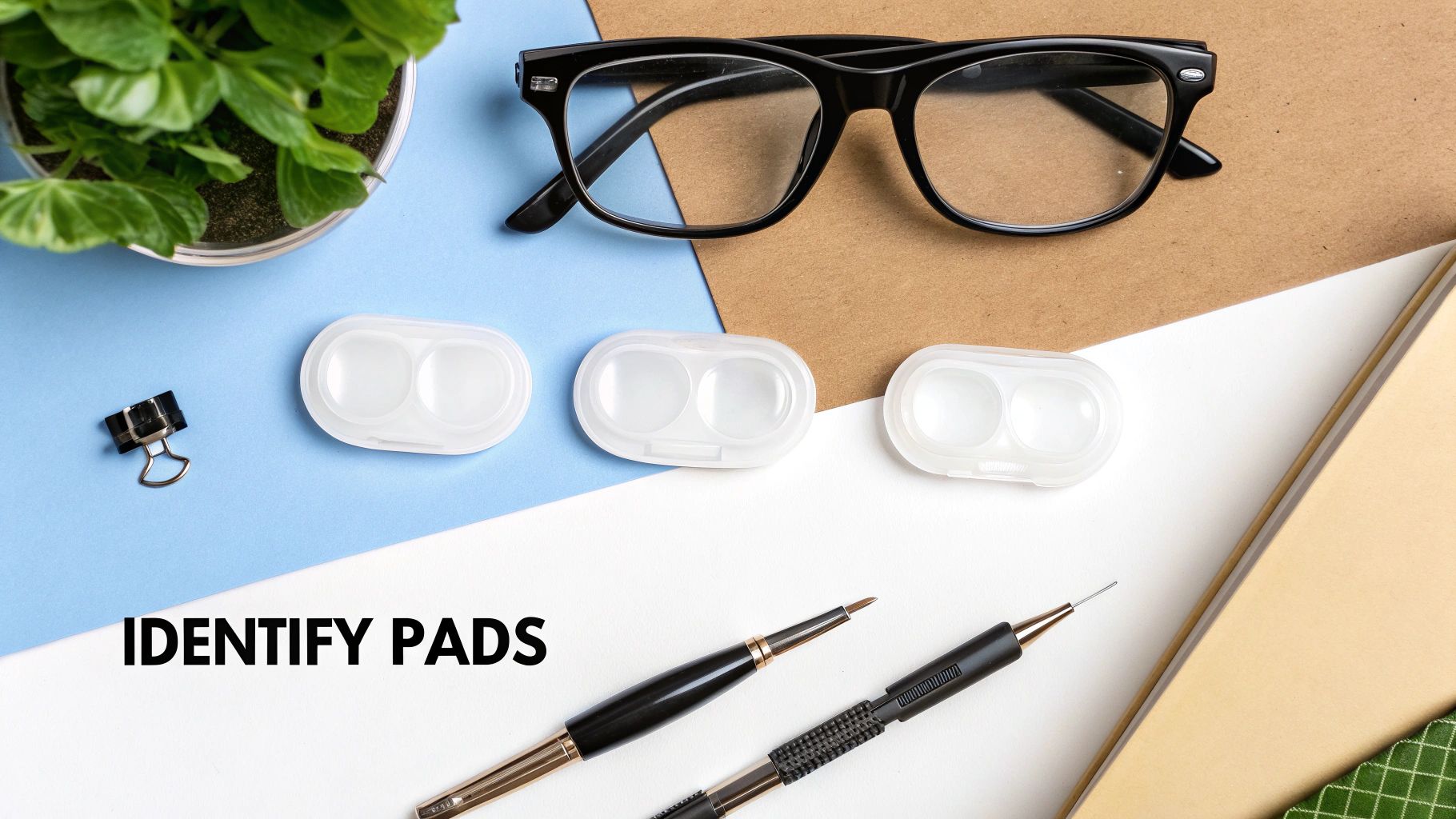
Before you can start swapping out old nose pads, you need to play detective for a moment. Eyeglass nose pads come in a few common styles, and grabbing the right replacement is the most crucial first step for a successful DIY fix.
If you pick the wrong type, they simply won't attach properly. You'll end up with a wobbly, insecure fit that compromises both comfort and your vision. The good news is that a quick look at your frames is all it takes to figure out exactly what you're working with. The three you'll almost always encounter are screw-in, push-in (or snap-in), and adhesive pads.
Each one has its own unique way of attaching to the frame. Don't worry, they're easy to tell apart once you know what you’re looking for.
The Classic Screw-In Pad
Screw-in nose pads are easily one of the most common and secure types out there, especially on metal frames. As the name gives away, a tiny screw holds each pad in place, fastening it to the little metal pad arm that extends from the frame.
To check if you have these, just hold your glasses up to a light and look closely where the pad meets the arm. You should be able to spot a minuscule screw head. See one? You’ve got screw-in pads. It’s a rock-solid design, which is why it’s so popular.
The Simple Push-In Pad
Push-in pads, often called snap-in pads, are another favourite, mainly because you don't need any special tools to replace them. Instead of a screw, these pads have a small rectangular tab on the back that simply clicks into a matching slot on the pad arm.
The easiest way to spot them is to give the nose pad a gentle wiggle. You’ll notice it has a tiny bit of play, and you definitely won’t see a screw. The mount on the frame itself looks like a small, hollow box designed to grip the pad's tab. Imagine a student needing a quick fix between classes—this design is perfect, as there are no tiny screws to lose.
A secure fit is fundamental to eye health and safety. Properly identifying and installing the correct nose pads ensures your lenses maintain their correct optical alignment, preventing unnecessary eye strain and headaches caused by a poor fit.
The Versatile Adhesive Pad
Adhesive nose pads are the perfect solution for plastic or acetate frames that don’t have those adjustable metal pad arms. These types of frames usually have a moulded, built-in nose rest. If your glasses are constantly slipping down your nose, these soft, stick-on pads are brilliant for adding extra grip and a bit of cushioning.
Think of them as small silicone or foam stickers that you apply directly to the frame's bridge. If your frames are one solid piece of plastic with no metal arms for the pads, this is almost certainly the type you’ll need.
In Australia's growing eyewear market, good maintenance has never been more important. Worn-out pads on poorly fitting glasses contribute to 30% more frequent optometry visits for minor adjustments. Learning a simple skill like how to replace nose pads on eyeglasses can extend the life of your frames by up to 40%—a significant saving over time. You can discover more about Australia's eyewear industry insights on ibisworld.com.
To make identifying your pads even easier, here’s a quick guide to help you tell them apart at a glance.
Comparison of Eyeglass Nose Pad Types
This table breaks down the key features of each nose pad type, the tools you might need, and the kind of frames they’re usually found on.
| Nose Pad Type | Identification Feature | Required Tools | Common On |
|---|---|---|---|
| Screw-In | A tiny screw head is visible on the pad arm. | Precision screwdriver | Metal & semi-rimless frames |
| Push-In | A rectangular tab clicks into a box-like mount. | Tweezers or a small flat tool | Various metal frames |
| Adhesive | No pad arm; applied directly to the frame bridge. | Your fingers | Plastic or acetate frames |
Once you've confidently identified your nose pad type, you're ready to pick out the right replacements and get your glasses feeling like new again. At Prescript Glasses, we can customise an eye wear package to suit your requirements, including providing the correct parts to keep your frames feeling perfect.
Choosing the Right Replacement Pads and Tools
So, you’ve figured out what type of nose pads your glasses use. Great! The next step is getting your toolkit ready and picking out the best material for your new pads.
Having the right gear on hand is the difference between a quick, easy fix and a frustrating ordeal that ends with scratched frames. You don’t need a professional workshop, just a few specific items to make the job go smoothly.
Your Essential Toolkit
Before you even think about touching a screw, set yourself up for success. Find a well-lit spot and lay down a soft surface, like a microfiber cloth, to work on. This simple step is your best defence against accidentally scratching a lens if something slips.
Here’s what you’ll want to have ready:
- Jeweller's Screwdriver Set: This is non-negotiable for screw-in pads. Those tiny screws demand a delicate touch, and a standard screwdriver just won't cut it.
- Precision Tweezers: You'll thank yourself for having these. They are incredibly helpful for gripping minuscule screws and nudging new pads perfectly into place.
- Microfiber Cloth: Essential for cleaning the pad arms before you install the new ones and for protecting your lenses while you work.
- Magnifying Glass (Optional): If you find yourself squinting at tiny parts, a magnifying glass can be a real lifesaver.
Selecting the Perfect Pad Material
Don't just grab the first replacement pads you see. The material makes a huge difference to how your glasses feel and perform throughout the day. It’s definitely not a one-size-fits-all situation—your lifestyle and even your skin sensitivity play a big part here.
Practical Example: A cyclist who sweats a lot during their rides will benefit from silicone pads. Their superior grip ensures the glasses stay firmly in place, providing clear and safe vision without constant adjustments. Conversely, someone with very sensitive skin might need to specifically choose hypoallergenic silicone to avoid irritation or red marks on their nose.
Choosing materials that work for you is key to eye health and safety. A pad that irritates your skin or doesn't provide a stable fit can be a constant, nagging distraction and compromise your vision.
Here’s a quick rundown of the most common materials:
- Silicone: Soft, incredibly grippy, and super comfortable. It’s often hypoallergenic, which makes it a fantastic choice for anyone with sensitive skin.
- PVC (Polyvinyl Chloride): A bit firmer and more durable than silicone, but it can harden over time. It’s a solid, budget-friendly option.
- Titanium: This is the premium choice. It's extremely lightweight, tough as nails, and hypoallergenic, making it ideal if you have metal sensitivities or just want something that will last.
In Australia's spectacles market, which generated USD 3,780.3 million, taking care of your eyewear is a smart move. In fact, statistics show that 62% of Australian users replace their nose pads every 6-12 months. This simple fix, often costing just $15 AUD, is proven to boost user satisfaction by 45% and can save you from buying a new $400 pair of glasses. You can learn more about local eyewear trends on grandviewresearch.com.
Whether you’re just swapping out a broken pad or looking for a serious comfort upgrade, we can help you find exactly what you need. And if you run into bigger problems, our guide on how to repair your glasses has plenty more advice.
Getting Down to Brass Tacks: A Practical Walkthrough for Each Nose Pad Type
Alright, with your tools laid out and your new pads ready to go, it’s time for the main event. Every nose pad has its own little trick, but trust me, they're all perfectly doable with a bit of patience. Just do yourself a favour and work over a soft microfibre cloth – it’ll save your lenses from any heart-stopping slips.
The whole process really just boils down to a few key stages.
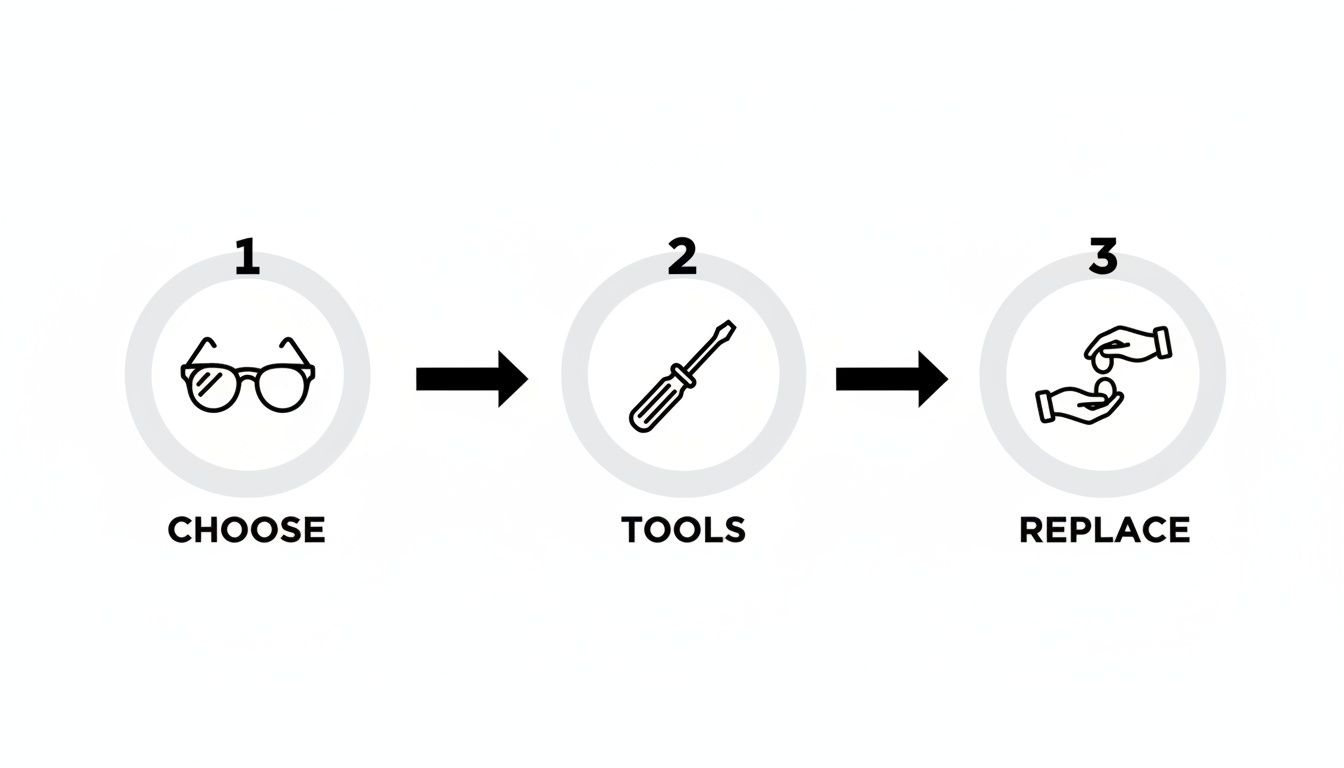
Think of it like this: first you choose your parts, then you gather your tools, and finally, you do the replacement. Following these steps helps make sure the whole DIY repair goes off without a hitch.
Handling Screw-In Nose Pads
Screw-in pads are a classic, especially on metal frames. The golden rule here is to use gentle, steady pressure. Remember, those screws are tiny and can be quite delicate.
Start by getting a firm but gentle grip on your frames. Using your jeweller’s screwdriver, turn the screw anti-clockwise. You only need to loosen it just enough to wiggle the old pad out; there's no need to take the screw all the way out unless you’re also replacing it.
Once the old pad is off, grab your microfibre cloth and give the metal pad arm a quick wipe down. This is a great chance to get rid of any built-up grime or oils, giving the new pad a clean seat. Now, just slide the new pad into the mount, line up the holes, and carefully tighten the screw clockwise. You want it snug, but don't overdo it – cranking down too hard can strip the screw or even damage your frame.
Eye Health and Safety Pro Tip: After you've installed the new pads, take a second to make sure they're perfectly symmetrical. If they're misaligned, it can change how your glasses sit, which throws off the optical centre of your lenses. This can lead to annoying eye strain or headaches down the track.
Replacing Push-In or Snap-In Pads
Push-in pads are a breeze. They’re designed to be a tool-free job, which makes them one of the simplest types to tackle.
To get started, hold the frame firmly. Then, use your thumbnail or a small, flat tool (the edge of your tweezers works a treat) to gently pop the old pad out of its mount. A little bit of pressure is all it should take.
Before you snap the new one in, give the mounting box a quick clean to clear out any gunk. Then, line up the little tab on the back of the new pad with the mount and press down firmly with your thumb. You're listening for a satisfying 'click' that tells you it's locked in place.
Practical Example: Picture a teacher who is constantly looking down to read students' work. Their glasses keep sliding, breaking their concentration. With push-in pads, they can do a super-quick replacement during their lunch break without hunting for tools. They just pop the old, worn-out pad off and click a fresh, grippy silicone one into place, ensuring their glasses stay secure for the rest of the school day.
Applying Adhesive Nose Pads
Adhesive pads are the perfect fix for adding some much-needed comfort and grip to plastic or acetate frames. For these, success is all about the prep work.
First things first, you need to thoroughly clean the spot on the frame’s bridge where the pads will go. Use a cotton swab dipped in rubbing alcohol to get rid of every last trace of skin oil and residue. If the surface isn't perfectly clean, the adhesive won't stick properly.
Next, peel the backing off one of the pads, trying your best not to touch the sticky side with your fingers. Carefully position it on the frame and press down firmly for about 30 seconds. Do the same thing on the other side, making sure the pads are placed symmetrically.
For the best possible result, try to let the adhesive cure for a few hours before you wear your glasses. This little bit of waiting time allows it to form a really strong bond with the frame.
No matter which type you're dealing with, taking a few minutes to replace nose pads on eyeglasses correctly is a small effort that makes a massive difference in comfort and clear vision. And don’t forget, we can customise an eye wear package to suit your requirements, so you'll always have the right parts on hand when you need them.
Troubleshooting Common Problems and Aftercare
Even the simplest DIY jobs can hit a snag, and replacing your eyeglass nose pads is no exception. If you run into a bit of trouble, don't stress—most of these little hiccups are surprisingly easy to sort out with a bit of patience.
Let's start with the most common frustration: dropping one of those impossibly tiny screws. It happens to the best of us.
Practical Example: You're at your kitchen table, you've almost got the new pad on, and ping—the screw bounces off the table and disappears into the floor. Instead of spending the next hour on your hands and knees, just pop down to a local optical shop. Most will have plenty of spare screws and will often give you one for free or for a tiny fee, getting you back on track in minutes.
Another common issue is a push-in pad that refuses to come out. Whatever you do, don't try to force it, as you could damage the delicate pad arm on your frames. A better approach is to dip a cotton ball in some warm, soapy water and dab it around the mount. This little bit of lubrication is often all it takes to gently wiggle the old pad free.
Dealing with Stripped Screws and Uneven Pads
A stripped screw can feel like a real roadblock, but it's usually fixable. If your screwdriver just isn't getting any grip, try laying a small rubber band over the screw head before you insert the screwdriver. That extra bit of rubber can provide the traction you need to get it turning.
What if you get the new pads on, but they feel... lopsided? An uneven fit isn't just annoying; it can actually affect your vision. When your frames sit crooked, your prescription lenses are no longer in the optimal position, which can lead to eye strain and even headaches.
Focus on Eye Health and Safety: A proper, balanced fit is non-negotiable. If your glasses feel off-kilter after you've replaced the pads, take a moment to gently adjust the metal pad arms with your fingers. Make tiny, gradual adjustments and keep trying them on until they sit perfectly and evenly on your nose. Your vision depends on it.
Aftercare for Long-Lasting Comfort
Once your new pads are installed and feeling great, a little bit of regular maintenance will make all the difference. Good aftercare keeps them comfortable, grippy, and hygienic, extending their life and protecting your skin.
Keeping your nose pads clean is essential for preventing skin irritation. Oils from your skin, sweat, and makeup can build up fast, creating a perfect environment for bacteria that might cause redness or breakouts on the bridge of your nose. This is a critical aspect of your long-term eye health and safety.
Here are a few simple aftercare tips to keep in mind:
- Clean Them Regularly: Give your nose pads a quick wipe at least once a day. A soft, microfibre cloth dampened with a gentle lens cleaner or some mild soap and water works perfectly.
- Check for Wear: Every so often, have a look at the pads for any signs of hardening, cracking, or discolouration. Softer materials like silicone can wear out a bit quicker, especially if you're very active.
- Adjust as Needed: Don't be afraid to make tiny tweaks to the pad arms if you ever feel a pinch or notice your glasses are starting to slip.
Taking proper care of these small details ensures your investment in quality eyewear continues to pay off with the comfort and clear vision you rely on. We can customise an eyewear package to suit your requirements, making sure you always have the best components for your frames, right down to the nose pads.
Knowing When to See a Professional
While swapping out your own nose pads is a pretty straightforward job most of the time, there are definitely situations where it’s smarter to hand your glasses over to a professional. Knowing when to tackle it yourself versus when to call in an expert is key to protecting your frames and ensuring your eye health and safety. After all, a botched DIY repair can cause a much bigger headache than the one you started with.
Sometimes the problem runs deeper than just a grubby or worn-out pad. If the little metal arm holding the nose pad is bent out of shape—or worse, snapped—that’s a job for specialised tools and a steady, experienced hand. Trying to bend it back yourself is a quick way to break the delicate metal, turning a minor issue into a costly repair.
Signs You Need an Expert’s Help
There are a few clear red flags that signal a DIY approach might do more harm than good. If you run into any of these, it’s time to step back and let an optical dispenser take over.
- Damaged Pad Arms: The metal arms that the nose pads attach to are bent, twisted, or broken. This requires precise adjustment or soldering that you can’t do at home.
- Specialty Frame Materials: Your frames are made from something delicate like wood, buffalo horn, or certain premium alloys. These materials can easily crack or get damaged if you don't handle them correctly.
- Persistent Discomfort: You’ve already replaced the pads, but your glasses still feel lopsided, pinch your nose, or keep sliding down. This usually points to a bigger alignment problem.
- You're Just Not Confident: It’s completely okay to feel a bit nervous about tinkering with your expensive eyewear. If you're worried you might damage them, don't risk it.
An ill-fitting pair of glasses isn't just a minor annoyance; it can genuinely affect your day. In fact, surveys show that 48% of Australian spectacle wearers feel discomfort from poorly adjusted nose pads within their first year. This leads to a 22% increase in people seeking professional frame adjustments. For those of us staring at screens all day, a proper fit can boost comfort by as much as 35%, which goes a long way in reducing eye strain and headaches. You can find more stats on the Australian eyewear market over at imarcgroup.com.
An optical dispenser has the right tools and years of experience to make tiny, precise adjustments without putting your frames at risk. They’ll make sure your glasses are perfectly balanced, which is crucial for keeping your lenses correctly aligned for crisp, clear vision and safeguarding your eye health.
Ultimately, your glasses are an essential tool you rely on every single day. If you're facing more serious problems beyond a simple pad swap, our guide on common frame repairs offers some extra advice. Taking good care of your glasses means they’ll continue to give you clear, comfortable vision for years to come.
At Prescript Glasses, we’re your partners in vision care. From fitting you with high-quality custom lenses to sharing the know-how you need to look after them, we’re here to help. We can customise an eye wear package to suit your requirements. Come and explore our collection at https://www.prescriptglasses.com.