
Repair My Glasses: A Guide to Quick, Safe Fixes at Home

Before you grab a screwdriver and start trying to repair my glasses, it's worth taking a moment to figure out what you're dealing with. A quick once-over can be the difference between a simple fix and a much bigger, more expensive problem.
This initial check is all about your safety and protecting your eyesight. It helps you decide if a DIY repair is a smart move or if it's time to call in a professional. Honestly, getting this first step right is the secret to a successful fix, preventing a simple issue from turning into a risk for your eye health.
Your Pre-Repair Safety and Tool Checklist
Just jumping into a repair without the right gear can easily damage your frames, scratch your lenses, or worse, compromise your vision. A bent frame isn't just a cosmetic issue; it can throw your lenses out of alignment, leading to annoying eye strain, headaches, and even dizziness. A few minutes of prep is well worth it to protect your eye health and safety.
This careful approach is pretty common across Australia. We tend to prefer fixing things up to extend their life rather than buying new ones straight away. In fact, the Australian eyewear market was projected to hit around US$2.89 billion in 2025, and a big part of that is people using simple repairs to keep their frames going. You can dig into more stats about the Aussie eyewear market over at Eyetalk.com.au.
Assess the Damage First
Before you even think about tools, lay your glasses on a flat table or benchtop. This is the classic test for alignment. Do both arms sit flat? If one is floating in the air, you’ve definitely got a bend to deal with.
Next, get a good, close look at the problem area. Is it just a tiny screw that's worked its way loose from the hinge? Or is the metal arm itself actually bent? For example, a loose screw is usually an easy fix that takes seconds. A crack in a plastic frame right next to the lens, however, is a major red flag that could compromise how the lens is held, directly impacting your vision.
Key Takeaway: Be extremely careful with any damage that could change how the lens sits in front of your eye. An improperly seated lens can throw off your prescription and cause some serious visual discomfort and eye strain. Eye health and safety must always come first.
Gather Your Essential Toolkit
Having the right tools on hand makes all the difference. You really don’t need a full workshop, but a few key items will save you from making a costly mistake.
- Precision Screwdriver Set: This is non-negotiable for tightening those tiny screws on hinges and nose pads.
- Needle-Nose Pliers: Perfect for gently tweaking metal frames. A pro tip: always wrap the tips with a soft cloth or a bit of tape to avoid scratching the finish.
- Microfibre Cloth: You need this for cleaning and handling lenses without leaving scratches. It’s always a good idea to make sure your lenses are clean before you start; our guide on how to clean glasses properly can walk you through it.
- Magnifying Glass: Don't underestimate this one. It’ll help you spot tiny screws and hairline cracks you might otherwise miss completely.
DIY vs Professional Repair Decision Guide
Deciding whether to tackle a repair yourself can be tricky. This quick table should help you make the right call based on what’s gone wrong with your specs, with a clear focus on eye health and safety.
| Type of Damage | DIY Recommendation | When to See a Professional |
|---|---|---|
| Loose Screw | Go for it! A simple and safe DIY fix with a precision screwdriver. | If the screw is stripped or the threads in the frame are damaged. |
| Bent Metal Frame | Often manageable. Gentle adjustments with cloth-wrapped pliers can work. | If the frame is severely bent, creased, or feels like it might snap. |
| Broken Nose Pad | Easy fix. You can usually snap or screw a replacement in place. | If the nose pad arm itself is broken off the frame. |
| Scratched Lenses | Leave it to the pros. DIY scratch removers rarely work and can ruin lens coatings, harming your eyes. | Always. A professional can assess if polishing is possible or if replacement is needed. |
| Cracked Plastic Frame | Stop! Do not attempt. Glue is not a safe or effective long-term solution and can fail unexpectedly. | Immediately. This kind of damage compromises the frame's integrity and safety. |
| Broken Hinge | Professional job. This usually requires specialised tools, soldering, or laser welding for a safe repair. | Always. A DIY fix will almost certainly fail and could cause more damage. |
Once you’ve checked the damage and have your tools, you can make a confident decision. Gently bending a metal arm back into place is often doable at home. But if you spot a stress mark or a crack on a plastic frame, it’s best to step away from the tools. If a repair isn't the safest bet, we can customize an eye wear package to suit your requirements and get you into a fresh, safe pair.
Fixing Common Problems with Your Glasses
Alright, let's get down to the nitty-gritty of fixing your glasses. When a screw comes loose or your frames get bent out of shape, it's tempting to panic, but tackling these common issues yourself can be surprisingly straightforward and satisfying. We'll walk through the most frequent problems and give you practical, step-by-step advice to get your specs back in working order.
Before you start, just a quick word on safety. Your vision and comfort are paramount. A wonky repair can misalign your lenses, which can lead to headaches and eye strain. Always find a well-lit spot to work in and lay down a soft cloth or towel on your table. This gives you a stable, scratch-proof surface and stops tiny screws from disappearing into the void.
This simple flowchart breaks down the prep work. It’s a good habit to get into before you start fiddling with your frames.
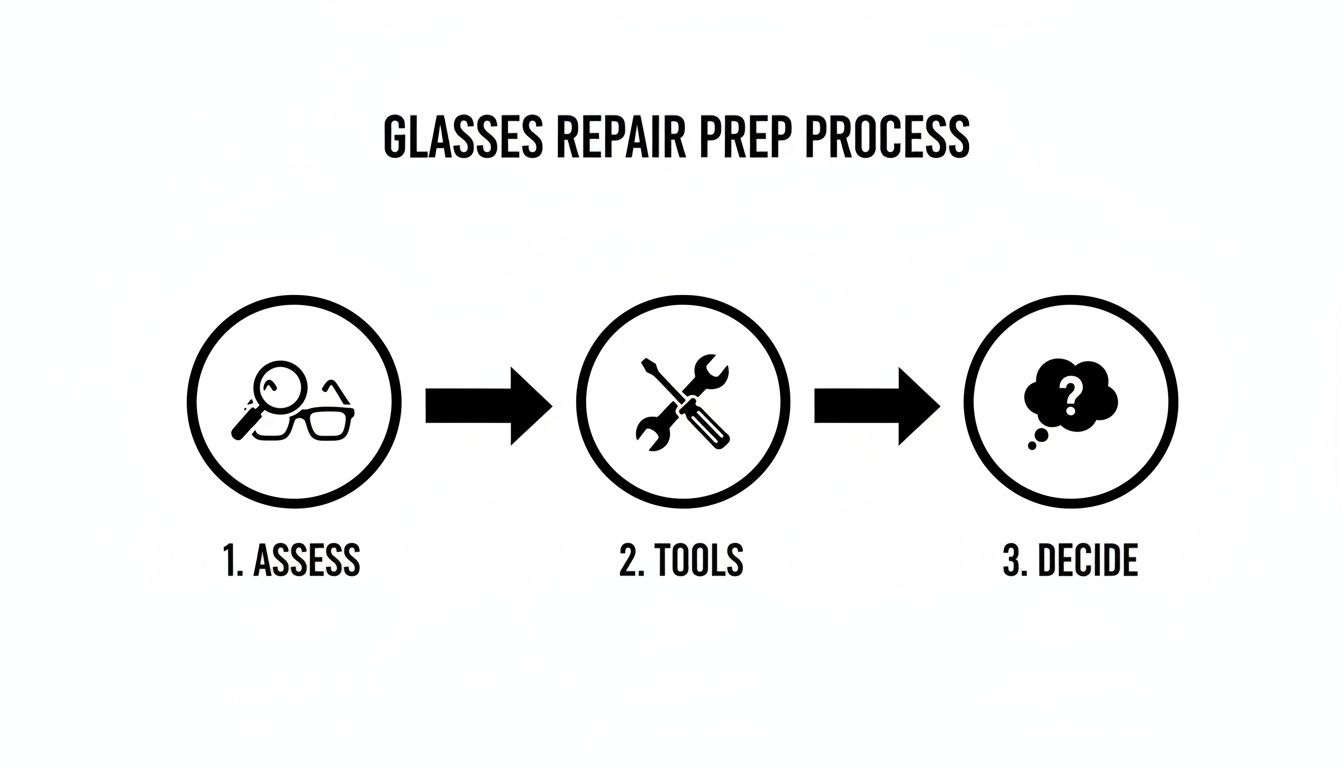
Following these three steps—assessing the damage, grabbing the right tools, and deciding if it’s a job for you—is the key to a successful fix. It stops a minor mishap from turning into a major headache.
Handling Loose Screws
A wobbly arm is probably the most common glasses complaint out there. Nine times out of ten, it's just a loose hinge screw. The fix is simple, but it demands a gentle touch to ensure a safe and secure fit.
Grab the tiny screwdriver from your glasses repair kit and make sure it’s the right size. If the head is too big, it won't fit. Too small, and you’ll strip the screw, making it impossible to tighten or ever get out again. Apply a bit of steady pressure and turn the screw clockwise until you just start to feel it resist.
Crucial Tip: Whatever you do, don't overtighten it. Forcing the screw can strip the threads inside the frame or even snap the screw's head clean off. You're aiming for snug, not rock-solid.
Adjusting Bent Frames
Bent frames are another classic. How you fix them depends entirely on what they’re made of, so first, you need to figure out if you're dealing with metal or plastic frames.
For Plastic (Acetate) Frames
These frames are your friend when it comes to adjustments because they get pliable with a bit of warmth. Your best tool here is a hairdryer on its lowest heat setting.
- Hold the hairdryer about 15 centimetres away from the bent part of the frame.
- Gently warm the area for 20-30 seconds, keeping the hairdryer moving so the heat spreads out evenly.
- Once the plastic feels a little flexible, use your hands to carefully bend it back into the right shape.
A word of warning: keep the heat well away from your lenses. High temperatures can wreck the protective coatings. Stick to heating the frame arms or the bridge only to protect your vision.
For Metal Frames
Metal frames need a bit more persuasion, usually with a pair of pliers. To avoid scratching up your frames, make sure you wrap the tips of your needle-nose pliers in a soft cloth or a bit of electrical tape first.
Grip the bent section firmly and use slow, steady pressure to guide it back into alignment. For example, if the left arm is bent downwards, gently grip the hinge area and apply upward pressure to the arm. It’s a game of small adjustments. Tweak it a little, then place the glasses on a flat surface to check your progress. For a more detailed guide, check out our post on how to fix a glasses frame without making things worse.
Replacing Lost Nose Pads
There's nothing more annoying than a missing nose pad. It makes your glasses sit crooked and feel incredibly uncomfortable. Thankfully, swapping them out is a piece of cake.
First, take a close look at the little metal mount on your frame to see what kind of pad you need. They're usually either a snap-in (or push-in) style or a screw-in style. A snap-in pad has a little tab that clicks into a boxy mount, while the screw-in type is held in place with a tiny screw.
Once you have the right replacements, fitting them is easy. For the screw-in ones, just undo the old screw, pop the new pad in, and tighten it up. For snap-in pads, use your thumb to push the old one out and press the new one firmly into the mount until you hear a satisfying click.
While these DIY fixes are great for common problems, know your limits. If a repair feels too tricky or your fix doesn't quite solve the issue, it’s always safer to seek professional help. And if your frames are truly beyond saving, don't worry—we can customize an eyewear package to suit your requirements, getting a perfect new pair sorted in no time.
Dealing with Scratched Lenses: What Actually Works
A scratch on your lens is more than just a visual blip. It's a constant distraction that can actively distort your vision, leading to some serious eye strain and even headaches. When you spot a scratch, the temptation to find a quick home remedy is strong, but it's vital to know what works and what will only make things worse for your eye health.
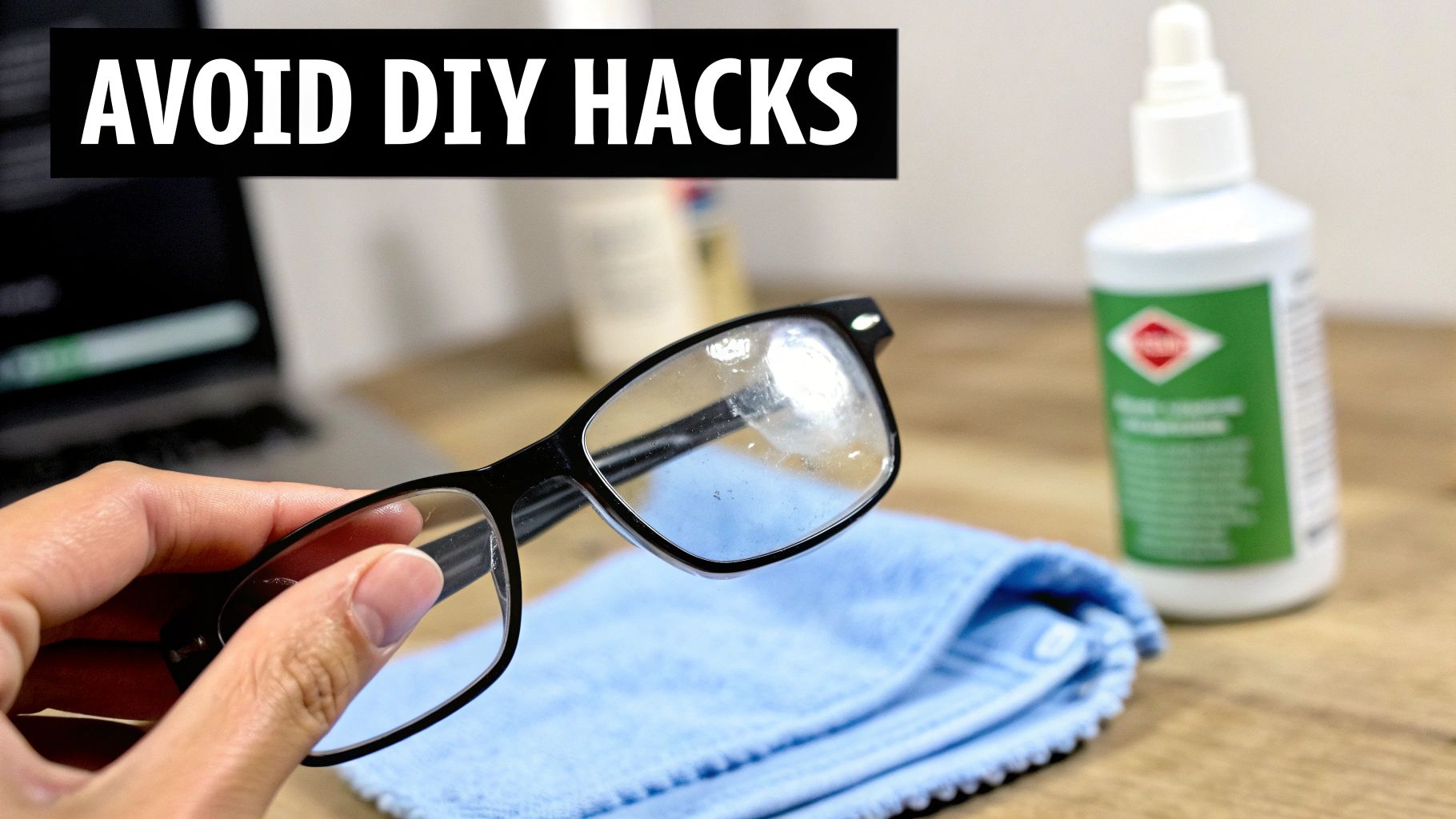
Trust me, those online "hacks" using household products are a direct threat to your lenses and your eyes. You need to avoid them at all costs.
Debunking Dangerous DIY Myths
Let's get one thing straight: the internet is brimming with well-meaning but terrible advice that can permanently ruin your glasses. Trying to repair my glasses with these methods will almost certainly cause more harm than good.
Here are the biggest culprits:
- Toothpaste: Most toothpastes contain tiny abrasive particles like baking soda or silica. They’re great for scrubbing plaque off your teeth, but on your lenses, they act like fine-grit sandpaper. This will strip away critical protective coatings like your anti-glare and UV protection layers, leaving your eyes more exposed.
- Baking Soda Paste: Just like with toothpaste, making a paste from baking soda and water is a recipe for disaster. This abrasive mix will etch a web of micro-scratches across the lens, clouding your vision even more.
- Wax or Polishing Compounds: It might sound logical to fill in scratches with car wax or furniture polish, but these substances leave behind a greasy, smeary film that’s impossible to fully clean. For example, trying to drive at night with this film on your lenses can create dangerous glare from headlights. The residue attracts dirt and completely impairs your visual clarity.
Those special coatings on your lenses are applied in ultra-thin layers and are essential for protecting your eyes. Once an abrasive substance grinds them away, they're gone for good. There’s no re-applying them.
What You Can Actually Do for Scratches
Unfortunately, there's no magic home remedy for a deep scratch. The only way to truly "remove" it would be to grind down the entire lens surface to the depth of the gouge, which would completely throw off your prescription.
For very minor surface scuffs, though, a thorough, proper cleaning can sometimes make them less obvious. Grab a cleaning solution made specifically for eyeglasses and a fresh microfibre cloth. This won't fix the damage, but by removing any tiny bits of debris caught in the scuff, you can sometimes improve clarity a little.
Your eye health and safety should always be the priority. Attempting to fix deep scratches at home poses a risk to your vision. The best solution for significant scratches is always a lens replacement.
Ultimately, the best approach is prevention. Always—and I mean always—store your glasses in a hard case when you’re not wearing them and clean them the right way.
If you're already dealing with scratches that are getting in the way of your sight, the safest and most effective solution is simply to replace the lenses. You can find out more about how that works and what your options are in our guide on replacing lenses in glasses.
While our focus here is on glasses, the core principle of treating surface damage correctly applies elsewhere. For instance, you can see a similar thought process in this material-specific guide to removing scuffs from shoes. If your lenses are past the point of a simple clean, remember that clear vision isn’t something to compromise on. We can customize an eyewear package to suit your requirements, ensuring you see the world perfectly again.
Knowing When to See a Professional
Knowing your limits is key to any successful DIY project, and glasses repair is no exception. While tightening a loose screw is a quick fix, some problems demand the specialised tools and steady hand of a professional. Pushing your luck with a complex repair at home can easily turn a fixable issue into a permanently broken pair of frames.
This isn't just about saving your glasses—it's about protecting your vision. Significant damage can wreck the structural integrity and precise alignment of your eyewear, transforming them from a helpful tool into a source of real discomfort and a risk to your eye health.
Critical Damage That Needs an Expert
Some breaks are immediate red flags, signalling that it's time to put the tools down and head to an optometrist. Trying to repair my glasses when you see these issues is a gamble with your eye health, and it's just not worth it.
Here are the situations where a professional visit is non-negotiable:
- Broken Hinges: A snapped hinge is a job for a pro, period. Glue won't cut it. Opticians use precise soldering or laser welding to fuse the metal parts back together, something that's impossible to do correctly at home.
- Snapped Frame Arms: If an arm has completely broken off, especially on a plastic frame, a DIY fix will never be strong enough. A practical example is when a toddler grabs your glasses and snaps an arm clean off; a professional can often source a perfect replacement or use specialised bonding for a secure, lasting repair.
- Cracks Near the Lenses: See a crack, chip, or stress mark on the frame right where the lens sits? Stop right there. This kind of damage can cause the lens to shift or pop out entirely, compromising your prescription and your safety.
Professional aftercare and repair are a huge part of the eyewear market in Australia. While it's estimated that Aussies will spend AUD 243.20 million on eyewear goods in 2025, the broader market includes essential services like these. You can dig into more Australian eyewear market trends and consumer habits online to see the full picture.
The Hidden Dangers of Misalignment
Often, the biggest reason to see a professional isn't the obvious break but the invisible problem it creates: misalignment. Your prescription lenses are crafted with a very precise optical centre—the one spot that must sit directly in front of your pupil for you to see clearly.
Think about a time you've tried to bend your glasses back into shape, but they still feel "off" or sit crooked on your face. That's a classic sign the optical centres are no longer aligned with your eyes, which can lead straight to headaches, dizziness, and nagging eye strain. This is a direct eye health issue.
An optometrist uses specialised equipment to make sure your frames are perfectly aligned to your unique facial structure. This guarantees your lenses are working exactly as your prescription intended, keeping your vision sharp and your eyes comfortable.
And if a repair just isn't on the cards, don't worry. We can customize an eye wear package to suit your requirements, getting you into a new pair that fits perfectly and gives you that crystal-clear vision you deserve.
How to Make Your Glasses Last Longer
Let’s be honest, the best way to avoid the headache of a glasses repair is to not need one in the first place. A little proactive care goes a much longer way than any last-minute fix. Forget the obvious stuff; building a few simple habits into your daily routine can dramatically extend the life of your eyewear and keep your vision clear.
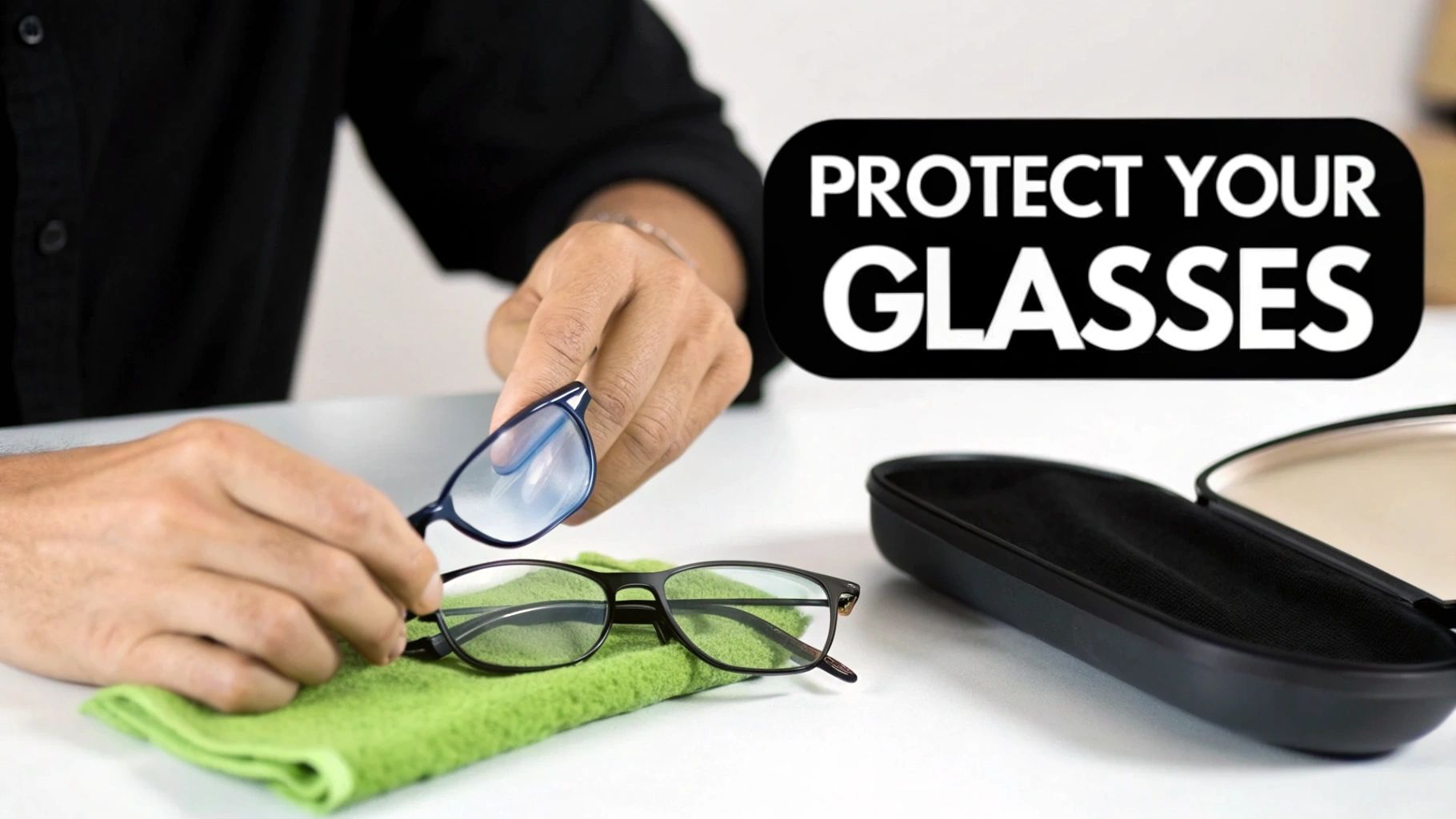
This kind of preventative mindset is more important than ever. As Australia's population grows, so does the need for vision correction. The local spectacles market hit roughly USD 3,780.3 million in 2024 and is still climbing, which means more of us are relying on our glasses every single day.
Build Better Daily Habits
Small, consistent actions make the biggest difference. The first thing to change is how you handle your frames. Always—and I mean always—use two hands to take your glasses on and off. When you pull them off with one hand, you're putting uneven stress on the hinge and arm, which is a surefire way to slowly bend them out of shape.
Also, never, ever place your glasses lens-down on a surface. It’s the number one cause of all those tiny scratches and scuffs that build up over time and cloud your vision. If they aren't on your face, they belong in their case. Simple as that.
Important Reminder: Leaving your glasses in a hot car is a recipe for disaster. For example, a car's interior can reach over 60°C on a summer day, which can warp plastic frames and permanently damage the delicate coatings on your lenses, forcing a costly replacement and potentially harming your eyes.
Establish a Simple Maintenance Routine
A quick weekly check-up can stop small issues from becoming big problems. Once a week, just take a moment to look at the tiny screws in the hinges. See one that looks a bit loose? A quick tighten with a precision screwdriver will stop the arm from getting wobbly or, worse, falling off completely.
Regular cleaning is just as crucial for maintenance and hygiene.
- Clean Nose Pads: Grime and skin oils love to build up on nose pads. This can degrade the material and cause skin irritation. Wipe them down with a soft cloth and a dab of rubbing alcohol.
- Wash the Frame: Give the entire frame a gentle wash with lukewarm water and a single drop of mild dish soap. This removes residue that can eat away at the finish over time.
- Use Proper Lens Care: This is non-negotiable. Only use a microfibre cloth and a proper lens cleaning solution. Anything else risks damaging the anti-glare and UV coatings you paid for, which are vital for eye health.
Thinking about the bigger picture, understanding the core principles of preventive maintenance can be a game-changer for all your belongings, including your specs. Applying these ideas protects your investment and ensures you're always seeing clearly. Of course, if your glasses need more than a simple tune-up, we can customize an eye wear package to suit your requirements.
Your Top Glasses Repair Questions Answered
Even with the best guide, it’s natural to have a few more questions. After all, you want to be sure you're doing the right thing for your specs and your eyes. Let's tackle some of the most common questions we get about DIY glasses repair.
Is It Okay to Use Super Glue on My Plastic Frames?
This is a big one we hear all the time. While grabbing the super glue for a snapped plastic frame feels like a quick, easy fix, it's actually one of the worst things you can do for your eye safety. It's a definite no-go.
Most super glues contain cyanoacrylate, a chemical that makes plastic brittle. So, while it might hold for a moment, it creates a rigid weak point. The slightest pressure—like putting your glasses on—can cause them to snap again, often in a worse spot and potentially near your eye. Plus, the messy glue residue makes it almost impossible for a professional to do a proper, safe repair later.
If you’re truly in a jam and just need to get through the next hour, a tiny piece of tape might work as a temporary patch. But for a safe, lasting solution for a broken frame, you really need to see a professional.
How Much Does a Professional Glasses Repair Cost?
The cost for a pro to fix your glasses can really vary, depending on how bad the damage is and what kind of frames you have. It's always smart to weigh the repair cost against how old your frames are and what they're worth to you.
Here’s a rough idea of what you might be looking at:
- Minor Fixes: Things like tightening a screw, tweaking the fit, or swapping out a standard nose pad are often done for free or for a tiny fee (usually under $15) at most optical shops.
- More Serious Repairs: If you've got a broken hinge that needs soldering, you could be looking at anywhere from $40 to over $75. Replacing a snapped frame arm would be in a similar ballpark, assuming the part is still available.
Our best advice? Always ask for a quote upfront. That way, you can make a clear-headed decision on whether it makes more sense to repair your old faithfuls or put that money towards a fresh new pair.
Are Eyeglass Repair Kits Actually Worth It?
For small, everyday problems? Absolutely. A basic eyeglass repair kit is a fantastic, and cheap, investment. You can pick one up for between $10 and $20, and it will have everything you need for those simple, on-the-go fixes.
A decent kit should come with a small multi-head screwdriver, a few common screw sizes, a microfibre cloth, and maybe even a little magnifying glass. Picture this: you're at your desk, and you feel that familiar wobble of a loose screw in the hinge. Instead of being distracted all day, you can grab your kit and fix it in 30 seconds. It saves you a trip to the optometrist and handles those annoying little issues perfectly.
If a repair isn't looking like the best option, or you’re simply ready for an upgrade, Prescript Glasses is here to help. We can customize an eye wear package to suit your requirements, making sure you get the right frames and lenses for your vision and lifestyle. Check out our collection at https://www.prescriptglasses.com.