Your Guide to Prescription Glasses Lenses for Clarity, Comfort, and Health

Choosing the right prescription glasses lenses isn't just about nailing your vision correction anymore. It's a critical decision for your daily comfort, your focus at work, and especially your long-term eye health and safety. From protecting your eyes against harmful UV rays to reducing digital eye strain, the lenses you pick literally shape how you see the world.
Why Choosing the Right Lenses Matters More Than Ever

Think of your spectacle lenses as a personalised tool, built specifically for the life you lead and the health of your eyes. A professional photographer wouldn't use the same lens for a close-up portrait as they would for a sweeping landscape, right? It’s the same with your glasses. The ideal lenses for an office worker staring at a screen for eight hours are completely different from what a delivery driver needs for eye safety while moving between bright sun and dim interiors.
Getting this choice right is crucial for both comfort and health. The wrong lenses can be the source of nagging headaches, constant eye fatigue, and blurry vision, affecting everything from how well you perform at your job to your ability to simply kick back with a good book.
Meeting Modern Visual Demands
Let's face it, our eyes are working harder than ever. All that time spent glued to computers, phones, and tablets bombards them with high-energy blue light, which can mess with our sleep and lead to that all-too-familiar feeling of digital eye strain.
The numbers back this up. The Australian eyewear market is tipped to hit US$2.89 billion in revenue by 2025, and a huge driver of that is the soaring demand for specialised lenses like blue light blockers. Our screen-heavy lives are making tailored solutions for eye health and safety a necessity, not a luxury. You can explore more on these market trends and what they mean for eye health.
Think of selecting the right prescription glasses lenses as a proactive move to protect your vision. It's an investment in seeing clearly today and safeguarding your eyes for tomorrow, helping you move through your day with total confidence.
A Customised Approach to Your Vision
The first step to making a smart choice is knowing what your options are. Whether you're a student cramming for exams, a gamer locked in for a long session, or a professional juggling a hectic schedule, the right lens technology can be a total game-changer for your eye health.
At Prescript Glasses, we can customise an eyewear package to suit your requirements. We're all about finding solutions that slot perfectly into your daily life. For instance:
- For the Office Professional: Lenses with a quality blue light filter can be a lifesaver, cutting down on digital eye strain during those long days at the desk. This helps reduce headaches and tired eyes, improving productivity.
- For the Outdoor Enthusiast: Photochromic or dedicated sunglass lenses offer essential UV protection, shielding your eyes from long-term damage like cataracts. They also slice through harsh glare, improving safety while driving or cycling.
- For the Student: A tough, scratch-resistant coating is a must to make sure your lenses can handle the rough and tumble of a busy academic life, ensuring vision remains clear and unobstructed.
When you match the lens to your life, you're not just getting glasses—you're getting the perfect tool for the job.
How to Read and Understand Your Eye Prescription
Before you can pick the perfect lenses, you need to be able to speak your eyes’ language—and that means understanding your prescription. That piece of paper from your optometrist might look like a bunch of confusing codes at first glance, but each number is a precise instruction for creating lenses that give you perfectly clear and safe vision.
Getting a handle on these details is the first step to making a smart choice for your eyes. Think of your script as the architectural blueprint for your lenses. It’s the absolute foundation for sharp, comfortable sight, containing the exact measurements needed to correct your specific vision issues so light focuses perfectly where it should.
Decoding the Main Numbers: SPH, CYL, and Axis
The heart of your prescription comes down to a few key abbreviations. Let's break them down so they make perfect sense.
The first value you’ll probably see is SPH, which stands for Sphere. This number tells you the main strength of the lens needed to correct your vision, measured in units called dioptres.
- A minus sign (-) means you’re nearsighted (myopic). If you see a SPH of -2.50, it means you have trouble seeing things far away, like road signs, but can see things up close just fine. This correction is vital for safe driving.
- A plus sign (+) means you’re farsighted (hyperopic). A SPH of +1.75, for example, signals that you struggle to focus on nearby objects, like the words in a book or on your phone screen. This helps prevent eye strain and headaches from close-up tasks.
Next up are CYL (Cylinder) and Axis. You’ll only see these numbers on your script if you have astigmatism, which is a very common condition where your cornea is shaped a bit irregularly. Instead of being perfectly round like a basketball, an eye with astigmatism is shaped more like an AFL footy. This causes light to focus unevenly, making things look blurry at all distances.
The CYL value provides the power to correct this irregularity, and the Axis (a number between 0 and 180) tells the lens maker the exact angle to place that correction. So, a script showing CYL -1.00 and Axis 90 is simply specifying the power and placement needed to fix the blur.
Why Your Pupillary Distance is So Important
Beyond the main correction numbers, one of the most critical measurements for your vision and comfort is your Pupillary Distance (PD). This is simply the distance in millimetres between the centres of your pupils.
An accurate PD isn’t just a nice-to-have; it's essential for eye health and safety. It ensures the optical centre of your lenses aligns perfectly with your pupils. If it’s off, your eyes are forced to strain, which can lead to headaches, visual discomfort, and fatigue.
Think about trying to look through a pair of binoculars that aren't adjusted for your eyes; you have to work much harder to see a single clear image. An incorrect PD creates a similar effect with your glasses, completely undermining what your lenses are trying to do. That’s why providing a precise PD is so crucial when you order your custom eyewear. If you need more guidance, check out our detailed article on finding the best prescription glasses online.
Once you understand these elements, you’re in the driver's seat. When you upload your details to Prescript Glasses, you’ll know exactly how each number plays its part in building your perfect pair. We can customise an eyewear package to suit your requirements, ensuring every detail from SPH to PD is crafted with absolute precision for your eyes.
Finding the Perfect Lens Type for Your Lifestyle
Once you’ve cracked the code of your prescription, the real fun begins: matching your lenses to your life. Not all lenses are created equal. Each type is engineered to solve specific visual challenges, making them a specialised tool for your eyes.
Think of it like choosing the right safety gear for a job. You wouldn’t wear flip-flops on a construction site. In the same way, the lenses that are perfect for someone staring at a computer all day might not be the best fit for a person who spends their days outdoors. It’s all about lining up the technology with your routine to get the best comfort, clarity, and eye protection.
The Foundation: Clear Lenses
For most people, Clear lenses are the go-to, and for good reason. They're the dependable workhorse for everyday use, giving you crisp, accurate vision without any extra tints or frills.
A student who splits their time between classrooms and the library is a perfect example. Their main goal is sharp vision for reading textbooks and seeing the whiteboard. Clear lenses nail this core function, making them a brilliant, straightforward choice for indoor life.
Lenses for the Great Outdoors
If you spend a lot of time outside, protecting your eyes from the sun's harsh ultraviolet (UV) rays is a non-negotiable for eye health. That’s where Sunglass lenses come in. These lenses are tinted to cut down on brightness and glare, which not only feels more comfortable but also acts as a crucial shield against long-term damage like cataracts and macular degeneration.
Picture a landscape gardener or a weekend hiker. They're constantly in direct sunlight, which leads to squinting, tired eyes, and potential damage over time. For them, tinted sunglass lenses with full UV protection aren't just an accessory; they're essential safety gear.
The All-in-One Convenience
Constantly switching between your regular glasses and sunnies can be a real pain. Photochromic lenses, often called transition lenses, offer a seamless fix. These clever lenses automatically darken when you step into UV light and lighten back to clear when you go inside.
Think of a busy real estate agent who is always moving from office meetings to outdoor property viewings. Photochromic lenses give them one pair of glasses that adapts on the fly, offering vision correction and essential sun protection without a second thought.
Specialised Lenses for Our Digital World
Let's face it, our lives are glued to screens—computers, tablets, smartphones, you name it. All that exposure to high-energy blue light is a growing concern for eye health, often leading to digital eye strain, headaches, and even messed-up sleep. This has had a huge impact on the eyewear market. In fact, Australia’s spectacles market hit USD 3,780.3 million in 2024, with lenses driving most of that revenue. This growth is fuelled by the demand for lenses that fight the side effects of screen time.
To tackle this head-on, we offer two advanced lens types:
-
BlueRay Lenses: These are designed specifically to filter out a portion of the blue light that digital screens emit. They’re a must-have for anyone who clocks long hours in front of a computer, like a graphic designer or an accountant. By cutting down on blue light, these lenses help reduce eye strain and make those long work sessions much more comfortable.
-
Bluecromic Lenses: This is the ultimate two-in-one solution for eye safety and convenience. It combines the power of a blue light filter with photochromic technology. A university student who studies on their laptop for hours but also walks across a sunny campus between classes is the perfect candidate. Bluecromic lenses protect their eyes from screen glare indoors and instantly turn into sunglasses the moment they step outside.
Now that you know the lens types, understanding your prescription is the next step. This simple decision tree can help you figure out what your vision needs.
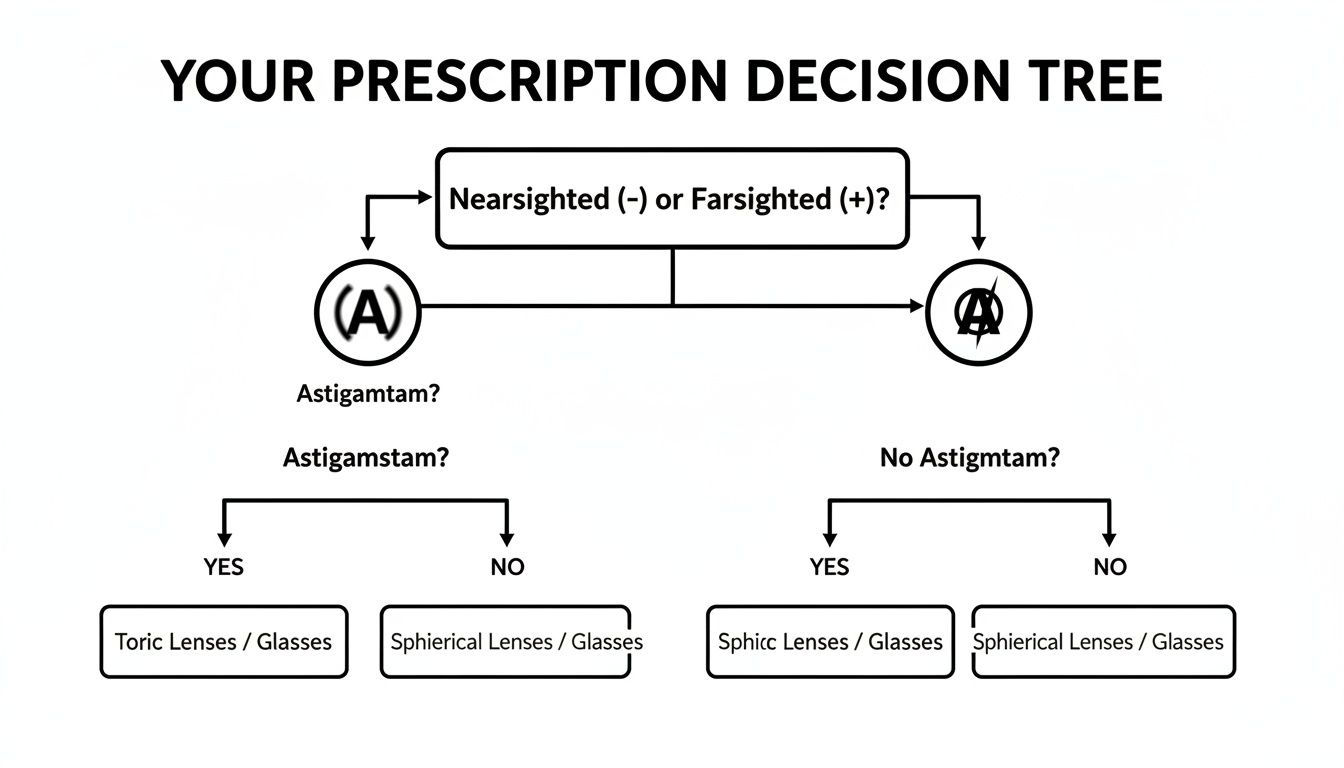
This chart helps clarify whether your prescription needs to correct for astigmatism, which is a key factor in choosing the right fundamental lens design.
Which Prescription Lens Type Is Right for You?
Still weighing your options? This table breaks down the five main lens types to help you find the perfect match for your lifestyle and vision needs.
| Lens Type | Primary Benefit | Ideal For | Practical Example |
|---|---|---|---|
| Clear | Standard, all-purpose vision correction | Primarily indoor use, general activities | A student needing sharp vision for reading and lectures. |
| Sunglass | Reduces glare and provides UV protection | Outdoor activities, driving, sports | A landscape gardener working in bright, direct sunlight. |
| Photochromic | Adapts to changing light conditions | Moving frequently between indoors and outdoors | A real estate agent going from office meetings to property viewings. |
| BlueRay | Filters blue light from digital screens | Heavy screen users, office workers | A graphic designer who spends 8+ hours a day on a computer. |
| Bluecromic | Combines blue light filtering with photochromic tech | Mixed indoor/outdoor use with heavy screen time | A university student studying on a laptop and walking across a sunny campus. |
By thinking carefully about your daily routine, you can pick the perfect lens to support your vision and protect your eyes. It’s a choice that makes a real difference to your comfort every single day.
For a deeper look, check out our guide on the different types of lenses for eyeglasses. At Prescript Glasses, we can customise an eyewear package to suit your requirements, ensuring your lenses are a perfect match for your lifestyle.
Choosing Lens Materials and Protective Coatings

Once you’ve locked in the perfect lens type for your lifestyle, it’s time to think about the material and coatings. These are the unsung heroes of your eyewear, playing a huge part in the durability, comfort, and overall safety of your prescription glasses lenses. Think of them as the behind-the-scenes tech that takes your vision from good to great.
The lens material dictates how thick and heavy your glasses will be, while the coatings act like a protective shield for both the lenses and your eyes. Getting these choices right can totally transform your experience, making sure your glasses aren’t just effective, but also tough enough for the daily grind. At Prescript Glasses, we can customise an eyewear package to suit your requirements, dialling in these crucial details to perfectly match your needs.
Lighter and Thinner Lenses with High-Index Materials
If you have a strong prescription, the thought of ending up with thick, heavy ‘coke bottle’ lenses is probably not appealing. This is where the right lens material makes all the difference. While standard plastic lenses are fine for mild prescriptions, high-index materials are an absolute game-changer if you need a bit more corrective power.
So, what is it? High-index plastic is a special material engineered to bend light more efficiently. This clever trick means it can achieve the exact same vision correction as standard plastic, but with way less material. The result is a lens that's noticeably thinner and lighter, giving you more comfort and a much sleeker look, especially in today's modern, slim frames.
Practical Example: Picture a professional with a -6.00 prescription who used to put up with bulky glasses that felt heavy all day. By switching to high-index lenses, they got a pair that was up to 40% thinner and lighter. That means all-day comfort without sacrificing an ounce of visual clarity.
Essential Coatings for Durability and Clarity
Coatings are micro-thin layers applied to your lenses that pack a powerful punch. They’re like armour, protecting your investment while seriously enhancing your vision. Two of the most important coatings you should consider are anti-reflective and scratch-resistant treatments.
-
Anti-Reflective (AR) Coating: This is a non-negotiable for crisp, clear vision. An AR coating dramatically cuts down that annoying glare bouncing off your lenses from things like office lights, computer screens, and oncoming headlights when you're driving at night. By letting more light pass through to your eyes, it makes your vision sharper and helps reduce eye strain.
-
Scratch-Resistant Coating: Let's face it, life happens. A scratch-resistant coating adds a hardened layer to your lenses, giving them a fighting chance against minor drops, scuffs, and the occasional wipe with the wrong end of your t-shirt. It keeps your vision clear and unobstructed for much longer, improving the safety and lifespan of your glasses.
Blue Light Filters: Sunscreen for Your Eyes
In our screen-heavy world, our eyes are constantly bombarded with high-energy blue light from digital devices. This has become a massive concern for eye health, fuelling a huge demand for protective eyewear.
The Australian eyewear market, valued at AUD 229.00 million in 2025, is tipped to hit AUD 417.91 million by 2034, a surge driven by rising myopia linked to our screen habits. This trend really underscores the need for advanced solutions like blue light blocking lenses. You can read the full research about the Australian eyewear market to get a better sense of these shifts.
A Blue Light Filter is best described as sunscreen for your eyes in a digital world. Just like sunscreen blocks harmful UV rays, this special coating blocks a portion of the high-energy visible (HEV) blue light that our screens emit.
This tech is crucial for anyone who spends their days glued to a computer, tablet, or smartphone. By filtering out this intense light, it can help ease the symptoms of digital eye strain, like tired eyes and headaches. It might even help regulate your sleep cycle, which blue light is known to disrupt. For gamers, students, and office professionals, it’s an essential upgrade for both comfort and long-term eye health.
How to Order and Care for Your Lenses Online
Ordering prescription glasses online can feel a bit daunting at first, but it’s actually a really simple way to get crisp, clear vision sent right to your doorstep. Once you know what you need, you can move through the process with confidence, from uploading your script to picking the perfect lenses.
And when your new glasses arrive? A little care goes a very long way. Looking after your lenses properly is the key to keeping them clear, protecting your investment, and making sure your vision stays sharp and safe for years.
The Simple Steps to Ordering Your Lenses
It all starts with a valid prescription from your optometrist. It's a legal requirement for them to give you a copy after your eye exam, which means you're free to buy your glasses from anywhere you like.
Got your script ready? Here’s how easy it is:
- Choose Your Frames: First up, the fun part. Find a frame style that you love and that suits your face. Pay attention to the size and material to make sure they’ll be comfortable enough to wear all day.
- Select Your Lens Type and Coatings: Think about your daily routine. Do you need Clear, Sunglass, Photochromic, BlueRay, or Bluecromic lenses? This is also the point where you add those crucial extras, like an anti-reflective or scratch-resistant coating, to enhance eye safety and lens durability.
- Upload Your Prescription: Next, you'll be asked for your prescription details. You can usually just upload a photo of the script or type in the numbers yourself. And don't forget your Pupillary Distance (PD)—it’s essential for getting the lenses perfectly aligned.
At Prescript Glasses, we can customise an eyewear package to suit your requirements. We'll walk you through every step to make sure all the details, from the lens index to the coatings, are just right for your vision and lifestyle.
Protecting Your Investment with Proper Lens Care
So, your new glasses are here, and the world has never looked clearer. To keep it that way, a bit of daily care is a must. Neglecting your lenses can lead to tiny scratches and smudges that permanently get in the way of your view, compromising both clarity and safety.
Think of it as a quick daily habit. It only takes a minute or two to clean your lenses the right way, ensuring you get the best performance out of them. For a complete walkthrough of buying glasses online, check out our ultimate guide to buying prescription glasses online.
Best Practices for Lens Health and Safety
To keep your prescription lenses in top condition, just follow these simple tips. They’ll help you steer clear of common mistakes that can cause damage you can't undo.
- Always Use a Microfibre Cloth: Wiping your lenses on your t-shirt or a paper towel is a recipe for disaster. These materials feel soft, but their fibres are rough enough to create tiny, permanent scratches on your lens coatings. A clean microfibre cloth is designed to grab dust and oil without harming the surface.
- Use an Approved Lens Cleaner: For stubborn smudges that water can’t tackle, use a spray made specifically for cleaning glasses. Never, ever use harsh chemicals like window cleaner, ammonia, or alcohol. They're way too aggressive and can strip the protective coatings right off your lenses.
- Store Them Safely: When you’re not wearing your glasses, put them in a hard case. It’s the single best way to protect them from being bent, crushed, or scratched. Leaving them lens-down on a desk is just asking for trouble.
- Rinse Before Wiping: If you notice bigger bits of grit or sand on your lenses, give them a quick rinse under lukewarm tap water before you wipe. This washes away any abrasive stuff so you aren't grinding it into the lens surface with your cloth.
Got Questions About Your Lenses? We've Got Answers.
Stepping into the world of prescription glasses lenses can feel a bit overwhelming at first. With so many options, it's natural to have a few questions. To make sure you feel totally confident in your choice, we’ve answered some of the queries we hear most often from our customers.
Think of this as your go-to guide for sorting out those final details. Our goal is to clear up any confusion and give you the peace of mind that you’re choosing the perfect lenses for your eyes and your life.
How Often Should I Get My Eyes Checked?
This is a big one, and the answer is crucial for keeping your eyes healthy. For most adults, optometrists recommend a full eye exam every one to two years. If you have kids or specific health conditions like diabetes, you might need to go more often.
Vision changes can be sneaky, happening so gradually you might not even notice. If you've been dealing with nagging headaches, tired eyes, or blurry vision, an outdated prescription is a very common culprit.
An eye exam is more than just a vision test—it's a vital health check-up. It ensures your prescription is spot-on and lets your optometrist screen for underlying health issues. Always use a current prescription for new lenses; it's the only way to guarantee you're seeing your best.
Can I Put New Lenses in My Old Frames?
Yes, you absolutely can! This is a brilliant way to hold onto a pair of frames you love while getting your prescription up to date. The process is called 'reglazing,' and it's a smart and sustainable choice.
The main thing to check is the condition of your frames. They need to be in good nick—not brittle, bent, or showing too much wear and tear. While some really intricate designs or materials can be tricky, it's usually a straightforward job.
We can customise an eyewear package to suit your requirements, and that includes taking a look at your current frames to see if they're a good candidate for new prescription glasses lenses. It’s a great way to make a cost-effective decision without giving up on style.
What's the Difference Between Blue Light and Anti-Reflective Coatings?
It’s easy to mix these two up, but they do very different jobs for your eyes. Knowing how they work helps you pick the right protection for what you do every day.
An Anti-Reflective (AR) coating is all about cutting down distracting glare from any light source. Its main purpose is to stop reflections from bouncing off your lenses, which lets more light through to your eyes for sharper, clearer vision.
- Here's a real-world example: When you're driving at night, an AR coating dramatically reduces the annoying halo effect from oncoming headlights. The result? A safer and much more comfortable view of the road.
A Blue Light Filter, on the other hand, is a specialist. It’s specifically designed to block a portion of the high-energy blue light that comes from digital screens—your computer, phone, and tablet. This is what helps ease the digital eye strain that so many of us feel after a long day of screen time.
While many of our top-tier blue light lenses come bundled with an AR coating for the best of both worlds, an AR coating on its own doesn't filter blue light. If you want maximum comfort and eye safety in front of a screen, you need a lens with a dedicated blue light filter.
Are More Expensive Lenses Always Better for My Eyes?
Not really. The "best" lens for you isn't about the price—it's about the right fit for your prescription, your lifestyle, and your eye health needs. A higher price tag usually points to more advanced tech, like lighter materials or multiple coatings all bundled into one.
For example, someone with a really strong prescription will get huge benefits from high-index lenses. They're much thinner and lighter, which gets rid of that thick, 'coke bottle' look and makes them way more comfortable to wear. In that scenario, the higher cost is definitely a worthwhile investment.
But what about someone with a mild prescription who barely looks at a screen? A standard lens with a basic scratch-resistant coating would be perfectly fine. Their eyes would be well looked after without paying for extra features they'd never use.
The key is to think about function, not just price. Here’s a simple way to approach it:
- Start with your script: Is it strong enough to justify high-index materials?
- Look at your daily life: Are you on a computer all day? A blue light filter is probably a must for your eye health.
- Think about your environment: Do you often move from inside to outside? Photochromic lenses that adapt to sunlight could be a game-changer for convenience and UV safety.
The smartest move is to invest in features that solve your daily visual challenges. By focusing on what you actually need, you’ll get the best performance and value from your prescription glasses lenses. We can customise an eyewear package to suit your requirements, helping you find the features that will truly make a difference to your vision and comfort.
At Prescript Glasses, we believe everyone deserves high-quality, customised eyewear. Explore our collection of frames and lens options to build the perfect pair for you. Visit us at https://www.prescriptglasses.com to get started.