how to get scratches out of your glasses: easy fixes

Let's cut straight to it: you can't really repair a deep scratch on modern eyeglass lenses at home. While you might be able to temporarily hide a tiny surface scuff, most of the DIY 'fixes' you see online will cause way more harm than good by stripping away the essential protective coatings on your lenses.
The hard truth is that permanently removing a scratch is impossible without wrecking the lens integrity and, in turn, harming your vision. Your eye health and safety should always be the top priority.
The Hard Truth About Scratched Lenses
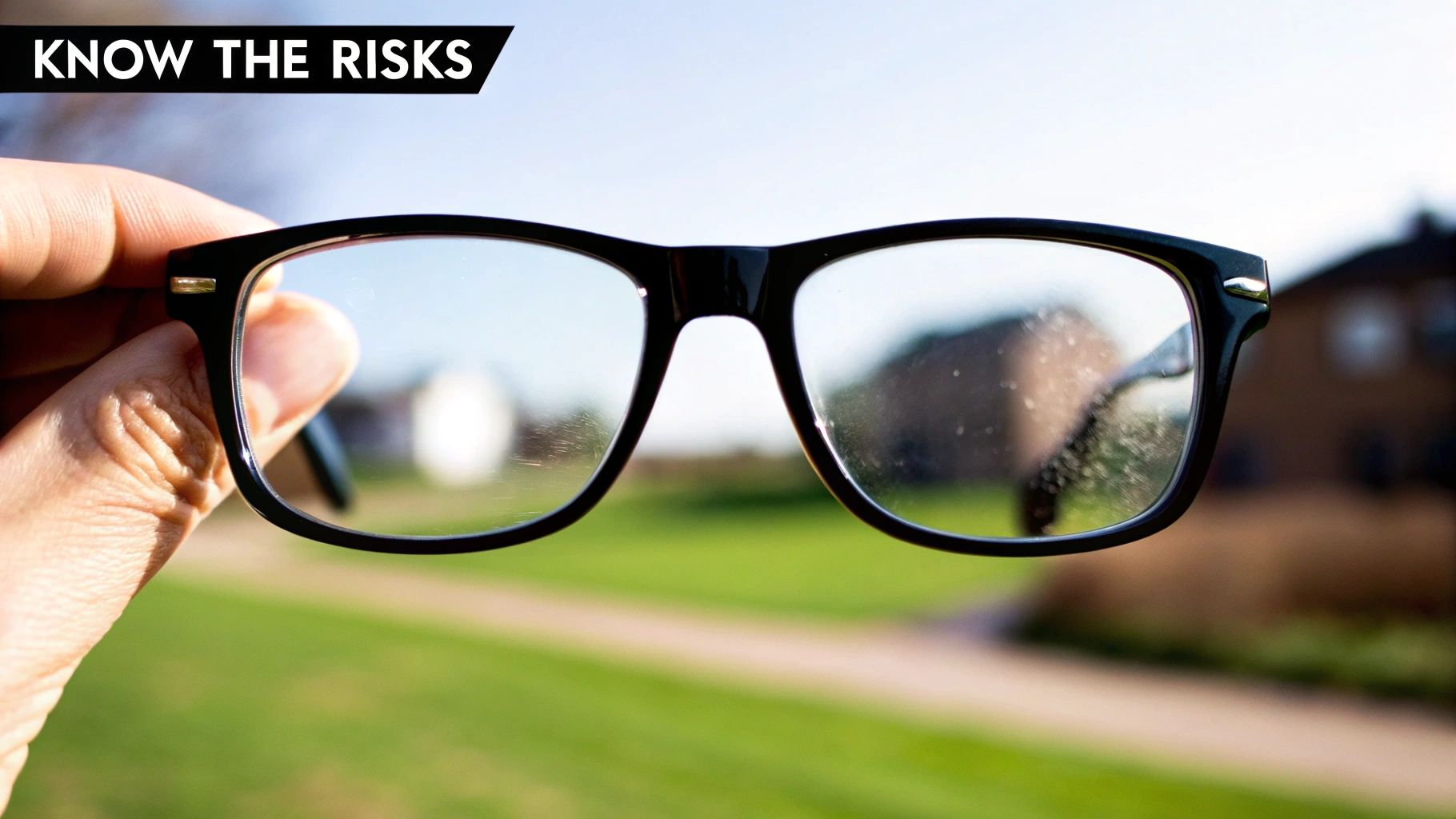
It’s completely understandable to look for a quick and cheap solution for how to get scratches out of your glasses. A quick search turns up dozens of so-called "hacks"—everything from toothpaste and bicarb soda to car wax. The problem is, these methods treat your lenses like simple bits of plastic or glass, ignoring the sophisticated optical technology they really are.
Your lenses almost certainly have multiple, micro-thin coatings that are absolutely critical for clear vision and your overall eye health and safety. These layers are meticulously applied in a lab to give you specific benefits.
- Anti-Reflective Coating: This is what cuts down the glare from headlights when you're driving at night or from your computer screen at work. It’s a game-changer for minimising eye strain.
- Scratch-Resistant Coating: A hardened top layer that gives your lenses a first line of defence against minor bumps and scrapes from daily life.
- UV-Blocking Coating: An invisible shield that protects your eyes from the sun's damaging ultraviolet rays—a must-have for long-term eye health.
- Blue Light Filtering: If you spend hours on digital devices, this coating is your best friend. It selectively filters out harsh blue light to reduce digital eye strain.
When you try to buff out a scratch with something abrasive like toothpaste, you aren't fixing the problem. You're just aggressively stripping away these vital coatings, creating a much bigger, hazier mess than the original scratch.
Why Common DIY 'Fixes' Fail
Before you try that "life hack" you saw on social media, have a look at what these common home remedies actually do to your high-tech lenses.
| Why Common DIY 'Fixes' Fail | ||
|---|---|---|
| DIY Method | The Promised Result | The Real-World Damage to Your Lenses |
| Toothpaste / Bicarb Soda | "Buffs out" the scratch with fine abrasives. | Creates thousands of new micro-scratches, stripping coatings and causing permanent blurry spots. Practical example: This is like using sandpaper on a window; you'll create a frosted effect that you can't see through. |
| Car Wax / Furniture Polish | Fills in the scratch, making it less visible. | Leaves a greasy, hard-to-remove residue that smudges easily and distorts your vision. It can also damage the frame material. Practical example: Imagine trying to see through a car windscreen smeared with oil; everything becomes blurry and distorted. |
| Glass Etching Cream | Removes the top layer of the lens to "erase" the scratch. | Immediately destroys all protective coatings (anti-glare, UV, scratch-resistant), leaving the lens unprotected and optically flawed. Practical example: This is a chemical burn for your lenses, permanently scarring their surface. |
| Sandpaper / Steel Wool | A more "aggressive" way to sand down the scratch. | This is a guaranteed way to completely ruin your lenses. It will leave them opaque, scratched beyond repair, and totally unusable. Practical example: There is no safe example; this is pure destruction. |
As you can see, the risk far outweighs any potential (and temporary) reward. These methods are a fast track to needing new lenses.
Why At-Home 'Fixes' Backfire
Think about it this way: you wouldn't use fine sandpaper on your smartphone screen to fix a scratch, right? The result would be a hazy, unusable disaster. That's exactly what happens when you use these DIY methods on your glasses. The tiny abrasive particles in toothpaste, for example, just create thousands of new micro-scratches that scatter light and cause a permanent blurry patch right in your line of sight.
This is a massive issue. A 2022 survey revealed that 63% of Australian respondents had dealt with scratched lenses, often due to improper cleaning habits. It’s fair to assume many of them turned to these home remedies, not realising the damage they were causing. You can learn more about these findings from Vision Direct Australia.
The damage goes well beyond just blurry vision. When you compromise your lens coatings, it can directly impact your eye health. A damaged anti-reflective coating increases glare, making night driving more dangerous. If you strip away the UV coating, you're leaving your eyes exposed to harmful radiation every time you step outside.
The most important thing to remember is this: A scratched lens is a damaged lens. Trying to 'fix' it at home almost always means compromising the optical clarity and protective features your eyes rely on every single day. Your eye health and safety are non-negotiable.
The Realistic Approach to Scratches
Instead of searching for a miracle cure that doesn't exist, the best approach is to understand the real-world consequences of these DIY methods. A tiny scuff outside your direct line of sight might be something you can live with, but a noticeable scratch that interferes with your vision is a clear sign you need to take proper action.
Protecting your investment in your eyewear starts with knowing what not to do. Before you reach for any household product, take a moment to consider the permanent damage it could cause. Recognising the limits of at-home repairs is the first step toward preserving both your glasses and your eyesight.
Ultimately, the safest and most effective solution nearly always involves a professional assessment. As eyewear experts, we believe informed decisions are key, which is why we can customise an eye wear package to suit your requirements, including fitting your frames with advanced protective coatings to prevent scratches from happening in the first place.
Why You Should Never Try a DIY Scratch Removal Hack
When you spot that first annoying scratch on your glasses, it’s tempting to jump online and look for a quick fix. You’ll find no shortage of "life hacks" promising a miracle cure using stuff you already have at home—toothpaste, bicarb soda, even car wax.
Before you start experimenting, stop. These so-called solutions don’t fix anything. In fact, they almost always cause more, often irreversible, damage.
The problem is that these methods treat your high-tech lenses like a simple piece of plastic. Modern lenses are far more complex. They’re layered with multiple, paper-thin coatings that are essential for clear vision, and trying to buff out a scratch with a household abrasive is like taking sandpaper to a new TV screen. You won’t fix the one flaw; you’ll ruin the whole thing.
The Abrasive Truth About Toothpaste and Bicarb Soda
The most common DIY "fix" you'll find is using toothpaste or a bicarb soda paste to polish away a scratch. On the surface, it almost makes sense—use a gentle abrasive to smooth down the edges of the scratch until you can't see it anymore. But the particles in these products are way too coarse for your lens coatings.
Instead of smoothing out that one scratch, you're grinding thousands of new micro-scratches across the entire surface. This aggressive action strips away your anti-reflective and UV-protective coatings, leaving behind a permanent, hazy mess that scatters light. The result? Distorted vision, way more glare, and constant eye strain. A practical example: if you try this, the next time you drive at night, oncoming headlights will look like massive starbursts, severely compromising your vision and safety.
A study from the Australian Optometrists Association highlighted this exact issue. It found that 58% of Australians with scratched lenses admitted to trying a home remedy first. Of that group, a massive 67% said their attempt either did nothing or made the damage much worse.
Car Wax and Furniture Polish: The Wrong Kind of Filler
Another popular but terrible idea is using a filler like car wax or furniture polish. The theory is that the wax will fill in the scratch and make it invisible. While you might see a brief improvement, it’s a short-lived illusion that creates a whole new set of problems.
These waxy products leave behind an oily, smeary film that’s almost impossible to clean off. This residue is a magnet for dust and smudges, meaning you'll be constantly wiping your lenses—which, ironically, causes even more surface damage over time. More importantly, that uneven layer of wax distorts the light passing through, messing with the precise optical correction your prescription is supposed to provide.
The Real Impact on Your Eye Health and Safety
This isn't just about appearances; failed DIY repairs pose a real risk to your eye health and safety. When you strip away those delicate, factory-applied coatings, you’re exposing your eyes to some serious issues.
- Compromised Night Vision: A damaged anti-reflective coating means a huge increase in glare from streetlights and oncoming headlights, making driving at night much more dangerous.
- Increased UV Exposure: If you’ve scrubbed off the UV-blocking layer, your eyes are left unprotected against harmful ultraviolet radiation. Over time, this can contribute to serious conditions like cataracts.
- Persistent Eye Strain: Scratches, waxy smudges, and hazy patches from abrasives all force your eyes to work harder to focus. This can lead directly to headaches, fatigue, and general discomfort.
Understanding why certain methods fail is key, and it’s a principle that applies to more than just glasses. For instance, there are professional techniques for removing scratches from various glass surfaces, like windows, which highlight just how carefully these jobs need to be done.
Ultimately, your glasses are a medical device, precision-engineered to give you the clearest and safest vision possible. The integrity of those lenses is everything. Once you understand what goes into a high-quality clear optical lens, it’s easy to see why risking it on a failed DIY hack is a gamble you shouldn't take. That's why we can customise an eye wear package to suit your requirements, making sure you get the toughest, most protective coatings right from the start.
Safely Addressing Minor Surface Scuffs
While it's true that a deep scratch is pretty much a done deal, not every little mark on your lenses is a crisis. Some very minor surface scuffs can sometimes be managed, but you have to be incredibly careful to avoid making things worse. The most important thing is figuring out what kind of damage you're actually looking at before you try anything.
Your first move—and often the only one you'll need—is a proper, meticulous clean. More often than you’d think, what looks like a hairline scratch is just a stubborn bit of grime, oil, or residue. A good clean will tell you what's really going on, much like washing a car reveals the true state of the paint underneath.
The Correct Cleaning Protocol
Before you even think about fixing a scratch, you need to master the art of cleaning your glasses without causing more. One of the top ways people scuff their lenses is by grinding dust and grit into them with a dry shirt corner.
Here’s the safe, optometrist-approved method:
- Rinse First: Start by running your glasses under a gentle stream of lukewarm tap water. This is a non-negotiable step; it washes away any abrasive grit or dust that could scratch the lenses during wiping.
- Use a Proper Cleaner: Add a tiny drop of lotion-free dish soap or a dedicated lens spray to each lens. Gently rub both sides with your fingertips to lift any oils.
- Wipe with Microfibre: Rinse all the soap off thoroughly, then carefully dry the lenses and frame with a clean, high-quality microfibre cloth. Never, ever use a t-shirt, paper towel, or tissue—their fibres are surprisingly coarse and can create a web of micro-scratches.
Once they're spotless, hold your glasses up to a light and have another look. If the "scratch" is gone, you’ve just saved yourself a headache. If it’s still there, you can now see exactly how bad it is.
This decision tree gives a clear, visual guide on what to do next.

The main takeaway here is simple: if you can feel a scratch with your fingernail or it’s distracting you, it’s time to see a professional. Trying to fix it yourself just isn't worth the risk to your eye health and safety.
A Word of Caution on Polishing Compounds
If, after a thorough clean, you've confirmed it's just a faint scuff on a basic, uncoated plastic lens, you might be tempted by products that claim to fix scratches. These non-abrasive fillers can sometimes make a scuff look less obvious, but this approach comes with a massive warning label.
Crucial Safety Alert: Never use any kind of abrasive or polishing compound on lenses with special coatings. This includes anti-reflective, blue light filtering, UV-blocking, or photochromic (Transitions) layers. Trying to buff these lenses will permanently destroy the coating, leaving you with hazy vision, intense glare, and no protection.
Those coatings aren't just for show; they're essential for your eye health and safety. The risk of ruining them completely outweighs the tiny benefit of hiding a minor scuff. If you're curious about the principles behind polishing delicate surfaces, looking into guides on simple DIY scratch removal methods for minor scuffs on things like car paint provides good context for why it's a job best left to the pros.
Your vision is too precious to gamble on a risky home remedy. If a scratch is bothering you, the safest path is always to get professional advice. As eyewear specialists, we know your lenses are key to your daily life, which is why we can customise an eye wear package to suit your requirements, ensuring you get the best vision and protection right from the start.
Knowing When to See a Professional
Sometimes, the smartest move is knowing when you’re fighting a losing battle. It’s tempting to try and salvage your lenses, but certain types of damage are a clear sign that it’s time to stop and see an expert.
Wearing significantly scratched glasses isn’t just a minor annoyance; it’s a genuine risk to your visual health. Think of it like a cracked windscreen—if a chip is directly in your line of sight, it’s a safety hazard that needs immediate attention. The same principle applies to your eyewear. Your vision is simply too important to compromise.
Red Flags That Signal Professional Help Is Needed
Not all scratches are created equal. Some are just frustrating, while others actively interfere with your sight and can even be dangerous. If you're experiencing any of the following, it’s a definite sign to book an appointment with your optician.
- Scratches in Your Direct Line of Sight: This is the big one. A scratch right in the centre of your lens forces your eye to constantly work around a distortion. This can lead to serious eye strain, headaches, and blurred vision.
- Deep Gouges You Can Feel: Gently run your fingernail over the scratch. If it catches in a distinct groove, the damage is too deep for any surface-level fix. A gouge like that fundamentally alters the lens’s structure.
- Widespread Haziness or Blurriness: If a failed DIY attempt has left your lenses with a permanent, cloudy film, you’ve likely stripped away the essential anti-reflective coatings. This haze scatters light, severely increasing glare and making things like night driving unsafe.
These issues are more than just cosmetic. They disrupt the precise optical correction your lenses are designed to provide, forcing your brain to work overtime to interpret distorted visual information.
The Impact on Your Eye Health and Safety
Wearing glasses with compromised lenses can have a surprisingly big impact on your daily life. The constant effort to see through a scratch isn't just tiring; it can lead to physical symptoms you might not immediately connect to your eyewear.
Persistent eye strain is a major cause of chronic headaches. What’s more, distorted perception can affect your balance and spatial awareness, increasing the risk of accidents. For example, a scratch could make you misjudge the height of a kerb, leading to a fall.
Your glasses are a bespoke medical device, crafted to correct your unique vision needs. When a lens is deeply scratched, its optical integrity is compromised, and it can no longer do its job effectively. Continuing to use it is like trying to walk in a shoe with a broken heel—you can do it, but not without strain and risk.
An optician won't try to buff or polish modern lenses, and for good reason. The Australian optical industry has seen warranty claims for scratched lenses jump by 25% between 2018 and 2023, showing a growing understanding that DIY fixes don't work. This is largely because over 90% of lenses sold in Australia are made from plastics that cannot be repaired without destroying their optical properties.
The Professional Solution: Lens Replacement
When you visit a professional, they’ll assess the damage and its impact on your vision. In nearly every case involving a significant scratch, the only safe and effective recommendation will be to replace the lenses. This isn't an upsell; it's the only way to restore the clarity and safety of your eyewear.
This process is often simpler and more affordable than people think. If you love your current frames, there's usually no need to buy a whole new pair. Our guide on replacing lenses in glasses explains how you can keep the frames you’re comfortable with while upgrading to fresh, clear lenses.
Ultimately, investing in new lenses is an investment in your health. Clear, unobstructed vision is essential for everything you do. Recognising when a scratch is beyond your control and seeking professional help is the responsible choice.
The Best Defence is a Good Offence: Preventing Scratches
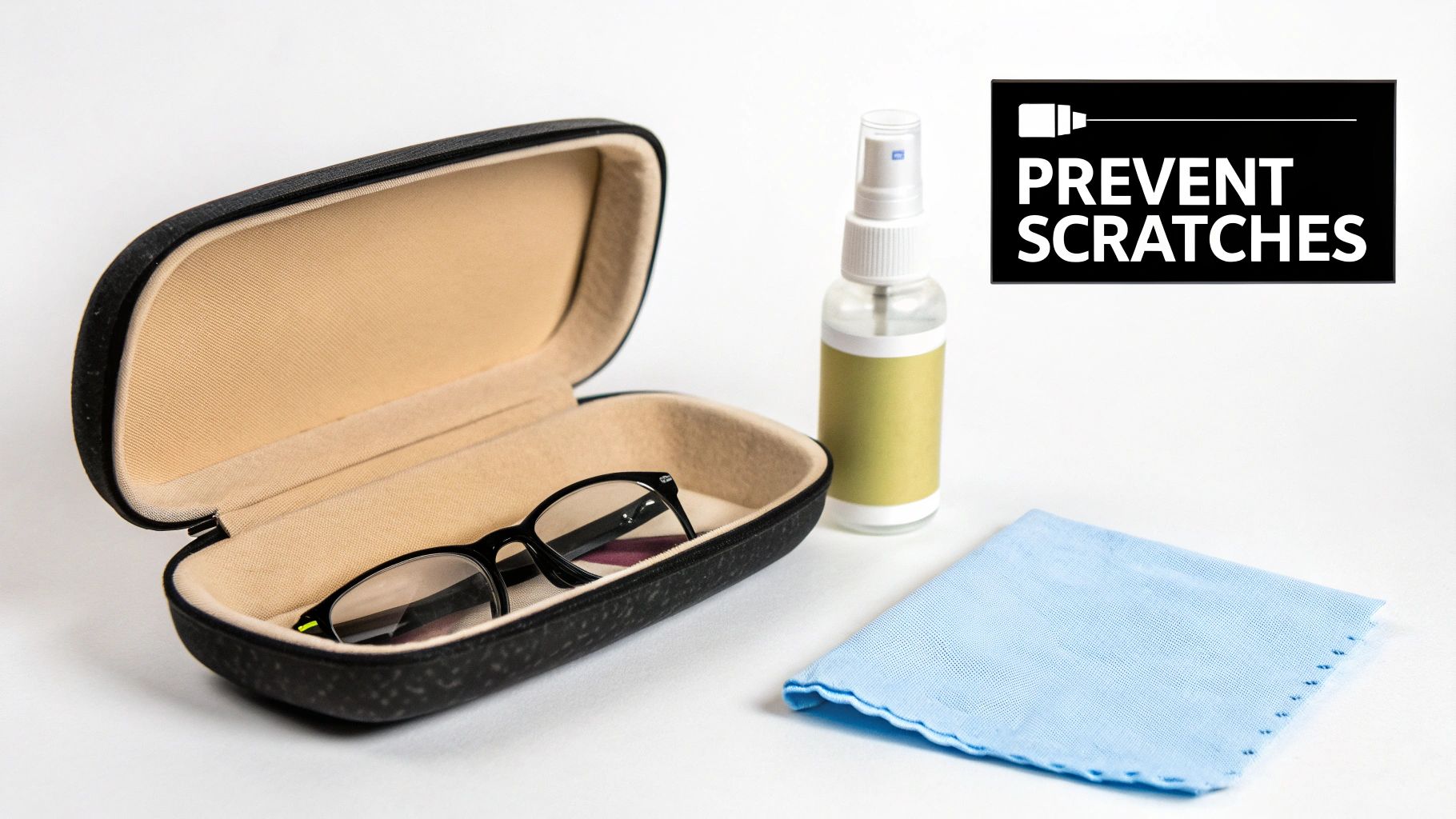
Let's be honest: once a lens is truly scratched, there’s no magic fix that won't risk further damage. That’s why your best strategy is a strong defence. Protecting your eyewear from harm in the first place is the only way to guarantee your vision stays clear and unobstructed.
The good news is that this doesn’t require a huge effort. A few simple, practical habits woven into your daily routine can make all the difference. Think of it less as a list of chores and more as a mindful approach to handling a crucial part of your daily kit.
Building Smarter Habits for Eyewear Care
Most scratched lenses are the result of small, thoughtless moments. Tossing your glasses on a desk, shoving them into a pocket, or giving them a quick wipe with your t-shirt are all fast-tracks to permanent damage. The fix is simply building a better routine.
It starts with how you handle your frames. Make a habit of using two hands to take your glasses off, holding them by the arms (temples). This small action prevents the frame from bending out of shape over time, which keeps the lenses correctly aligned with your eyes. A wonky frame can subtly throw off your vision and lead to eye strain. If you want to learn more, check out our guide on how to tighten your glasses to keep the fit perfect.
Next, and this one is huge: never, ever place your glasses lens-down. It’s so easy to do when you’re in a hurry, but tables and benchtops are covered in microscopic grit that acts like sandpaper on your lenses.
The single most effective tool in your arsenal is a hard-shell case. Tossing your glasses into a bag or pocket is like putting them in a tumble dryer with keys, coins, and lint. A sturdy case is their non-negotiable safe zone.
Try this practical example: make it a routine to place your glasses in their case on your bedside table every night. This one simple action stops them from getting knocked to the floor in your sleep—a surprisingly common cause of serious scratches and broken frames.
The Right Way to Keep Your Lenses Clean
Using the wrong cleaning method is just as bad as dropping your glasses. Wiping a dry lens with a cloth, even a microfibre one, just grinds any dust and grit directly into the surface. You have to rinse first.
Here’s a safe and effective cleaning process:
- Rinse with lukewarm water: This gently washes away any abrasive particles before you even touch the lens.
- Add a tiny drop of proper cleaner: Use a dedicated lens spray or a small dab of lotion-free dish soap.
- Wipe with a clean microfibre cloth: After rinsing the soap off, gently dry the lenses and frame. Forget paper towels or the corner of your shirt—they are too abrasive.
A great tip is to assemble a small "eyewear care kit" for your bag, car, or desk. All it takes is a hard-shell case, a small bottle of lens spray, and a fresh microfibre cloth. Having this on hand makes it easy to clean your glasses the right way, no matter where you are.
Investing in Long-Term Protection
While daily habits are your first line of defence, the ultimate protection starts before you even own the glasses. When you’re buying new eyewear, opting for high-quality, anti-scratch lens coatings is one of the smartest decisions you can make.
This isn’t just some optional extra; it's a fundamental part of modern eyewear. These advanced coatings create a much harder surface that is significantly more resistant to everyday scuffs and minor knocks.
As vision experts, we can customise an eye wear package to suit your requirements, making sure your lenses are kitted out with premium protective coatings from day one. It’s a proactive choice that keeps your vision sharper for longer and saves you the frustration of dealing with damaged lenses down the track.
Your Questions About Scratched Lenses, Answered
When you’ve got a scratch on your glasses, you’ve probably got a lot of questions. It's frustrating, and you want clear, simple answers to protect your eyewear and your vision. Let's tackle some of the most common things people ask about getting scratches out of their glasses.
Can an Optician Buff Scratches Out of My Lenses?
It's a question we hear all the time, but the answer is almost always a firm no. Your lenses aren't just simple pieces of plastic. They’re highly sophisticated optical tools with multiple, delicate coatings for things like anti-reflection, UV protection, and scratch resistance.
Trying to buff or polish a scratch would mean aggressively stripping away all those crucial layers. Not only would this fail to fix the scratch, but it would also permanently wreck your prescription, creating weird visual distortions. When a scratch is noticeable, the only safe and effective fix is a lens replacement. It’s the only way professionals can guarantee your eye health and safety.
Is It Really a Big Deal to Wear Glasses with a Minor Scratch?
You'd be surprised. Even a tiny scratch that isn't directly in your line of sight can cause real problems. You might think you can just look past it, but your brain and eyes are constantly working overtime to compensate for that imperfection.
That little flaw catches and scatters light, creating distracting glares and reflections. This is especially noticeable with headlights when you're driving at night or from overhead lights in an office. This subconscious effort to "see around" the scratch can lead to nagging eye strain and headaches over time. For your own comfort and safety, your lenses should always be completely free of defects.
Aren't Scratch-Resistant Coatings Supposed to Be Scratch-Proof?
This is a very common mix-up. A 'scratch-resistant' coating is essentially a hardened layer that makes your lenses much more durable against the knocks of everyday life. It’s a fantastic line of defence, but it doesn't make them invincible.
Think of it like the screen protector on your phone—it's great protection, but a hard drop or a scrape from your keys can still leave a mark. A fall onto a rough surface like concrete, tossing them unprotected into a bag with keys, or even cleaning them with an abrasive paper towel can easily cause a scratch.
For instance, just placing your glasses lens-down on a kitchen bench can be enough to create micro-scratches from tiny, unseen bits of grit. Even with the best coatings, proper care is still non-negotiable. That's why we can customise an eye wear package to suit your requirements, making sure you get the toughest options available to keep your vision clear for longer.
At Prescript Glasses, we know that clear vision is everything. If your lenses are scratched up, we can help you find the perfect replacements for your favourite frames. Upload your prescription and let us craft a new, flawless set of lenses made exactly to your specifications.