How to Measure PD Accurately at Home

Getting your pupillary distance (PD) right is the single most important step for clear, comfortable vision in your new glasses. Think of it as the core measurement for your eyewear—it’s the exact distance in millimetres between the centres of your pupils. Taking this measurement seriously is a fundamental part of maintaining your eye health and safety.
A dodgy PD measurement can lead to eye strain, headaches, or even make your vision feel distorted. Taking a few minutes to get this number spot-on is a small investment for your long-term eye health and comfort.
Why Your Pupillary Distance Is a Big Deal
When we make your new prescription glasses, our goal is to align the optical centre of each lens perfectly with the centre of your pupil. This precise alignment is what makes your prescription work exactly as your optometrist intended. Your PD is the key that unlocks this precision, and getting it wrong can compromise your vision and overall eye health.
If the PD is off, your lenses will be incorrectly centred, forcing your eyes to work overtime just to see clearly.
Imagine trying to look through a keyhole that isn’t quite lined up with your eye—you’d have to strain and shift your head to get a clear view. An incorrect PD creates a similar effect, leading to common problems like:
- Visual Discomfort: This can pop up as blurry or double vision, especially when you look through the edges of your lenses.
- Headaches: Your brain and eye muscles go into overdrive to compensate for the misalignment, which is a classic trigger for tension headaches.
- Eye Strain: You might notice your eyes feel tired, sore, or gritty even after just a short time wearing your new glasses.
Single PD vs. Dual PD Explained
For most people, a single PD (also called a binocular PD) is all that’s needed. This is one simple number, like 63mm, which represents the total distance from the centre of one pupil to the other.
However, if you're getting progressive lenses or have a higher-strength prescription, a dual PD (or monocular PD) is the way to go for superior accuracy. A dual PD gives you two numbers, such as 31.5/32.5, measuring the distance from the centre of your nose bridge to each pupil separately.
This is critical because almost nobody's face is perfectly symmetrical. One eye might be a touch further from your nose than the other, and a dual PD measurement accounts for that subtle difference. For instance, someone with a complex prescription for progressive lenses might find their vision is blurry at the edges if they use a single PD. A dual PD would ensure each part of the lens is perfectly aligned for their unique facial structure, providing clear vision at all distances.
Getting this measurement right is a non-negotiable part of ordering glasses online. While it might seem like a tiny detail, it has a massive impact on how well your glasses perform and how comfortable they feel all day long.
Ultimately, knowing your PD is just as important as knowing your frame size. Getting the right fit goes far beyond just how the frames look; it’s about making sure your vision is supported correctly. For more on this, check out our guide on finding what glasses fit your face.
With an accurate PD in hand, we can craft a pair of glasses that are perfectly customised to your unique needs.
Using a Mirror and Ruler to Measure Your PD
The classic mirror and ruler method is one of the oldest tricks in the book, and honestly, it’s surprisingly reliable for measuring your PD at home. With a steady hand and a bit of focus, you can get a solid measurement. All you’ll need is a standard mirror and any ruler that has millimetre markings. Your safety is paramount, so be careful not to poke yourself in the eye with the ruler.
First up, position yourself about 20 centimetres (that's roughly 8 inches) away from a mirror. Hold the ruler flat against your brow, making sure it's straight and stable. The key here is to keep your head perfectly still and level through the whole process to avoid any wonky numbers.
Getting Your Measurement Right
Time to get started. Close your right eye and carefully align the '0' mark on the ruler directly with the centre of your left pupil. Getting this starting point spot-on is crucial for an accurate final measurement. Try to look straight ahead into the distance (as reflected in the mirror), not down at the ruler itself.
Now, keeping the ruler completely still, close your left eye and open your right. The millimetre mark that lines up perfectly with the centre of your right pupil is your binocular PD measurement. Simple as that.
To be extra sure you haven’t made a mistake, I always recommend repeating this measurement three times. If you get slightly different readings—say, 62.5mm, 63mm, and 63.5mm—just take the average. In this scenario, your most accurate PD would be 63mm. This quick check gives you peace of mind and is a great safeguard for your visual comfort and eye health.
An accurate PD is non-negotiable. It ensures the optical centre of your lenses aligns directly with your pupils. This isn't just about sharp vision; it’s fundamental to your eye health, helping prevent the annoying headaches and strain that come from misaligned lenses.
The diagram below really brings home why getting your pupillary distance right is so important for avoiding discomfort.
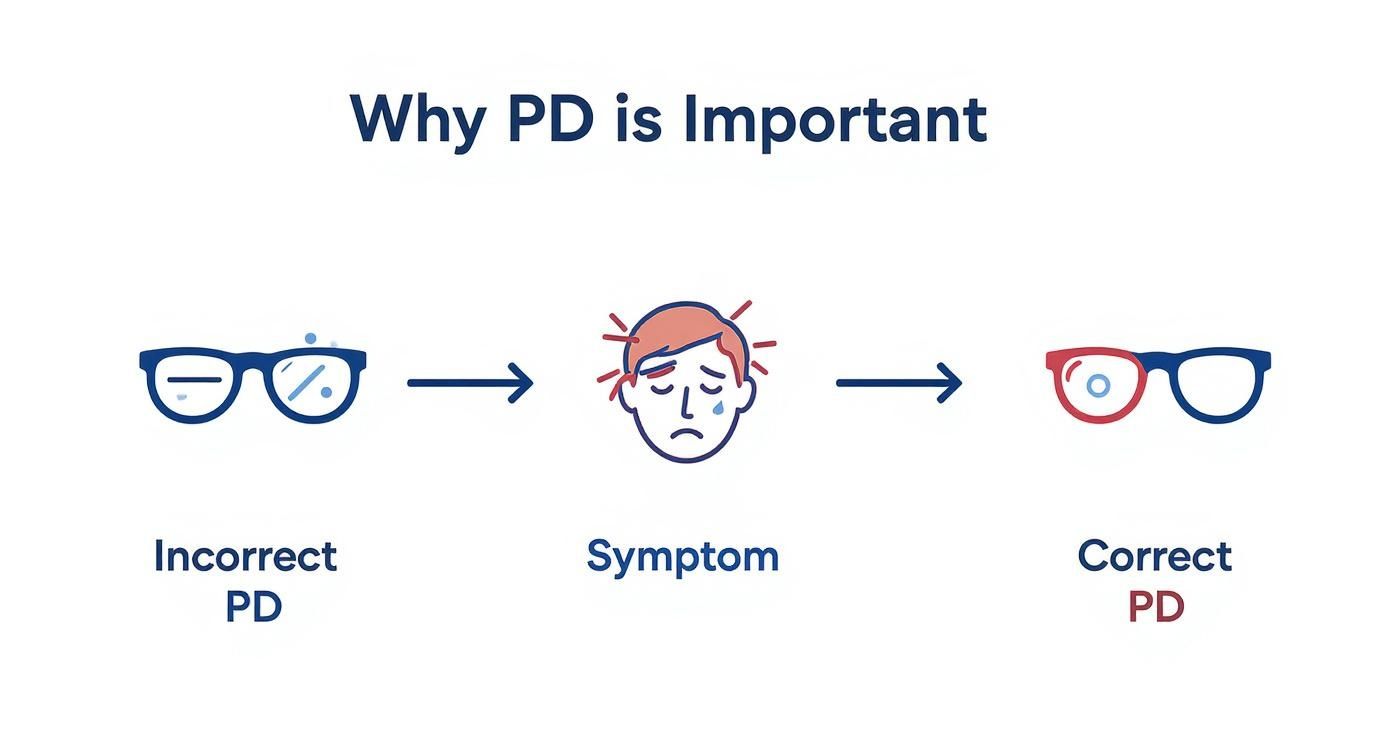
As you can see, an incorrect PD is a direct path to issues like headaches. A correct measurement, on the other hand, leads to properly aligned lenses and comfortable, happy eyes.
A Practical Example in Action
Let's walk through a real-world scenario. Sarah needs to measure her PD at home before ordering new glasses. She grabs a small plastic ruler and stands in front of her bathroom mirror.
- First, she closes her right eye and carefully lines up the 0mm mark with the very centre of her left pupil.
- Next, keeping her head and the ruler perfectly still, she switches eyes.
- Looking with her right eye, she sees the centre of that pupil lines up exactly with the 61mm mark. Her PD is 61.
By taking a minute to do this, Sarah ensures her new lenses will be perfectly centred for her eyes. This is exactly how we can customize an eye wear package to suit your requirements, turning a simple frame into a precision tool for clear, comfortable vision.
Measuring Your PD with a Friend's Help
While you can definitely measure your own PD, grabbing a friend or family member often makes the whole process quicker and much more accurate. Let's be honest, trying to hold a ruler steady while looking into the distance is a bit of a juggling act. An extra set of hands takes the guesswork right out of it and helps ensure a safe, poke-free measurement.
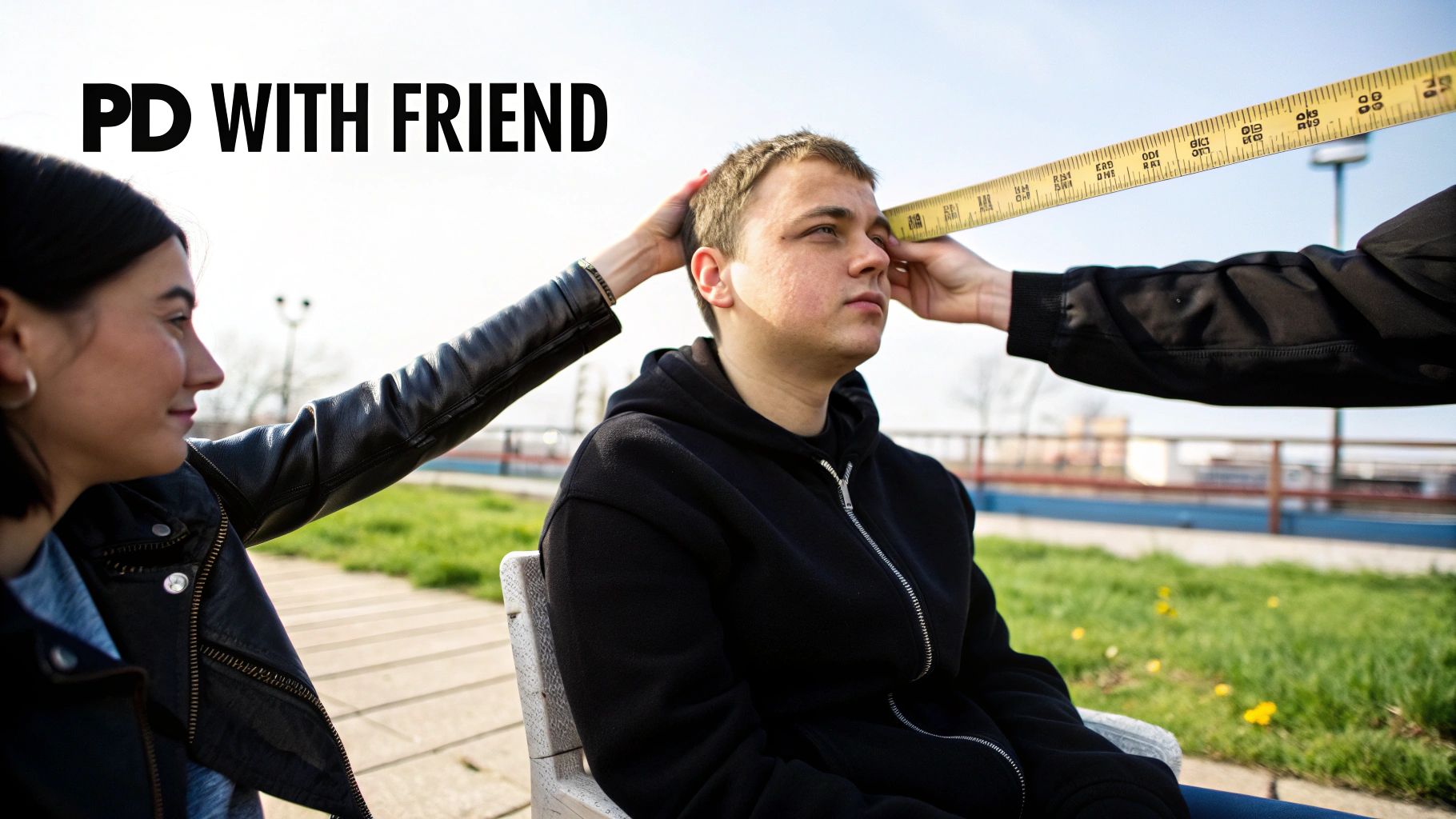
First things first: the person having their PD measured should sit down comfortably. Your friend needs to sit directly across from you, making sure you're both at the same eye level. This isn't just for comfort—it's crucial for an accurate reading. Measuring from an odd angle can cause a parallax error, which will throw the final number off.
Getting the Setup Right
Alright, if you're the one being measured, you need to look straight ahead. Find a spot on the wall or an object that's at least 6 metres (about 20 feet) away and just lock your gaze on it.
This is the most important part. Don't look at your friend, and definitely don't look at the ruler. If you do, your eyes will naturally converge (turn inwards), and you’ll end up with a reading for near vision, not the distance vision your glasses are for. This focus on proper procedure is vital for your eye health.
Your helper can now place a millimetre ruler flat across your brow, right above your eyes, making sure it isn't tilted.
From there, it’s pretty straightforward:
- Your friend lines up the 0mm mark on the ruler with the dead centre of one of your pupils. Let’s say they start with your left eye.
- Keeping the ruler perfectly still, and while you keep staring off into the distance, they’ll read the measurement at the centre of your right pupil.
- That number is your binocular, or single, PD. Simple as that.
Dialling in the Precision with a Dual PD
For anyone with progressive lenses or a particularly strong prescription, a dual PD is the way to go. This gives us two separate numbers: one from the bridge of your nose to your left pupil, and another from the bridge to your right.
This method is fantastic because it accounts for any subtle asymmetries everyone has. For example, your helper might find your left measurement is 31mm and your right is 32mm. That gives us a much more precise dual PD of 31/32 to work with.
Getting this level of precision is something we take seriously—it's a bit like how other technical fields demand accuracy. Take the Australian energy market, where the System Average Interruption Duration Index (SAIDI) is used to meticulously track service quality. You can read about their reliability standards on the AEMC website. Just as a tiny deviation matters there, a single millimetre here can make a world of difference to how well you see.
Once we have this spot-on measurement, we can ensure your lenses are perfectly centred for crisp, comfortable vision.
Using Apps and Online Tools for Your Measurement
Technology gives us a handy shortcut for measuring PD, and often, your smartphone is the only tool you need. A bunch of reliable apps and online tools can give you a quick and surprisingly accurate pupillary distance measurement without having to fiddle with a physical ruler.
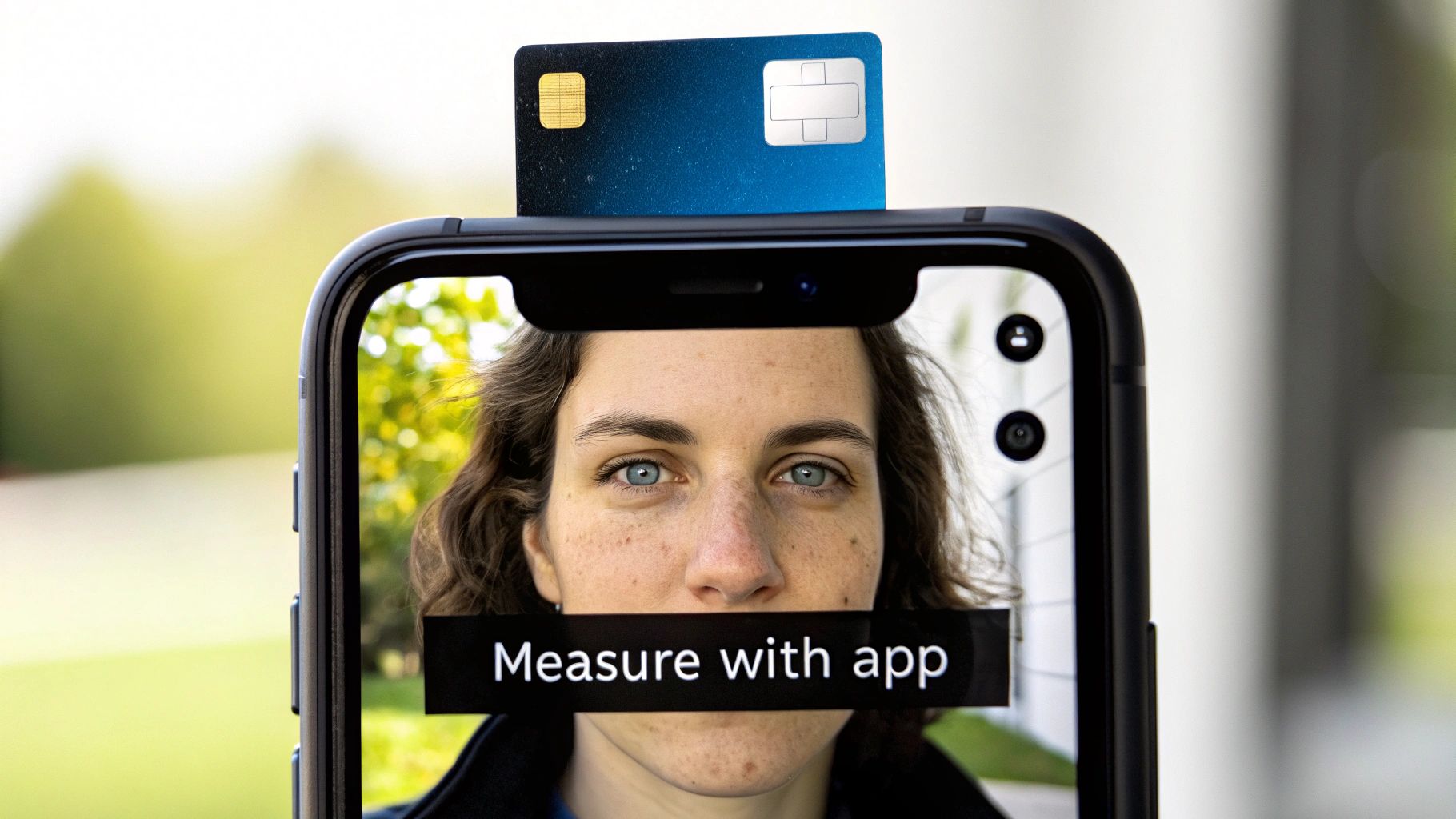
Most of these digital tools work on a pretty clever principle. They use your phone’s camera to snap a photo of your face while you hold a standard-sized object—usually a credit card or any card with a magnetic strip—flat against your forehead. The card acts as a scale reference. This allows the software’s algorithm to calculate the true size of the image and precisely measure the distance between your pupils in millimetres.
The whole process is designed to be super user-friendly, guiding you through each step to make sure you get a spot-on result. A great practical example is using an app like EyeMeasure, which guides you to position your face in the frame and automatically detects your pupils and the card, delivering your PD in seconds.
Getting the Best Results from Digital Tools
To get a measurement you can truly rely on, a little bit of prep work makes all the difference. Before you start, find a spot with good, even lighting. You want your face to be well-lit without any harsh shadows or glare getting in the way. Natural light from a window is almost always your best bet. Prioritizing a clear, well-lit photo contributes directly to the accuracy of the measurement and your future eye health.
Next up, make sure your face is clear and nothing is blocking the view.
- Take off your glasses: Your current specs will obviously block the camera’s view of your pupils.
- Pull your hair back: You don’t want any stray hairs covering your eyes or the reference card.
- Hold the card right: Place it flat against your forehead, making sure the magnetic strip is facing the camera.
Once you’ve taken the photo, the app does all the heavy lifting. It analyses the image and calculates both your single and dual PD. Some tools even have extra features to help with the fun part—choosing your frames. For instance, right after getting your measurement, you can jump into a virtual eyewear try-on to see how different styles look on you.
The biggest win for using an app is the combination of convenience and accuracy. For most people with straightforward prescriptions, these tools provide a reliable PD measurement that is perfectly fine for ordering single-vision glasses online.
Weighing the Pros and Cons
While these apps are incredibly handy, it’s smart to look at both sides. On one hand, they offer a fast, easy way to get your PD right from your living room. They also cut out the human error that can creep in when using a ruler, like parallax mistakes or just misreading those tiny millimetre marks.
On the other hand, some people might have concerns about data privacy. Before you dive in, it’s always a good idea to take a quick look at the app’s privacy policy to see how your photos and data are being handled. By choosing a reputable app and following the instructions carefully, you can get an accurate measurement that helps us create a solution for you, because we can customize an eye wear package to suit your requirements, ensuring your new glasses are a perfect fit for your vision.
Common Mistakes to Avoid for an Accurate PD
Getting a precise pupillary distance measurement is easier than you might think, but a few common slip-ups can easily throw off the result. A small error might not seem like a big deal, but it can lead to noticeable discomfort, so let’s make sure you get it right. Your eye health and safety depend on this precision.
Troubleshooting these frequent mistakes is the key to ensuring your new glasses provide perfect clarity and comfort from day one.
The Near vs. Distance PD Trap
The most common pitfall is accidentally measuring your "near" PD instead of your "distance" PD. This happens when your focus shifts. For instance, if you're using the mirror method and your eyes flick down to read the numbers on the ruler, you've just measured your near PD.
This causes your eyes to converge, or turn slightly inward, which will always result in a narrower, incorrect measurement. Keep your gaze fixed on a distant point!
Sidestepping Parallax Error
Another frequent issue is parallax error. This optical illusion happens when you view the ruler from an angle, making the millimetre mark appear to be in a different position than it actually is. It's the same reason your car's speedometer looks different from the passenger seat.
To beat this:
- If you’re measuring alone: Keep the ruler completely flat against your brow and make sure your head is perfectly level with the mirror. Don't tilt your head up or down.
- If a friend is helping: They absolutely must be positioned directly in front of you, at the exact same eye level. Any deviation, even a slight one, can skew the reading.
Using the Right Tools for the Job
It might sound obvious, but using the wrong ruler is a recipe for an inaccurate measurement. A ruler that only has centimetre markings, or one where the lines are faded and hard to read, simply won't cut it. For example, using a fabric tape measure that can bend or a worn-out wooden ruler could easily lead to a 1-2mm error, which is enough to cause eye strain.
You absolutely need a ruler with clear, distinct millimetre (mm) markings to get the precision required for your eyewear.
A single PD measurement isn’t always enough, especially for more complex prescriptions. For anyone ordering progressive or bifocal lenses, a dual PD (measuring from your nose bridge to each pupil separately) is essential for aligning the different visual zones of the lens correctly.
Making an effort to avoid these mistakes ensures the measurement you submit is one you can trust. It’s a bit like managing infrastructure; small inefficiencies can lead to bigger problems. For instance, the Australian energy network has faced challenges with underutilisation. At its peak in 2006, network utilisation was 57%, but this figure has since dropped to around 41%, meaning much of the network’s capacity goes unused even during peak times. You can learn more about the importance of accurate measurements in large-scale systems by exploring insights on electricity network utilisation.
Just as precision matters there, it’s vital for your vision. Taking these extra steps helps us ensure that we can customize an eye wear package to suit your requirements with the highest degree of accuracy, ensuring your focus remains on your eye health and safety.
Ordering Your Glasses with Confidence
While measuring your PD at home works brilliantly for most people, there are times when it's best to call in the professionals. Your eyesight is everything, and protecting your eye health and safety sometimes means leaving the measurements to an expert.
If you have a particularly strong or complex prescription, think high astigmatism or prism correction, visiting an optician is definitely the way to go. The same is true if you're ordering bifocal or progressive lenses, especially for the first time. These lenses require pinpoint accuracy that can only be achieved with specialised optical tools.
When to See a Professional
It's a good idea to book an appointment with an optician if your prescription has:
- High Sphere (SPH) or Cylinder (CYL) values: As a general rule, if your SPH is stronger than +/- 4.00 or your CYL is above +/- 2.00, professional precision is your best bet.
- Prism Correction: This absolutely requires an expert's touch to make sure the lenses correctly align your eyes and prevent discomfort.
- Progressive or Bifocal Lenses: Multifocal lenses like these demand extremely precise vertical and horizontal alignment that DIY methods just can't guarantee.
Once you have a PD measurement you can trust, ordering from us is simple. You can confidently enter your numbers when you're finalising your order, knowing you've done the essential groundwork for crystal-clear vision. This is just one part of a smooth online ordering experience; for a full walkthrough, check out our ultimate guide to buying prescription glasses online.
This final step is what turns your accurate measurement into perfectly crafted eyewear. It allows us to ensure we can customize an eye wear package to suit your requirements, ensuring your new glasses feel fantastic and work flawlessly right out of the box.
For instance, we had a customer with a progressive lens prescription who visited their optician to get a dual PD of 32/33.5. By providing these exact figures, they ensured the reading, intermediate, and distance zones of their new lenses were perfectly positioned for seamless, natural vision. This professional step was a crucial part of their long-term eye health and comfort.
Pupillary Distance FAQs
Got questions about your PD? You're not alone. Here are some quick answers to the things people ask us most often.
Can My PD Change Over Time?
For adults, your pupillary distance is pretty much set in stone. Once you're fully grown, it generally won’t change.
It's a different story for children and teenagers, though. Their PD will naturally increase as they grow, so it’s vital to get a fresh measurement with every new pair of glasses. This is a simple but crucial step for their eye health and safety, making sure their developing vision gets the correct support.
What Is a Typical PD Range for Adults?
Most adults have a PD that falls somewhere between 54mm and 74mm.
But remember, that's just an average. Everyone's face is unique, so a measurement outside this range is completely normal. This is exactly why getting your specific number is so important rather than just guessing.
What Happens If I Use the Wrong PD?
Using an incorrect PD is a recipe for discomfort. It means the optical centres of your lenses won't line up properly with your pupils.
This misalignment forces your eyes to work overtime to focus, which can lead to some really unpleasant symptoms like persistent eye strain, nagging headaches, and even blurry or distorted vision. A practical example is someone who reuses an old PD from five years ago, unaware their optometrist has since updated it. They might experience headaches within hours of wearing their new glasses, a clear sign of misalignment.
An accurate PD isn't just a number—it's the foundation of comfortable, effective glasses. Taking a moment to get it right is a key part of safeguarding your eye health and ensuring your vision stays clear all day long.
At Prescript Glasses, we rely on your precise measurements to craft perfectly aligned lenses. We understand that everyone's needs are different, which is why we can customize an eye wear package to suit your requirements, giving you the best clarity and comfort.
Ready to see the difference? Explore our collection.