Measure Your PD at Home for Perfect Glasses

Getting your Pupillary Distance (PD) right isn't just a small detail—it's the absolute foundation of clear, comfortable vision with your new glasses. This measurement is the precise distance in millimetres between your pupils, and it’s what allows us to centre the optical part of your lenses perfectly over your eyes. This alignment is critical for visual clarity and overall eye health.
Why an Accurate PD Is Key for Clear Vision
Think of your PD as the unique blueprint for your eyes. Every single prescription lens has an "optical centre," which is the one spot that gives you the sharpest vision. For your glasses to work the way they're supposed to, this centre needs to sit directly in front of each pupil. When you measure your PD correctly, you guarantee this perfect alignment.
An incorrect PD forces your eyes to work overtime just to see clearly, which can lead to a whole host of uncomfortable symptoms. It’s not just about comfort; it's a matter of eye health, as constant strain can cause nagging issues over time. A precise measurement is a crucial step in proactive eye care.
The Real-World Impact of an Inaccurate Measurement
Even a tiny error can make a massive difference, especially for those of us with stronger prescriptions. An inaccurate PD can compromise your safety, particularly during activities that require clear peripheral vision, like driving.
Let’s imagine someone with a -5.00 prescription whose PD is off by just 2mm. It sounds like nothing, right? But this seemingly minor mistake can induce a prismatic effect, causing light to bend incorrectly before it ever reaches their eye. The result is often pretty miserable:
- Persistent Headaches: Your eye muscles are constantly fighting to correct the misalignment, leading to tension headaches, especially around the temples and behind the eyes.
- Noticeable Eye Strain: A feeling of fatigue or ache in your eyes, especially after a bit of reading or screen time. For example, you might find yourself needing to take frequent breaks from your computer because your eyes feel sandy and tired.
- Blurry or Distorted Vision: The world might just look slightly "off" or out of focus, which completely defeats the purpose of wearing glasses in the first place. You might notice the edges of your vision seem to swim or warp.
An inaccurate PD can make a brand-new pair of glasses feel like you're wearing someone else's prescription. Precision isn't just a preference; it's a necessity for comfortable, effective eyewear.
Ensuring Your Custom Eyewear Performs Perfectly
When you buy glasses online, an accurate PD is your ticket to clear vision. This measurement is foundational not just for lens placement, but it also helps power advanced tools. A complete guide to virtual try on technology explains how these systems often use your facial data to ensure new frames will fit you perfectly.
For a deeper dive, our ultimate guide to buying prescription glasses online covers all the essentials you'll need.
Here at Prescript Glasses, we can customize an eye wear package to suit your requirements, but it all starts with accurate data from you. Taking a few moments to measure your PD correctly ensures the final product delivers the crisp, comfortable vision your optometrist intended.
Your Simple Toolkit for Measuring PD at Home
You don't need any fancy optical equipment to get an accurate PD measurement right from your living room. Chances are, you already have everything you need tucked away in a drawer. This is a straightforward method using common household items to get a precise result, keeping things simple and safe.
The most important tool you'll need is a millimetre ruler. Any standard ruler from your school days or even a soft measuring tape will do the trick, as long as it has clear millimetre markings. Precision is everything here, so steer clear of rulers with faded lines or those that only show inches – converting units can easily lead to small but significant errors. Your eye safety depends on this accuracy.
Setting Up Your Measurement Space
Getting your environment right is just as crucial as having the right tools. A good setup eliminates common mistakes and helps you nail the reading on your first attempt.
All you really need is a mirror and a well-lit spot where you can sit comfortably without fidgeting.
- Find a Stable Surface: Prop a mirror up on a desk or table so you can see your face clearly from about an arm's length away. Using a mirror that stands on its own is much easier than trying to hold one.
- Get the Lighting Right: Make sure the light source is in front of you, not behind or to the side. This prevents shadows from falling across your face, which can make it surprisingly difficult to see the centre of your pupils. A desk lamp or sitting opposite a window works perfectly.
Think of it this way: sit at your study desk with the lamp on, facing a small makeup mirror that you’ve propped up against a book. This simple, stable setup with direct light is exactly what you need for an accurate measurement.
That’s really all it takes to get ready. By taking a moment to control these small details, you create the perfect conditions for a measurement that will properly support your vision. A few extra seconds setting up now can save you from the frustration of an inaccurate reading, which could lead to annoying headaches or eye strain later on.
We're all about empowering you with the knowledge to get it right. Once you have your accurate PD, we can customize an eye wear package to suit your requirements perfectly.
Measuring Your PD With The Mirror Method
Of all the do-it-yourself techniques out there, the mirror method is easily the most popular and reliable way to measure your PD. The idea is simple: find the exact distance, in millimetres, between the centres of both your pupils. It’s a pretty straightforward process that gives a surprisingly accurate result when you do it with a bit of care.
First up, find a well-lit room and get comfortable in front of a mirror. You’ll want to hold a millimetre ruler flat against your brow, sitting just above your eyes. The trick here is to keep your head perfectly still and look straight ahead, focusing on something in the distance behind your reflection. This little tip stops your eyes from turning inwards (converging), which can throw off your measurement and make it seem narrower than it really is.
Performing The Measurement
Let's get started. Close your right eye first. Looking with just your left eye, line up the '0' mark on the ruler precisely with the centre of your left pupil. Nailing this starting point is the most important part of getting an accurate reading.
Now, the key is to keep that ruler completely steady. Once the '0' is locked in place, close your left eye and open your right. Without moving a muscle, glance at the number on the ruler that aligns perfectly with the centre of your right pupil. That number is your pupillary distance.
For example, if the mark lines up right on the 63 mm line, your PD is 63 mm. Simple as that. Because a steady hand is so crucial, I always recommend giving it a few goes.
A Quick Tip From Experience: Don't just measure it once and call it a day. I always tell people to repeat the process three or four times. You'll quickly see a consistent number pop up, and that's the one you can trust. This helps iron out any tiny mistakes.
The infographic below shows just how simple the toolkit for this is.
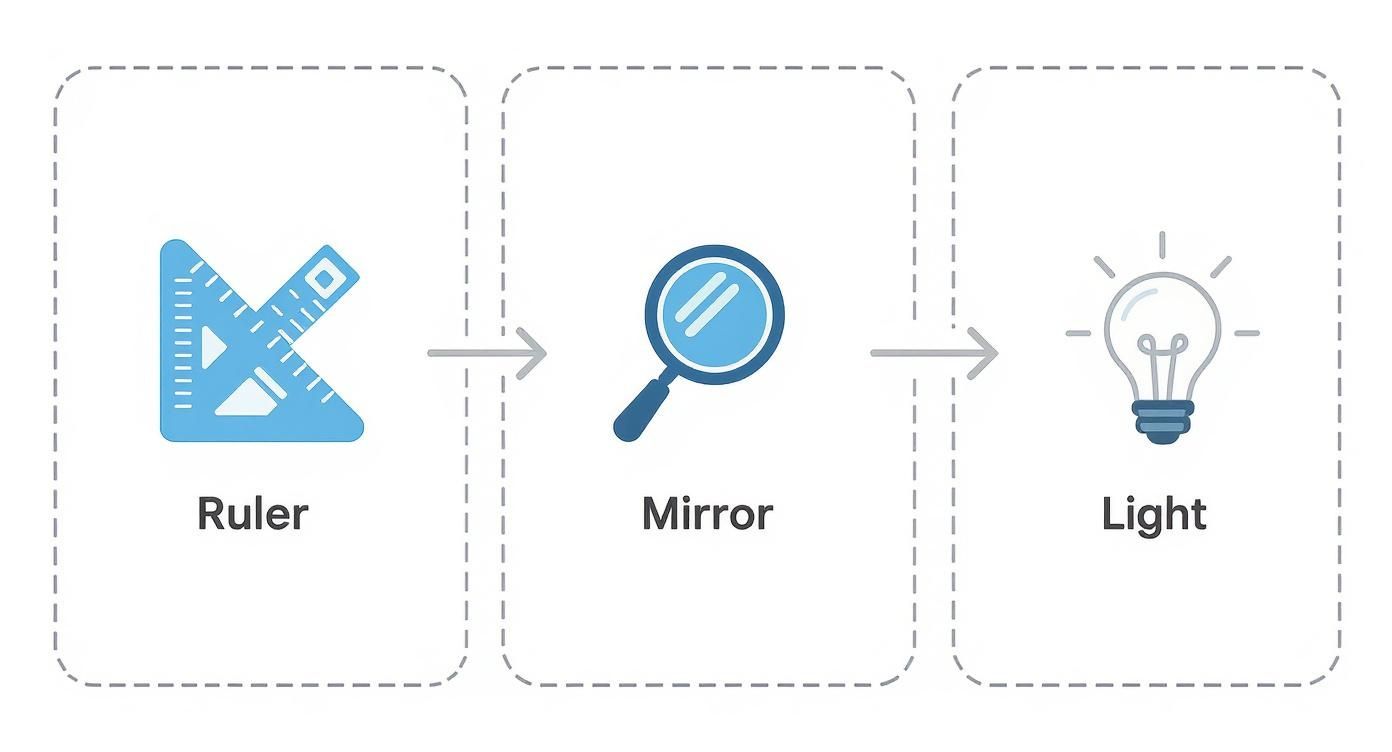
As you can see, all it takes is a ruler, a mirror, and some decent lighting to get the job done.
Checking Your Results
Once you have your number, it’s a good idea to see if it falls within the typical range. This isn't a hard-and-fast rule—everyone's face is different, after all—but it’s a great way to sanity-check your measurement.
Common Pupillary Distance Ranges
Use this table to check if your measurement falls within a typical range. Remember, these are just averages; your unique PD is what truly matters for your glasses.
| Category | Average PD Range (mm) |
|---|---|
| Adults | 54-74 mm |
| Children | 43-58 mm |
If your number is somewhere in that ballpark, you’ve probably done a great job. Getting an accurate PD is the foundational step to ensuring your new glasses give you perfect vision. Once you've got this crucial bit of info, you’re ready to go.
When You Need a More Precise Monocular PD
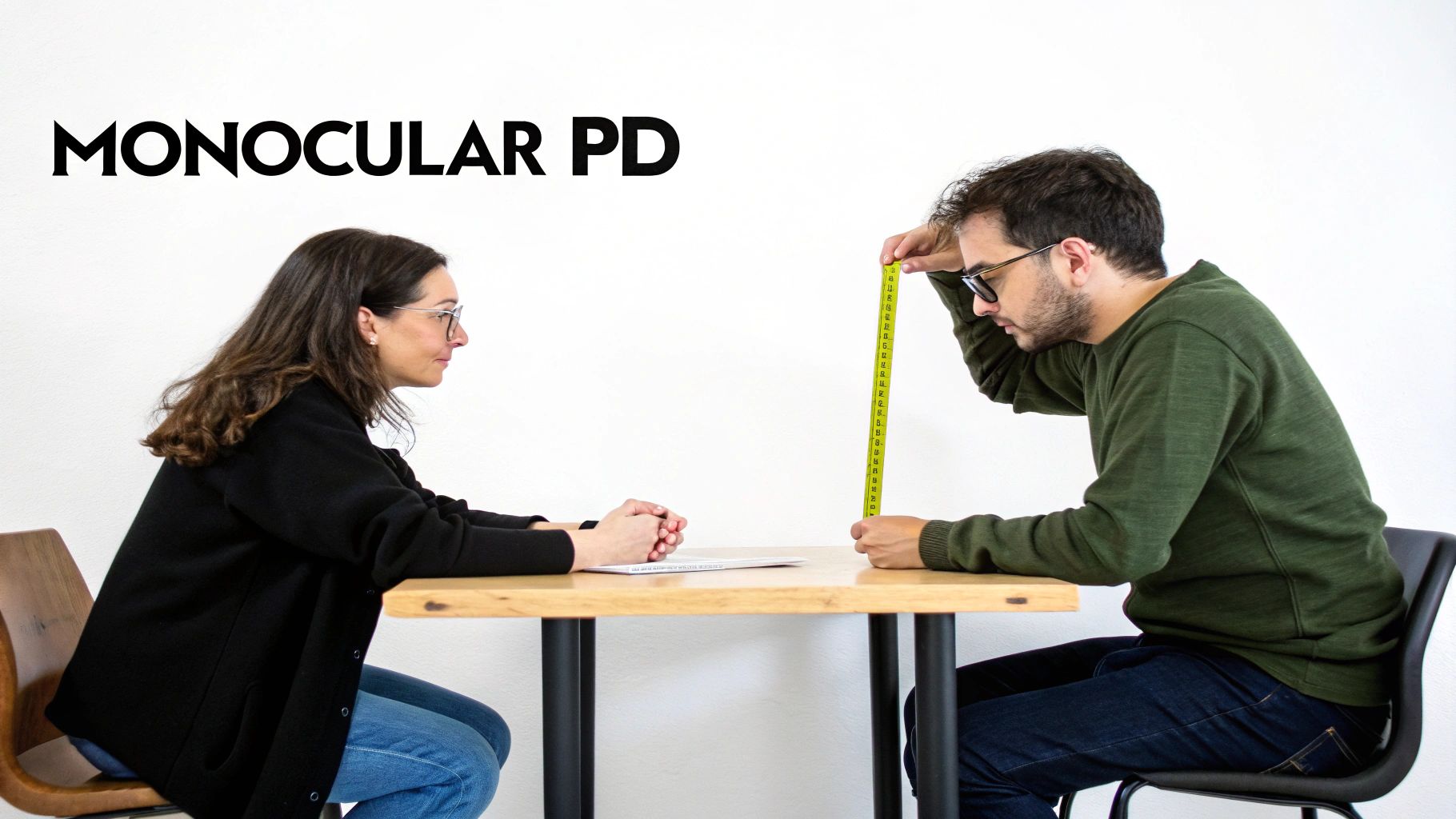
While the standard single-number PD works perfectly for a lot of people, certain lenses demand a much higher level of precision. If your prescription is for progressive lenses or is particularly strong, getting a monocular PD is absolutely essential. This isn’t just for a better fit; it’s crucial for your long-term visual comfort and eye health.
So, what is it? Instead of one number for the total distance between your pupils, a monocular PD is two separate measurements. Each one measures the distance from the centre of your nose bridge to the centre of each pupil, one at a time. The result will look something like this: R: 31.5 mm, L: 32.5 mm.
This level of detail is critical for complex lenses like progressives, where the optical centre of the lens has to align perfectly with each eye independently. Even a tiny discrepancy can lead to visual distortion, nagging eye strain, and headaches—basically undermining the whole point of your custom lenses.
Why This Method Requires a Partner
Let’s be honest: measuring your own monocular PD is next to impossible. Trying to hold a ruler steady, focus on a distant point, and read a tiny measurement for each eye is a recipe for an incorrect reading. The safest and most reliable approach is to grab a friend or family member to help you out.
The process is a little different from the mirror method. You'll need to sit directly opposite your helper, both of you with good posture. The most important thing is for you to keep your eyes fixed on a distant object, looking straight over your friend’s shoulder. This stops your eyes from converging (turning inwards), which would give you an inaccurate, narrower measurement.
Focus on Eye Health and Safety: Whatever you do, don't focus on your friend’s face or the ruler itself while they're measuring. Your gaze must stay locked on a point at least 6 metres away to ensure your pupils are in a natural, forward-looking position for an accurate reading.
The Two-Step Measurement Process
Once you’re both sitting comfortably and you’re focusing into the distance, your friend can get started.
-
Measuring the Right Eye: Your helper should place the '0' mark of a millimetre ruler right at the centre of your nose bridge. While you keep staring straight ahead, they'll measure the distance from that '0' mark to the exact centre of your right pupil and write down the number.
-
Measuring the Left Eye: Without moving the ruler from the centre of your nose bridge, they will then do the same for your left eye, measuring the distance to the exact centre of your left pupil. This second number completes your monocular PD.
For example, you might end up with a measurement of 32 mm for the right eye and 33 mm for the left. This kind of asymmetry is completely normal—very few faces are perfectly symmetrical. Providing us with these two distinct values is the final, critical step.
This two-part measurement gives our team the precise data needed to craft your lenses with pinpoint accuracy. Armed with this information, we can ensure every part of your lens is perfectly placed for your unique visual needs. If you're curious to see how different frames will look with such precisely made lenses, you might want to explore the benefits of a virtual eyewear try-on experience.
Common PD Measurement Mistakes to Avoid
Getting your pupillary distance right isn't about mastering some complex optical skill. It’s mostly about sidestepping a few simple, but very common, mistakes. A precise measurement is the cornerstone of comfortable vision, making sure your new lenses work for you, not against you. Even a tiny error can lead to nagging discomfort, so let's walk through what to watch out for.
The single biggest mistake people make? Looking down at the ruler while they’re measuring. The moment your eyes focus on something close up—like the little markings on a ruler pressed to your brow—they naturally converge, turning slightly inward. This will always give you a PD reading that’s too narrow, sometimes by several millimetres.
This seemingly small error is enough to completely misalign the optical centres of your new lenses. Your eye muscles are then forced to constantly strain to correct your vision, leading to those frustrating, unexplained headaches, eye fatigue, and that general feeling that your new glasses just aren’t quite right.
Ensuring Accuracy Through Correct Technique
To avoid this trap, where you focus is everything. Always look straight ahead into the mirror at an object that’s at least 6 metres away. This keeps your eyes relaxed and looking forward, which is their natural position for distance vision—exactly what we need to measure your PD correctly.
Another surprisingly common issue comes down to the tool itself. Using a ruler with markings that are faded, smudged, or just hard to read is a recipe for an inaccurate measurement. It's incredibly easy to be off by a millimetre or two if you're squinting to see the numbers, and that small difference can have a big impact on your visual comfort.
A customer once told us they accidentally measured from the outer edge of their iris instead of the centre of their pupil. The difference was only a couple of millimetres, but it was enough to cause persistent headaches until they got a corrected measurement from us.
Practical Examples of What to Avoid
To put it into perspective, here are a few real-world scenarios that often lead to the wrong numbers:
- Rushing the Process: Trying to quickly measure your PD between other tasks is a surefire way to be careless. For example, doing it in the car mirror before work is a bad idea. Take your time, get comfortable, and repeat the measurement at least three times to make sure you get a consistent result.
- An Unstable Ruler: If you hold the ruler at an angle or let it slip, your measurement is instantly useless. Press it firmly and flat against your brow and forehead so it stays perfectly still.
- Poor Lighting: Trying to measure in a dim room makes it nearly impossible to see the exact centre of your pupil. For example, using only the light from a TV screen will cast flickering shadows, making an accurate reading impossible. Make sure the light is in front of you, lighting up your face clearly.
Paying close attention to these small details isn't just about getting a number; it’s a critical step for your long-term eye health and comfort. Double-checking your work and focusing on precision ensures the glasses you get will provide the crisp, easy vision you expect. Once you have an accurate measurement, we can customize an eye wear package to suit your requirements perfectly.
Answering Your Pupillary Distance Questions
Even with the best instructions, it's totally normal to have a few questions bubble up when you measure your PD for the first time. Honestly, getting this measurement right is a huge part of our commitment to your eye health. It's the key to making sure your new glasses give you that perfectly crisp, clear vision you're after.
So, let's walk through some of the most common questions we hear. My goal is to help you feel completely confident in getting your measurement spot-on.
What if My PD Isn't on My Prescription?
This happens all the time. You look at the prescription slip your optometrist gave you, and the PD measurement is nowhere to be found. Don't stress – it doesn't mean they skipped it. That number is a standard part of every eye exam; it's just kept in your official file.
The easiest and most foolproof solution? Just give their office a call. A quick, polite ask is all it takes. For instance, you could say, "Hi, I'm ordering some glasses online and need my pupillary distance from my last exam. Could you please provide that for me?" The receptionist can usually pull up your record and give you the number right over the phone. This is the safest way to get a professionally measured, perfectly accurate PD.
Distance vs. Near PD – What’s the Difference?
Yes, there's a real difference between your distance PD and your near PD, and it definitely matters. Using the wrong one can lead to headaches and eye strain.
Your distance PD is for looking at things far away – think driving, watching a movie, or looking across the room. This is the standard measurement we use for most single-vision glasses.
Your near PD is specifically for close-up tasks like reading or scrolling on your phone. To focus on something up close, your eyes naturally converge, or turn slightly inward. Because of this, your near PD is typically about 3-4mm smaller than your distance PD.
Don't worry about trying to figure out which one to send us. When you place an order, we'll ask for the right measurement based on the lenses you need. For example, if you order reading glasses, we will specifically use your near PD. We can customize an eye wear package to suit your requirements, making sure your glasses are perfectly centred for their purpose.
Are Smartphone PD Apps Reliable?
The technology behind those PD-measuring smartphone apps has come a long way, and they can be a handy tool. But, from our experience, their accuracy can be a bit hit-or-miss. So many little things can throw off the result – the quality of your phone's camera, the lighting in the room, or even a tiny head movement.
While an app can be a great way to double-check a number you've measured with a ruler, we still find that a careful measurement using the mirror method is one of the most reliable ways to do it at home. For your own peace of mind and eye safety, why not try both? A correct PD is just as crucial as picking the right frames. If you need help with that part, have a look at our guide on finding out what glasses fit your face.
Here at Prescript Glasses, our mission is to craft high-quality eyewear that is perfectly suited to you. Once you have your accurate PD and prescription in hand, you can easily upload them and start exploring our huge range of stylish frames and advanced lens options. Start building your perfect pair today!