Glasses Frame Repair: Quick Fixes for Bent Frames and Loose Screws

It’s a scenario every glasses wearer knows and dreads: you set them down for just a moment, hear that awful crunch, and suddenly your world goes blurry. A bent frame, a missing screw, or a snapped arm can throw your whole day off track.
But here’s the good news: many common glasses frame problems are surprisingly fixable right at home. With a bit of know-how and a focus on eye health and safety, you can save yourself time, money, and a trip to the optician for those minor mishaps.
Why Learning to Repair Your Own Glasses Is a Smart Move
The frustration of damaged glasses is more than just an inconvenience. For professionals, gamers, and students who rely on crisp vision for hours on end, any downtime is a huge setback. Improperly fitted glasses aren't just annoying; they are a direct threat to your eye health and safety.
For a practical example, imagine you're a graphic designer on a tight deadline. The last thing you need is your glasses constantly sliding down your nose because of a loose arm. That endless readjusting shatters your focus and strains your eyes. Likewise, a competitive gamer can’t afford a crooked frame distorting their view during a crucial match. Knowing some basic repair skills lets you tackle these issues on the spot, turning a potential crisis into a simple five-minute fix.
The Instant Wins of DIY Repair
The most obvious perk is the savings. A simple screw replacement or frame alignment at an optical shop can set you back, and you’re often left waiting for hours or even days to get your glasses back. Doing it yourself cuts out both the cost and the wait.
But it’s about more than just money. Being able to perform a quick fix gives you a real sense of self-reliance. You're no longer stuck if your glasses get bent while you're on holiday or right before a big meeting. It’s a practical skill, much like knowing how to repair a broken window pane.
Protecting Your Eye Health and Safety
This is easily the most critical reason to learn the basics. Your glasses are a precision medical device, and their alignment is directly tied to your eye health. When frames are bent or sit crookedly on your face, the optical centre of your lenses no longer lines up correctly with your pupils. This misalignment is a serious safety concern as it can impair vision and cause discomfort.
This forces your eyes to work overtime to focus, which can lead to a whole host of problems:
- Digital Eye Strain: Symptoms like tired, burning, or itchy eyes get much worse when your lenses aren't positioned correctly.
- Persistent Headaches: Your brain struggles to compensate for the skewed visual information, often resulting in tension headaches.
- Dizziness or Nausea: In more severe cases of misalignment, you might even feel a sense of disorientation or vertigo, which can be dangerous when driving or operating machinery.
By learning to properly straighten your frames, you aren't just fixing an accessory; you are actively protecting your vision and preventing the physical discomfort that comes from improperly seated lenses. Your eye health and safety should always be the top priority.
We get that everyone's vision is unique. That’s why we can customise an eye wear package to suit your requirements, ensuring you get the perfect frames and lenses from the start. Taking care of that investment begins with knowing how to maintain it.
Your Essential Toolkit for At-Home Frame Repairs
Trying to fix your glasses without the right gear is a recipe for disaster. It’s like trying to build flat-pack furniture with a butter knife—you’ll end up with more frustration and probably more damage than you started with. A small, dedicated toolkit is your best bet for making clean, safe, and effective repairs that protect both your frames and your vision.
The great thing is, you don't need a professional workshop. Just a handful of specific items can tackle most common problems, whether it's a loose screw or a slightly bent arm. Putting these tools together is a small investment that pays for itself the first time you save yourself a trip to the optician.
Building Your Repair Kit
Pulling together your own kit is straightforward. You can find many of these items in affordable, pre-made eyeglass repair kits, and you might even have some of them lying around the house already. The trick is knowing what each tool is for and why it’s always better than a makeshift substitute.
Here are the absolute must-haves for any at-home setup:
- Precision Screwdriver Set: Your standard household screwdrivers are way too big for the tiny screws in your frames. A set with various small flathead and Phillips heads is essential for tightening hinges or replacing lost screws.
- Nylon-Jaw Pliers: These are the unsung heroes of frame adjustments. The soft nylon tips let you gently grip and bend metal frames back into shape without scratching the finish—a common mistake when using regular pliers.
- Magnifying Glass or Loupe: Those tiny hinge screws are incredibly hard to see, let alone work with. A simple magnifying glass makes the task much less fiddly, helping you avoid dropping and losing those vital little parts.
- Soft Microfibre Cloths: You'll want at least two of these. Use one to protect your lenses while you work and the other for a final clean-up. Never use paper towels or your shirt; they can leave behind microscopic scratches.
Your eye health and safety should always come first during any repair. A wonky, misaligned frame forces your eyes to constantly readjust, which can lead to strain and headaches. Using the proper tools ensures your adjustments are precise, helping to maintain the correct optical alignment your eyes need for safe, clear vision.
Tools for Specific Frame Materials
The material your frames are made from will determine some of the tools you need, especially when it comes to making adjustments.
For Metal Frames:
This is where your nylon-jaw pliers really shine. For a practical example, say you've accidentally sat on your glasses and bent one of the arms outwards. You’d use the pliers to apply gentle, steady pressure right at the bend, guiding it back into place. Trying to do this with your fingers often results in an uneven or overly sharp bend, which compromises the frame's integrity.
For Plastic Frames:
Plastic frames need a little bit of heat to become pliable enough to adjust. A standard hairdryer on a low setting is perfect for this. For instance, if the arms feel too wide and your glasses keep slipping, you can gently warm the bend where the arm meets the temple for about 30-60 seconds. This will soften the plastic enough for you to carefully press the arm inward for a snugger fit. Trying to bend cold plastic is a surefire way to snap it, creating sharp edges that could be a safety hazard.
Below is a quick checklist to help you assemble your toolkit.
DIY Glasses Repair Toolkit Checklist
Having the right tools on hand makes all the difference between a quick fix and a costly mistake. This table summarises the essentials for most common frame repairs.
| Tool | Primary Use | Pro Tip |
|---|---|---|
| Precision Screwdriver Set | Tightening or replacing hinge and nose pad screws. | Get a magnetic-tipped set to prevent tiny screws from getting lost. |
| Nylon-Jaw Pliers | Bending and adjusting metal frames without scratching them. | Wrap the jaws in masking tape for extra protection if you don't have nylon ones. |
| Magnifying Glass/Loupe | Getting a clear, up-close view of tiny screws and components. | One with a built-in light is a game-changer for working in low light. |
| Microfibre Cloths | Cleaning lenses and protecting them from scratches during repairs. | Keep one cloth exclusively for cleaning and another for repair work to avoid smudges. |
| Hairdryer | Gently heating plastic frames to make them pliable for adjustments. | Always use the lowest heat setting and keep it moving to avoid melting the frame. |
With these items, you'll be well-equipped to handle most minor repairs and keep your glasses fitting perfectly.
Properly tightening your frames is often the first step in any adjustment, and you can find more detailed instructions in our guide on how to tighten your glasses. Remember, we can customise an eye wear package to suit your requirements, and having the right tools on hand helps you maintain that perfect, comfortable fit.
Practical Fixes for Common Eyeglass Problems
When your glasses take a tumble or start feeling 'off', it’s easy to think a trip to the optometrist is inevitable. But often, the most common issues—a wobbly arm, a slightly squashed frame, or a crooked fit—are surprisingly manageable right at home with a bit of patience and the right technique.
Let's move from just preparing to actually doing. This is about more than just bending metal back into shape; it's about carefully restoring the precise alignment your eyes rely on every day. A botched fix can be just as bad as the original damage, leading to annoying eye strain or headaches. Our focus here is on safe, effective repairs that keep your vision sharp and comfortable.
Tackling the Wobbly Arm: A Loose Screw
One of the first things to go wrong is a loose arm that swings a bit too freely, making your glasses feel unstable. This is almost always down to a tiny hinge screw working its way loose over time. If you ignore it, the screw can fall out completely and vanish, turning a small annoyance into a much bigger problem.
The fix is straightforward but needs a steady hand.
First, lay a soft microfibre cloth on a flat, well-lit surface. This simple step saves your lenses from getting scratched and gives you a clean background to catch that tiny screw if you drop it. Next, grab your precision screwdriver set and find the bit that fits perfectly into the screw head. Using one that's too big or too small is a surefire way to strip the screw, making it impossible to tighten or remove later.
Hold the frame securely and gently turn the screwdriver clockwise until you feel a little resistance. Do not overtighten it. Forcing it can strip the threads inside the hinge itself, which is a much trickier repair. A practical example of this problem is when you consistently take your glasses off with one hand for months—it puts uneven stress on one hinge, causing that screw to loosen much faster. If one arm feels floppier than the other, this is almost certainly why.
Reshaping Bent Metal Frames
We've all done it—sat on them, dropped them, or pulled them out of a bag to find them looking a bit wonky. With bent metal frames, the key is to make gentle, gradual adjustments, not one big forceful bend. This is where your nylon-jaw pliers are worth their weight in gold, as they won't scratch or mar the frame’s finish.
Let's use a practical example: you dropped your glasses and now one side sits higher on your face. This usually means an arm is bent up or down right at the hinge.
- To fix it, get a firm grip on the frame front.
- Use your nylon-jaw pliers to grasp the arm right where it’s bent, as close to the hinge as you can get.
- If the arm is sitting too high, apply gentle, even pressure downwards. If it's too low, apply gentle pressure upwards.
After a small adjustment, stop and try the glasses on. Repeat this process until they feel level again. Rushing this is how you end up overcorrecting and making it worse.
Always remember that your eye health is the top priority. A crooked frame means your lenses aren't properly aligned with your pupils. This forces your eyes to work harder to compensate, which can lead to headaches and fatigue, defeating the entire purpose of your prescription.
Adjusting Plastic Frames with Gentle Heat
Plastic or acetate frames are a different beast. Unlike metal, you can't just bend them cold—they have a high risk of snapping. The secret is to apply a little bit of controlled heat to make the material just pliable enough to reshape. A standard hairdryer is the perfect tool for the job.
A practical example, especially for students and professionals, is when glasses start sliding down the nose after months of wear. This usually means the temple arms have widened and lost their snug grip.
Here's how to tighten them up:
- Hold your hairdryer about 15 centimetres away from the part of the arm you need to bend (usually the curve that goes over your ear).
- Use the lowest heat setting and keep the hairdryer moving for 30-45 seconds. The frame should feel warm to the touch, but never hot.
- Once it's warm, carefully apply inward pressure on the arm to create a tighter fit. Hold it in that new position for about a minute while it cools and sets.
Whatever you do, never use an open flame or boiling water. These methods provide way too much uncontrolled heat and can easily melt or warp your frames beyond repair, posing a safety risk.
The Nuance of Nose Pad Alignment
Uneven nose pads are a sneaky source of discomfort. If one pad is digging into your nose more than the other, your glasses will sit crooked, throwing your vision off and creating sore spots. This is a critical adjustment for gamers and heavy device users who wear their glasses for hours on end.
Getting them right requires precision. You can use your fingers or a pair of needle-nose pliers (just wrap the tips in tape to prevent scratching) to gently bend the small metal arms holding the pads.
- If your frames are sliding down your nose, gently push the pads a little closer together.
- If they're sitting too high, gently widen the pads apart.
The goal is perfect symmetry. Look at your glasses head-on to check that both pads are at the same angle and height. Small, incremental changes are the secret to getting a fit that's both comfortable and visually correct. If your pads are just old and worn out, our guide on how to replace nose pads on your eyeglasses has more detailed steps.
This visual shows the basic flow for gathering your essential glasses frame repair tools.
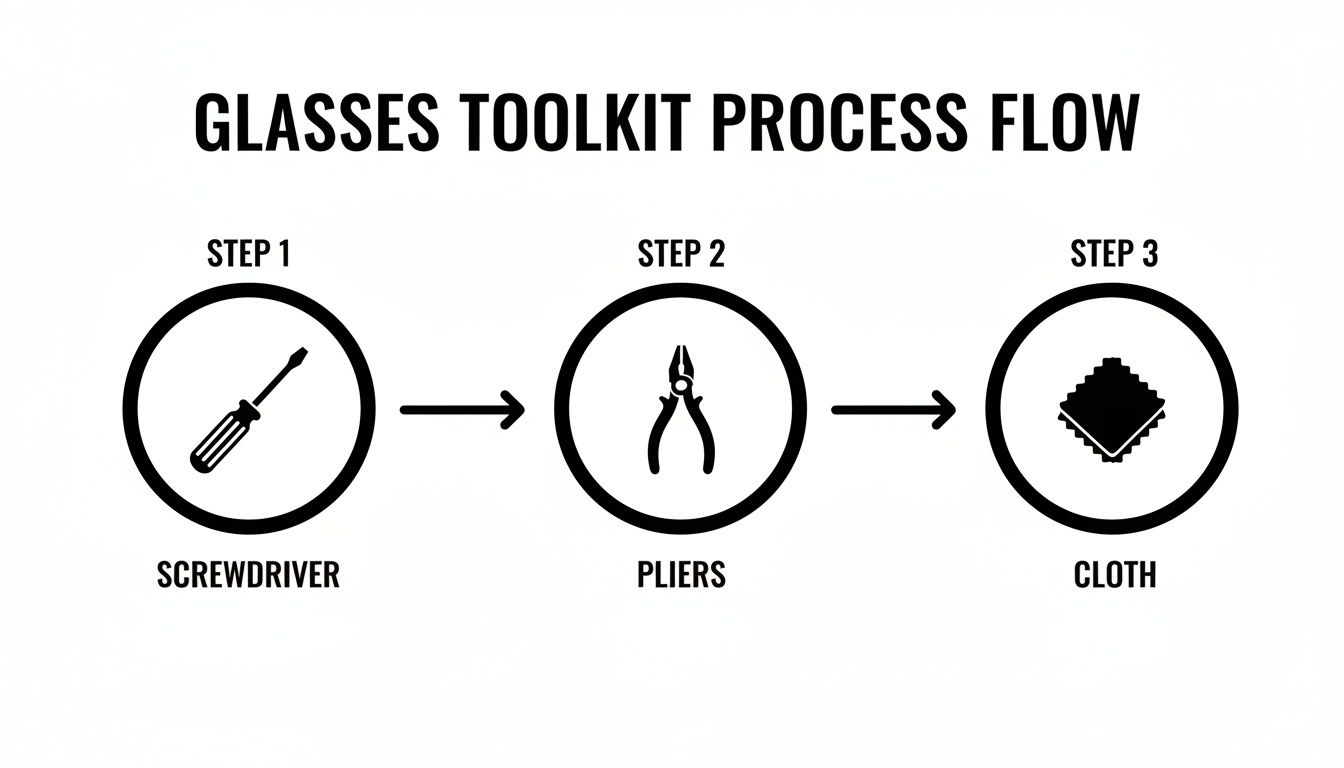
Starting with the right screwdriver, moving to pliers for adjustments, and finishing with a cloth for protection covers the core needs for most simple repairs.
Temporary Fixes for Emergencies
Sometimes, a proper repair just isn’t an option right away. If a screw falls out and you don’t have a spare, a paperclip or the wire from a twist-tie can be a real lifesaver. Just thread a small piece of the wire through the hinge holes and twist it securely. It’s definitely a temporary solution, but it’ll hold your glasses together until you can get a real screw.
For a cracked plastic frame, a tiny dab of super glue can work in a pinch, but be extremely careful. Apply it with a toothpick to avoid getting any glue on your lenses or the hinge. Just remember, this should be a last resort, as it can make a future professional repair much more difficult.
Everyone’s needs are different, which is why we can customise an eye wear package to suit your requirements. Keeping that custom fit perfect through these minor adjustments ensures you continue to get the comfort and visual clarity you paid for.
Knowing When to See a Professional
Fixing your own glasses can be incredibly satisfying, but it's crucial to know where to draw the line. There’s a big difference between a smart DIY tune-up and a potential disaster. Recognising your limits isn’t about giving up; it’s about protecting your investment and, more importantly, your eye health and safety.
Some breaks just aren't meant for a home toolkit. Trying to force a repair on serious damage can often make things worse, turning a fixable problem into a permanent one.
The single biggest risk? Messing up the optical alignment of your lenses. If your frames are bent even a millimetre out of place, your eyes will have to work overtime to compensate. This can lead to headaches, dizziness, and persistent eye strain. Your eye health and safety should always come first, and sometimes that means handing the job over to an optician.
Red Flags That Mean You Need an Expert
Some types of damage are clear signals to step away from the repair kit and head straight to a professional. These aren't just cosmetic issues—they affect the core structure of your frames and how your lenses are positioned, impacting your eye health and safety.
Don't even think about a DIY fix in these situations:
- A Completely Snapped Frame: If your frames have broken clean in two, especially across the bridge or where the temple arm connects, super glue is not the answer. Professionals use specialised tools to weld or solder the frame back together, creating a bond that’s both strong and perfectly aligned. A glued frame is a weak frame, and it will almost never sit straight again.
- Broken or Damaged Hinges: The hinge is a surprisingly complex part. If the barrel has snapped or the screw threads are stripped out, simply popping in a new screw won’t do anything. An optician has the precise tools and tiny replacement parts to rebuild or replace the entire hinge without damaging the frame around it.
- Serious Damage Near Coated Lenses: If fixing the frame means you might have to pop out a lens, it's time to stop. Lenses with anti-glare, anti-scratch, or blue light coatings are more delicate than they look. Forcing a frame back into shape can easily scratch or chip these coatings, ruining your expensive lenses. If the damage is too severe, you can explore options for eyeglass lens replacement.
An optician once told me that nearly 30% of the major repairs they perform started out as failed DIY jobs. That attempt to glue a snapped bridge often just adds more work (and cost) to the final professional repair.
Why Frame and Lens Integrity Matters So Much
Your glasses aren't just a fashion accessory; they're a custom-fitted medical device. When your eyewear is made, the optician ensures the optical centre of each lens is perfectly aligned with your pupils. This precision is non-negotiable for clear, safe, and comfortable vision.
When you try to fix major structural damage yourself, you almost guarantee that this critical alignment will be lost. You might manage to piece the frame together, but if it sits even slightly crooked on your face, the lenses will be in the wrong position. This forces your eyes to constantly strain, which is a big problem for anyone, but especially for those with strong or complex prescriptions where even a tiny deviation can cause major issues. Maintaining this alignment is paramount for your eye health and safety.
When to Call the Manufacturer Instead
Sometimes, your local optician isn't the final stop—you need to go straight to the source. Contacting the manufacturer is the best move in a couple of specific scenarios.
- Manufacturing Defects: Did your frames break during normal use while still under warranty? This could be a defect. Contact the manufacturer or the shop where you bought them first, as you might be eligible for a free repair or a brand-new pair.
- Specialised or Designer Frames: High-end and designer frames often use proprietary parts, like unique hinges or custom-shaped screws that your local optician won't have in stock. The only way to get a perfect repair that maintains the frame's original function and aesthetic is to go through the manufacturer.
In the end, it all comes down to being honest about the scale of the damage. A loose screw is one thing; a structural failure is another. Because everyone's vision and style are unique, we can customise an eye wear package to suit your requirements, ensuring a perfect fit from the moment you get them. Protecting that investment means knowing when to roll up your sleeves and when to call in the pros.
Proactive Care to Prevent Frame Damage
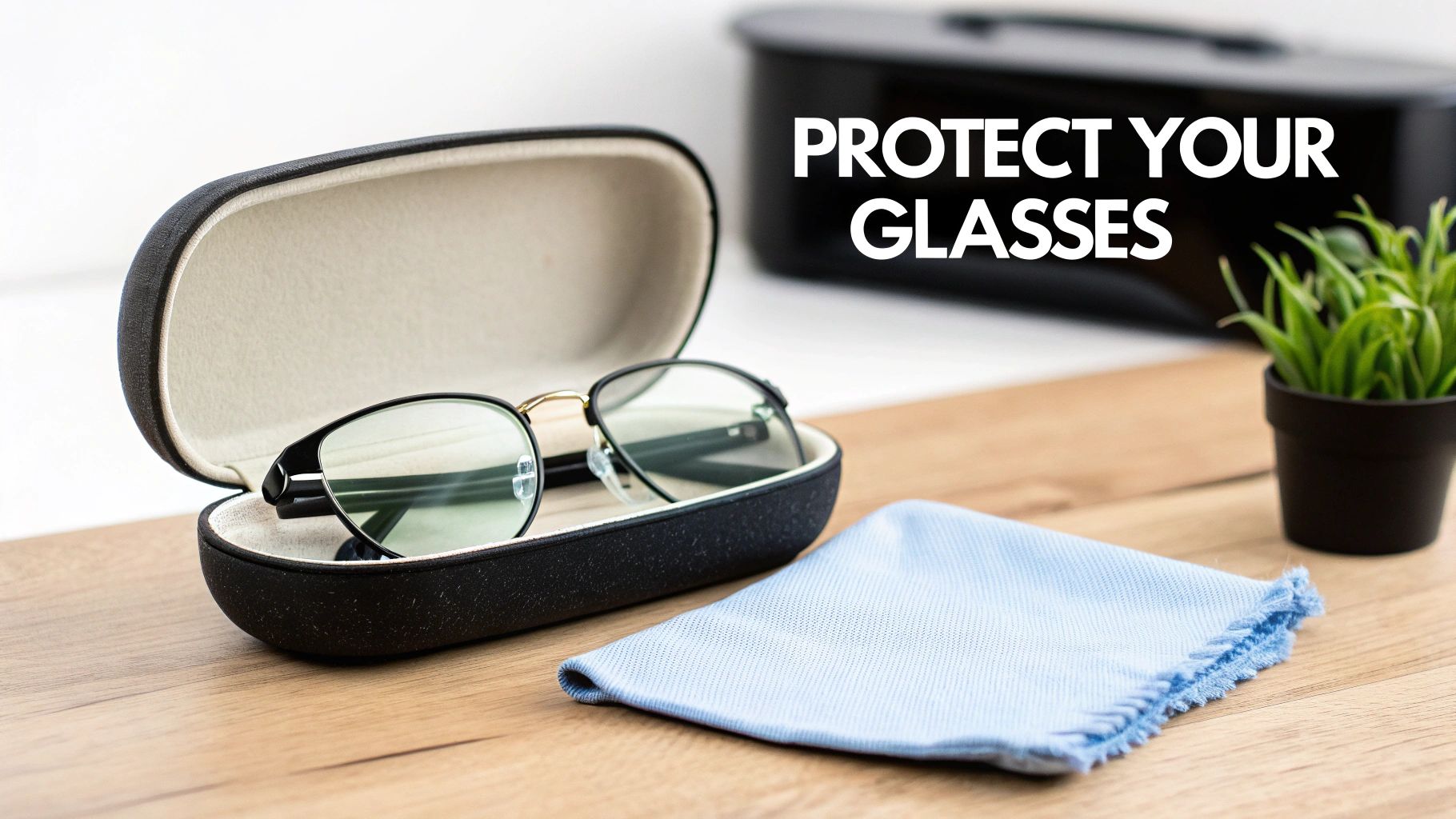
Knowing how to patch up your glasses is a great skill, but the real win is avoiding the need for repairs altogether. It’s far better to focus on proactive care than to get good at reactive fixes. Making a few simple habits part of your routine can dramatically extend the life of your eyewear and keep your frames out of trouble.
These aren't complex routines, but they make a massive difference in stopping the usual suspects—bends, breaks, and misalignments—before they start. A little bit of mindfulness goes a long way in protecting your investment and keeping your vision sharp.
Daily Habits for Frame Longevity
Small, conscious actions are the bedrock of good eyewear maintenance. Weaving these into your daily life will help you sidestep unnecessary damage and keep your frames in prime condition. After all, your eye health and safety rely on glasses that fit properly, as even slight misalignments can cause strain.
Here are a few game-changing habits to pick up:
- The Two-Handed Rule: Always, always use both hands to put on and take off your specs. When you grab them by one arm, you put uneven stress on the hinge, which is the number one reason screws loosen and frames get bent out of shape.
- Never on Your Head: I know it’s tempting, but pushing your glasses up onto your head is a guaranteed way to stretch out the arms and warp the whole frame. It slowly destroys the snug, custom fit your face needs for correct lens alignment.
- Case Is King: If your glasses aren't on your face, their only other home should be in their hard case. Leaving them on a desk, bedside table, or tucked into your shirt collar is just asking for them to get knocked off, sat on, or scratched.
Lifestyle-Specific Care Tips
The way you live your life exposes your glasses to different kinds of risks. Tailoring your care routine to your daily activities adds an extra layer of defence against predictable wear and tear.
For Gamers and Heavy Device Users
Long hours in front of a screen mean your frames are constantly exposed to skin oils and sweat, which can break down materials and coatings. Get into the habit of wiping down not just the lenses but the entire frame with a microfibre cloth after a long session. This simple clean-up prevents build-up and corrosion.
For Professionals on the Move
If you're constantly rushing between meetings, your glasses are in the danger zone inside a briefcase or handbag. A hard-shell case is absolutely non-negotiable. It provides vital protection against getting crushed or bent by your laptop or keys, making sure your frames are perfectly straight for that next big presentation. A practical example would be tossing your glasses into a backpack with books; without a case, the pressure will almost certainly bend the frames over time.
"Preventive care is the most effective form of repair. A few seconds of proper handling each day can save you from the cost and inconvenience of fixing a preventable break."
By understanding these risks, you can stay one step ahead. Remember, we can customise an eyewear package to suit your requirements, including durable frame materials and protective coatings that are up to the challenge of your daily grind. Taking these small, proactive steps ensures that custom fit lasts.
Your Top Glasses Frame Repair Questions Answered
When your glasses break or don't fit right, it's easy to feel a bit lost. Should you fix them yourself? Is it time for a new pair? We get these questions all the time. Here are some straight answers to the most common queries we see.
Can I Use Super Glue on My Broken Frames?
It's the first thing everyone reaches for, but trust me, putting super glue anywhere near your glasses is a big mistake. While it might give you a temporary fix for a snapped plastic frame, that bond is incredibly brittle. The second you put any real pressure on them, they'll just break again.
Even worse, the chemicals in super glue can permanently damage the frame's finish and eat away at your lens coatings. It also makes a professional repair almost impossible. An optician would have to painstakingly scrape off all the hardened glue before they could even start a proper fix. Your eye health and safety come first, and a wonky, poorly glued frame can throw off your lens alignment and cause serious eye strain.
A much better temporary fix is a small piece of tape. It'll hold things together until you can get a proper repair done, and it won't ruin the frame for a future, more permanent solution.
Where Can I Find Replacement Screws for My Glasses?
Losing one of those microscopic screws is a rite of passage for every glasses wearer. Your best bet is to grab an eyeglass repair kit, which you can find at most pharmacies or online. These handy little kits usually come with a tiny universal screwdriver and a handful of the most common screw sizes.
If you're dealing with designer frames or just can't find a match, pop into your local optical shop. They have a massive inventory of replacement parts and can almost always find the perfect fit. Sometimes, they'll even give you one for free.
Is It Cheaper to Repair or Replace My Glasses?
This one really comes down to the numbers, and repairing often makes more financial sense, especially if you've invested in a good pair of frames. Just look at the Australian eyewear market—industry revenue is at $5.0 billion because more and more people are choosing to fix their premium frames instead of buying new ones.
A good repair can easily add another two to three years to the life of your glasses, saving you an average of AUD 150. Compare that to dropping AUD 300 or more on a brand-new pair, and the choice becomes pretty clear. It's no wonder frame repair is such a fast-growing part of the industry. You can learn more about the trends in the Australian eyewear market on Eyetalk.com.au.
How Often Should I Get My Glasses Professionally Adjusted?
Even if you take great care of your glasses at home, nothing beats a professional tune-up. We recommend getting your glasses checked and adjusted by an optician at least once a year. They can tighten all the hardware, spot any potential weak points, and realign the frames perfectly to your face before giving them a thorough clean.
This annual check-in is especially crucial for your eye health and safety if you have a strong or complex prescription. Even a tiny misalignment can throw off your vision and cause discomfort. It’s a simple step that goes a long way in making sure your glasses are doing their job properly.
At Prescript Glasses, we know that the perfect fit is non-negotiable. That’s why we can customise an eye wear package to suit your requirements, from ultra-durable frames to highly specialised lenses.
Check out our collection to find the pair that works as hard as you do. Find your next pair at https://www.prescriptglasses.com.