Glasses light sensitivity: A Practical Guide to Comfort and Clarity

We've all had that moment—squinting hard against a bright screen or a sunny day. It's a familiar feeling, but for many people, this discomfort is more than just a passing annoyance. It's a daily battle that impacts their eye health and safety.
If you have photophobia, or light sensitivity, the right glasses for light sensitivity aren't a luxury; they're an essential tool for getting through your day comfortably. Specialised glasses like these are designed to filter out harsh light, slash through glare, and shield your eyes from the specific light sources that cause you problems, protecting your vision for the long term.
Decoding Light Sensitivity and Finding Relief
Picture this: you step out of a dim room and into the full force of the midday sun. That intense, almost painful brightness that makes you immediately squeeze your eyes shut is a small taste of what people with chronic photophobia deal with all the time. It's not a "fear" of light, but a genuine intolerance where even normal light levels feel overwhelming and cause discomfort.
This isn’t just a minor inconvenience. It's a clear signal from your eyes that they're struggling to handle the light in your environment. Protecting your eyes from these triggers is a key aspect of eye health and safety. The triggers can be anywhere:
- The relentless glare of natural sunlight on a clear day.
- The sharp, sometimes flickering light from fluorescent bulbs in offices and stores.
- The high-energy blue light blasting from our digital screens—computers, phones, and tablets.
A Widespread Concern for Eye Health
Light sensitivity is an incredibly common issue, affecting people of all ages. Here in Australia, it’s actually one of the most frequent eye-related complaints. The 2022 Vision Index report revealed that a massive 80% of Australians have experienced sensitivity to light, highlighting just how significant this is for our nation's eye health. You can dig deeper into these kinds of statistics through various research studies on vision.
The good news is that managing this condition is completely doable. One of the most effective and immediate solutions is finding the right pair of glasses, as modern lens technology gives us a whole toolkit of options designed to tackle light sensitivity at its source.
The goal is to filter out the problematic wavelengths of light while still giving you comfortable, clear vision. Think of it as a personalised shield for your eyes, built to block exactly what causes you grief.
Throughout this guide, we’ll walk you through the different types of glasses for light sensitivity to help you figure out which solution fits your life best. We can customise an eyewear package to suit your requirements, ensuring your vision is both sharp and comfortable.
Common Light Triggers and Eyewear Solutions
To kick things off, here’s a quick look at the most common light triggers and the types of glasses designed to handle them. This table can help you pinpoint the source of your discomfort and see which lens technology might be the best fit.
| Light Source Trigger | Primary Eyewear Solution | Key Benefit | Practical Example |
|---|---|---|---|
| Digital Screens | Blue Light Filtering Lenses | Reduces digital eye strain and headaches. | An office worker staring at spreadsheets all day. |
| Bright Sunlight | Polarised Sunglasses | Eliminates harsh glare and provides UV protection. | A driver on a sunny day facing glare from the road. |
| Indoor & Outdoor Use | Photochromic Lenses | Adapts automatically to changing light conditions. | A student moving between classrooms and the outdoors. |
| Harsh Indoor Lighting | Anti-Reflective Coating | Minimises reflections from fluorescent and LED lights. | A retail worker under bright, overhead store lights. |
Understanding your specific triggers is the first step toward finding lasting relief and making your daily life much more comfortable.
Understanding the Causes of Light Sensitivity
Light sensitivity, or photophobia as it's known clinically, isn’t a one-size-fits-all issue. Think of it less as a disease and more like a warning light on your car's dashboard—it's a symptom telling you something else is going on. To find the right solution, you first need to figure out what's triggering the alert.
Most of the time, the culprits fall into one of three buckets: medical, environmental, or lifestyle-related. Pinpointing your personal triggers is the first real step toward getting your visual comfort and safety back on track.
Medical Conditions and Your Eyes
Certain health conditions are intrinsically linked to light sensitivity, turning what should be normal brightness into a major source of discomfort. For people dealing with these issues, photophobia isn't just a minor annoyance; it's a primary symptom that really impacts their quality of life.
Migraines are a classic example. For many sufferers, bright light isn't just irritating—it can be a direct trigger for a debilitating headache. With around 4.9 million Australians experiencing migraines, light sensitivity plays a huge role in both starting and worsening attacks. Research has even identified specific wavelengths of light, including blue, amber, and red, that are known to ramp up the pain.
Other common medical causes include:
- Dry Eye Disease: When your eyes aren't properly lubricated, the surface becomes irritated and far more vulnerable to light. For instance, a person with dry eyes may find their vision becomes painfully sensitive in an air-conditioned office.
- Eye Infections or Inflammation: Conditions like conjunctivitis (pink eye) or uveitis can make the eyes feel incredibly sensitive while they're healing.
- Post-Surgery Sensitivity: It's quite common to experience temporary photophobia after procedures like cataract surgery as the eye adjusts to its new, crystal-clear lens.
For some, light sensitivity can also be tied to broader neurological differences. In these cases, exploring effective sensory processing disorder treatment options may offer another layer of understanding and relief.
Environmental and Lifestyle Triggers
Let's be honest, modern life can be tough on our eyes. Our surroundings and daily habits play a massive part in how our eyes feel, and we're constantly surrounded by artificial light and demanding visual tasks that can push them to their limit.
Think of your eyes like a muscle. If you force them to work overtime under harsh conditions without proper support or rest, they're going to get fatigued. That's exactly what happens with constant exposure to harsh lighting.
Once you know what to look for, the most common environmental and lifestyle culprits are pretty easy to spot.
A Practical Example: The Busy Office Worker
Picture Sarah, who works in a big, open-plan office. She spends her entire day under bright, flickering fluorescent lights, staring at a computer screen for eight hours straight with hardly any breaks. By 3 PM, her head is pounding, her eyes are watery, and the glare from her monitor feels unbearable. Sarah's light sensitivity is a direct result of being overstimulated by her environment and staring at a screen for too long. This ongoing strain is a serious concern for her long-term eye health.
Here are the key lifestyle factors that often contribute to photophobia:
- Non-stop Screen Time: The high-energy visible (HEV) blue light from our phones, tablets, and computers is a notorious cause of digital eye strain and sensitivity.
- Harsh Indoor Lighting: Fluorescent and super-bright LED lights, common in offices and shops, can have an imperceptible flicker that leads to irritation and eye fatigue.
- The Wrong Glasses: Wearing an outdated prescription or glasses without an anti-reflective coating can make it much harder for your eyes to deal with glare from all kinds of light sources.
Recognising these causes is the first step to taking back control. It helps you connect your symptoms to specific situations, making it so much easier to find solutions that actually work. Whether it’s a medical condition or your work setup, we can customise an eyewear package to suit your requirements and bring you the relief you need.
Choosing the Right Lens Technology for Relief
Once you have an idea of what might be triggering your light sensitivity, the next step is finding the right tool to manage it. Think of modern lenses less like simple pieces of glass and more like sophisticated filters, each engineered to tackle specific light problems, cut down glare, and bring back your visual comfort.
Picking the right technology is everything. A graphic designer who’s glued to a screen all day has completely different needs from a truck driver navigating sun-bleached highways. It’s all about matching the lens to your daily grind to keep your eyes comfortable and safe.
Blue Light Filtering Lenses for Screen-Heavy Days
These days, we spend a massive amount of time staring at digital screens. Our phones, laptops, and tablets all pump out high-energy visible (HEV) light, more commonly known as blue light. For many of us, that’s a direct ticket to digital eye strain, headaches, and even messed-up sleep patterns.
Blue light filtering lenses are made specifically to block a big chunk of this troublesome light. They act like a smart gatekeeper, letting in the useful light you need for clear vision while keeping the harsh, high-energy blue light out. This can be a real game-changer for your comfort during a long day of work or a late-night study session.
Practical Example: Take an IT professional who spends 8-10 hours a day writing code. Without any protection, they’re likely to end the day with sore, tired eyes and a nagging tension headache. By popping on a pair of glasses with a blue light filter, they can cut that strain way down, improving their comfort and helping them stay focused, which is a key part of maintaining their eye health.
Photochromic Lenses for Seamless Adaptation
If you’re constantly moving between indoors and outdoors, photochromic lenses are an absolutely brilliant all-in-one solution. These lenses, which you might know by brand names like Transitions, are packed with special molecules that react to UV radiation.
Inside, the lenses are crystal clear. But the second you step out into the sun, they automatically darken into proper sunglasses, giving you 100% UV protection. This slick, seamless transition means you don't have to juggle a separate pair of prescription sunnies, which is incredibly convenient. To get a better sense of how they compare to other options, you can check out our detailed breakdown of photochromic lenses vs Transitions.
Practical Example: Picture a university student dashing between a dim lecture theatre, a brightly lit library, and the sunny campus grounds. Photochromic lenses would adapt instantly to every change in light, providing perfect vision and protection without the student ever needing to think about switching glasses.
Polarised Sunglasses for Cutting Harsh Glare
While standard sunglasses just make things darker, polarised lenses go a massive step further by wiping out glare. Glare happens when light bounces off flat surfaces like wet roads, water, or the bonnet of a car, becoming intensely concentrated. It’s not just uncomfortable—it can be downright blinding and pose a serious safety risk.
A great way to think of polarised lenses is like a microscopic venetian blind. They block the intense, horizontal light waves that create glare, but let the comfortable, vertical light waves pass right through. The result is vision that’s crisp, clear, and easy on the eyes.
This technology is a must-have for anyone who spends a lot of time outside, especially drivers. Practical Example: A delivery driver on a sunny day is constantly battling glare from the road and other cars, which is both exhausting and a serious safety risk. Polarised sunglasses slice right through that glare, easing eye strain and making the road ahead much clearer and safer. Learning about visual comfort can also lead to interesting related topics, such as the principles behind color contrast accessibility for visual impairment online, which also aims to make things easier to see.
To help you piece together the different causes of light sensitivity, the decision tree below maps out some of the most common culprits.
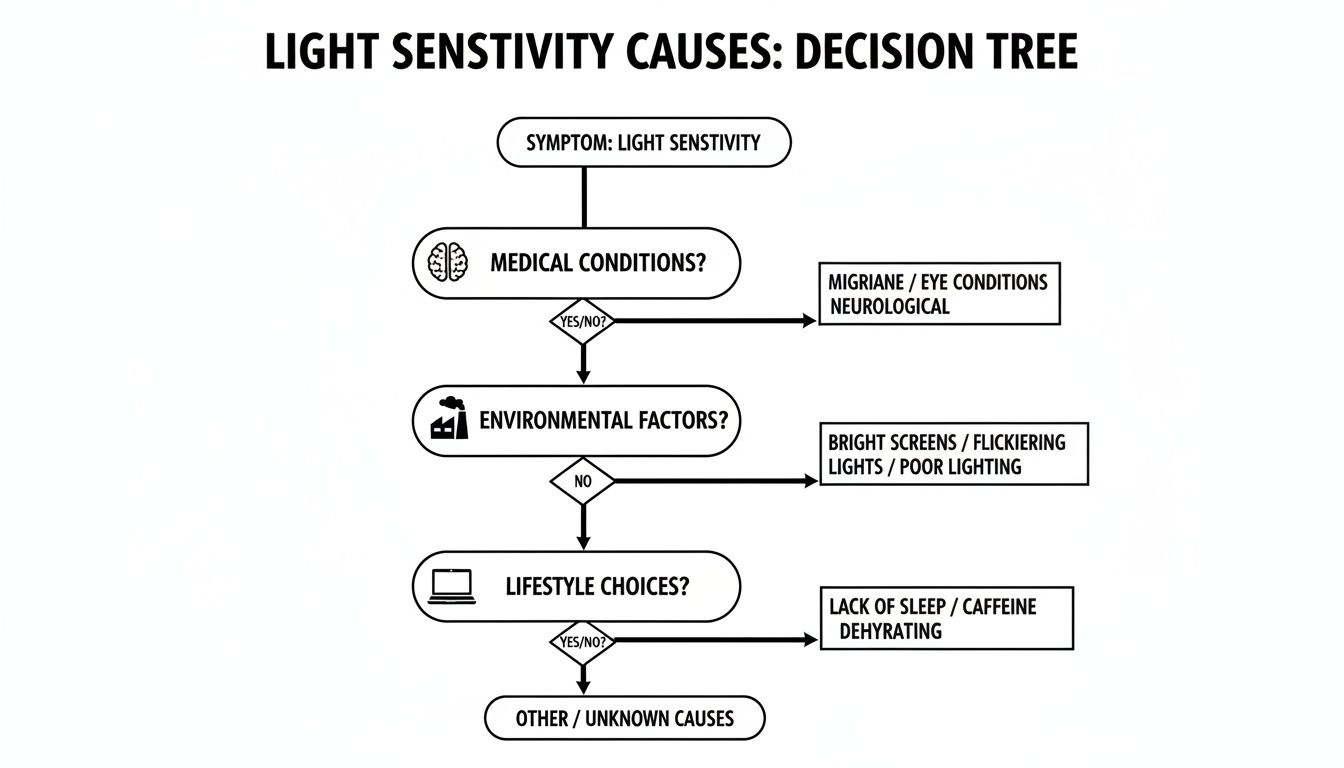
This chart highlights how medical conditions, your environment, and even lifestyle choices can all contribute to discomfort from light, showing why a one-size-fits-all solution rarely works. Each of these lens technologies offers a unique advantage, and sometimes the best approach is to combine them. You might have polarised prescription sunnies for the car and a separate pair of blue light glasses for the office.
Whatever your situation, we can customise an eyewear package to suit your requirements.
Finding the Right Fit for Your Daily Grind
Let's be clear: the "best" glasses for light sensitivity aren't a one-size-fits-all solution you can just grab off a shelf. The perfect pair is a personalised tool, designed to slot right into your daily routine and tackle the specific light challenges you face day in and day out.
Your job, your hobbies, even your commute—they all create a unique visual environment. Your eyewear needs to be equipped to handle all of it. Choosing the right mix of lenses and coatings is all about matching the technology to your lifestyle. This way, your eyes get the right protection at the right time, keeping you comfortable and safe.
Let’s break down what this looks like for different people.
For the Office Professional
Picture an accountant staring at a monitor for eight hours straight, all under the harsh, flickering glare of office fluorescent lights. Their eyes are fighting a two-front war: the sharp overhead lighting and the constant stream of high-energy blue light from the screen.
This kind of dual assault is a classic recipe for digital eye strain, headaches, and some serious light sensitivity.
- Our Go-To Solution: A combination of blue light filtering lenses and an anti-reflective (AR) coating.
- Why It Works: The blue light filter gets straight to the source, cutting down the high-energy wavelengths from the screen that cause eye fatigue. Meanwhile, the AR coating takes care of the annoying glare bouncing off your lenses from the overhead lights. Together, they create a much more comfortable and productive visual world.
For office workers, this is about more than just comfort; it's about protecting your long-term eye health. Easing that constant strain can prevent chronic issues and help you stay focused through a demanding workday. You can dive deeper into finding the right glasses for computer eye strain in our dedicated guide.
For the Outdoor Enthusiast
Now, think about a landscape gardener or a weekend hiker who spends most of their time under the full force of the Australian sun. Their biggest challenges are the blinding glare reflecting off water or pavement and the non-stop exposure to harmful ultraviolet (UV) radiation.
These aren't just minor annoyances that make you squint; they pose a real, long-term risk to your eye health.
- Our Go-To Solution: Polarised sunglasses with 100% UV protection.
- Why It Works: UV protection is absolutely non-negotiable for shielding your eyes from damage that can lead to cataracts or macular degeneration. But the real game-changer for immediate comfort and safety is polarisation. Polarised lenses act like a smart filter, blocking the intense horizontal light waves that create that blinding glare. The result is vision that’s clearer, safer, and far more comfortable.
For the University Student
Finally, imagine a uni student whose day is a blur of different environments. They’re running from a dim lecture hall to a brightly lit library, then grabbing lunch outside in the sun before settling in for an evening of studying on their laptop.
All this constant shifting between light conditions forces their eyes to work overtime, trying to adapt again and again.
- Our Go-To Solution: Photochromic lenses, possibly with a blue light filter and AR coating added on.
- Why It Works: Photochromic lenses are the ultimate all-in-one solution. They darken automatically in sunlight and clear up indoors, seamlessly adapting to whatever environment you’re in. Adding a blue light filter tackles the hours of screen time, making this an incredibly versatile setup for a dynamic lifestyle.
These practical, real-world examples show that the most effective eyewear is never a generic fix. By looking at how you live your life, we can customise an eyewear package to suit your requirements, ensuring you get the precise protection you need to see clearly and comfortably.
Protecting Children From Light Sensitivity
A child's eyes aren't just scaled-down versions of our own. They’re still developing, which makes them incredibly vulnerable to bright light and UV radiation. Their pupils are naturally larger and the lens inside their eye is crystal clear, meaning more harmful light can get straight through to the delicate retina at the back. This makes eye health and safety a massive priority for parents.
From the harsh glare at the local park to the focused light from a tablet during schoolwork, kids today are surrounded by intense light. Protecting their vision early on is one of the most important things we can do to set them up for a lifetime of healthy sight.
Sun Safety for Young Eyes
We all know outdoor play is vital for a child's development, but it also means a lot of time under the sun, exposed to UV rays. This is a big deal in Australia, where the sun’s intensity is no joke.
In fact, research shows that Aussie kids in sunny Brisbane get far more outdoor light exposure than their peers in other parts of the world—averaging around 105 minutes every day. This constant exposure in a high-UV environment seriously ramps up the risks. According to the 2020 Vision Index, while 47% of parents noticed signs of light sensitivity in their kids, a shockingly low 13% actually bought them sunglasses with UV protection. You can dive deeper into the Australian eye health statistics to see the full picture.
Practical Tip: For kids, high-quality sunglasses are not a fashion accessory—they’re a non-negotiable health measure. It's just like putting sunscreen on their skin; a pair of sunnies with 100% UV protection is essential for shielding their developing eyes.
Screen Time and Digital Learning
On top of sunlight, kids are spending more time than ever staring at screens for school, games, and everything in between. This long-term exposure to the high-energy blue light blasting from tablets and laptops can lead straight to digital eye strain, fatigue, and worsening light sensitivity.
Here are a few practical tips for parents:
- Get Them Blue Light Glasses: These are designed specifically for screen use and can make a real difference in reducing discomfort during long homework sessions or online classes.
- Encourage Regular Breaks: Teach your kids the 20-20-20 rule. It's simple: every 20 minutes, they need to look away from their screen at something 20 feet away for at least 20 seconds. This is a simple but powerful habit for long-term eye health.
Choosing Kid-Friendly Frames
Let's be honest, getting a child to consistently wear their glasses can feel like a battle. The secret? Choose frames that are both durable and comfortable, so they’ll actually want to keep them on.
Look for frames made from flexible, lightweight materials that can survive the rough and tumble of the playground. A great tip is to involve your child in picking out the style and colour they love. This can completely change their perspective, turning their glasses from a chore into a cool accessory they're proud of.
At Prescript Glasses, we get it. We can customise an eyewear package to suit your requirements, matching tough, kid-friendly frames with the right protective lenses to keep your child's precious vision safe for years to come.
When to See an Optometrist for Your Symptoms
While the right glasses for light sensitivity can bring fantastic relief from daily discomfort, it's important to remember they're a tool for managing the problem, not a cure for an underlying issue. Knowing when your symptoms are pointing to something that needs a professional eye is key to looking after your long-term eye health and safety.
Think of it like this: if a warning light flashes on your car's dashboard, you don't just stick a piece of tape over it. You get a mechanic to look under the bonnet. In the same way, certain eye symptoms are red flags that need an expert opinion to rule out anything more serious.
Key Signs It’s Time for a Check-Up
Don't put off getting professional advice if you experience any of the following. These symptoms could point to an infection, inflammation, or another medical condition that needs a proper diagnosis and treatment to protect your vision.
- Sudden Onset or Worsening: Your light sensitivity appears out of nowhere or gets much worse in a short amount of time.
- Pain or Headaches: The photophobia comes with sharp eye pain, a constant ache, or severe headaches.
- Vision Changes: You also notice your vision getting blurry, you're seeing halos around lights, or you have a sudden increase in floaters or flashes.
- Daily Disruption: The sensitivity is so bad it’s getting in the way of your ability to work, drive, or just go about your day.
An eye exam is so much more than a simple vision test. It’s a full health check for your eyes, allowing an optometrist to spot potential problems before they become serious. This proactive approach is fundamental to eye safety.
What to Expect During Your Appointment
An eye exam is a completely straightforward and painless process. Your optometrist will likely start by asking about your symptoms, your lifestyle, and your general health to build a complete picture. Be ready to chat about when your light sensitivity started and what situations seem to trigger it.
They’ll run a few simple tests to check your vision and examine the different structures of your eye. This helps them identify potential causes like dry eye disease, inflammation, or even neurological factors. Getting a proper diagnosis is the only way to make sure you get the most effective treatment. You can learn more about what happens during a professional eye check-up to feel fully prepared.
Remember, even the best glasses are just one part of a bigger eye care strategy. We can customise an eyewear package to suit your requirements, but this should always be used to complement professional medical advice, never to replace it.
Your Questions About Light Sensitivity Glasses, Answered
Jumping into the world of specialised eyewear can feel a bit overwhelming, and it’s natural to have questions. To help you out, we’ve answered some of the most common queries we get about glasses for light sensitivity. Think of this as a straightforward guide to help you feel confident about your next pair.
Everyone's experience with photophobia is different, which is why understanding what each lens technology actually does is so important for finding the right fit for you.
Can Light Sensitive Lenses Be Added to My Prescription Glasses?
Yes, they absolutely can. All the clever lens technologies we’ve talked about—like blue light filters, photochromic tints, and anti-reflective coatings—are designed to work seamlessly with your prescription.
Whether you need single vision, bifocal, or progressive lenses, we can build a pair that combines your exact vision correction with the right protection against light sensitivity. You shouldn’t have to choose between seeing clearly and feeling comfortable.
This is really the heart of modern eyewear. It’s all about creating a single, perfect pair of glasses that does everything you need it to—blending precise vision correction with targeted light filtering for total eye comfort and health.
Are More Expensive Glasses Always Better?
It's a fair question. Generally, a higher price tag reflects the quality of the lens materials and the sophistication of the coatings. Premium lenses tend to offer superior optical clarity, last longer, and provide more precise light filtering. For instance, a top-tier anti-reflective coating will cut out far more distracting glare than a standard one.
However, the "best" glasses for you are the ones that solve your specific light sensitivity issues. Sometimes, a simple, well-made solution is all it takes. Our goal is to offer options that provide real, tangible value for your eye health, no matter your budget.
Will I Need to Wear These Special Glasses All the Time?
Not necessarily. It's all about using them as a tool when you need them most. You might find you only pop on your blue light glasses when you’re at your desk or save your polarised sunnies for really bright days. The key is targeted use.
Practical Example: A graphic designer might only wear their blue light filtering glasses while deep in a project on their monitor but switch to their regular specs for meetings. On the flip side, someone with photochromic lenses will wear them all day, since the lenses do all the work, adapting automatically to different light. Your optometrist can give you personalised advice based on what’s causing your light sensitivity and how severe it is.
At Prescript Glasses, we know that no two pairs of eyes are the same. We can customise an eyewear package to suit your requirements, making sure you get the perfect blend of frames, prescription, and protective lens tech.
Explore our options and start your journey to clearer, more comfortable vision today at https://www.prescriptglasses.com.