Types of Lenses for Glasses: Find Your Perfect Match

Choosing the right types of lenses for glasses can feel a bit overwhelming at first, but it really just boils down to matching your specific vision needs with the right lens technology. From simple single-vision lenses that fix one field of vision to advanced multifocals that let you see clearly at any distance, your choice has a huge impact on your daily comfort and eye health. Getting your head around these core options is the first step toward getting that perfect clarity.
Your Quick Guide to Choosing the Right Lenses
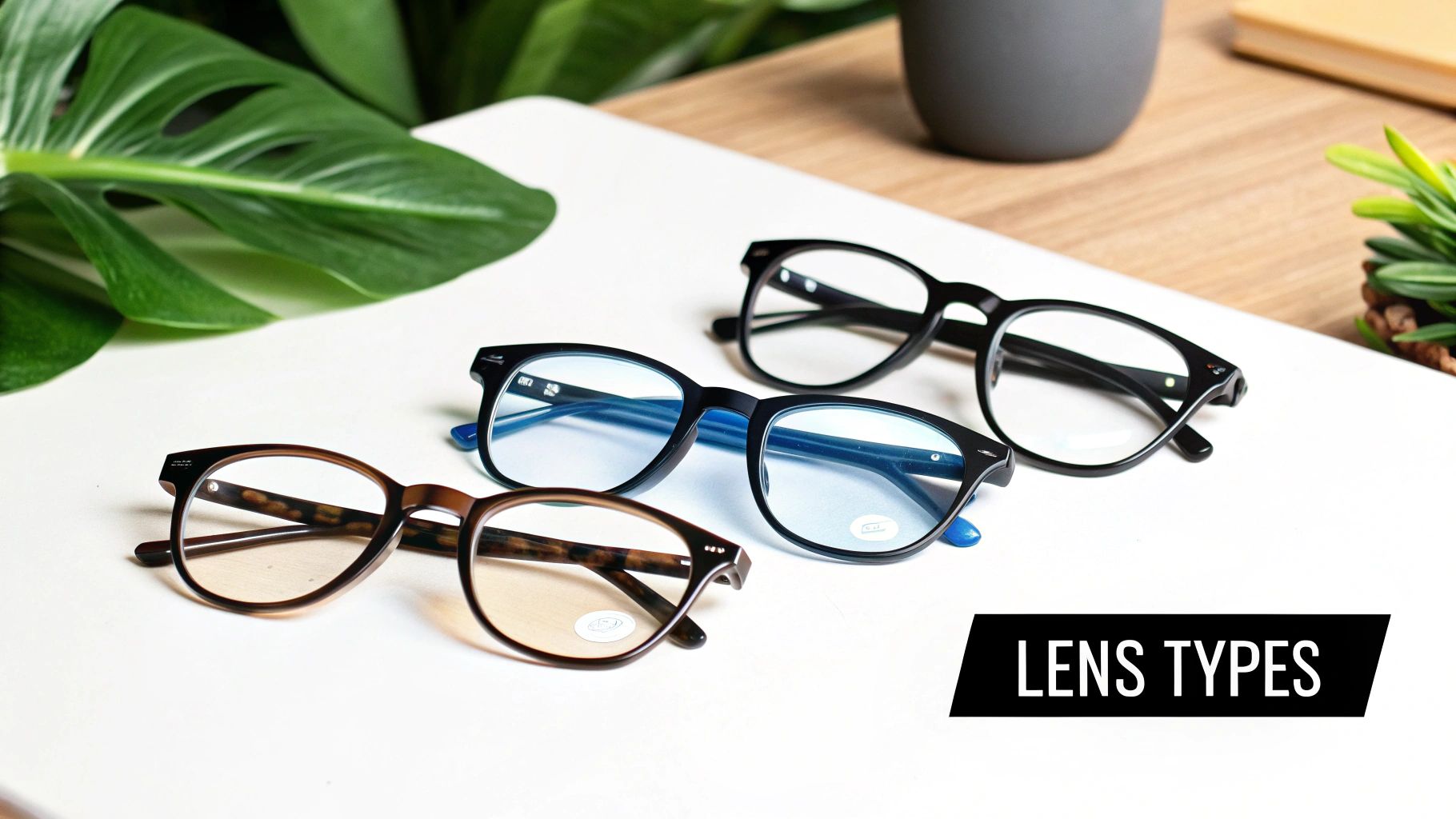
Let's cut through the jargon. Think of this guide as your personal map to navigating the world of eyeglass lenses. It's all about giving you the confidence to understand the main categories, because each lens type is built for a unique purpose, tailored to different lifestyles and visual demands.
The journey always starts with your prescription. This is what determines whether you need a lens for just one distance or for several.
-
Single-Vision Lenses: These are the most common and straightforward of the lot. They have one corrective power across the entire lens, designed to fix a single vision issue like nearsightedness or farsightedness. For example, a student might need single-vision lenses just to see the whiteboard clearly from the back of the class, or a librarian might use them for reading books up close.
-
Multifocal Lenses (Bifocal/Progressive): These are for anyone who needs a hand seeing at more than one distance. Imagine a graphic designer who needs to switch focus seamlessly from their detailed screen work up close to their colleagues across the room. Progressive lenses let them do that without ever having to swap glasses, protecting against unnecessary eye strain.
Specialised Lenses for Modern Life
But it doesn't stop at basic correction. Modern lenses come packed with features that can seriously enhance your vision and protect your eyes from the strains of everyday life. These options are built to handle the demands of our daily routines, from long hours staring at screens to just enjoying a sunny day outdoors. Focusing on eye health and safety means thinking about lenses that do more than just make things clear.
For instance, you can get specialised lenses that filter out that harsh blue light from digital devices, or lenses that automatically tint when you step outside, giving you UV protection and sunglasses all in one.
Choosing the right lens isn't just about seeing clearly; it's about seeing comfortably and safely in every environment you find yourself in. Your lenses should work just as hard as you do, protecting your eyes all day long.
This quick overview should help simplify your decision. Once you identify which of these categories best fits your daily routine, you can start narrowing down the options. We believe in creating a solution that's just for you, and because we can customise an eyewear package to suit your requirements, getting a handle on these basics is the perfect place to start.
Understanding the Foundation of Lens Materials
Before you pick a lens coating or style, it’s worth getting to know what your lenses are actually made of. The material is the very foundation of your glasses, shaping everything from how clearly you see to how heavy the frames feel on your nose after a long day. It's a choice that directly affects durability, visual clarity, and most importantly, your eye safety.
Think of it like choosing fabric for your clothes. A standard cotton shirt is great for everyday wear, but you'd want something tougher and more flexible for hiking. Lens materials work the same way; each one has its own unique strengths designed for different lifestyles and needs.
Standard Plastic CR-39 Lenses
The classic workhorse of the eyewear world is the CR-39 plastic lens. For decades, this has been the go-to material, offering fantastic optical quality at a great price. It's an excellent choice for anyone with a mild to moderate prescription who needs a reliable, cost-effective solution. A practical example would be someone getting their first pair of reading glasses, where advanced features aren't a priority.
The only real downside is its thickness. As prescriptions get stronger, CR-39 lenses have to get thicker and heavier, which isn't always comfortable or stylish.
Polycarbonate Lenses for Superior Safety
This is where putting eye health and safety first really comes into play. Polycarbonate lenses are a massive step up in toughness. They are far more impact-resistant than standard plastic, which makes them the only real choice for children's glasses, safety eyewear, or anyone who lives an active life.
Eye safety should never be an afterthought. Polycarbonate's remarkable toughness provides peace of mind, protecting your eyes from unexpected impacts during sports or daily activities.
A practical example? A tradie on a worksite or a kid kicking a footy around the school oval. In those moments, the shatter-resistant nature of polycarbonate isn't just a nice feature; it's vital protection. On top of that, these lenses are naturally thinner and lighter than CR-39, making for a more comfortable fit.
High-Index Lenses for Stronger Prescriptions
If you have a stronger prescription, high-index lenses are a complete game-changer. Imagine making a super-concentrated cordial; you use less water to get the same punch of flavour. High-index lenses work on a similar principle: they bend light more efficiently, so you need less material to do the job.
The result is lenses that are dramatically thinner and lighter than their standard plastic or polycarbonate counterparts.
- Goodbye 'Coke-Bottle' Look: They eliminate that thick, magnified edge that often comes with strong prescriptions.
- Enhanced Comfort: The lighter weight means less pressure on your nose and ears, perfect for wearing your glasses all day.
- Wider Frame Compatibility: Their slim profile means you aren't limited in your choice of frames and can go for more minimalist styles.
These premium materials are a big reason why spectacle lenses are the leading revenue contributor to Australia's eyewear market, a market projected to hit around USD $2.89–3.59 billion by 2025. As more people discover the aesthetic and comfort benefits, high-index materials are playing a huge role in that growth. You can dive deeper into these market trends and their impact on Australian eyewear choices.
Ultimately, knowing a bit about these materials helps you have a better conversation about what you really need. By thinking about your prescription, lifestyle, and safety priorities, you can choose a foundation that perfectly supports your vision. As we always say, we can customise an eyewear package to suit your requirements, and that all starts with picking the right material for you.
Finding Your Focus with Core Lens Types
Once you’ve settled on the right material for your lenses, it's time to get down to the real business: matching the lens technology to how you actually see the world. This is where we go from the lens foundation to its functional design, picking the core lens type that gives you the precise vision correction you need.
For many people, the most common and straightforward solution is the single-vision lens. This design is beautifully simple—it has one corrective power across the entire lens, designed to tackle one specific field of vision.
Single-Vision Lenses for Pinpoint Clarity
A single-vision lens is a specialist. It’s designed to do one job, and it does that job exceptionally well. Whether you’re correcting for nearsightedness (myopia), farsightedness (hyperopia), or astigmatism, a single-vision lens provides crisp, clear vision at a specific, set distance.
Think of a university student who needs to see the lecturer and presentation slides clearly from halfway back in a large hall. Their single-vision lenses for distance will make everything perfectly sharp. On the flip side, an avid reader might only need single-vision lenses for close-up tasks, making the words on a page pop with clarity. To get a better handle on how these foundational lenses work, you can check out our detailed guide on what are single vision lenses.
Bifocal Lenses: A Classic Two-in-One Solution
For anyone who finds themselves needing a hand with both near and distant vision, bifocal lenses offer a direct, no-fuss fix. These lenses are pretty easy to spot—they have a distinct, visible line that separates two different prescription powers on the lens.
The top, larger part of the lens is for distance vision, while the smaller segment at the bottom holds the power you need for reading or other close-up work. A practical example is a tailor who needs to see their stitching up close but also look up to speak with customers across the shop. They’re undeniably effective, but that visible line and the abrupt "jump" between focus points can feel a bit jarring for some people.
The core purpose of any lens is to provide clear, comfortable vision that supports your daily activities. Whether you need a simple fix for one distance or a dynamic solution for many, the right lens type makes all the difference for your eye health.
Progressive Lenses for Seamless Vision
This brings us to the modern powerhouse of multifocal correction: progressive lenses. Unlike their bifocal predecessors, progressives have absolutely no visible lines. Instead, they feature a smooth, gradual transition of focusing power from the top of the lens to the bottom, giving you clear vision at pretty much any distance.
Imagine it as a smooth ramp instead of a sharp set of stairs. The top section is for distance, the middle part handles intermediate vision (like looking at your computer screen), and the bottom is dialled in for near vision (like reading your phone). This creates a much more natural and continuous visual experience.
A practical example is a chef. They need to read a recipe up close, chop ingredients on a bench at an intermediate distance, and then glance up to see orders across the kitchen. Progressive lenses let them do all of this effortlessly, without ever needing to switch glasses or awkwardly tilt their head. It’s this seamless functionality that has made them so incredibly popular.
Progressive lenses have seen a steady rise in use across Australia, particularly as the population ages and the need for presbyopia correction grows. With the proportion of Australians aged 65 and over increasing from around 13.5% in 2005 to an estimated 17.8% by 2025, it’s no surprise more people need this kind of advanced multifocal solution. This trend is a major reason why lenses are the single largest revenue segment in the Australian spectacles market.
Ultimately, choosing between these core lens types comes down to your daily life and what your eyes need to do. Whether you prefer the simplicity of single-vision or the fluid versatility of progressives, we can customise an eyewear package to suit your requirements, ensuring your lenses give you the exact focus you need to navigate your world with confidence.
Enhancing Your Lenses with Protective Coatings
Think of your basic lenses as the engine of a high-performance car. They do all the heavy lifting for your vision, but it's the special coatings that really fine-tune the experience. These treatments aren't just flashy extras; they're essential upgrades that boost clarity, improve durability, and protect your long-term eye health and safety.
These coatings are microscopic layers applied directly to the lens surface, with each one designed to solve a specific, common problem. From annoying reflections that cause eye strain to the inevitable risk of scratches, the right set of coatings can make a world of difference to how you see and how long your glasses last.
Say Goodbye to Glare with Anti-Reflective Coating
One of the most valuable upgrades you can get is an anti-reflective (AR) coating. This clever treatment works by stopping the reflections that bounce off both the front and back of your lenses. Without it, you’re left dealing with distracting glare from computer screens, bright overhead lights, and even oncoming headlights when you're driving at night.
All that glare forces your eyes to work harder just to focus, which often leads to fatigue, headaches, and general eye strain. An AR coating allows much more light to pass straight through the lens to your eye, giving you sharper, clearer, and far more comfortable vision.
A perfect practical example is anyone who spends hours on video calls or has to drive frequently after dark. For them, an anti-reflective coating isn't just nice to have—it's a non-negotiable for both comfort and safety.
Defend Your Lenses with a Scratch-Resistant Coating
Let's face it, daily life is tough on glasses. Tossing them in a bag, an accidental drop, or even just cleaning them with the wrong corner of your shirt can lead to tiny scratches that build up over time. A scratch-resistant coating is a tough, protective film that acts as a shield against all this everyday wear and tear.
While no lens is ever completely scratch-proof, this durable layer significantly extends the life of your glasses, keeping your vision clear and unobstructed. It’s a fundamental treatment that protects your investment. This is especially vital for kids' glasses or for anyone who works in a dusty environment, like a carpenter or builder.
Protecting your lenses from damage is a key part of maintaining your eye health. Scratches can create visual distortions that force your eyes to strain, undermining the very purpose of your prescription.
Shield Your Eyes with Full UV Protection
We all know to put on sunscreen to protect our skin, but our eyes are just as vulnerable to harmful ultraviolet (UV) rays. Long-term exposure to UV radiation can increase the risk of serious eye conditions down the road. A UV protection coating acts like sunscreen for your eyes, blocking 100% of harmful UVA and UVB rays.
Many modern lens materials like polycarbonate already have this protection built-in, but it can also be applied as a clear coating to standard plastic lenses. This is a crucial feature for every single pair of glasses you own, not just sunglasses. It ensures your eyes are shielded every time you step outside, rain or shine, making it a cornerstone of good eye health and safety.
Keep Things Clear with a Hydrophobic Coating
Finally, a hydrophobic coating is one of those simple things designed to make your life that much easier. This treatment creates an incredibly smooth surface that repels water, oil, and smudges. Raindrops simply bead up and roll right off, and annoying fingerprints from accidental touches are much easier to wipe clean.
- Repels Water: Keeps your vision clear when you get caught in the rain or walk into a steamy room.
- Resists Smudges: Fights off grease and fingerprints, which means you spend a lot less time cleaning your glasses.
- Easier Maintenance: Makes cleaning your lenses faster and more effective when you do need to give them a wipe.
These coatings are just a few of the ways you can improve your eyewear. And for those spending long hours in front of screens, understanding how specific lens features can help is key. You can discover more about specialised options in our detailed guide on blue light filters. At the end of the day, we can customise an eyewear package to suit your requirements, combining the perfect coatings to match your lifestyle.
Choosing Specialised Lenses for Your Lifestyle
Getting the right core lenses and materials is the foundation, but it's the specialised lens types that truly tailor your glasses to your life. The modern world is a mix of digital screens and constantly shifting between indoors and outdoors. This means your lenses need to do more than just correct your vision—they need to protect, adapt, and make life easier.
Ultimately, this is about eye health and safety. It’s about picking lenses that actively cut down on strain and shield you from the elements. Whether you're chained to a desk, studying late, or love being outside, there's a specialised lens that will make your world clearer and more comfortable.
Blue Light Filtering Lenses for the Digital Age
If you spend hours staring at a computer, tablet, or smartphone, you’re getting a constant dose of high-energy visible (HEV) blue light. This is a well-known cause of digital eye strain, which often shows up as dry eyes, nagging headaches, and blurry vision.
Blue light filtering lenses are designed to specifically block a portion of this blue light before it hits your eyes. Think of them as a protective shield that softens the harshness of screen glare, making those long sessions much more bearable.
- Practical Example: A uni student pulling an all-nighter to finish an essay on their laptop is a perfect candidate. These lenses can help dial down the eye fatigue that inevitably creeps in, making it easier to stay focused and comfortable.
Photochromic Lenses for Seamless Adaptation
For anyone who’s constantly moving between the office and the sunny outdoors, switching between regular glasses and sunnies is a real pain. Photochromic lenses, which you might know by the brand name Transitions, offer a smart, all-in-one fix.
These lenses are packed with special molecules that react to UV radiation. When you're inside, they're completely clear. The second you step into the sun, they darken automatically, giving you full UV protection and a comfortable sunglass tint. A practical example is a real estate agent who is constantly going from indoor viewings to outdoor property tours. If you're curious about the tech behind it, you can dive deeper in our guide on what are transition lenses.
By automatically adjusting to light conditions, photochromic lenses provide continuous protection for your eyes, ensuring both comfort and safety without you ever having to think about it.
This flowchart can help you figure out which lens treatments are most important for you, whether you’re battling glare, worried about scratches, or spend a lot of time outside.
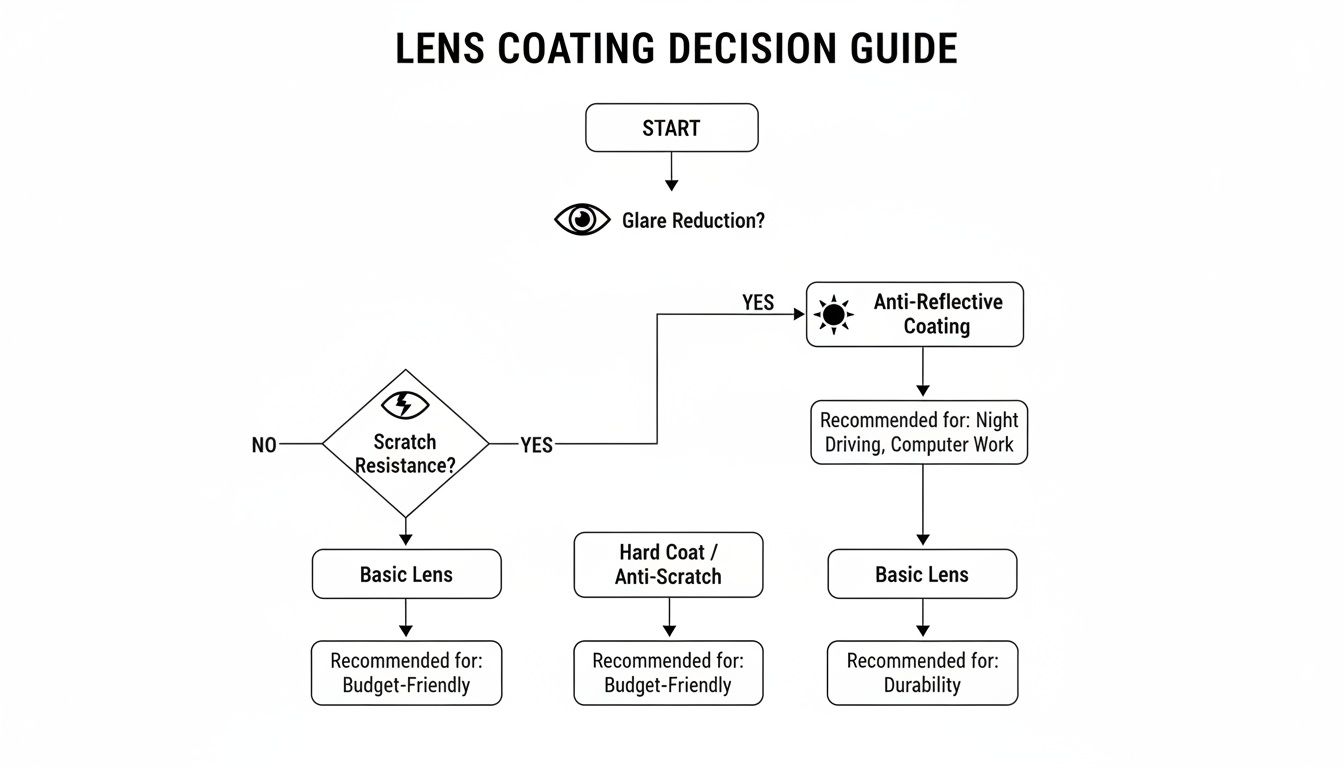
As you can see, your daily routine and biggest visual frustrations point you directly to the best lens treatments for your lifestyle.
To make things even clearer, here’s a quick comparison of the specialised lens treatments we offer. This should help you pinpoint exactly which option is the best fit for your daily life and visual needs.
Choosing Your Specialised Lens
| Lens Type | Best For | Key Benefit | Primary Environment |
|---|---|---|---|
| BlueRay Lenses | Gamers, office workers, students | Reduces digital eye strain and fatigue | Indoors, in front of digital screens |
| Photochromic Lenses | People who move between indoors and outdoors frequently | Automatically adapts from clear to dark in sunlight | Both indoors and outdoors |
| Polarised Sunglass Lenses | Drivers, fishermen, skiers, beachgoers | Eliminates blinding glare from reflective surfaces | Outdoors, especially in bright sun or near water |
| Bluecromic Lenses | Heavy screen users who are also often outdoors | Combines blue light filtering with photochromic technology | All environments (indoors, outdoors, screen use) |
Each of these lenses solves a specific problem. By matching the key benefit to your primary environment, you can build the perfect pair of glasses that work just as hard as you do.
Dedicated Sunglass Lenses for Peak Performance
While photochromic lenses are incredibly convenient, sometimes you just need a dedicated pair of sunglasses, especially for certain outdoor activities. This is where polarised lenses really come into their own.
Polarised lenses are engineered to do one job and do it exceptionally well: kill blinding glare. They have a special filter that blocks the intense, horizontal light that bounces off flat surfaces like water, wet roads, and snow.
- Practical Example: A fisherman with polarised sunglasses can see right through the water's surface to spot fish, which would be totally invisible with normal sunnies because of the glare. In the same way, a driver's journey is safer and more relaxing because the blinding reflections off a wet road are completely gone.
Picking the right specialised lens all comes down to looking at your daily routine. Once you know your main activities and where you spend your time, you can choose a lens that doesn't just correct your vision but actively improves your lifestyle. And because we can customise an eyewear package to suit your requirements, you can mix and match these options with the right coatings and materials to create glasses that are perfectly you.
Alright, you've got the lowdown on the different types of lenses available. Now for the fun part: putting it all together to create your perfect pair of glasses. This is where we get personal and figure out exactly what you need. It’s actually much simpler than it sounds, and it all starts with a quick look at your everyday life.
The whole point is to go beyond just correcting your vision. We want to build a pair of glasses that genuinely makes your day more comfortable while protecting your eyes for the long haul. Once you know what your daily grind looks like, picking the right features becomes second nature.
Start with a Quick Lifestyle Check
First things first, what does a typical day look like for you? A few honest answers here will point you straight to the lens tech that’ll make the biggest difference.
- Professional driver or cyclist? You know the struggle. Glare from wet roads and oncoming headlights isn’t just annoying; it’s a safety hazard. An anti-reflective coating and a solid pair of polarised sunglasses are non-negotiable.
- Enjoying your retirement in the garden or outdoors? You need something that can keep up with you moving in and out of the sun. Photochromic lenses with full UV protection are the ultimate convenience. No more swapping glasses.
- Student juggling textbooks and a laptop? That’s a double whammy of eye strain—focusing fatigue from reading and digital strain from the screen. A combination of progressive lenses and a blue light filter could be a game-changer for you.
Seriously, don’t skip this step. This little self-assessment ensures you’re not just buying features, but solving real-world problems you face every single day.
Layering Your Choices into the Perfect Package
Once you've pinpointed your main challenges, building your custom package is easy. Think of it as layering different technologies to create the one perfect pair of glasses designed just for you.
We can customise an eyewear package to suit your requirements. This isn't just a marketing line for us. It’s a promise that your glasses will do exactly what you need them to do for clear vision, comfort, and total eye protection.
Let’s take a graphic designer, for instance. With a strong prescription, they’d likely start with a lightweight, high-index material so their glasses don't feel heavy. Next, they'd opt for progressive lenses to handle the constant refocusing between their screen, their sketchbook, and their colleagues across the room. Finally, they'd add an anti-reflective coating to kill screen glare and a blue light filter to reduce digital eye strain. Just like that, they’ve built a complete solution that supports both their career and their eye health and safety.
By following these simple steps, you can go from feeling swamped by options to feeling totally in control. You now have everything you need to build a pair of glasses that doesn't just help you see better but is tailor-made for the life you actually live.
Got Questions About Your Lenses? We've Got Answers.
Choosing the right lenses for your glasses can feel a bit overwhelming with all the options out there. To help clear things up, we've put together answers to a few of the most common questions we get asked.
How Often Should I Get My Eyes Checked?
For most adults, a comprehensive eye exam every one to two years is the general rule of thumb. Think of it as a regular tune-up for your eyes. These check-ups are vital for maintaining great eye health and safety and making sure your prescription is spot-on for the sharpest vision possible.
Of course, if you have specific risk factors or conditions, your optometrist might recommend you pop in more often.
Are More Expensive Lenses Always Better?
Not at all. The "best" lens isn't about the price tag; it's about what suits your specific prescription and your day-to-day life. A standard lens might be absolutely perfect for someone with a mild prescription, while premium options can be a game-changer for those with stronger needs.
The key is to invest in features that actually solve your daily challenges. Focus on eye health and safety by choosing durable materials like polycarbonate, or add an anti-reflective coating if you do a lot of night driving.
What Is the Best Way to Clean My Lenses?
To keep your lenses and their coatings in top shape, start by rinsing them with lukewarm water to wash away any dust or grit. A tiny drop of lotion-free soap on each lens, a good rinse, and a gentle dry with a clean microfibre cloth is all you need.
Whatever you do, try to avoid using the corner of your shirt or a paper towel. Their fibres can create tiny scratches over time that dull your view and undermine your long-term eye health by causing unnecessary strain.
At Prescript Glasses, we can customise an eyewear package to suit your requirements. Just upload your prescription, and we’ll help you build the perfect pair of glasses. Explore all your options at https://www.prescriptglasses.com.