How to get the scratches out of glasses: A Practical DIY Guide

There's nothing quite like that sinking feeling when you spot the first scratch on a brand-new pair of glasses. It can completely ruin your day.
While you might be tempted to search for a quick DIY fix, the reality is that most "hacks" you'll find online risk causing permanent, irreversible damage. Before you do anything, you need to properly assess the scratch. In most cases, your safest bet is going to involve professional care, because when it comes to your vision, Eye Health and Safety must always be the top priority.
Why Scratched Glasses Are More Than Just an Annoyance
A perfect pair of glasses gives you a crystal-clear, sharp view of the world. The moment a scratch appears, that clarity is gone.
What starts as a tiny, distracting blur in the corner of your eye can quickly become a constant source of frustration. It can make reading a chore, driving feel unsafe, and interfere with even the simplest daily tasks. This isn't just about looks; it's a real issue for your visual performance and eye health.
Scratches can happen in an instant. A clumsy drop onto the pavement, a quick wipe with the hem of your t-shirt, or just tossing them unprotected into a bag can all leave lasting marks. Each tiny abrasion scatters the light passing through the lens instead of letting it focus cleanly, which often leads to:
- Blurriness and visual distortions
- Increased glare, which is especially noticeable from headlights when driving at night
- Headaches and eye strain as your eyes are forced to work harder to see clearly
Your Eye Health Always Comes First
Before you reach for the toothpaste or baking soda (please don't!), you have to adopt a safety-first mindset. Your vision is far too precious to risk on a questionable repair that could turn a small cosmetic issue into a serious problem.
A method that seems to buff a scratch out of a basic plastic lens could completely strip the anti-reflective or UV-protective coating off another pair. This would render the lens not only useless but potentially harmful to your eyes. For example, removing the UV coating exposes your eyes to harmful radiation, which is a significant Eye Health and Safety concern.
The most crucial step is to figure out what type of lens you have, what coatings are on it, and how bad the damage really is before you try any kind of repair. A deep gouge needs a totally different approach than a light surface scuff.
This is a really common problem. In Australia, scratches are one of the main reasons people end up needing to replace their lenses. This has a big impact on the Australian eyewear market, which generated around AUD 229 million in revenue in 2024, with damaged lenses driving a lot of those repeat purchases. You can explore more data about the Australian eyewear market and its trends.
We believe in making smart, informed decisions, which is why we also offer customisable eyewear packages built to suit your specific lifestyle and needs.
Assess the Damage Before You Do Anything
Before you jump into trying to fix those annoying scratches on your glasses, you need to play detective for a moment. Trust me, grabbing the first DIY solution you find online without knowing what you're working with is a recipe for disaster. It's the fastest way to turn a small scuff into a completely ruined pair of lenses.
First things first, what are your lenses made of? Are they plastic, high-index plastic, polycarbonate, or old-school glass? Your prescription paperwork should have this info, but if you can't find it, a simple tap test usually works. Gently tap a lens with your fingernail. Plastic and polycarbonate have a duller, softer sound, while glass will give you a sharper, higher-pitched "clink."
Next up are the coatings. Modern lenses are rarely just a simple piece of plastic or glass; they almost always have special coatings that are vital for clear, comfortable vision.
- Anti-reflective (AR) coating: Hold your glasses up to a light. See a faint green, blue, or purple sheen on the surface? That's a tell-tale sign of an AR coating.
- Blue light filtering: These lenses often have a subtle yellow or amber tint, which is easiest to spot when you look through them at a plain white background.
- Photochromic (Transitions): This one's easy. If your glasses darken automatically when you go outside, they have a photochromic coating.
Knowing the specific types of lenses for eyeglasses you have is non-negotiable. A method that might seem to work on a basic plastic lens could completely strip a delicate coating, wrecking your vision and wasting the money you spent on them.
To help you figure this out, here’s a quick guide to what you might be looking at.
Lens Material and Coating Identification Guide
Use this guide to identify your lens type and coatings before attempting any scratch repair.
| Lens Material or Coating | How to Identify It | DIY Scratch Repair Suitability |
|---|---|---|
| Glass | Heavier than plastic; makes a sharp "clink" sound when tapped. | Very Low. Extremely hard to polish without professional equipment; high risk of distortion. |
| Standard Plastic (CR-39) | Lightweight; makes a dull sound when tapped. Scratches more easily than glass. | Low. Only suitable for the most minor surface scuffs. Abrasives can easily create haze. |
| Polycarbonate | Very lightweight and impact-resistant. Often used in kids' and safety glasses. | Very Low. The material is soft and often has a hard coat that, if removed, makes it scratch even more. |
| High-Index Plastic | Thinner and lighter than standard plastic, especially for strong prescriptions. | Very Low. Almost always comes with multiple coatings (AR, scratch-resistant) that you will damage. |
| Anti-Reflective (AR) Coating | Faint green, blue, or purple reflection under light. Reduces glare. | None. Any abrasive will strip the coating, creating a splotchy, unusable lens. |
| Blue Light Filtering Coating | Slight yellow or amber tint, or a blue/purple surface reflection. | None. Similar to AR coatings, DIY methods will remove the filtering properties. |
| Photochromic (Transitions) | Lenses darken in UV light and lighten indoors. | None. The photochromic molecules are embedded in the lens. Polishing can damage this layer. |
As you can see, most modern lenses are not good candidates for at-home experiments.
Classify the Type of Scratch
Once you've identified your lens, it's time to get up close and personal with the damage. Hold your glasses towards a light source and very gently run your fingernail across the mark. This simple test tells you almost everything you need to know.
A superficial scuff, maybe from a quick wipe with a paper towel (we've all been there), might be something you can see but not feel. A minor scratch will create a tiny catch as your nail passes over it. But a deep gouge—say, from dropping your specs on concrete—will feel like a noticeable groove that your nail actually sinks into.
Key Takeaway: If you can easily feel the scratch with your fingernail, or if it sits directly in your main line of sight, it’s not something you should try to fix yourself. Attempting to buff it out will almost certainly warp the prescription in that area, which can lead to eye strain and headaches.
This entire diagnostic process is the crucial first step. It helps you decide whether to proceed with a cautious at-home attempt or to stop before you cause more harm.
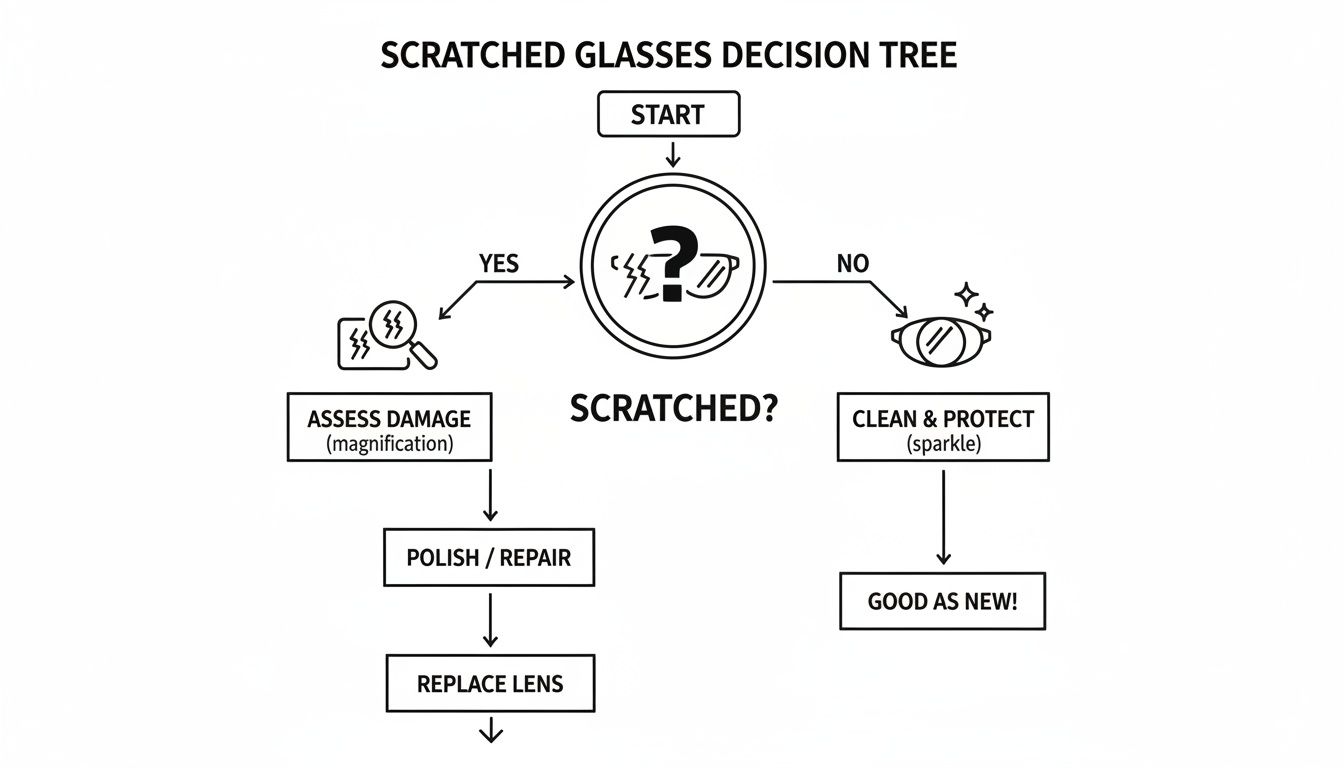
This flowchart really drives the point home: you have to identify the problem before you can choose the right solution. A careful assessment protects both your glasses and, more importantly, your eyesight. Every pair of glasses is different, which is why we can customize an eye wear package to suit your requirements, ensuring you get the best materials and coatings for your lifestyle right from the start.
Trying an At-Home Fix for Minor Scuffs? Read This First.
Before you reach for the baking soda or toothpaste, let's get one thing crystal clear: any DIY scratch repair is a last-ditch effort. Think of it as a gentle polish, not an aggressive scrub.
These methods should only ever be attempted on very minor, superficial scuffs and only on basic, uncoated plastic lenses. If your glasses have any kind of special coating—like anti-reflective, anti-scratch, or blue light filtering—stop right now. Trying these techniques will strip those coatings right off, causing permanent, cloudy damage that’s far worse than the original scratch.
We’re talking about that tiny, hairline mark near the edge of your lens that you can only see when the light hits it perfectly. That's the only kind of imperfection you should even consider tackling at home. The idea behind these fixes is to remove a microscopic layer of the lens material to level out the surface around the scratch. Because you're altering the lens, your Eye Health and Safety must come first.
The Baking Soda Paste Method
One of the most common at-home remedies you’ll see online is a simple paste made from baking soda and water. Baking soda can act as an incredibly fine, mild abrasive, which can sometimes be just enough to buff out the lightest surface marks without creating more haze.
If you decide to give it a go, here’s what you’ll need:
- Baking soda: Standard bicarb soda from your kitchen will do.
- Water: A few drops to form a paste.
- Two clean microfiber cloths: One for applying the paste and a separate one for the final clean.
First things first, clean your glasses properly. Use lukewarm water and a tiny drop of dish soap to get rid of any dust, oil, or debris. If you skip this, you’ll just be grinding dirt into the lens and making things worse.
Now, mix about one tablespoon of baking soda with just enough water to create a thick, smooth paste. You're aiming for a consistency that’s not runny or gritty. Dab a small amount onto the scratch with your clean cloth and, using your fingertip over the cloth, gently rub in a small, circular motion for 10 to 20 seconds. Be gentle. Then, rinse the lens thoroughly under cool water and dry it with your second clean, fresh microfiber cloth.
Important Takeaway: Gentleness is everything. Too much pressure or rubbing for too long can easily wear down the lens surface and distort your vision. Always start with the lightest touch possible.
Using Non-Abrasive Toothpaste
The logic here is similar to the baking soda method—using a mild polishing agent to smooth out a tiny imperfection. But the type of toothpaste you use is critical. It absolutely must be a plain, non-gel, non-whitening, and non-gritty white toothpaste. Anything with whitening agents, microbeads, or other abrasive particles will just cover your lens in thousands of new micro-scratches.
The process is pretty much the same as with the baking soda.
Imagine you have a barely-there scuff on your old pair of reading glasses. You’d take a pea-sized amount of basic white toothpaste on a cotton ball and gently buff the area in a circular motion for about 15 seconds. Sometimes, that tiny bit of polishing is just enough to make the scuff less obvious.
After buffing, rinse every last bit of toothpaste off the lens. Any residue left behind will create a cloudy film and mess with your vision. Dry with a fresh microfiber cloth. Always remember, these DIY tricks are a gamble and not guaranteed to work. The risk of making it worse is real, especially if you’ve misidentified your lens type.
If you find yourself constantly dealing with scratches, prevention is your best bet. We can customize an eye wear package to suit your requirements, including lenses with advanced scratch-resistant coatings that provide far more durability than standard, uncoated ones.
DIY 'Hacks' That Are Guaranteed to Ruin Your Glasses
Hop online for a quick search on fixing scratched glasses, and you'll be swamped with all sorts of tempting, quick-fix solutions. While these DIY "hacks" promise an easy, cheap repair, they almost always cause irreversible damage. A minor scuff can quickly become a major disaster.
Let's be clear: your vision isn't something to experiment with. Prioritising your Eye Health and Safety over a risky home remedy is always the right call.
These so-called fixes typically use abrasive or chemical compounds that are totally unsuitable for the delicate surfaces and advanced coatings on modern prescription lenses. Let’s break down the worst offenders and explain exactly why you need to steer clear.
The Problem With Abrasive Household Products
Many of the most popular "fixes" floating around online involve using abrasive household products. These things are designed for tough surfaces like metal, wood, or car paint—not precision optics. Applying them to your eyeglass lenses is a recipe for disaster.
Here are a few you should never, ever use:
- Metal or Brass Polish: These are literally designed to grind away layers of oxidation from hard surfaces. On a lens, this action will completely strip away your protective coatings and carve thousands of new micro-scratches into the surface. The result is a permanent hazy or cloudy mess.
- Car Wax: It might seem logical to fill in a scratch with wax, but this is a terrible idea. Car wax is packed with chemicals that can react badly with anti-reflective and UV coatings, causing them to bubble, peel, or become permanently clouded. Not to mention, it can cause some nasty skin irritation around your eyes.
- Glass Etching Cream: This is probably the most dangerous "hack" out there. Etching cream contains hydrofluoric acid, a potent chemical made to permanently dissolve glass. Using it on your lenses won’t just destroy them; it poses a serious risk of chemical burns to your skin and eyes.
Think of your prescription lenses as precisely crafted medical devices. Using harsh, unregulated chemicals on them can fundamentally alter their optical properties. This can lead to distorted vision, crippling eye strain, and headaches. The potential harm just isn’t worth it.
Why Everyday Cleaners Are a Bad Idea
Even cleaners that seem harmless can cause serious problems. That all-purpose cleaner that works wonders on your kitchen bench? It contains chemicals that are far too aggressive for the specialised coatings on your lenses.
Ammonia-based window cleaners, for example, are notorious for breaking down and stripping away anti-glare layers. You’ll be left with a splotchy, unusable lens that’s worse than when you started. A practical example of this is seeing a rainbow-like, oily film appear on your lenses after using Windex—that's the coating being destroyed.
Remember, the goal is to protect your investment and, more importantly, your vision. Scratched lenses are frustrating, but completely ruining them with a failed experiment is far worse. If you're dealing with damaged eyewear, talking to a professional is always the safest path forward.
And for your next pair? We can customize an eye wear package to suit your requirements, making sure you start with durable, high-quality lenses that have advanced protective coatings built right in.
When to See a Professional: Protecting Your Investment and Your Vision
We’ve all been there—that heart-sinking moment you notice a scratch on your glasses. While it’s tempting to grab the nearest household polish and try to buff it out, knowing when to stop and call in a professional is key to protecting your Eye Health and Safety.
Some scratches are just too much for any DIY remedy. Trying to fix them yourself can do more harm than good, potentially warping your prescription or stripping away expensive, protective coatings. Learning to spot the difference is the most important part of getting scratches out of your glasses safely.
Clear Signs a DIY Fix Is Off the Table
Certain types of damage are immediate red flags. If you notice any of these, it's time to put down the home remedies and book an appointment with your optician.
- Deep Scratches or Gouges: Can you feel the scratch with your fingernail? If so, it’s far too deep for a simple polishing paste. Trying to grind down a significant gouge will only wear away the surrounding lens material, creating a distorted "low spot" that can lead to headaches and serious eye strain.
- Damage in Your Direct Line of Sight: Any scratch, no matter how small, that sits right in your field of vision is a problem. Your brain will constantly try to compensate for the blur, causing fatigue and making it harder to see clearly.
- Visible Harm to Coatings: If you can see the anti-reflective, blue light, or UV coating peeling, bubbling, or flaking away, don't touch it. Any abrasive will just strip the coating further, leaving you with a splotchy, unusable lens that’s impossible to see through cleanly.
For scratches that are beyond a simple at-home fix, professional help is the only way to go. It's not unlike how you'd handle a badly damaged car window by calling in professional glass repair services instead of trying to fix a major crack yourself.
What Your Optician Can Do
When you take your glasses to a professional, they’ll assess the damage and walk you through the best options. While some specialised optical labs might offer polishing for very specific lens materials, it's not a common practice. The risk of altering the prescription's accuracy is just too high.
By far, the most common and safest solution for significant scratches is a complete lens replacement. This is the only way to guarantee your vision is crisp, your prescription is perfect, and all those important protective coatings are fully intact.
Let's say you dropped your progressive lenses on the pavement, and now there’s a deep gouge right in the middle. A home repair is completely out of the question. Your optician will recommend a new set of lenses to restore your vision properly. This is also a great time to check on your anti-scratch warranty, as many policies cover this kind of accidental damage within a certain timeframe. You can learn more about what's involved in our guide to replacing lenses in glasses.
Here in Australia, we've seen a clear shift in how people approach lens care. Retailers have reported a boom in sales of protective coatings and accessories as more of us realise the importance of looking after our eyewear. In fact, industry reports show that the sports and protective eyewear market was the largest segment in 2024 Australian studies, largely because manufacturers are meeting consumer demand for more durable, scratch-resistant technologies.
At Prescript Glasses, we can customize an eye wear package to suit your requirements, including fitting your frames with advanced scratch-resistant coatings to give you peace of mind from day one.
Preventing Scratches: The Best Long-Term Solution
After looking at ways to fix existing damage, it becomes pretty clear that the best strategy is to stop scratches from happening in the first place. Think of a proactive care routine as a long-term investment in your vision. It not only protects your lenses but also safeguards your Eye Health and Safety.
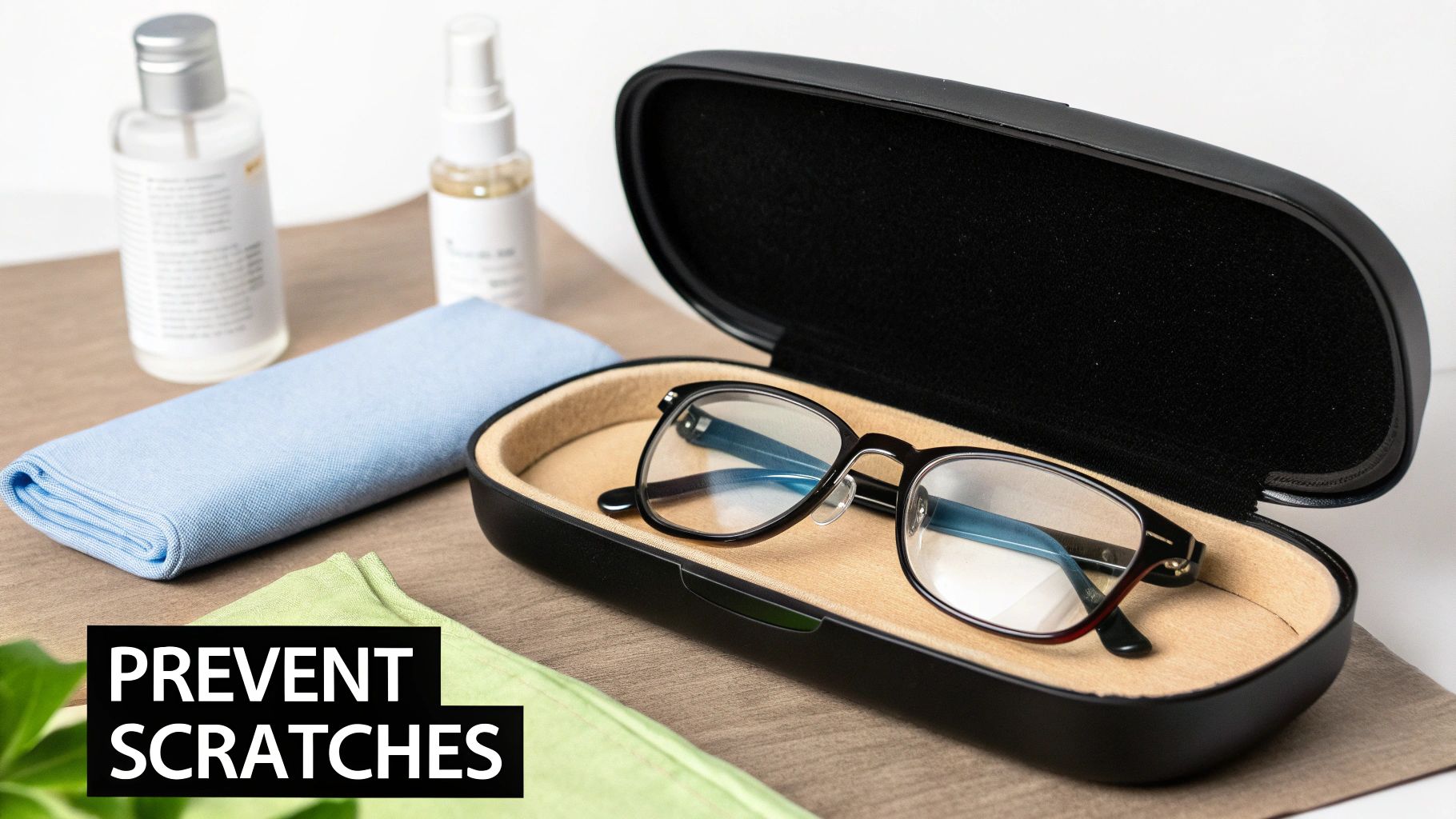
The single most effective habit you can build is proper cleaning. It’s so tempting to just grab your shirt hem or a paper towel for a quick wipe, but these materials are surprisingly abrasive. Their fibres trap tiny particles of dust and grit, essentially turning them into fine sandpaper that grinds micro-scratches into your lens coatings with every wipe.
Adopt a Smart Daily Care Routine
The only things that should touch your lenses are a dedicated lens spray and a clean, high-quality microfiber cloth. These cloths are specifically designed to lift and trap oils and dust without smearing them around or causing damage. Gentle, regular cleaning keeps your vision crisp and preserves the integrity of those important lens coatings. For a full rundown, check out our complete guide on how to clean glasses properly.
Another game-changer is proper storage. When your glasses aren't on your face, they should be in their hard-shell case—no exceptions. Tossing them onto a desk, into a pocket, or loose in a bag leaves them completely vulnerable to scrapes and impacts from keys, coins, and whatever else is in there.
A protective case is your number one defence against accidental drops and impacts. It’s like a suit of armour for your eyewear, preventing the kind of deep damage that even the toughest coatings can't withstand.
Practical Habits for Scratch Prevention
A few small tweaks to your daily habits can make a massive difference in how long your glasses last. Building these simple routines will protect your investment and keep your vision perfectly clear.
- Lenses Up, Always: When you have to set your glasses down for a moment, never place them lens-down. This basic habit prevents direct contact with hard or gritty surfaces that cause scuffs.
- Use Both Hands: Get into the habit of taking your glasses off with two hands. This stops you from accidentally bending or misaligning the frame, which makes them less stable and more likely to fall off.
- Avoid Harsh Environments: Be mindful of where you are. Places with a lot of dust, sand, or airborne particles—like a workshop, a construction site, or even the beach—can cause rapid lens damage.
To get a better sense of the expertise involved in professional lens care, it can be insightful to look at the benefits, process, and value of professional restoration for something like car headlights. The same principles of careful polishing, coating, and protection apply.
Ultimately, prevention is always the most effective and affordable solution. By investing in durable lenses from the start and taking good care of them, you save yourself the hassle and expense of repairs down the road. At Prescript Glasses, we can customize an eye wear package to suit your requirements, including advanced scratch-resistant coatings that provide superior protection for your daily life.
Got Scratched Glasses? Here's What You Really Need to Know
When you’re dealing with a frustrating scratch on your glasses, it’s easy to get lost in a sea of online advice. Let's cut through the noise and answer some of the most common questions about fixing scratched lenses, because navigating the myths and facts is crucial for your Eye Health and Safety.
Can an Optician Buff Out Scratches?
In almost all cases, the answer is a firm no. Your local optical shop just doesn’t have the highly specialised equipment needed to safely polish scratches from modern prescription lenses.
The process is incredibly risky. Attempting to buff a lens will almost certainly change its precise curvature, which messes with the accuracy of your prescription. On top of that, it will completely strip away any protective coatings like your anti-reflective or UV-blocking layers. Because of this, replacing the lens is the only safe and reliable professional solution for noticeable scratches.
Your glasses have one primary job: to give you clear, accurate vision. Any so-called "fix" that compromises the prescription will only lead to eye strain, headaches, and frustration. It’s simply not worth it.
Does Toothpaste Really Work on Scratched Glasses?
This is one of the most popular internet "hacks," but it's a terrible idea for modern eyewear. The logic behind it is that the mild abrasives in toothpaste can polish away a microscopic layer of a very basic, uncoated plastic lens, making a tiny scuff seem less obvious. You might see a slight improvement on an old pair of cheap readers, for example.
But try this on any modern lens with coatings, and you're asking for trouble. Toothpaste will shred the anti-reflective layer, leaving behind a cloudy, blotchy mess that looks far worse than the original scratch ever did. You’ll have permanently ruined the lens.
Are Scratch-Resistant Coatings Worth the Extra Cost?
One hundred percent, yes. While no lens is completely scratch-proof, a quality scratch-resistant coating makes the surface significantly harder and more durable.
Think of it as an essential shield against the realities of daily life—from the occasional drop on the pavement to wiping them with the wrong cloth in a pinch. Investing in a good coating is one of the smartest things you can do for your glasses. It keeps your vision clear, extends the life of your lenses, and saves you the cost of replacing them prematurely.
At Prescript Glasses, we believe great vision starts with the best protection. We can customize an eye wear package to suit your requirements, ensuring your lenses have the advanced coatings you need. Explore your options and build your perfect pair today.