What Are Single Vision Lenses A Clear Guide to Your Best Vision

When it comes to glasses, you’ve probably heard the term “single vision” thrown around. But what does it actually mean? Put simply, single vision lenses are designed to correct your vision at one specific distance. They have the same prescription power across the entire surface of the lens.
This makes them the most common and straightforward solution for people who are either nearsighted or farsighted—but not both in the same pair of glasses. This focus on a single distance is crucial for eye health, as it reduces the strain that comes from struggling to see clearly.
A Clear Look at Single Vision Lenses
Think of a single vision lens like a camera lens that's perfectly tuned to a single focal point. Its one and only job is to bring objects at a set distance into sharp, crystal-clear focus. This creates a seamless, uninterrupted field of view, free from the different zones or lines you might see in bifocals.
It’s this simple, effective approach that makes them the go-to choice for most people under the age of 40, helping to tackle common vision problems that can get in the way of everyday life and impact your safety.
Solving Common Vision Problems
So, what exactly do these lenses fix? Single vision lenses are the frontline solution for two of the most common refractive errors. To give you a better idea, here’s a quick rundown of what they do and who they’re for.
Single Vision Lenses at a Glance
| Vision Problem (Refractive Error) | Common Symptom | How Single Vision Lenses Help |
|---|---|---|
| Nearsightedness (Myopia) | Close-up objects are clear, but distant ones are blurry. | A "distance" lens adjusts the focal point so you can see far-away objects. |
| Farsightedness (Hyperopia) | Difficulty focusing on nearby objects, causing eye strain. | A "reading" or "near" lens helps your eyes focus on close-up tasks. |
| Astigmatism | Blurry or distorted vision at all distances. | Corrects the irregular shape of the cornea to provide clear vision overall. |
These lenses directly address the root of the problem, whether that's seeing the whiteboard at school, reading a menu without squinting, or just getting a clearer view of the world around you. This clarity is a fundamental aspect of eye health and safety.
Why They Are So Common in Australia
In Australia, single vision lenses are a cornerstone of eye care, and for good reason. With eye conditions on the rise, they offer a reliable fix for millions.
In fact, an estimated 14.4 million Australians—that’s a staggering 56.7% of the population—have at least one long-term eye condition, with myopia (nearsightedness) being a major contributor. This data, highlighted in reports from sources like IBISWorld on Australian eye health trends, underscores just how vital these lenses are.
Here’s how that plays out in real life: A university student with myopia relies on their single vision glasses to see the lecturer clearly from the back of the hall. On the other hand, a graphic designer with hyperopia uses their single vision "reading" glasses to focus on their computer screen for hours without getting headaches or eye strain. Both are practical examples of protecting eye health by using the right tool for the job.
Ultimately, understanding the role of single vision lenses is the first step toward getting crisp, comfortable vision. Because they correct for one specific distance, they provide an uncomplicated and highly effective solution for millions of Aussies.
At Prescript Glasses, we can customize an eyewear package to suit your requirements, ensuring your lenses are perfectly matched not just to your prescription, but to your lifestyle, too.
So, Are Single Vision Lenses Right for Your Lifestyle?
Choosing the right lenses isn't just about matching a prescription—it's about matching your glasses to your actual, everyday life. Single vision lenses are brilliant when you need crystal-clear focus for one specific distance. Think of them as specialists: perfect for the task at hand, whether that's seeing the road ahead or reading the fine print.
They offer a clean, uninterrupted field of view tailored to that single distance.
This kind of clarity is a game-changer for your eye health and safety. If you’re squinting to read road signs or getting headaches after a couple of hours on the computer, your eyes are working way too hard. Those are tell-tale signs that a dedicated pair of single vision glasses could make a huge difference, cutting down on strain and keeping you safe.
Matching Lenses to Your Daily Grind
The best lens for you comes down to what you spend your time doing. Just think about your day-to-day routine and where you need the sharpest vision.
Let's get practical:
- The Student: A uni student squinting at the whiteboard from the back row needs glasses for distance. A single vision pair would make lectures a breeze, reducing eye strain and improving focus.
- The Office Pro: An accountant staring at spreadsheets all day needs sharp near vision. A pair of single vision reading glasses will prevent that dreaded digital eye strain.
- The Creative Hobbyist: Someone who loves knitting or building models for hours will find that near-vision lenses make their passion comfortable and enjoyable again.
- The Driver: A truck driver needs perfect distance vision for road safety. Single vision lenses ensure signs and hazards are seen clearly, preventing accidents.
In each case, a simple, single-power lens solves a very specific and recurring vision problem. It's the right tool for the job.
What About Astigmatism?
On top of being nearsighted or farsighted, a lot of us also have astigmatism. It’s a super common condition where your cornea or lens is shaped more like a footy than a perfectly round ball. This irregular shape bends light unevenly, causing vision to be blurry or distorted at every distance.
The good news? Single vision lenses are masterfully designed to correct astigmatism. Your prescription will include a cylinder (CYL) and axis value that tells the lens maker exactly how to compensate for your eye’s unique shape, bringing everything into sharp, clear focus.
So, even if you have astigmatism, a single vision lens can still deliver complete clarity for whatever distance you need, near or far. It’s a common myth that astigmatism automatically means you need complicated, expensive lenses. For most people, a well-made single vision lens is precisely what the optometrist ordered for optimal eye health.
Ultimately, picking the right eyewear is a personal call. It hinges on your unique vision and how you live your life. Here at Prescript Glasses, we can customize an eyewear package to suit your requirements, ensuring your lenses are a perfect match for everything you do.
How Lens Materials and Coatings Enhance Your Vision
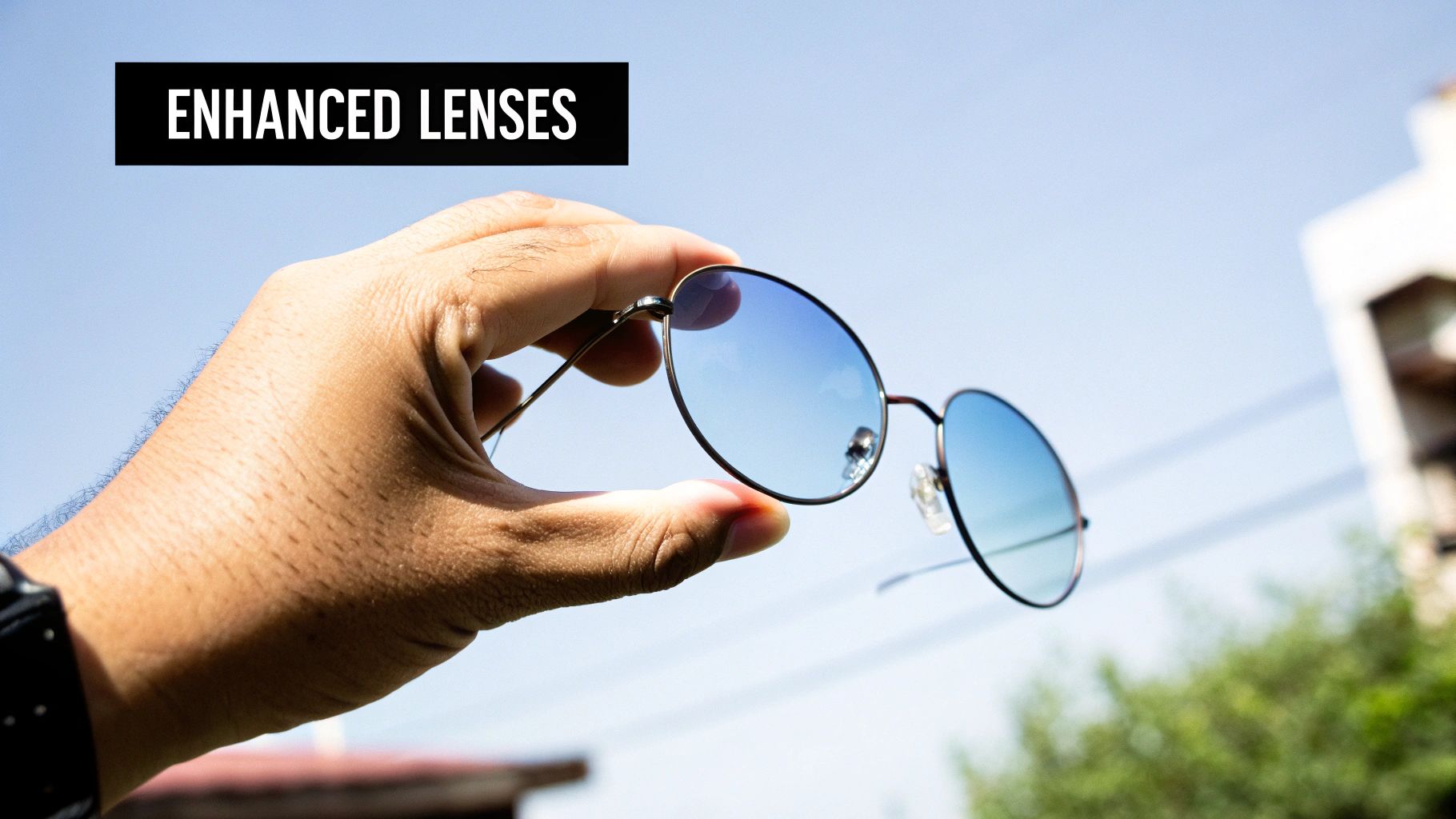
Think of your single vision lenses as more than just a prescription—they're a personalised tool, fine-tuned for the clearest sight and best eye protection. Choosing the right materials and coatings is a bit like picking the perfect gear for a specific job; it makes all the difference in performance and safety. It all starts with the lens material, which sets the foundation for weight, thickness, and how tough your glasses will be.
But the real customisation happens with the coatings. These are high-tech treatments applied to the lens surface that can filter specific types of light, cut down on annoying glare, and protect both your eyes and the lenses themselves. This is a crucial step in promoting long-term eye health.
Choosing the Right Lens Material
The material your lenses are made from has a massive impact on comfort and safety. While standard plastic is a common starting point, modern advancements give us far superior options for different lifestyles.
-
Polycarbonate Lenses: These are the undisputed champions of eye health and safety. They’re way more impact-resistant than standard plastic, which makes them a brilliant choice for kids' glasses, sports eyewear, or anyone with an active job or lifestyle. A tradie on a worksite, for example, would be much safer with polycarbonate lenses protecting their eyes from accidental debris.
-
High-Index Lenses: If you’ve got a stronger prescription, high-index materials will be your best friend. They are engineered to be much thinner and lighter than their standard plastic counterparts, which gets rid of that thick "coke-bottle" look and makes your glasses comfortable enough to wear all day long.
Unlocking Peak Performance with Lens Coatings
Coatings are where you can really tailor your glasses to fit your life. Each one serves a unique purpose, whether it's reducing the eye strain from staring at a screen all day or giving you the convenience of glasses that adapt to the sunlight. The key is to think about your daily routine to find the perfect match.
It’s no surprise that the Australian eyewear market is forecasted to grow at a CAGR of 6.20%. This boom is largely driven by savvy consumers demanding advanced coatings like blue light filters and top-tier UV protection, showing a clear shift towards health-first eyewear choices.
At Prescript Glasses, we can customize an eyewear package to suit your requirements. This means you can build the perfect pair of single vision glasses by combining the ideal material with coatings that protect your vision and enhance your comfort.
Let’s take a closer look at a few of the most popular and beneficial options we offer.
Comparing Lens Coatings: Your Guide to Customisation
Choosing the right lens coating can feel a bit overwhelming, but it's all about matching the technology to your daily life. This table breaks down the most common options to help you see exactly what each one does and who it's best for.
| Coating Type | Primary Benefit | Best For (Practical Example) |
|---|---|---|
| BlueRay Filter | Reduces digital eye strain by filtering blue light from screens. | An office worker or student who spends hours on a computer, helping to reduce tired, sore eyes at the end of the day. |
| Photochromic | Lenses automatically darken in sunlight and lighten indoors. | Someone who frequently moves between inside and outside, like a real estate agent or a delivery driver, eliminating the need to swap glasses. |
| Bluecromic | Combines blue light filtering with photochromic technology. | The ultimate all-in-one for a tech professional who works indoors but also takes frequent outdoor breaks, offering seamless protection everywhere. |
| Anti-Reflective | Minimises reflections and glare for sharper, clearer vision. | Night drivers who want to reduce the glare from headlights, or anyone who wants their lenses to look nearly invisible in photos. |
| Anti-Scratch | A hard coating that protects lenses from everyday scuffs and scratches. | A must-have for everyone, especially parents with young kids or anyone who occasionally forgets to use their glasses case. |
| Tinted Sunglass | Provides permanent UV protection and reduces sun brightness. | Anyone looking for dedicated prescription sunglasses for driving, beach days, or just enjoying the Aussie sun safely. |
As you can see, each coating offers a distinct advantage. By layering the right ones onto your chosen lens material, you can create a pair of glasses that doesn’t just correct your vision, but actively improves it.
Of course, you can also opt for clear lenses with standard anti-scratch and anti-reflective coatings for maximum clarity, or choose permanently tinted sunglass lenses. To dive deeper into all the possibilities, feel free to explore our complete guide on the different types of lenses for eyeglasses.
Single Vision vs. Multifocal Lenses: What's the Difference?
Stepping into the world of prescription lenses can feel a bit overwhelming, but the main differences are actually pretty straightforward. When you boil it down, your choice is between single vision and multifocal lenses. Getting this right is the key to making sure your glasses are a help, not a hassle, for your eye health and safety.
Let’s think of it like this: a single vision lens is your non-stop express route. It's designed to get you to one specific destination with perfect clarity—whether that's seeing things far away or focusing up close. The entire lens has one single power, giving you a crystal-clear, uninterrupted view.
When One Focus Is All You Need
For most people under the age of 40, single vision lenses are the standard, and for good reason. They do one job, and they do it exceptionally well. If you're nearsighted (myopic), your lenses are set to make distant objects sharp for things like driving. If you're farsighted (hyperopic), they're dialled in for close-up tasks like reading.
The real beauty of single vision lenses is their simplicity. You get the widest possible field of clear vision for your specific need, with no distortions or visual shifts. This straightforward design makes them incredibly easy to get used to and highly effective.
Enter Multifocal Lenses: When Your Vision Needs Change
As we get older, our eyes start to struggle with focusing on things up close. It’s a completely normal part of ageing called presbyopia. This is when glancing from a distant street sign to the GPS on your dashboard becomes a blurry, frustrating experience. At this point, one lens power just can't cover all the bases, which is where multifocal lenses come in.
Think of multifocal lenses as a more advanced road network:
- Bifocal Lenses: These are like a highway with a single, clearly marked exit. The top part of the lens handles distance vision, while a distinct line separates a lower segment dedicated to reading.
- Progressive Lenses: These are the seamless superhighways of the lens world. They provide a smooth, gradual shift in power from top to bottom, letting your eyes move effortlessly from distance to intermediate, and finally to near vision without any visible lines.
While multifocal lenses are fantastic tools for tackling presbyopia, they are designed to solve a very specific problem. If you only need correction for one distance, the edge-to-edge clarity and simplicity of a single vision lens is still the best choice for visual comfort.
Understanding how these lens types differ is crucial for getting the right pair of glasses. To dive a bit deeper, you can explore the differences between progressive lenses vs bifocals in our in-depth guide.
Ultimately, choosing the right lens is all about matching the technology to your eyes. Whether you need a simple, single-focus solution or a more complex multifocal design, we can customize an eyewear package to suit your requirements and deliver perfect vision for your lifestyle.
How to Read Your Prescription and Order Glasses Online
Getting your head around an optical prescription can feel like trying to decode a secret message. But once you know what you're looking at, ordering single vision glasses online becomes incredibly simple. Think of it as a personalised map for your eyes—every number and abbreviation is a crucial instruction to create lenses that give you perfect clarity.
Getting this right is essential for your eye health and safety, so let's break down those terms. They're not as complicated as they seem.
- SPH (Sphere): This is the main lens power needed to correct your vision. If you see a minus sign (-), it means you're nearsighted (myopia). A plus sign (+) means you're farsighted (hyperopia). For example, a sphere of -2.50 is for someone whose distance vision is blurry.
- CYL (Cylinder) & AXIS: These two always work as a pair to correct astigmatism, which is when your eye isn't perfectly round. CYL measures how much astigmatism you have, and the AXIS tells us its orientation in degrees, from 1 to 180. If these boxes are empty on your script, you don't have astigmatism.
This infographic gives you a quick visual on where single vision lenses sit compared to other options.
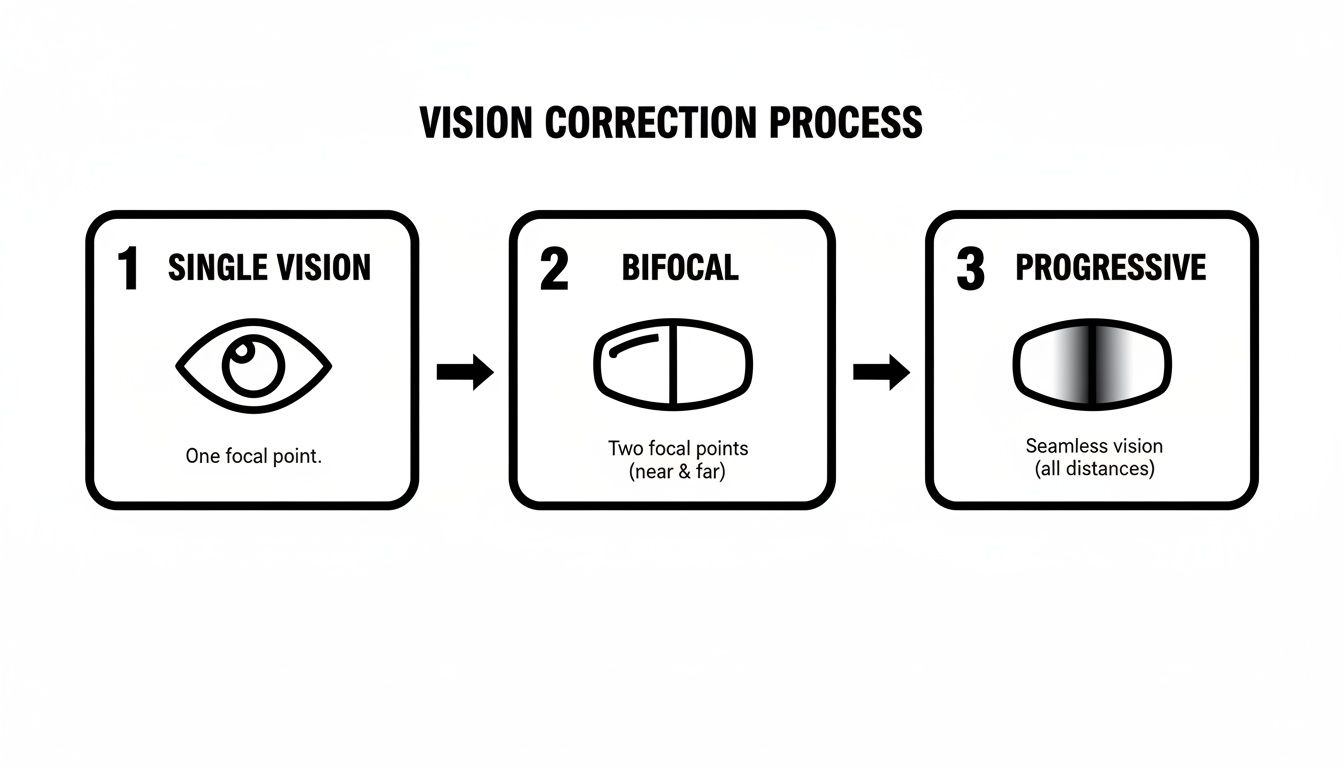
As you can see, single vision is the go-to for fixing one field of vision. It’s the foundation before you might need something more complex like bifocals or progressives down the track.
The Importance of Pupillary Distance (PD)
Beyond the main prescription numbers, your Pupillary Distance (PD) is arguably the most critical measurement for buying glasses online. It's simply the distance in millimetres between the centres of your pupils. An accurate PD makes sure the optical sweet spot of your lenses lines up exactly with your eyes.
An incorrect PD is a recipe for trouble. It can cause eye strain, nagging headaches, and even distorted vision because your eyes are constantly fighting to see through the wrong part of the lens. This directly impacts both your eye health and your safety, especially when driving.
Your optometrist can measure this for you, but sometimes they leave it off the prescription slip. The good news? It's really easy to measure yourself with a ruler and a bit of help from a friend. We’ve put together a simple guide on how to measure pupillary distance to walk you through it. Taking a few minutes to get this right will save you a world of discomfort later.
Once you have your prescription and PD in hand, you're all set. Just pop those values into the fields on our website. At Prescript Glasses, we can customize an eyewear package to suit your requirements, transforming that bit of paper into a pair of high-quality glasses that feel like they were made just for you.
Caring for Your Lenses for Lasting Clarity
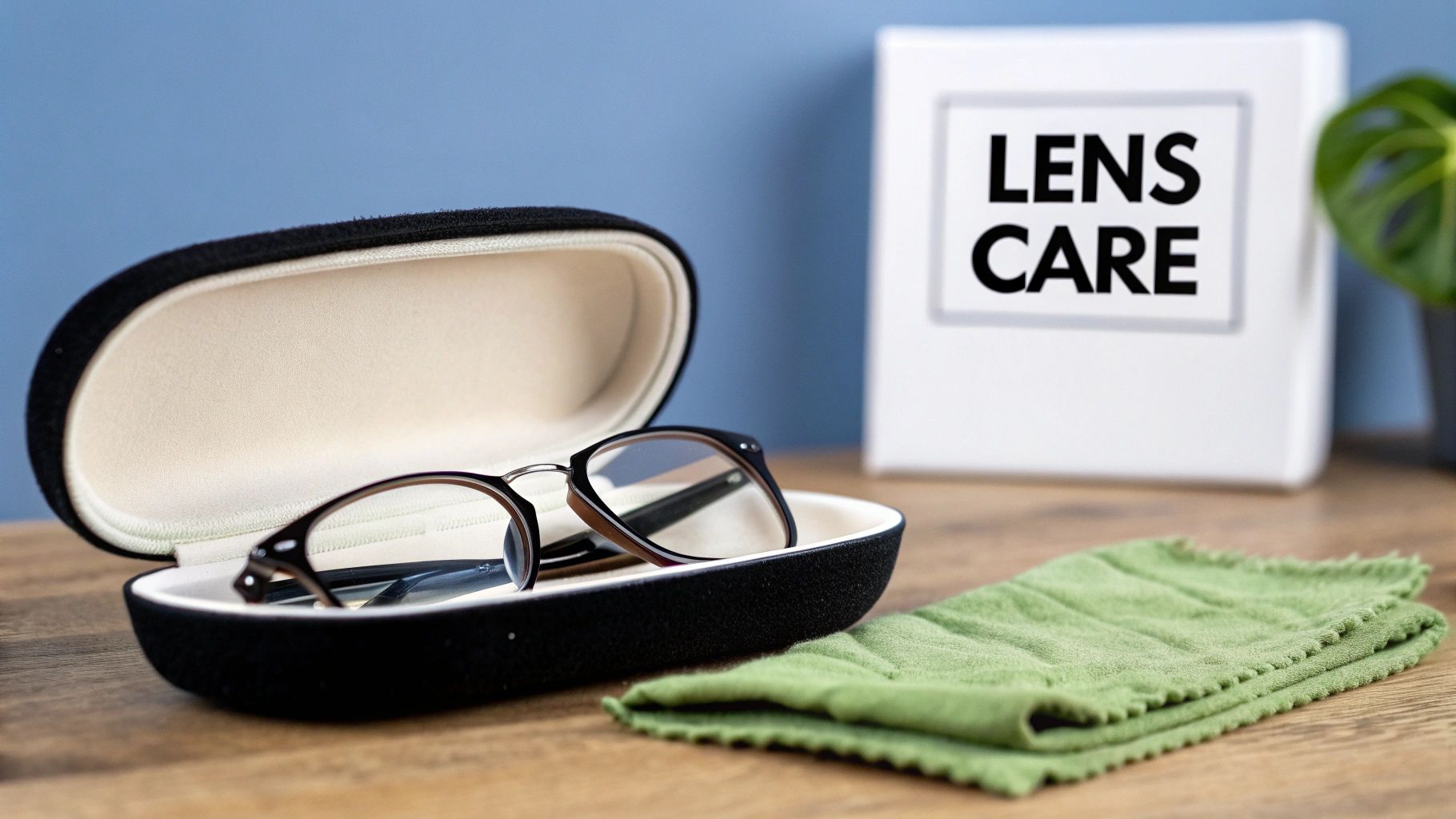
Think of your single vision lenses as an investment in your sight. Just like any good investment, a little maintenance goes a long way in making them last, keeping your vision perfectly sharp for years to come. Proper care is a simple but vital part of maintaining your eye health and safety.
The biggest mistake people make? Cleaning their glasses on the corner of their shirt. It’s tempting, I get it. But fabrics like shirts or paper towels are surprisingly abrasive and can leave behind permanent micro-scratches. Over time, these tiny scuffs build up, scattering light and causing that frustrating blurry haze that leads to eye strain.
The secret to pristine clarity is simple: always use a dedicated microfibre cloth and a proper lens cleaning spray. This combination is designed to lift grease and dust away without harming the delicate coatings on your lenses.
The Dos and Don'ts of Eyewear Care
Building good habits is easy, and it’s the best way to protect your glasses from accidental damage.
- DO store your glasses in a hard case whenever they’re not on your face. Tossing them on a desk or into a bag is the fastest way to get them scratched, bent, or worse.
- DON'T ever leave them in a hot car. Extreme temperatures can warp the frame and can even damage the advanced coatings on your lenses.
- DO use both hands when you take your glasses on and off. This keeps the arms properly aligned and prevents them from stretching out.
Following these simple rules will protect your investment and keep your vision crystal clear. Because every detail matters, we can customize an eyewear package to suit your requirements, ensuring you get the perfect lenses and coatings for your lifestyle.
Your Single Vision Lens Questions, Answered
We get asked a lot about single vision lenses and where they fit into everyday life. It's a common topic, and it's smart to ask! Here are some clear, straightforward answers to the questions we hear most often.
Can I Use the Same Pair of Glasses for Reading and Driving?
In a word: no. Think of single vision lenses as specialist tools. Each pair is precisely crafted for one specific job.
Your driving glasses are calibrated to bring distant signs and traffic into sharp focus. Your reading glasses, on the other hand, are set for close-up work like looking at your phone or a book. Trying to use one for the other’s task will just lead to blurry vision, eye strain, and probably a headache. For the clearest vision and best eye health, it's always best to have a dedicated pair for each distance.
How Often Should I Get a New Prescription?
This is a really important one. Regular eye exams are key to keeping your vision sharp and your eyes healthy. The general rule of thumb is to see your optometrist every one to two years.
They’ll be able to spot any changes in your vision and let you know if your prescription needs an update.
Remember, an old prescription forces your eyes to work overtime, which can lead to fatigue and nagging headaches. Staying on top of your eye exams is a simple but powerful way to look after your long-term eye health and safety.
Are More Expensive Lenses Actually Better?
Often, yes—and for good reason. The price tag usually reflects the quality of the lens material and the sophistication of the coatings.
A pricier lens might be made from a high-index material, which is a game-changer if you have a strong prescription because it makes the lenses significantly thinner and lighter. Plus, those advanced coatings like anti-reflective or our BlueRay filters aren't just fancy extras. They genuinely improve your visual comfort and protect your eyes, making them a very worthwhile investment for your day-to-day life.
At Prescript Glasses, we know that no two pairs of eyes are the same. That's why we can customize an eyewear package to suit your requirements, helping you find the perfect blend of frames, lenses, and protective coatings for your lifestyle. Come and build your ideal pair today by exploring our collection online.