What Are Multifocal Lenses: Do They Fit Your Eyes and Lifestyle?

If you’ve ever found yourself holding a menu or your phone at arm's length just to make the words come into focus, you're in good company. This is a classic sign of presbyopia, a completely normal change in vision that happens as we get older.
For years, the only answer was to juggle multiple pairs of glasses—one for driving, one for reading. Thankfully, there’s a much smarter, all-in-one solution: multifocal lenses. Unlike your standard single-vision glasses that only correct for one distance, multifocals pack multiple prescriptions into a single lens, giving you crisp, clear vision whether you're looking near, far, or anywhere in between.
Understanding Multifocal Lenses and How They Work

Think of the natural lens inside your eye like a sophisticated camera with a brilliant auto-focus. When you’re younger, it flexes effortlessly, shifting focus between a distant road sign and the text on your phone in a split second. As we age, that lens naturally becomes a bit less flexible, making it much harder to focus on things up close.
This is where the frustration starts. Suddenly, you need one pair of glasses for driving and another for reading the newspaper. It's a constant, annoying shuffle.
Multifocal lenses put an end to all that. They cleverly build different prescription strengths into one seamless lens. The top part is designed for your distance vision, the bottom is for close-up tasks like reading, and the middle section smoothly transitions between them for intermediate distances, like your computer screen.
A Practical Solution for Everyday Life
This all-in-one design is a genuine game-changer. Imagine a teacher looking up from their lesson plan to see a student at the back of the room—all without fumbling for another pair of glasses or experiencing that jarring "image jump" common with old-school bifocals. Or think of a chef who needs to read a recipe (near), chop vegetables on a counter (intermediate), and see an order on a screen across the kitchen (far). Multifocals make these transitions effortless.
It’s this kind of seamless convenience that has made multifocals so popular here in Australia, especially for professionals, students, and anyone who juggles screens, paperwork, and the world around them. For more details on eyewear trends, you can find a wealth of information about the Australian contact lenses market and its growth online.
For a quick overview, this table breaks down the essentials of multifocal lenses.
Multifocal Lenses at a Glance
| Feature | Description | Primary Benefit |
|---|---|---|
| All-in-One Vision | A single lens with multiple prescription zones (distance, intermediate, and near). | No more switching between different pairs of glasses for various tasks. |
| Seamless Transition | Powers blend gradually from top to bottom without visible lines (in progressive lenses). | Provides natural vision correction without distracting "image jump." |
| Customised Correction | Tailored to your specific vision needs for all ranges. | Reduces eye strain and offers clear, comfortable vision throughout the day. |
Ultimately, this technology simplifies your life while improving your vision.
The real beauty of multifocal lenses lies in the visual freedom they give back to you. They let your eyes and brain work together naturally, just like they used to, restoring comfort and clarity to your daily routine.
Prioritising Your Eye Health and Safety
Beyond simple convenience, choosing multifocals is a smart move for your long-term eye health and safety. Constantly straining to see or switching between the wrong glasses can lead to headaches, neck pain, and serious eye fatigue. By providing the correct prescription for every distance, multifocal lenses ensure your eyes are always properly supported, reducing strain that can accumulate over the day. This is crucial for tasks requiring sustained focus, like night driving or detailed craftwork.
This is why we're so passionate about getting your eyewear just right. We can customise an eyewear package to suit your requirements, making sure your multifocal lenses not only correct your vision perfectly but also protect and support your eyes all day long.
Exploring Different Types of Multifocal Lenses
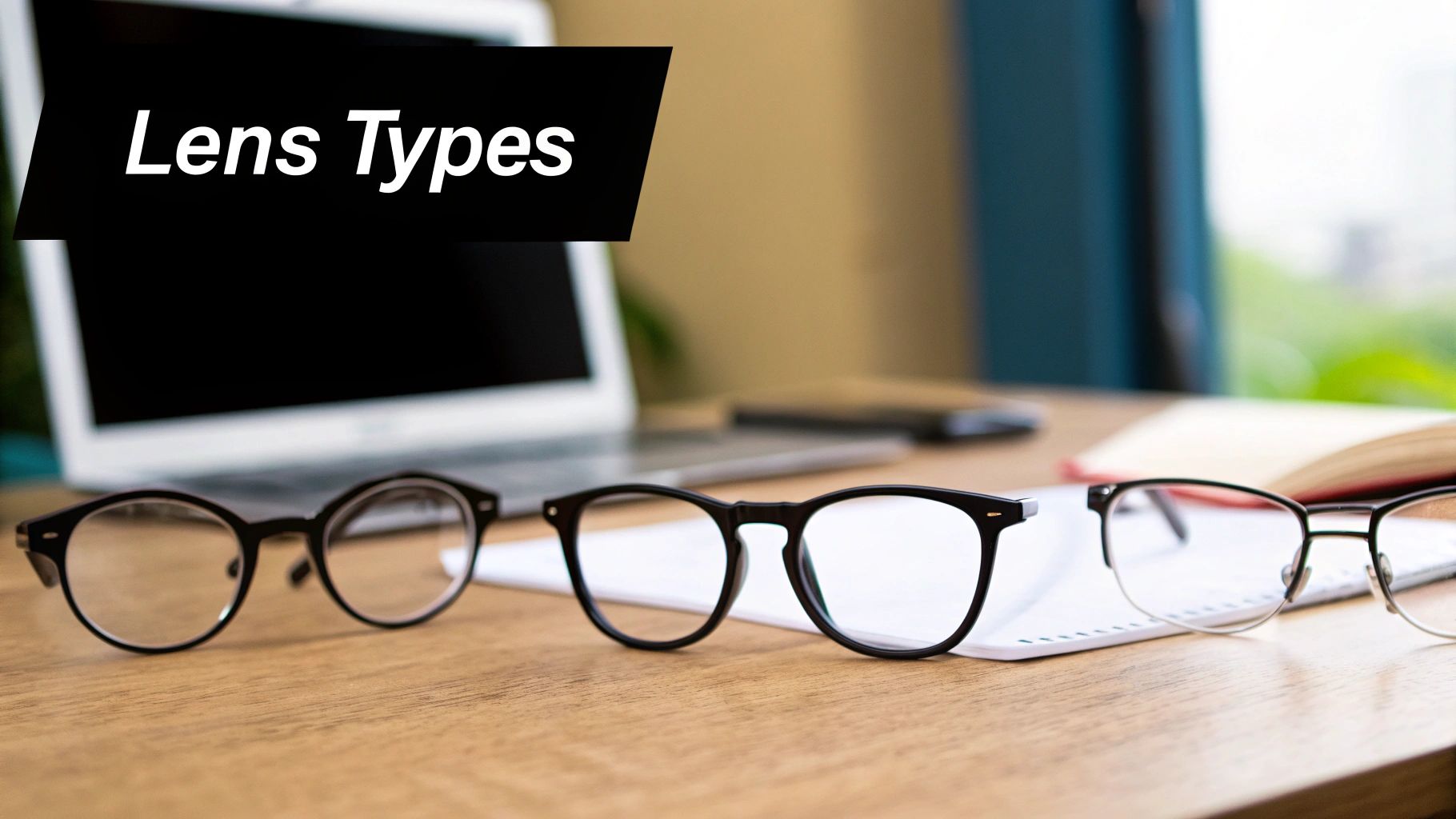
Not all multifocal lenses are created equal, and figuring out the differences is the secret to finding the perfect fit for your life. Think of them as specialised tools in a toolbox—each one designed for a specific job, with its own unique design and perks. The technology has come a long way, evolving from simple two-zone lenses to totally seamless designs that offer a much more natural way of seeing.
The main players in the multifocal world are bifocals, trifocals, and progressive lenses. Each one tackles the core challenge of presbyopia—that frustrating difficulty focusing up close—but they do it in distinct ways that can make a real difference to your daily comfort and vision.
Let's break down how each of them works.
Bifocals: The Original Two-in-One Solution
Bifocal lenses are the classic multifocal design and the easiest to spot. They have two different prescription powers separated by a distinct, visible line. The larger top section of the lens corrects your distance vision, while a small segment at the bottom gives you the magnification you need for reading and other close-up tasks.
Just imagine a little window at the bottom of your glasses made specifically for reading. When you need to read a book or check a text message, you simply glance down through this segment.
A practical example is a librarian who spends their day looking up to shelve books (distance vision) and down to read tiny book spines or a computer screen (near vision). For them, the clear, no-fuss separation of a bifocal lens is incredibly straightforward and effective.
Trifocals: Adding the Intermediate Zone
Trifocals take the concept one step further by adding a third zone for vision. Like bifocals, they have visible lines separating the different powers. The top is for distance, the bottom is for near, and a small, ribbon-like segment in the middle is specifically for intermediate distances—things at roughly arm's length.
This middle zone is incredibly handy for all those tasks that fall in the gap between near and far.
Trifocals were actually designed to solve a modern problem before it became so widespread: the need for clear vision at a computer screen's distance. This innovation bridged the visual gap that bifocals couldn't quite handle on their own, paving the way for even more advanced designs.
An architect could use trifocals to see across the office (distance), view a computer monitor (intermediate), and examine detailed blueprints on their desk (near)—all with a single pair of glasses. The defined zones provide crisp clarity for each specific task.
Progressive Lenses: The Modern, Seamless Standard
Progressive lenses are the most modern and popular type of multifocal lens today. Their defining feature is what’s missing: any visible lines. Instead of distinct zones, the prescription powers blend into each other gradually, creating a smooth, seamless transition from the top of the lens to the bottom.
Think of it as a gentle ramp of power. The top gives you clear distance vision, the middle subtly shifts for intermediate focus, and the bottom provides your full reading strength. This line-free design not only offers a more youthful look but, more importantly, a much more natural and safe visual experience. To see a deeper comparison, you might like our guide on progressive lenses vs bifocals.
A real-world example is a retail worker who needs to see customers across the store (distance), use a point-of-sale computer (intermediate), and check small price tags (near). Progressives allow for fluid vision changes, crucial for a fast-paced environment. We can customise an eyewear package to suit your requirements, making sure your progressive lenses are perfectly matched to your daily activities and frame choice.
So, Who Are Multifocal Lenses Really For?
While multifocal lenses are a fantastic solution for many, they're an absolute game-changer for certain people. If you find yourself constantly switching focus between near, far, and everything in between, you're the perfect candidate. They simplify life by getting rid of the need to juggle multiple pairs of glasses.
This is especially true for anyone over the age of 40 who’s starting to deal with the frustrating signs of presbyopia. This is the completely normal, age-related change that makes focusing up close a struggle. Suddenly, reading a text message or a restaurant menu becomes an arm-stretching exercise. Multifocal lenses are the modern answer—a single, elegant solution that brings back clear vision at every distance.
The demand for these kinds of solutions is growing fast. In Australia, the contact lenses market, which has a rapidly expanding multifocal segment, was valued at USD 252.0 million and is expected to hit USD 376.6 million by 2033. A major driver of this growth is an ageing population looking for more convenient options than old-school bifocals. You can dive deeper into this trend by checking out the latest findings on the Australian contact lenses market.
Professionals and Heavy Screen Users
Today's work life often means flicking your eyes between a laptop screen, handwritten notes on your desk, and your colleagues across the meeting table. For office workers, teachers, and creatives, progressive lenses eliminate the visual gymnastics that kill productivity.
- Office Workers: Go from staring at a spreadsheet on your monitor to reading a printed report without a hint of eye strain. This reduces the risk of Computer Vision Syndrome.
- Artists and Designers: See your canvas up close for those fine details, then step back to take in the whole masterpiece with perfect clarity.
- Gamers and Smartphone Users: Using the right lens power for your screen distance can improve your posture and seriously cut down on the digital eye strain that causes headaches and fatigue.
By giving you the right correction exactly where you need it, multifocal lenses also support better ergonomics. That means less neck craning and physical discomfort after a long day glued to a screen.
Drivers and People on the Go
Outside of the office, multifocal lenses offer huge benefits for everyday life, where seeing clearly at different distances is key to safety and enjoyment.
For drivers, being able to see the road ahead (distance), check the dashboard and GPS (intermediate), and glance at a passenger (near) without a second thought is a massive plus for safety. The seamless transition in progressive lenses means there are no distracting lines cutting across your field of view, which is vital for maintaining focus on the road.
It’s the same for anyone with a hobby that demands varied focus. Whether you’re a gardener needing to see distant plants and close-up weeds, or a cook reading a recipe then chopping ingredients, multifocal lenses restore ease and safety to your activities. We understand these diverse needs, which is why we can customise an eyewear package to suit your requirements, making sure your vision solution is a perfect match for your lifestyle.
Comparing the Advantages and Drawbacks
Deciding on multifocal lenses is a big step, so it’s important to weigh up the good with the not-so-good. Getting a clear, balanced picture helps you know what to expect and makes the whole experience much smoother, leading to happier eyes and clearer vision.
So, let's break down the pros and cons to help you make a choice you feel confident about.
The single biggest win is the sheer convenience. Imagine going from driving, to glancing at a text message, to working on your laptop without ever having to swap your glasses. It's a game-changer. For those choosing progressives, the seamless look—with no visible lines—offers a modern style and a totally uninterrupted field of vision, a world away from old-school bifocals.
The Upsides of Seamless Vision
The benefits of multifocal lenses aren't just about convenience; they directly boost your daily comfort and can even improve your eye health and safety.
- Natural Vision: Modern progressive lenses are engineered to mimic the way your eyes naturally focus. This means you get a smooth, effortless shift between distances with just a simple tilt of your head or glance of your eyes.
- Reduced Eye Strain: By giving you the exact prescription power you need for any distance, multifocals help cut down on the eye fatigue and headaches that come from squinting or using the wrong glasses for a task.
- Aesthetic Appeal: With no distracting lines, progressive lenses look exactly like single-vision glasses. This offers a more youthful and clean appearance that many people love.
If you find you only need correction for one specific distance, it might be worth exploring other options. You can learn more in our guide on what are single vision lenses.
Potential Challenges and Considerations
On the flip side, there are a few things to keep in mind before you jump in. The main hurdle for new wearers is the adjustment period. Your brain needs a little time to get used to looking through the different zones of the lens.
Some people initially report a slight distortion at the edges of their vision, sometimes described as a 'swim' or 'wobble' effect, especially with quick head movements. This can affect peripheral awareness, which is why a careful adjustment period is crucial for safety. But here’s the good news: advanced digital lens technology has massively reduced this problem, making the adaptation process easier than ever before.
While the cost is a bit higher, it’s best to think of it as an investment in your vision, safety, and everyday comfort. The infographic below highlights just a few of the people who find this investment well worth it.
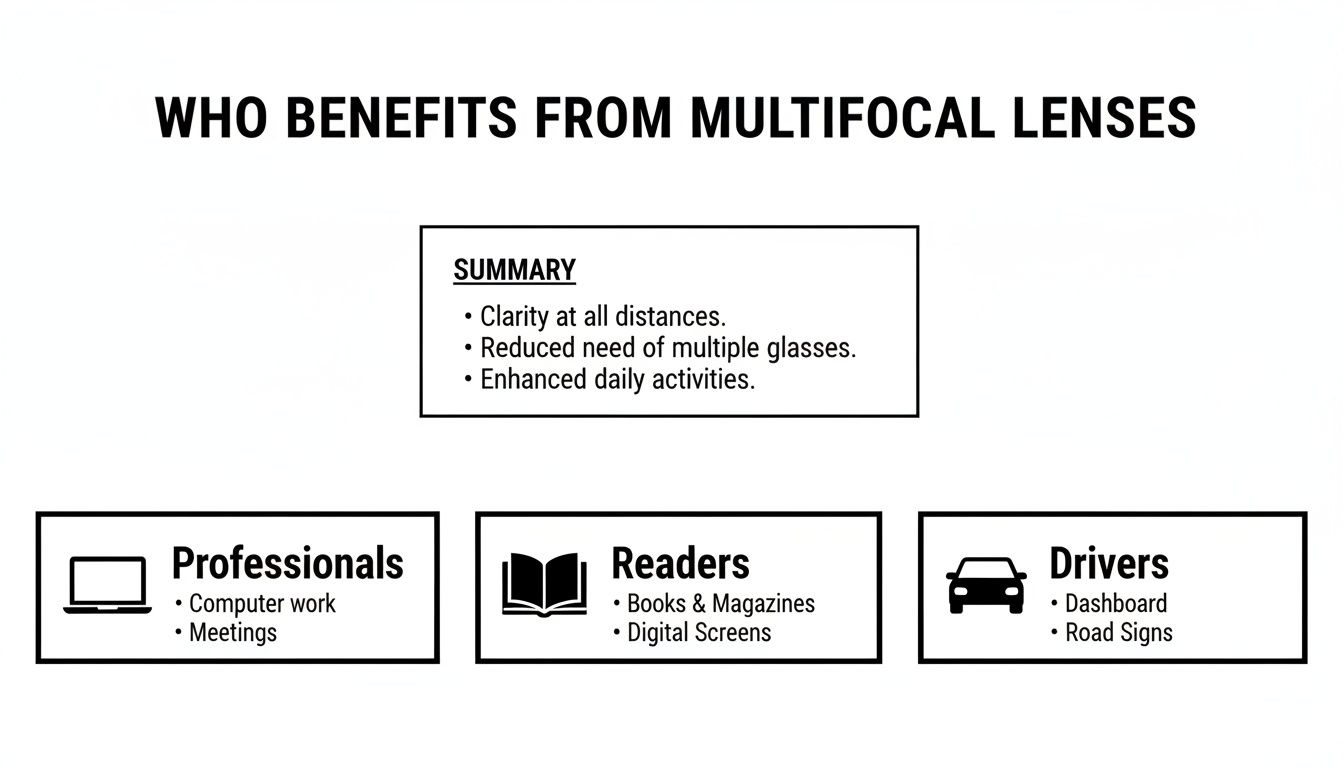
As you can see, professionals, avid readers, and frequent drivers all find multifocals invaluable for their day-to-day lives. Ultimately, we can customise an eyewear package to suit your requirements, ensuring your lenses are a perfect match for your lifestyle.
Adapting to Your New Multifocal Lenses
Getting used to your new multifocal lenses is a journey, not a sprint. Your brain just needs a little bit of time to learn a new way of seeing. Think of it less as a chore and more as unlocking a new level of visual freedom. It’s a brief adjustment for a long-term payoff.
The golden rule for a smooth transition is wonderfully simple: point your nose, not just your eyes, at whatever you want to see. This small change in habit is the real key to finding the right part of the lens for every single task.
Finding Your Sweet Spot
Imagine your multifocal lenses have different “zones,” each perfectly designed for a specific distance. Tilting your head is how you navigate between them.
-
For Distance: To see something far away, like a street sign or the TV across the room, look straight ahead through the top part of your lenses. Keeping your chin level gives you the clearest view.
-
For Intermediate: When you’re looking at your computer monitor or the car dashboard, just lower your eyes slightly to peek through the middle of the lens. You might find adjusting your screen height makes things even more comfortable.
-
For Reading: For a book, menu, or your smartphone, drop your gaze down to look through the bottom part of the lens. It feels a bit strange at first, but you'll get the hang of it quickly.
This whole process becomes second nature faster than you'd think. Picture yourself reading in a café: you'll look through the top of your lenses to see who just walked in, the middle to read the menu board, and the bottom to check a message on your phone—all without thinking about it.
Your brain and eyes are working together to create a seamless visual map. Be patient with yourself during these first few days. The more you wear them, the faster you'll adapt and feel completely comfortable.
A Focus on Eye Health and Safety
While your brain is adapting, it’s smart to prioritise safety. Your depth perception, especially when looking down, might feel a little off at first. This is completely normal.
Be extra cautious when going down stairs, stepping off curbs, or walking on uneven ground. Make a conscious effort to tuck your chin down so you’re looking through the top (distance) part of your lenses, not the bottom (reading) part. This keeps your view of the ground sharp and accurate, helping prevent trips and falls. This is one of the most important safety habits to build.
Remember, this adjustment period is temporary. Soon enough, you’ll be enjoying that effortless, all-in-one vision that makes multifocal lenses so popular. We can customise an eyewear package to suit your requirements, ensuring your new lenses are a perfect match for both your vision and your lifestyle.
Building an Eyewear Package That Fits Your Life
Your vision is unique, and your glasses should be too. While standard multifocal lenses are fantastic on their own, the real magic happens when you pair them with coatings and treatments that solve your specific daily challenges. It’s about creating a personalised set of glasses that works as hard as you do.
Think of your multifocal lens as the perfect foundation. Now, let’s add the features that will protect your eyes and elevate your vision from good to great.
Customising Lenses for Your Day-to-Day
The best lens choices are always guided by what you do most. Whether you’re a student hitting the books, a professional staring down deadlines, or someone enjoying a well-earned retirement, we can build a lens combination that feels made for you. In a world full of digital screens and unpredictable light, looking after your eye health has never been more important.
Here’s how you can tailor your multifocal lenses for real-world situations:
-
For the Office Professional: If your day is spent in front of a computer, adding a BlueRay filter to your progressive lenses is a must. This duo is your best defence against digital eye strain, cutting down on screen glare and keeping your vision comfortable through long workdays.
-
For the Outdoor Enthusiast: Constantly moving between indoors and outdoors? Photochromic technology will be a game-changer. Your lenses will automatically darken in the sun and clear up inside, giving you non-stop UV protection and visual comfort without ever needing to swap your specs. A practical example is a delivery driver who is constantly in and out of their vehicle.
This move towards highly functional, all-in-one vision solutions is happening everywhere. In the medical world, you see it with surgical options like multifocal intraocular lenses (IOLs). You can find some interesting data on the rise of multifocal IOLs on DataBridge Market Research, which shows just how high the demand is for sharp vision at every distance. For those of us who wear glasses, combining different coatings with a multifocal base gives us that same versatility and tailored protection.
We can customise an eyewear package to suit your requirements. This means manufacturing a solution that directly addresses your lifestyle, whether it's battling screen fatigue or adapting to sunlight.
For the ultimate all-in-one setup, Bluecromic lenses are the answer. They merge both BlueRay filtering and photochromic tech into one powerful lens. It’s the perfect choice for anyone who goes from their office desk to a sunny lunch spot and back again. Before you make a final decision, why not see how your favourite frames look with our guide to virtually trying on glasses?
Your Multifocal Lens Questions Answered
Getting your head around a new type of lens can feel a bit confusing, so let's clear things up. Here are the answers to the most common questions we get about multifocal lenses and what it's like to wear them day-to-day.
How Do I Know if I Need Multifocal Lenses?
The classic giveaway is the "long-arm." You know the one—stretching your arm out further and further just to read the menu or your phone. This is a tell-tale sign of presbyopia, something most of us encounter over the age of 40.
A quick look at your prescription is another way to tell. If you see an 'ADD' power, that’s the extra bit of magnification you need for close-up tasks. For instance, if your distance script is -2.00 but your optometrist has added a +1.50 boost for reading, that ADD value is a strong hint that multifocals could be a game-changer for you. Of course, a proper eye exam with a qualified optometrist is the only way to be certain and is a critical step for your eye health.
Are Multifocal Lenses Good for Computer Use?
Absolutely. Progressive multifocals are fantastic for desk work. They have a seamless intermediate zone that’s perfectly designed for screen distance, which can do wonders for reducing that all-too-familiar eye and neck strain from staring at a monitor all day.
For anyone spending hours in front of a screen, we can customise an eyewear package that pairs your multifocal prescription with a protective BlueRay filter. It’s the perfect setup for professionals and students looking for both clear vision and top-tier eye protection.
Most people find they adjust to modern progressive lenses within a few days, or a couple of weeks at most. The latest digital designs have really smoothed out the adaptation period, creating wider, more natural viewing corridors with less of that "swimmy" feeling in your peripheral vision.
What Is the Best Way to Care for My Lenses?
Looking after your lenses properly is the key to keeping your vision sharp and making them last. Proper care is an essential part of eye health and safety, as smudged or scratched lenses can impair vision. Always use a soft microfibre cloth and a cleaning solution made specifically for coated lenses.
To get them sparkling clean without causing any damage, a specialised product like an Eyeglasses Cleaner Spray is your best bet. This helps protect all the advanced coatings on your lenses and keeps your view crystal clear.
At Prescript Glasses, we can customise an eyewear package to suit your requirements, ensuring you get the perfect combination of clear vision and eye protection. Explore our frames and lens options today at https://www.prescriptglasses.com.